A firefighting robot is a tough, remote-controlled machine that goes where heat, smoke, or unstable ground make entry unsafe for people. It carries cameras, heat sensors, and a water or foam cannon, driven from a safe distance. It does not replace a fire crew — it gives them eyes, reach, and water first.
Key Takeaways
- Firefighting robots are usually tracked vehicles, built to cross debris, rubble, and wet ground.
- A remote operator drives them and aims the water cannon using live camera and heat-sensor views.
- They can spray water or foam for a long time in heat and smoke that would exhaust a person quickly.
- They are best for industrial sites, tunnels, warehouses, and wildfire edges — not for every house fire.
- They still need water supply, a clear radio link, and human firefighters to finish the job.
What Is a Firefighting Robot?
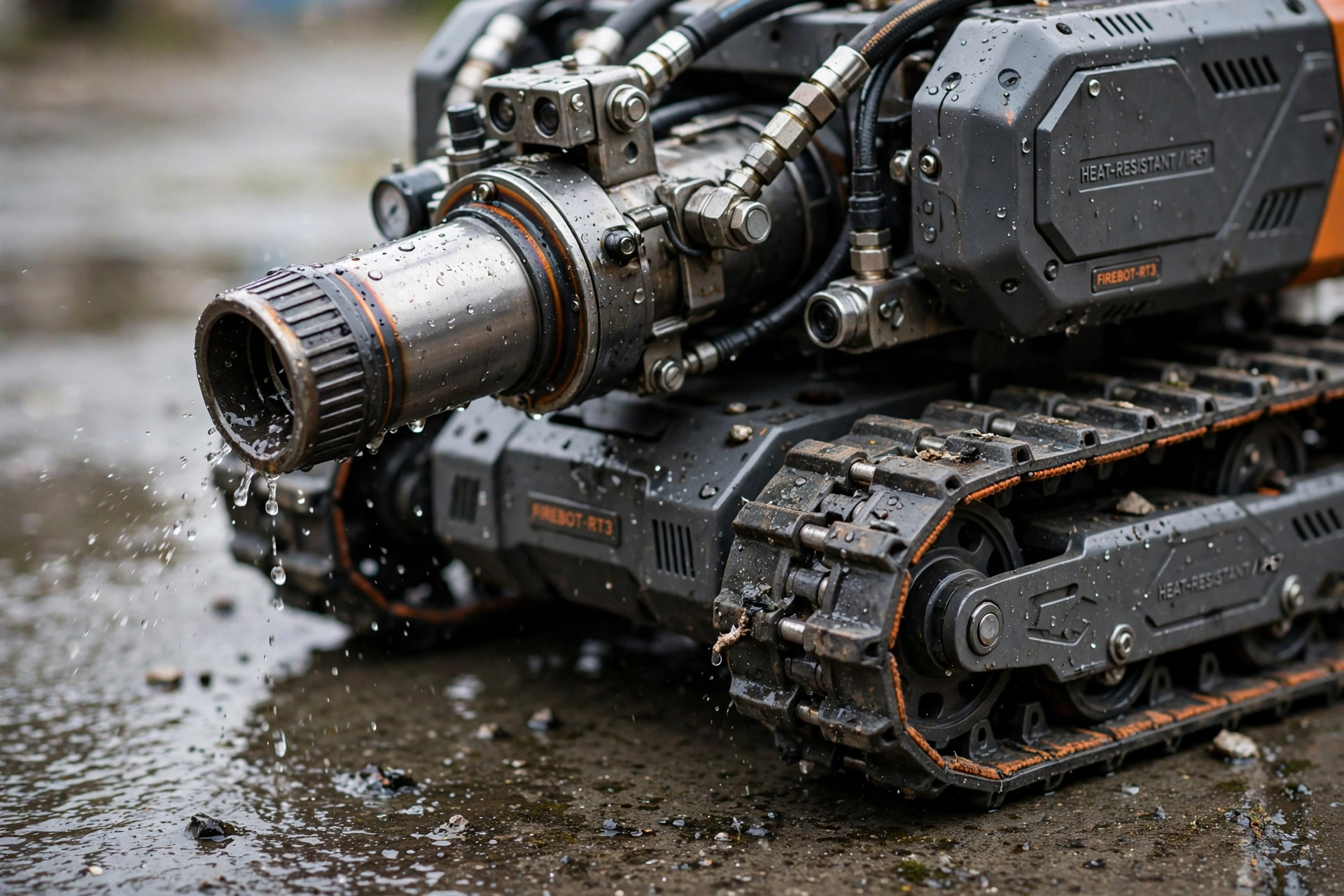
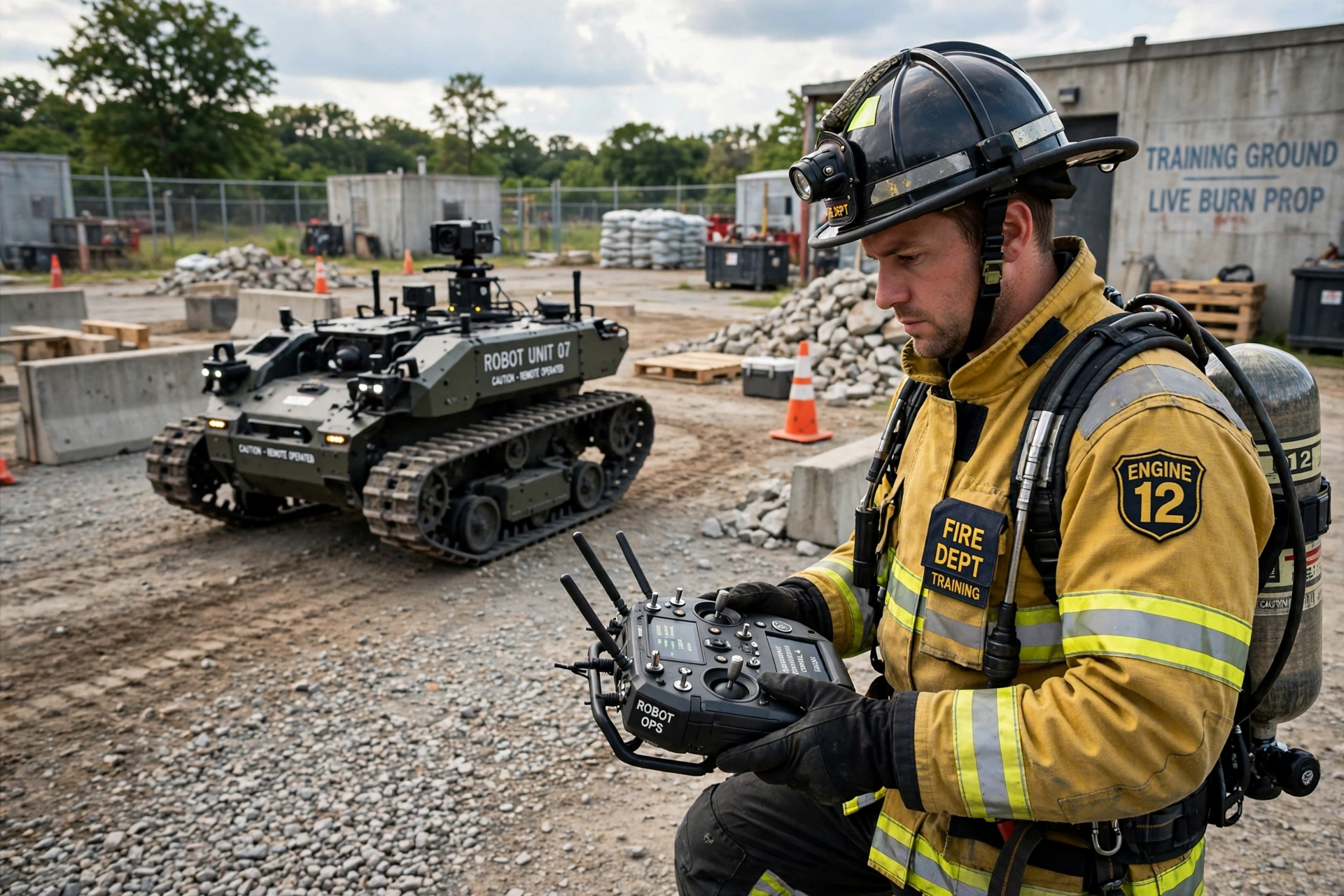
Think of a small, armoured vehicle without a driver inside. Most models run on tracks rather than wheels, like a mini tank, so they can climb over hoses, rubble, and uneven ground without tipping. The body is shielded against heat and water, and on top sits a movable nozzle that can aim a powerful jet of water or foam.
Sizes vary a lot. Some are compact enough to fit through a doorway, while others are as large as a small car and carry a much bigger water supply. The common idea is the same: keep the person out of the worst danger, and send the machine in first to look, cool, and spray.
How Does the Operator Control It?
A firefighter usually controls the robot with a handheld controller or a rugged laptop, watching live video from cameras on the robot. Joysticks drive the tracks and tilt the nozzle, while buttons switch between water and foam, adjust the spray pattern, and turn on lights or thermal cameras.
The link is normally a radio connection, sometimes with a tethered cable as backup in places where radio signals struggle, such as tunnels or concrete buildings. If the link drops, a well-designed robot stops in place rather than driving on blind. That fail-safe matters: a robot rolling without guidance could block an escape route or damage equipment.
Control is a skill in itself. The operator must judge distance from a camera view, watch for collapsing debris, and keep track of the water hose trailing behind the robot. Training with the real machine, not just a simulator, is how crews learn those judgements.
How Does It See Through Smoke and Heat?
Ordinary cameras struggle in thick smoke, so firefighting robots often carry thermal cameras as well. A thermal camera shows heat as bright shapes, so a hidden fire behind a wall, a hot spot under debris, or a person in a smoky room can show up even when normal video shows only grey.
Gas sensors, temperature sensors, and simple distance sensors add more information. Together, they help the operator answer the key questions: where is the fire hottest, is the structure still stable, and is it safe to move forward? The robot does not make the final call. It supplies the picture, and the incident commander decides the plan.
How Does It Spray Water and Foam?
The nozzle is the working end of the robot. It can produce a tight jet that reaches a long way, or a wide spray that cools a large area. Water cools burning material and the surrounding structure, while foam can smother certain types of fire and slow re-ignition, depending on the fuel involved. Choosing between them is a firefighting decision, not a robot decision.
Water supply is a practical limit. A robot may carry a small tank, but for a long attack it usually connects to a fire hose or a hydrant. That hose then trails behind it, which limits how far it can travel and how sharply it can turn. Operators plan the route with the hose in mind, keeping it clear of sharp debris and hot spots that could damage it.
Where Are Firefighting Robots Used?
Industrial sites are a natural fit. Chemical plants, fuel depots, warehouses, and recycling yards can hold large fires with toxic smoke, exploding containers, or unstable structures. Sending a robot in first lets crews cool the fire and gather information without standing in that danger.
Tunnels and large buildings are another use. A robot can enter a smoke-filled tunnel, find the fire, and start spraying while firefighters set up ventilation and escape routes. At wildfire edges, larger tracked robots can clear vegetation, spray water lines, and work in heat and ash that would quickly tire a crew, though they still work alongside people, not alone.
Rescue work overlaps here too. Robots built for searching rubble share many parts with firefighting robots — tracks, cameras, and remote control — as explained in our guide to rescue robots. The difference is the payload: a rescue robot carries sensors and sometimes medical supplies, while a firefighting robot carries a cannon and a hose.
What Can They Not Do?
Firefighting robots cannot climb stairs easily, open every door, or rescue a person by carrying them out. They cannot replace the judgement of a firefighter who can hear a floor creak, smell a gas leak, or spot a trapped person through a small gap. They also need maintenance: heat, water, ash, and debris wear out seals, tracks, and electronics, so a robot that is not cleaned and tested may fail when it is needed most.
Battery and fuel limits matter as well. A robot that runs out of power in a hot zone becomes another obstacle. Crews therefore plan operating time, keep a spare robot or a recovery plan ready, and pull a machine back before it becomes stranded.
Are Firefighting Robots Safe?
They improve safety by creating distance between people and the fire, but they introduce their own risks. A high-pressure water jet can injure someone nearby, a tracked machine can damage hoses or equipment, and a robot in a doorway can block an escape route. Crews handle this with clear zones, radio discipline, and a rule that no one walks in front of an active nozzle.
For the public, the rule is simple: stay behind barriers, do not approach a working robot, and follow firefighters’ instructions. A robot that looks like a toy is still a heavy machine spraying water at high pressure.
How Much Do They Cost, and Who Uses Them?
Firefighting robots are specialist equipment, so they cost far more than a standard fire hose or a handheld thermal camera. That is why they are most common with large city fire services, industrial fire teams, airports, and military or port fire units, rather than every small station. Sharing a robot between stations, or buying one for a high-risk industrial site, can make more sense than giving one to every crew.
Costs include training, spare parts, hose fittings, and regular testing under heat and water. A robot that sits unused for years without testing is a false comfort. Services that use them well practise with them often, so operators, commanders, and hose teams all know what the robot can and cannot do on a real incident.
Frequently Asked Questions
Can a firefighting robot put out a house fire on its own?
Usually not on its own. It can cool a fire, spray from outside, and gather information, but a house fire still needs firefighters to search rooms, ventilate, check for people, and make sure the fire is fully out.
Does a firefighting robot work without a human operator?
Most current models are remote-controlled, not fully self-driving. A human drives, aims, and decides when to spray, while sensors and cameras help that person see and judge.
What happens if the robot loses its radio link?
It should stop safely in place. Operators then try to restore the link, use a backup connection, or recover the robot once the area is safe enough, rather than letting it drive blind.
Can firefighting robots use foam as well as water?
Yes, many can switch between water and foam, depending on the fire type and the supply connected to them. The choice depends on what is burning and on the fire service’s procedures.
Are firefighting robots used for wildfires?
Larger tracked models can help at wildfire edges by spraying water lines and working in hot, smoky conditions, but they work with ground crews and aircraft as part of a wider response, not as a lone solution.
Conclusion and Next Step
A firefighting robot works by combining a tough tracked base, heat and video cameras, a remote operator, and a powerful water or foam cannon. It reaches hot, smoky, or unstable places first, cools the fire, and gives commanders a clearer picture — while human firefighters stay at a safer distance and handle rescue, ventilation, and the final check that a fire is out.
If this topic interests you, the practical next step is to look up your local fire service’s community pages or open days, where specialist equipment is often shown and explained. Seeing a firefighting robot in person, and hearing how crews train with it, gives a much clearer sense of its size, limits, and value than any video — and it is a good reminder that behind every robot, there is still a team of people making the hard calls.
Further reading: Robot Arms | Warehouse Robots | Robot Dogs | Britannica robotics | Robots International firefighting robots guide