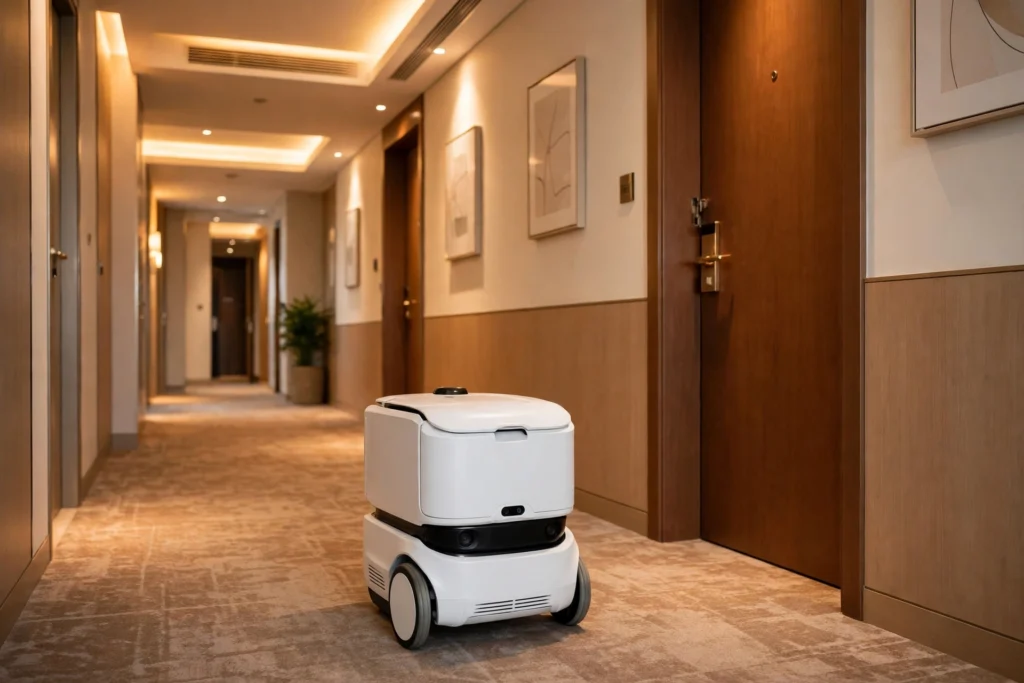
Hotel robots work by combining a pre-loaded map with sensors and cameras that plan a route, avoid obstacles, and link to the hotel’s systems. A guest requests towels or a snack, staff load the robot, and it travels to the right floor and room on its own. People still handle loading, unusual requests, and anything that goes wrong.
Key Takeaways
- Most hotel robots are wheeled machines built for one kind of job: delivery, cleaning, check-in help, or carrying luggage.
- They navigate with maps, cameras, and distance sensors, and many can call and ride an elevator.
- A delivery usually ends with a phone or app message, not a knock, and the guest takes the items from a compartment.
- Robots are best at repeated, predictable trips. They are not a replacement for staff when a guest needs judgment, comfort, or a complex fix.
- Before judging a hotel robot, look at what it actually does well — and where a person still steps in.
What kinds of hotel robots are there?
Not every hotel robot looks the same, because they are not all doing the same job. The most common type is the delivery robot: a small, low, wheeled box with a locked or lidded compartment. It carries towels, toiletries, snacks, or a light room-service order from a service area to a guest room.
Then there are cleaning robots, which are closer cousins of the machines many people already use at home. A floor scrubber can work through a lobby or corridor during quiet hours, while a smaller machine may handle vacuuming. Like robot vacuums, they follow a planned path and use sensors to avoid furniture and people, but hotel versions are built for larger, busier spaces.
A third group works at the front desk or in the lobby. These may be a screen on a mobile base, a humanoid-style greeting machine, or simply a self-service kiosk with a friendly face on screen. They answer common questions — where is the pool, what time is checkout, how do I get a taxi — and can guide a guest to the lift or restaurant. Luggage robots are less common, but some larger hotels trial them for moving bags between the lobby and a storage area. The key point is simple: a hotel robot is usually a specialist, not an all-purpose helper.
How does a hotel robot find its way?
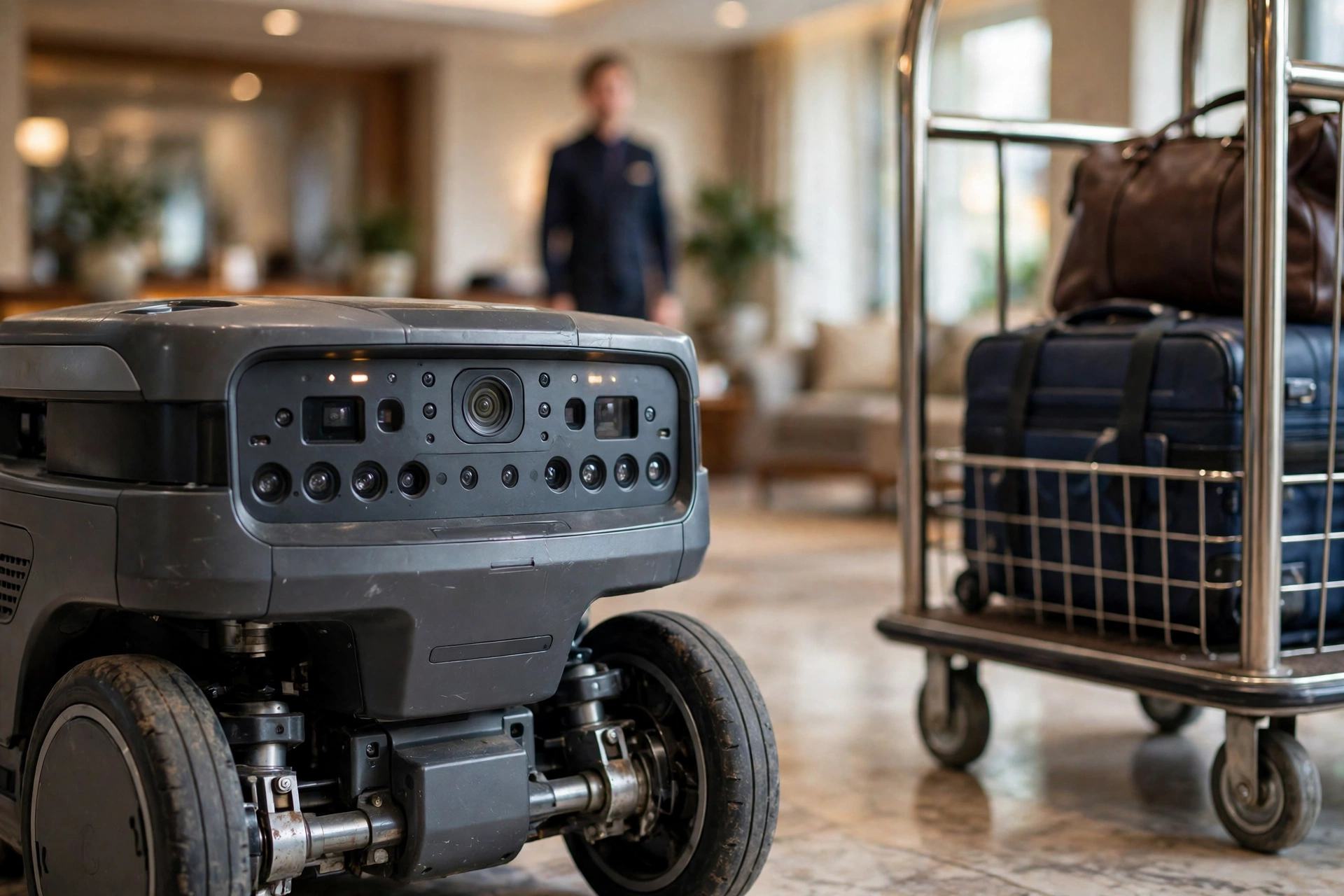
A hotel robot does not wander and hope. Before it serves guests, staff or engineers help it learn the building. It may be driven slowly through corridors while its sensors record walls, doorways, lifts, and turns, building a map it can reuse. That map is the robot’s mental picture of the hotel: which corridor leads where, where the lift is, and which rooms sit on each floor.
On a real trip, the robot compares what its sensors see right now with that map, so it can work out where it is and which way to go next. Cameras help it spot people, carts, and luggage. Distance sensors — often using laser light, in a method called LiDAR — measure how far away obstacles are. Wheel sensors track how far it has rolled. Put together, that is enough for a slow, careful trip down a corridor, around a housekeeping cart, and to a stop outside the right door.
Speed matters here, and not in the way you might expect. Hotel robots usually move at walking pace or slower. That is deliberate. A slow robot has more time to stop, more time for a guest to step aside, and less chance of a nasty bump if someone walks out of a room without looking.
How do hotel robots use elevators?
Elevators are one of the hardest parts of the job, and also one of the most useful. A robot that cannot change floors can only serve one level, which limits it badly in a tall hotel. So many hotel robots are connected to the lift system.
In a typical setup, the robot asks the lift system for a car, waits for the doors, rolls in, and selects — or is assigned — the right floor. That needs a reliable link between the robot and the building, plus enough space in the lift for the robot and any guests already inside. If the link fails, or the lift is full, the robot waits and tries again, or staff are alerted. This is also why older buildings can be harder to fit with robots: the lift controls, Wi-Fi coverage, and corridor widths all have to suit the machine, not just the other way round.
Guests do not usually need to do anything special in the lift. If you share a lift with a delivery robot, give it a little room, let it roll out first if it is in your way, and do not try to steer it. It is following a route, even if that route looks odd from the outside.
What happens during a delivery?
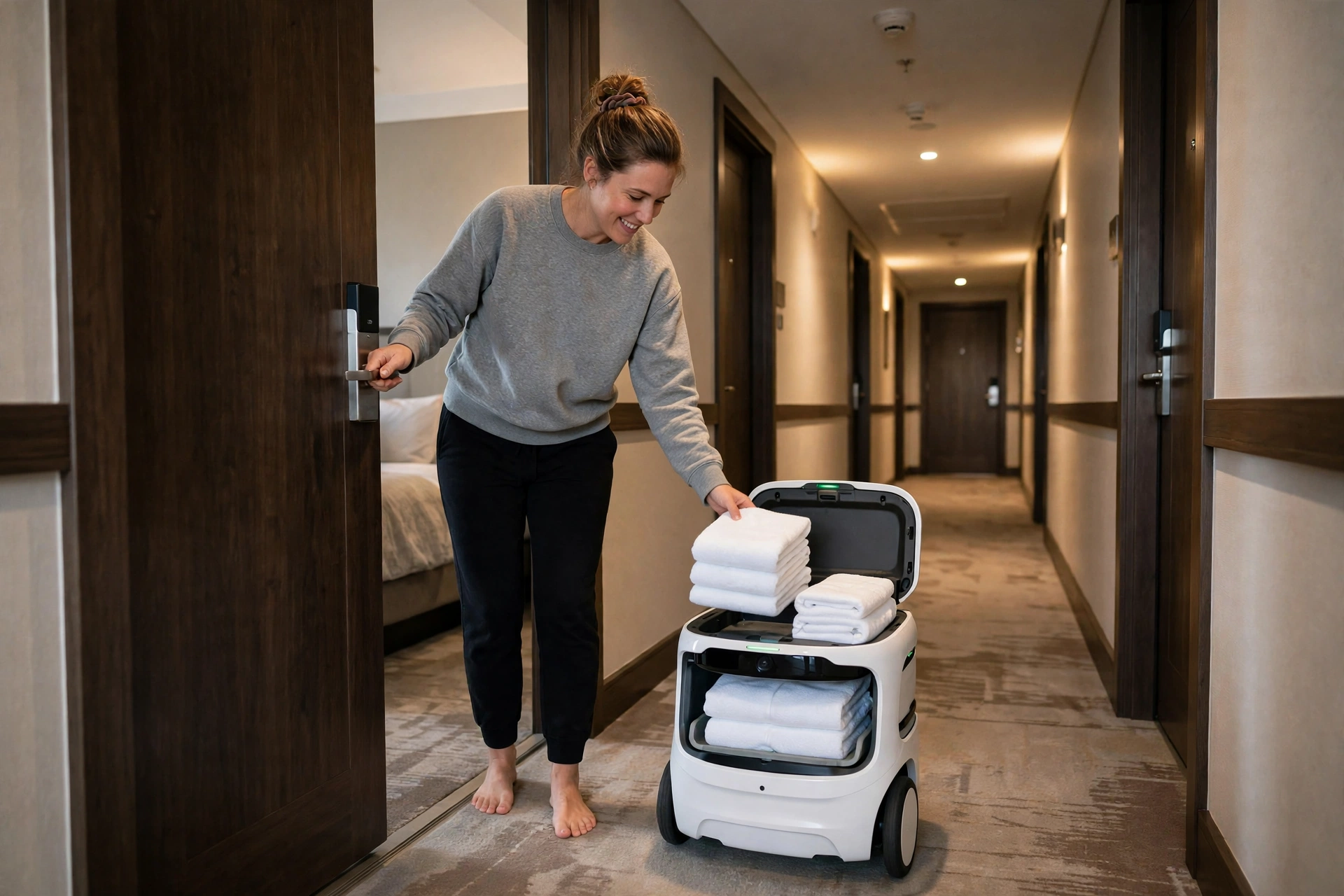
A delivery starts long before the robot moves. A guest requests towels or a snack through the room phone, the hotel app, or the front desk. Staff check the request, put the items in the robot’s compartment, and send it on its way — or the robot is dispatched automatically from a service station.
The robot then follows its mapped route, calls the lift if needed, and stops outside the guest’s room. Instead of knocking, it usually sends a message to the guest’s phone or the room phone, or it plays a short sound. The guest opens the door, opens the compartment, and takes the items. Some robots then wait for a tap on a screen or a button to confirm the delivery is complete, close the lid, and head back to charge or to its next job.
That handoff is where expectations matter. The robot cannot hand you a hot plate with a smile, explain a menu, or notice that you look unwell and ask if you need help. For a towel delivery at midnight, that may be fine — even welcome. For a special occasion, a complaint, or a confused guest, a person is still the better choice. Good hotels use robots for the routine trips so staff have more time for the moments that need a human touch.
How do check-in and concierge robots help?
Check-in and concierge robots are less about carrying things and more about answering and guiding. A lobby robot may greet guests, show them where to go, and answer the same handful of questions all day without getting tired or impatient. A self-service check-in screen can take details, issue a key card, and cut queueing at busy arrival times.
That sounds convenient, and often it is, but it has clear limits. A robot can struggle with an unusual booking, a language it does not handle well, a guest with accessibility needs, or a problem that needs a decision rather than a script. The best setups make it easy to reach a person quickly — a button, a staff member nearby, or a clear handover — instead of trapping a guest in a loop of repeated prompts. If a hotel’s robot help feels like a wall rather than a door, that is a design problem, not a guest problem.
What about cleaning and luggage robots?
Cleaning robots in hotels work much like their cousins in warehouses and homes, only on a bigger stage. A floor machine follows a planned route through a lobby or corridor, scrubs or vacuums, and returns to charge when its battery runs low or its tank needs emptying. Staff still handle detailed cleaning, stains, and rooms themselves. The robot takes the long, repetitive floor work, which is exactly the kind of job machines handle well. Warehouse robots follow the same logic on a larger scale: let the machine do the repeated route, and let people handle judgment calls.
Luggage robots are a smaller, more experimental group. Some move bags in a set area, such as from a lobby to a storage room, while others are really a powered cart that follows a staff member. They need wide, clear paths and careful handling, because bags vary in size, weight, and fragility. A robot arm that can pick up a suitcase without dropping it is a different challenge from a delivery box rolling down a corridor, which is why robot arms in factories usually work in a fixed, controlled space rather than a busy lobby.
What are the limits and safety rules?
Hotel robots have real limits, and knowing them helps you use them well. Most delivery robots carry only a small load, so they cannot bring a full dinner service, several heavy bags, or items that need careful temperature control unless they have a special compartment. They can get stuck behind a blocked corridor, a closed door, or a lift fault. They can also confuse a guest if they stop in an odd place or fail to explain what they need.
Safety is built around slow speeds, obstacle sensors, and a clear stop behaviour. A robot should slow down or stop when someone steps in front of it, and it should not block an accessible route, a fire exit, or a narrow doorway for long. Hotels also need rules for data: a robot that knows your room number and request should handle that information carefully, just like any other hotel system. For background on how robots in general are defined and used, see the overview of robotics from Britannica, and for hotel-specific types and trade-offs, the hotel robots guide from Robots International.
There is also a human limit worth naming. Robots do not replace good service; they change where staff time goes. A hotel that uses robots well will still have people visible, reachable, and ready to help. A hotel that hides behind robots for every request will feel colder, not smarter. Security robots raise a similar point: a machine can patrol and alert, but a person still decides what to do next.
FAQs
Can a hotel robot come into my room?
Usually, no. Most delivery robots stop at the door and wait for you to collect the items. That keeps your room private and avoids the robot getting stuck on luggage, cables, or furniture inside.
What should I do if a hotel robot stops in front of me?
Give it a moment and a little space. It may be waiting for a lift, recalculating its route, or letting someone pass. If it stays stuck for a while, tell front-desk staff rather than pushing or lifting it.
Are hotel robots safe around children and pets?
They are designed to move slowly and stop for obstacles, but they are still machines in a shared space. Keep small children and pets from climbing on them or blocking their path, and supervise any interaction.
Do hotel robots work at night?
Yes — overnight delivery is one of their most useful jobs. A guest can get towels or a snack at 2 a.m. without a staff member leaving the front desk, which is why many hotels start with night-time deliveries.
Will hotel robots replace hotel staff?
Not for the work that matters most. Robots handle repeated trips and simple questions well, but guests still need people for complaints, special requests, accessibility help, and genuine hospitality. The best hotels use robots to free up staff, not to remove them.
Conclusion
Hotel robots are at their best when they are boring in a good way: a quiet trip down the corridor, a towel delivery that arrives without fuss, a clean lobby floor before breakfast. They work because a map, sensors, and a link to the hotel’s systems turn a repeated route into a reliable service. They fall short when a guest needs empathy, a judgment call, or a fix that does not fit a script.
Next time you stay somewhere with a delivery robot, try it for a simple request — extra towels, a toothbrush, a late-night snack — and notice how the handoff works. Then, if you need something more complex, go straight to a person. That small habit — robot for the routine, human for the rest — is the practical way to get the best out of both.