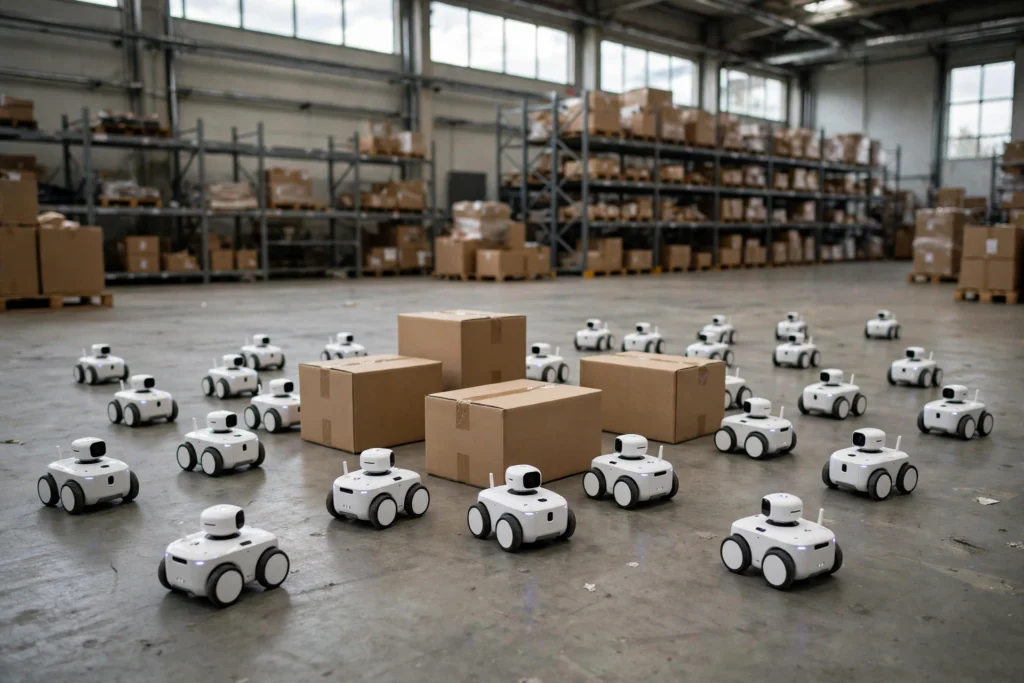
Swarm robots work by following simple local rules, sharing small pieces of information with nearby robots, and letting useful group behaviour emerge from those interactions. No single robot needs to see the whole job, and no central boss has to direct every move. Instead, each robot senses its surroundings, reacts to its neighbours, and repeats that loop until the group covers an area, moves an object, or finds a target together.
Key Takeaways
- A robot swarm is a group of relatively simple robots that cooperate without one central controller.
- Each robot follows local rules based on what it can sense nearby, not a full map of the whole task.
- Communication can be direct, through radio or light signals, or indirect, through changes left in the environment.
- Swarms can be more flexible than one large robot, because the group can keep going if a few units fail.
- The same idea has limits: coordination, battery life, safety, and cost still shape where swarms make sense.
What Is a Robot Swarm?
Think of ants finding food. One ant doesn’t plan the whole route for the colony. It wanders, finds something useful, and leaves a trail other ants can follow. Over time, that trail gets stronger, and more ants join in. Swarm robotics borrows that pattern, but with machines, sensors, and code instead of scent trails.
That difference matters when you compare a swarm with a single big machine. A single warehouse robot, like the ones described in our guide to warehouse robots, can be powerful and precise. A swarm, by contrast, spreads the work. If one unit gets stuck, others can take over its patch. If the job grows, you can often add more robots rather than rebuilding the whole system.
How Do Swarm Robots Communicate?
Communication in a swarm is usually local. A robot talks mainly to neighbours within range, not to every robot at once. That keeps the system simpler and helps it scale, because adding robots doesn’t mean every message has to travel across the whole group.
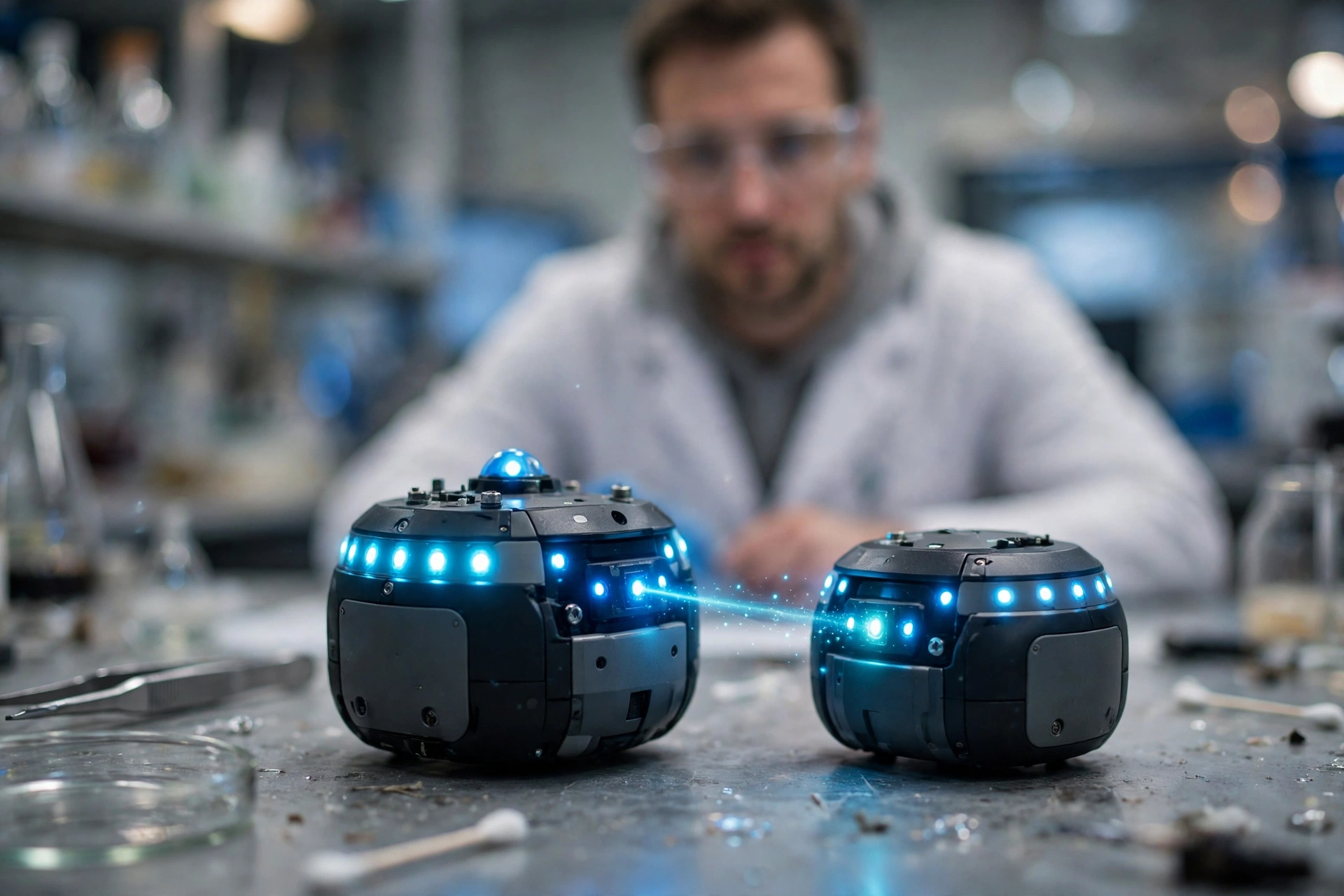
Direct communication is the most familiar kind. Robots can send short radio messages, flash lights, or use infrared signals to say things like “I’m here,” “I’ve covered this spot,” or “I need help with this load.” These messages are short on purpose. Long, detailed reports would slow the group down and drain batteries faster.
Indirect communication is subtler, and often more interesting. A robot can change the environment in a way other robots notice later. It might mark a visited area, leave a physical trail, move an object into a new position, or update a shared digital map when it returns to a charging point. Other robots then react to that changed world, even if they never met the first robot directly.
What Rules Do Swarm Robots Follow?
Underneath the group behaviour, each robot runs a small set of rules. A common set might look like this in plain language: stay a safe distance from neighbours, move toward an uncovered area, avoid obstacles, and return to charge when the battery is low. None of those rules mentions the final goal in detail. The goal emerges when dozens or hundreds of robots follow them at the same time.
Flocking is a good example. Birds don’t hold a meeting about formation flying. Each bird roughly matches the speed of nearby birds, stays close without colliding, and steers toward the middle of its local group. Robot swarms can copy that logic for drone displays, field surveys, and search patterns. The result can look coordinated from a distance, even though no robot planned the full shape.
Where Are Swarm Robots Used?
Search and rescue is one of the clearest uses. After a disaster, small robots can spread through rubble, tunnels, or flooded areas that are unsafe for people. Each robot can report what it finds, and together they can map a larger area faster than a single machine. This connects closely with rescue robots, which are built for difficult terrain, but a swarm adds coverage: many eyes and sensors instead of one.
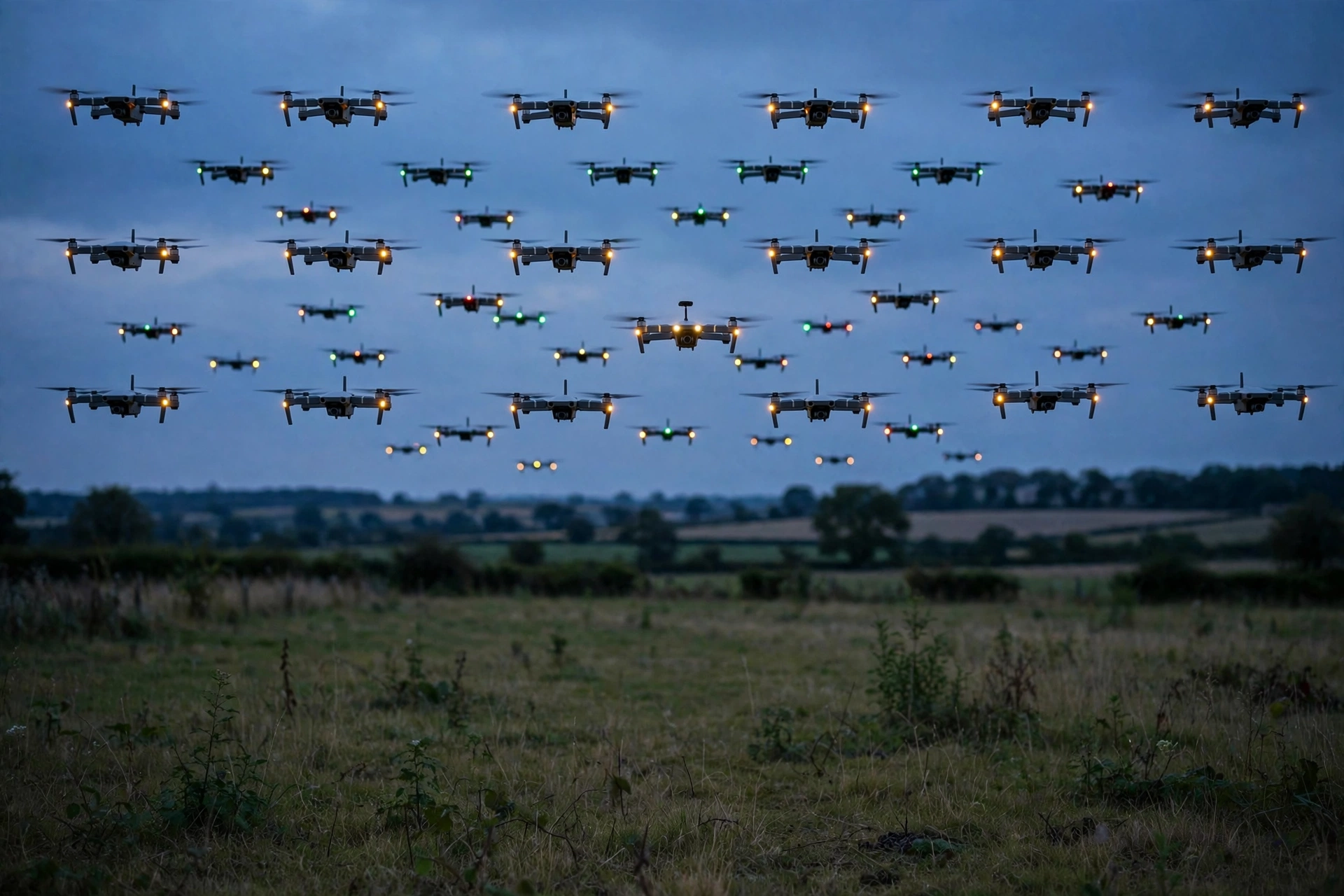
Warehouses and farms offer more everyday examples. In a warehouse, a group of small robots can sort, move, and track items across a wide floor. On a farm, similar groups could in principle monitor crops, check soil conditions, or help with repetitive field tasks, though weather, dust, and uneven ground make outdoor work harder than a clean indoor floor. Light shows are another visible use: hundreds of drones fly in formation to draw shapes in the sky, each drone following its own flight path while staying in step with its neighbours.
What Limits Swarm Robots Today?
Swarms are promising, but they are not a simple replacement for every robot. Battery life is a constant limit. Small robots carry small batteries, and constant movement, sensing, and communication all use power. Charging, swapping batteries, or returning to a dock adds complexity, especially outdoors.
FAQs
Do swarm robots have a leader?
Usually not in the strict sense. Some designs include a coordinator that sets the overall goal, but the moment-to-moment movement is handled locally by each robot. If the coordinator fails, a well-designed swarm should still be able to keep doing basic tasks or return safely, rather than freezing completely.
How many robots are in a swarm?
It depends on the job. A classroom or lab test might use ten or twenty robots. A drone light show can use hundreds. Research demonstrations have used more than a thousand tiny robots. More robots can mean more coverage, but also more communication, charging, and maintenance to manage.
Can swarm robots work without the internet?
Many can, at least for short periods. Local radio, light, or infrared links let neighbours share information without a cloud connection. A central system may still be useful for setting goals or collecting results, but the swarm should not need a constant internet link just to avoid collisions or cover an area.
Are swarm robots the same as drone swarms?
Drone swarms are one type of robot swarm. The broader idea also includes ground robots, boats, and mixed groups. Drones get a lot of attention because their formations are easy to see, but the same principles — local rules, neighbour communication, and emergent group behaviour — apply on the ground too.
Will swarm robots replace single robots?
Not in general. A single robot is often better for heavy lifting, precise assembly, or delicate work. Swarms are better when coverage, redundancy, or parallel searching matters. In practice, the two approaches often work together: a swarm might find and map a problem, while a larger robot or a person handles the heavy or delicate part.
Conclusion
Swarm robots show how simple parts can add up to something larger. Give each robot a few clear rules, a way to sense its neighbours, and a way to share small updates, and the group can search, sort, monitor, and map in ways that would be slow or risky for one machine alone. The technology still has real limits around batteries, communication, cost, and safety, so it fits some jobs much better than others.
A practical next step is to compare swarms with the single-robot systems you already know. Read our guides to warehouse robots and robot vacuums, then ask a simple question about any job you have in mind: does it need coverage and redundancy, or does it need strength and precision? If the answer is coverage, a swarm may be worth exploring. If it’s precision, a single well-built robot is probably still the better starting point.