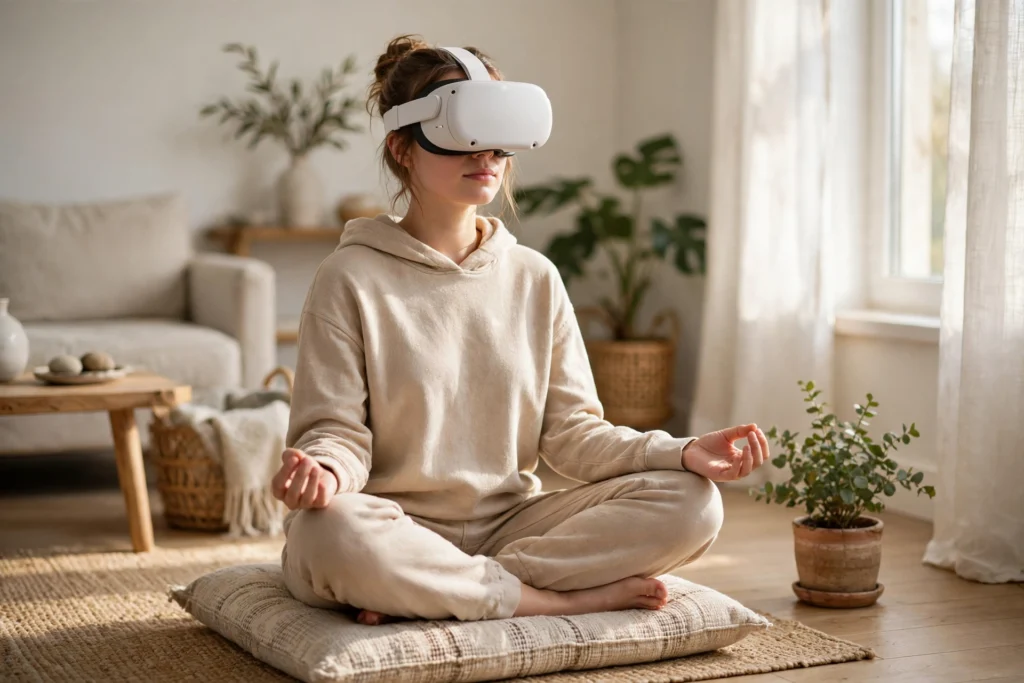
VR meditation places you inside a calm, quiet scene — a beach at sunrise, a forest clearing, a still mountain lake — and guides your breathing while the everyday world fades away. The headset blocks out distractions, a calm voice or gentle visuals set the pace, and your only job is to breathe slowly and pay attention to the moment.
Key Takeaways
- VR meditation uses a headset to place you in a calm virtual scene while a guide leads your breathing.
- It can help beginners most, because the scenery and guidance make it easier to stay focused.
- Short sessions of five to ten minutes are a good place to start; longer sessions suit regular practice.
- It is a relaxation and focus tool, not a treatment — anyone with a health condition should check with a clinician first.
- You need a headset and a quiet, clear space; most sessions work sitting down, so no large room is required.
What makes VR meditation different from an app on your phone?
A meditation app on your phone asks you to close your eyes and ignore everything around you. That works for plenty of people, but it is also easy to drift: a notification buzzes, the washing machine hums, and suddenly you are thinking about dinner instead of your breathing.
Virtual reality fills your field of vision, so your brain treats the virtual beach or forest as the place you actually are. You are not fighting distractions; they are simply gone.
That said, VR meditation is not magic. It is the same basic practice — sitting still, breathing slowly, noticing your thoughts without chasing them — with a nicer room around you. The headset helps you start; it does not do the meditating for you.
How does a VR meditation session actually work?
Most sessions follow a simple pattern. First, you put on the headset and choose a scene and a length — usually five to thirty minutes. If you are new, pick a short one. Five calm minutes beat twenty restless ones.
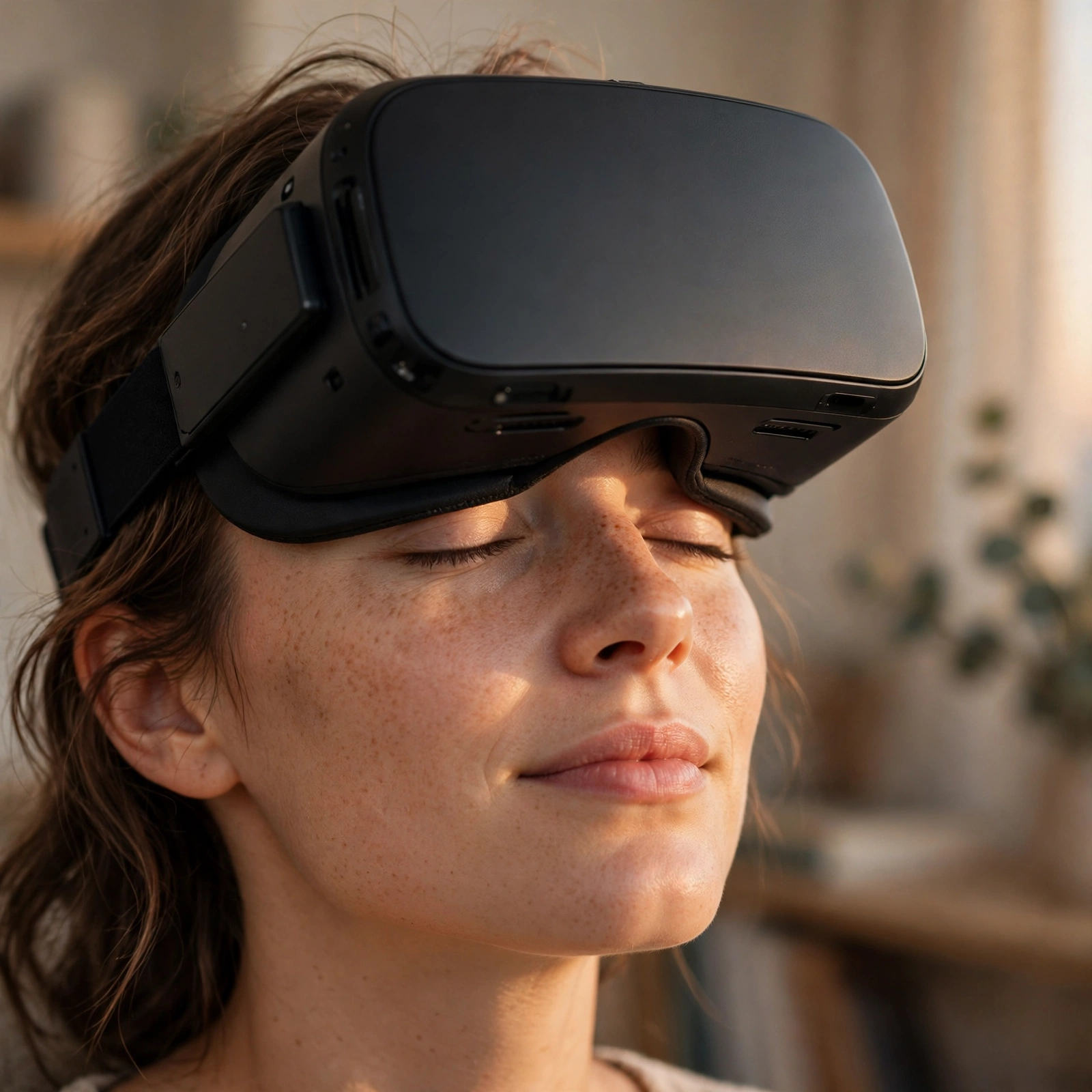
Then the guide begins. A calm voice talks you through slow breathing — in for a count, out for a longer count — while the scene moves gently around you. Some apps add soft music; a few use visuals that respond to your breathing, such as a glowing orb that grows as you breathe in and shrinks as you breathe out.
You control the session with your controllers or with hand tracking, depending on the headset. In practice, you will barely touch them — most sessions are hands-free once they start, so you can rest your hands in your lap and forget the hardware is there.
When the session ends, the guide brings you back gently, the scene fades, and you take the headset off. Give yourself a minute before jumping up; a slow return to the real room is part of the calm.
Can VR really help you relax and focus?
For many people, yes — with honest limits. People who struggle to sit still with a phone app often find it easier to stay with a VR session, because the headset removes the usual interruptions and the scene gives the mind somewhere quiet to rest.
Beginners tend to notice the biggest difference. If you have never meditated, the hardest part is usually the first three minutes, when your mind races and you wonder whether you are doing it wrong. A guided voice plus a calm scene carries you through that stretch, which is often enough to reach the quieter part of the session.
Keep expectations modest. VR meditation can help you feel calmer after a session and can make it easier to build a regular habit, which is where the real benefit of meditation comes from. It is not a cure for stress, anxiety, or sleep problems, and it does not replace professional help when that is needed. Think of it as a pleasant, low-effort way to practise a useful skill — not as a treatment.
What are the limits — and who should be careful?
Motion sickness is the most common problem. Slow, still scenes rarely cause trouble, but scenes with lots of movement — flying, drifting, or fast camera motion — can make some people feel queasy. If that happens, stop, take the headset off, and choose a still scene next time.
Space matters too, even though you will mostly be sitting down. Clear the area around your chair before you start. Room mapping on modern headsets helps here: it shows a boundary if you move too far, so you are less likely to knock a mug off the table mid-session.
People with certain health conditions should be cautious. If you have epilepsy, a history of seizures triggered by flashing lights, or any condition your clinician has warned you about in relation to screens or headsets, ask them first. The same goes if you are recovering from an eye condition or a head injury.
How to start meditating in VR
Starting is simpler than most people expect, and you do not need to buy anything new if you already own a headset.
Pick a short guided session, five to ten minutes, in a still scene such as a beach or a garden. Sit in a comfortable chair with your back supported and your feet flat, or cross-legged on a cushion. Clear a little space around you, put your phone on silent, and tell anyone at home you will be away for ten minutes.
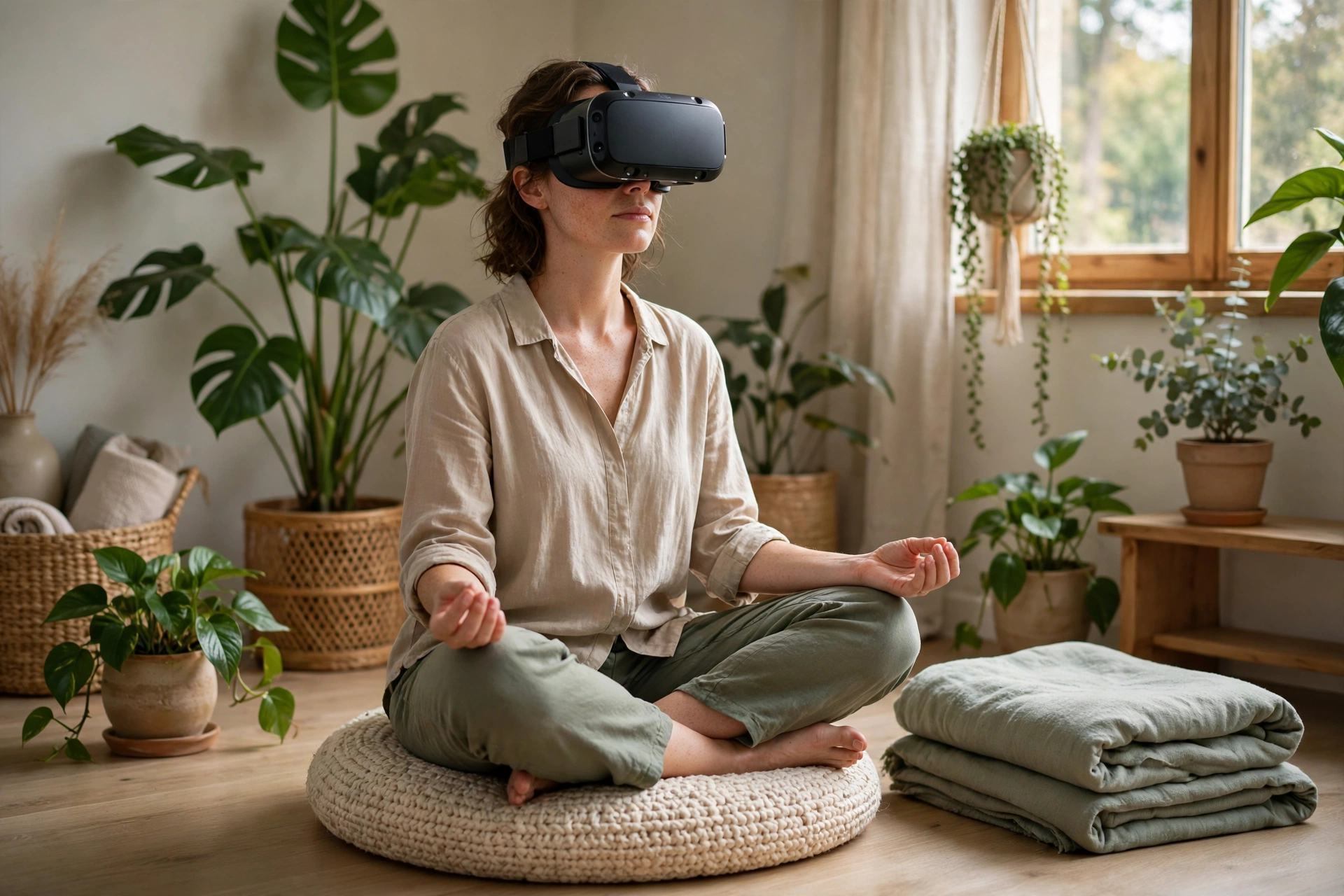
Put on your VR headset, choose your scene, and press start. Then do as little as possible: breathe in slowly through your nose, out slowly through your mouth, and let the guide do the talking. When your mind wanders — and it will, probably within the first minute — just notice it and return to your breathing. That gentle return is the practice itself, not a failure.
Try three short sessions over your first week rather than one long one. Short and regular beats long and rare. If after a few tries it still feels like a chore, drop it without guilt — the best form of meditation is the one you will actually do. If you are curious about the wider ways headsets are used outside games, our look at VR beyond gaming covers training, healthcare, and design.
Frequently Asked Questions
Do I need an expensive headset to meditate in VR?
No. Any modern standalone headset that runs meditation apps will do — the scenes are simple by design, so even an entry-level headset handles them well.
How long should a VR meditation session last?
Five to ten minutes is ideal when you are starting; fifteen to twenty suits most people once the habit sticks. Length matters less than regularity.
Can VR meditation replace regular meditation?
It is regular meditation, just in a different setting — the breathing, focus, and gentle return of attention are the same. Some people use VR every time; others alternate with quiet sitting. Both count.
Is VR meditation safe if I get motion sickness?
Usually yes, if you choose still scenes and sit down. Avoid flying, spinning, or fast movement, and stop if you feel queasy. If motion sickness is a regular problem for you in VR, a phone app may suit you better.
What if my mind keeps wandering in VR?
That is normal, and it happens to everyone. Noticing the wandering and gently returning to your breathing is the exercise itself — the scenery helps, but it does not stop thoughts, and it is not meant to.
Conclusion
VR meditation works by giving an old practice a calmer room to happen in: a quiet virtual scene, a steady guide, and a headset that keeps the everyday world at bay while you breathe. It will not transform your life in a week, but it can make starting — and sticking with — a meditation habit noticeably easier. If you already own a headset, try one short guided session this week: five minutes, a still scene, and no expectations beyond seeing how it feels. That small experiment is the whole next step, and it is enough.