
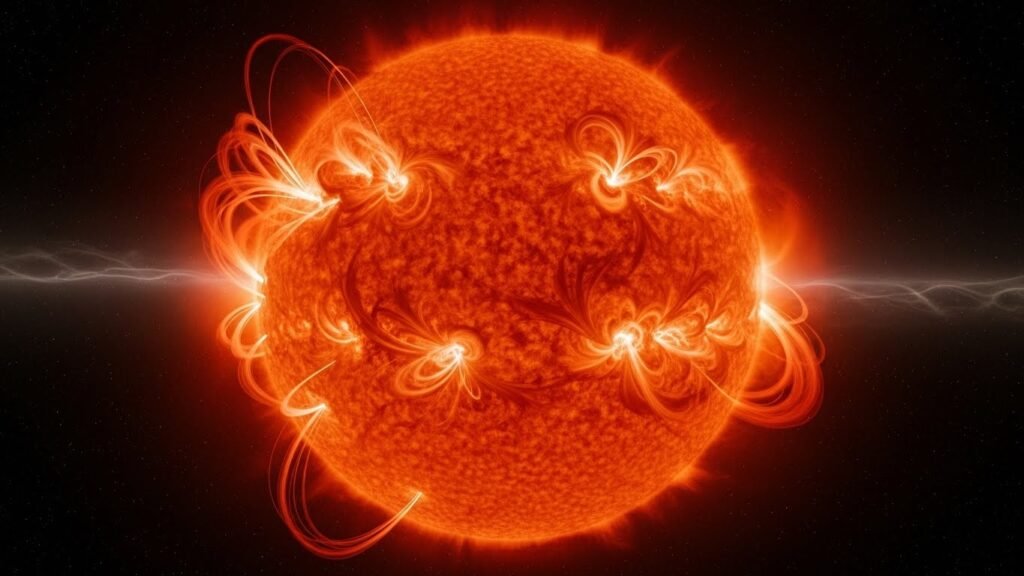
The sun — our closest star, and the center of our solar system — has remained both a mystery and an inevitability throughout human history: a glowing object in the sky whose presence influences everything from the air people breathe to its role in global climate. As a G-type main-sequence star, it offers scientists an opportunity to observe that very first step in things that are going on inside every one of the trillions upon trillions other stars around us. In this last ultimate guide, we burrow into the Sun’s mighty and mysterious scientific underbelly. We describe everything from the subatomic quantum physics at its fiery core, to astonishing magnetic effects that reach all the way to our solar system’s surfaces.
Explore More:
What Is the Sun? A Stellar Profile
The Sun is a natural fusion reactor: energy source is the atoms that make-up its filament (plasma/Filmata/SF). It is running middle of the road as far as stars go in our galaxy: ordinary, when compared with the giant blue stars and tiny red dwarfs found elsewhere in the galaxy, but with vital statistics that make your eyes pop.
Distance from Earth: Approximately 149.6 million km (1 Astronomical Unit).
Age: 4.603 billion years.
Mass: 1.989 * 10^30 kilograms (333000 times that of Earth).
Type : Mainly Hydrogen (73%), Helium (25%) and other elements like Oxygen, Carbon Neon, Iron.
The sun contains 99.86% of the mass in our solar system. It’s the gravity of it that keeps not just Jupiter, but even the tiniest speck of space dust from going off in a straight line.
Its Inner Structure: View Layer by Layer
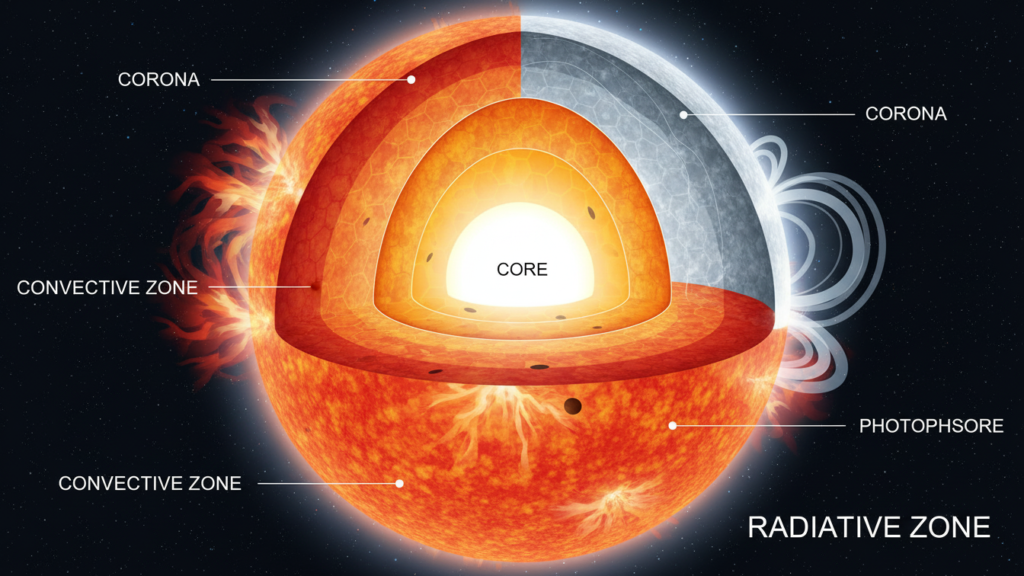
The Sun is not a solid object, but rather a ball of gas, over 99% of which comprises the power source that holds itself by the strength of its own gravity. It has 6 distinct layers that are defined according to the physical events occurring inside them.
The Core: The Nuclear Furnace
The middle part of the sun is known as its core and extends out to roughly 25% along it’s radius. It is the only place where nuclear fusion occurs.
Temperature: 15 to beyond 100 million °C (27 million to over 180 million °F) +.
Pressure: 260 billion Earth atmospheres.
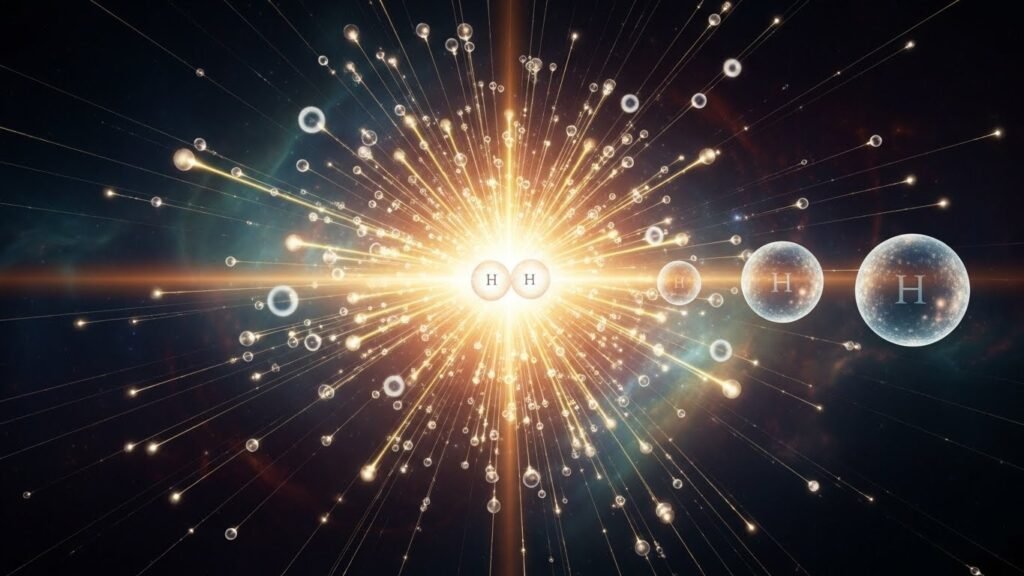
In such extreme conditions the hydrogen atoms are crushed together to form helium. This process, known as the proton-proton chain, produces a huge amount of energy. The Sun fuses approximately 600 million tons of hydrogen into helium each second.
The Radiative Zone
This core is enveloped by a radiative zone (to approximately 70% of the solar radius). There the density is so high that energy (in the form of photons) can no longer even move in a straight line.
The “Random Walk”: A photon generated at the core may have to walk for 10,000-170,000 years in the radiative zone of particle absorption and re-emission.
The Convection Zone
This temperature, in turn, declines so that the plasma density becomes low enough for buoyancy-driven convection to operate in the outermost 30% of its interior.
Mechanism: Hot plasma flows up toward the surface, cools and then rolls back down in a constant churning reminiscent of boiling water on a stovetop.
magnetic Generation: It is, These gigantic currents of Ion gases are responsible for Solar Dynamo here as it produces huge magnetic fields from Sun.
The Sun’s Surface and Subsurface: Origin, Structure, Atmosphere, Interiors and Magnetosphere
Beyond the interior there is the atmosphere, where finally the energy of the Sun gets out to look into emptiness.
The Photosphere (The Visible Surface)
If you look up at the sun (without that whole proper filtration), seeing is the photosphere.
Features: It is about 500 km thick.
Granulation: The surface appears like a rough orange peel as the tops of convection cells ascend from beneath.
Sunspots: These are dark, cooler regions (about 3,800°C) that result from intense magnetic activity which prevent convection.
The Chromosphere
This “color sphere” is a thin shell above the photosphere. It gives off red light from hydrogen gas. It is visible such as a thin red circle during a total solar eclipse.
The Corona: The Great Mystery
The corona is the outermost layer, which stretches millions of miles out.
-
The Temperature Paradox: While the surface is “only” 5,500°C, the corona reaches 2 million°C.
-
Solar Wind: The corona constantly sheds plasma into space, creating the solar wind—a stream of charged particles that travels at speeds of 400 km/s.
The Science of Energy: The Sun.ToBoolean_FOLLOW_THE_SUN\’S_PATH.
The physics of SunForce can be explained by studying the Proton-Proton Chain Reaction. It is the most effective process of energy generation.
Fusion of Hydrogen: Four protons (nuclei of hydrogen) combine.
Lost Mass: The helium nucleus is about 0.7% less massive than four separate protons!
Mass-Energy Equivalence: The mass that is “lost” becomes energy according to the famous equation by Einstein, $E = mc^2$.
That energy is emitted as gamma rays; higher in the solar atmosphere, that charge gives up some of its intensity to the medium in exchange for visible light and heat.
Solar Activity and Space Weather
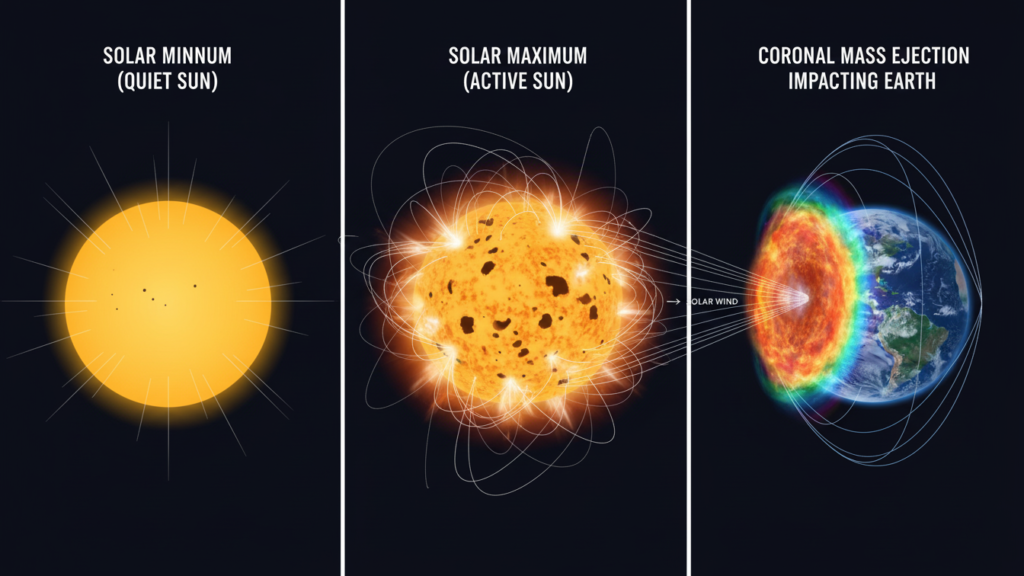
The Sun is not a quiescent thing, it goes through an 11 year Solar Cycle. During “Solar Maximum,” the orientation of the Sun’s magnetic poles are reversed and activity increases.
Solar Flares and CMEs
Solar Flares: Violent eruptions of energy from the sun.
Coronal Mass Ejections (CME’s): Giant bubbles of plasma and magnetic fields that are released into space.
When they strike the Earth, they interact with our magnetic field to produce Auroras (Northern and Southern Lights) but they can also mess with GPS, satellites and power grids.
The Life of the Sun: from Birth to Death
Right now, the Sun is considered a middle-aged star, although its just about halfway through its Main Sequence stage. Its fuel has been burning for 4.6 billion years, and it has approximately 5 billion more years worth of a fuel supply.
The Death of a Star
Red Giant Phase: The sun will have used up all of its hydrogen in approximately 5 billion years. It’ll start to burn helium and puff up, probably swallowing Mercury, Venus and maybe Earth.
Planetary Nebula: The outer layers will be shed off into space, forming an attractive gas shell.
White Dwarf: The leftover core — an object about the size of Earth but as massive as a star — will slowly cool over trillions of years as a white dwarf.
The Sun and Modern Technology
In the 21 century our own relationship to the Sun is evolving. We are no longer just onlookers: We have begun to pay heed, and work with, its force — and defend our digital infrastructure from its temper tantrums.
Solar Power: Photovoltaic technology has turned into the cheapest source of new power in dozens of countries.
Parker Solar Probe: NASA’s mission is currently ‘‘touching the sun,’’ passing through its corona to figure out why it gets so hot there.
Nuclear Fusion Research: Projects such as ITER are working to replicate the “core” of the Sun on Earth in order to generate abundant and clean energy.
Conclusion
The Sun’s the composer of our reality. Knowing its form and cycle is not merely an academic pursuit; it’s crucial to our modern, technology-driven society. As we seek to understand the stars, the Sun is our most vital key to unlocking the baffles of the universe.
At Techserps,we brings up to date with astronomical and futuristic discoveries. For more on how space weather impacts modern AI and satellite communication, read two of our recent articles.
FAQs:
How does the Sun’s Corona get so much hotter than its surface?
This continues to be one of the biggest puzzles in solar physics, known as the “Coronal Heating Problem.” The surface of the Sun (photosphere) is 5,500°C but the corona, which is farther away from it, can be above 2 million°C.Science’s best understanding of this phenomenon warrants “nanoflares” — small energy bursts — or “magnetic waves” (Alfvén waves) carting energy from inside to snap in the atmosphere and emit staggering heat. Now, NASA’s Parker Solar Probe is in the process of validating those theories.
What impact does “Space Weather” have on our technology here on Earth?
The sun continuously gives off a stream of charged particles – such as electrons and protons – that make up the solar wind. During things like Coronal Mass Ejections (CMEs), this wind turns into a storm. When these particles collide with Earth’s magnetic field, they can cause electrical currents to flow in power grids and prevent such systems from working (as happened with the 1989 Quebec blackout). They also disrupt the accuracy of GPS, erode satellite electronics and can even present radiation risk to astronauts and passengers on high-altitude polar flights.
Will the Sun ever “run out” of oxygen or air?
No, the Sun does not burn! The sun is hot because it burns? On Earth, fire is a chemical reaction that combusts when it has the elements of fuel (such as wood) and oxidizer (oxygen). The Sun, on the other hand, runs on nuclear fusion. It doesn’t require oxygen to create heat and light; it relies on the crushing pressure and extreme temperatures in its core to smash hydrogen atoms into helium. As long as it has hydrogen to burn — and for the next five billion years, it will have plenty — it will continue to shine.
Solar Flare vs CME – What Are They & What’s the Difference?
Although they occur simultaneously, they’re not the same thing. Solar Flare is an intense burst of radiation coming from the release of magnetic energy; it takes only about 8 minutes to reach Earth. A CME, though, is a cloud of actual solar plasma and magnetic fields. A CME travels much more slowly, typically requiring 1 to 3 days to arrive at Earth. If a flare is the flash of a muzzle-loader gun, then the CME is the cannonball.
Are the dimensions of the Sun constant, or do they change.
For now, the Sun is in hydrostatic equilibium – going in and out equally hard so that the inward pull of gravity is exactly balanced by the outward push of nuclear fusion. This helps it to maintain the same size. But as it ages and burns through its supply of hydrogen, this equilibrium will change. In approximately 5 billion years, when it becomes a Red Giant, its expansion may be so significant that it will extend all the way to Earth’s orbit.




Your article helped me a lot, is there any more related content? Thanks!
Thank you! We’re glad the article was helpful. Yes, we have more related content—feel free to check our blog for similar posts, and let us know if there’s a specific topic you’d like us to cover!
Thank you! We’re glad the article helped. Yes, we have more related content—feel free to browse our blog, and let us know if there’s a specific topic you’d like us to cover next!