
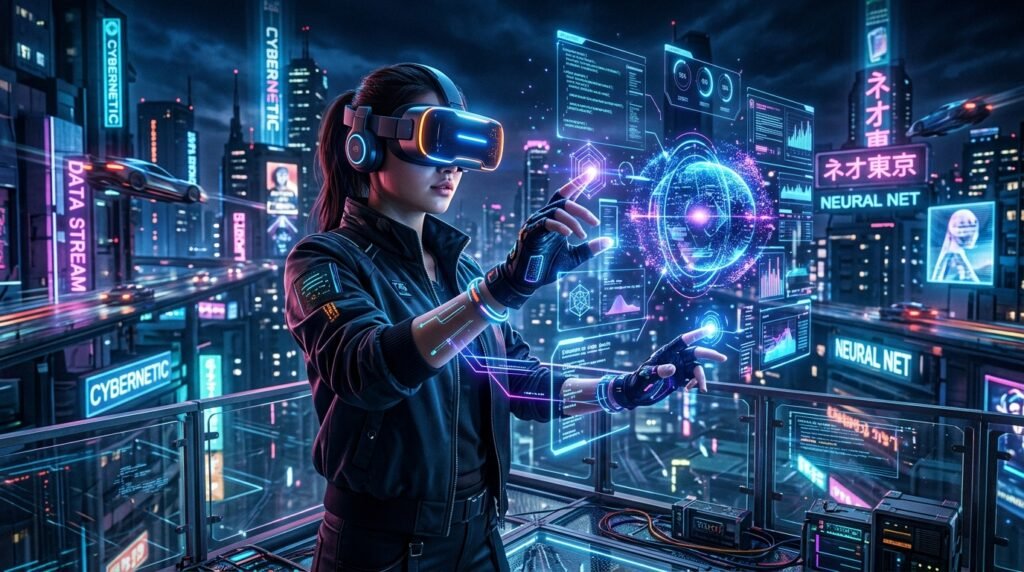
Virtual Reality (VR) is not a thing of the future anymore. It’s a technology capable of transforming how we navigate virtual places. Everything from immersive gaming experiences to professional applications like in healthcare, education and real estate relies on a Virtual Reality Headsets Explained at the center of it all. BUT, there are so many kinds of VR headsets available now that it can be a bit daunting to find the right one for exactly what you want to do.
In this ultimate guide, we’ll explore exactly what VR headsets are, how they function, the different types of VR available, and look at what you need to think about before buying one. So whether you’re a gamer, tech enthusiast, creator, or business professional that wants to know how VR can be utilized for his/her sector — we’ve got you covered in this post on everything from the basic knowledge up to advanced information.
Explore More:
- What Is Virtual Reality? Exploring the Future of VR
- Future of Artificial Intelligence
- How VR Is Transforming Education
What Are Virtual Reality Headsets Explained?
Headsets for VR are specialized devices intended to offer immersive digital experiences. The VR naturally makes us connected to imaginary environments as if we are there in the real world without any virtual tool.
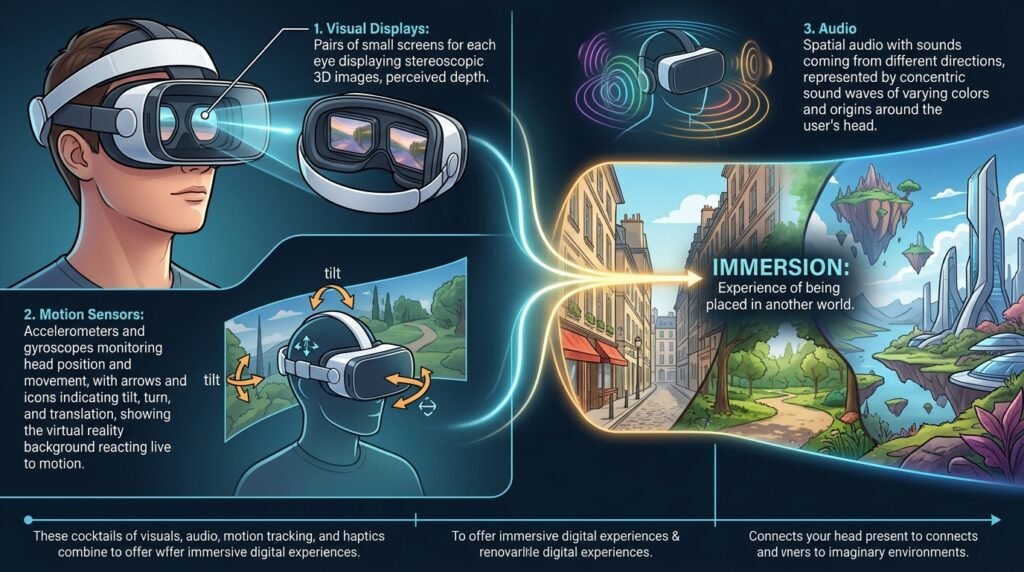
The concept of immersion in virtual reality (VR) is at the heart of every VR headset. Using a cocktail of visuals, audio, motion tracking and, when available, haptics, the technology provides users with an experience that places them in another world. These contexts could be realistic simulations, like strolling through a city or engaging in a video game-like experience, or fictional environments where everything is imaginable.
There are three main components to a VR headset that work together to create this feeling of immersion:
Visual Displays: The headset generally contains a pair of small screens (for each eye) that show stereoscopic 3D images. These displays recreate the perceived depth of life.
Motion Sensors: Sensors such as accelerometers and gyroscopes monitor the position of your head. The virtual reality background reacts live to the motion, allowing you the sensation of traversing through a digital universe.
Audio: Many VR headsets also come with spatial audio, which enables you to hear sounds coming from different directions for a more immersive experience.
How Do VR Headsets Work?
At a fundamental level, VR headsets create an often interactive three-dimensional universe that responds to your motions. When you don a headset, visually it transports you somewhere else. So here is an insight into how VR technology works:
The Display:
Typically, the VR headset is composed of OLED or LCD screens inside that can provide HD image quality. These are placed right in front of your eyes, therefore gives you a panoramic, wide-angle view. The two screens (one for each eye) display slightly different images to create the illusion of depth, similar to human binocular vision.
Head Tracking:
Motion sensors in the VR headset register your head movements. When you move your head to the left or right, the virtual environment moves. What this means is that when you turn your head in the virtual world, the display will shift as it would if you were actually there.
Controllers and Haptics:
VR headsets include controllers or gloves that let users interact with the virtual environment. This allows these devices to track your hand movements in the real world, enabling actions such as picking up objects and pressing buttons to complex tasks. Haptic feedback: A unique feature of many VR controllers, which allows you to “feel” an interaction like a vibration, impact, or texture.
Audio:
VR headsets also deliver audio to support the visuals and motion. Even better, high-quality spatial audio systems make the experience even more immersive. But it was important for VR, where sounds originate from different points of the space where something is going on, the same as in real life.
Types of VR Headsets
The latest models of VR headsets in the market today are versatile and include many types designed for different audiences. If you are a gamer or someone who works professionally, knowing the different types will help you choose the right receiver for your needs.
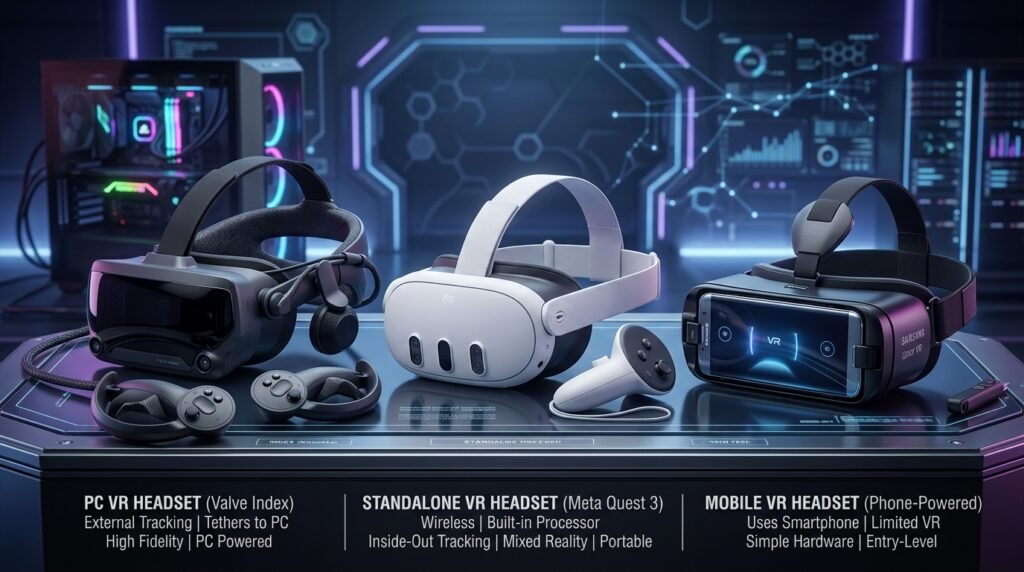
PC VR Headsets:
Best For: Hardcore gamers, professionals and VR enthusiasts.
Examples : Oculus Rift S, HTC Vive Pro 2, Valve Index.
Description: These headsets use a PC or gaming console to run and typically have the greatest graphical power. They offer a high-definition, low-latency experience with accurate motion tracking. PC VR headsets are the best choice for anyone looking to get high-quality VR experiences with minimal latency.
Standalone VR Headsets:
Best For: Casual users, beginners, or anyone looking for an easy, portable experience.
Examples: Oculus Quest 2, Pico Neo 3
Standalone VR headsets are self-contained devices that don’t need any external computer or console Description: They are simple to operate, lightweight and frequently less expensive. Standalone headsets can deliver a decent VR experience for casual gamers or those simply dipping their toes into the water, even if their graphics aren’t as high-end as PC VR systems.
Mobile VR Headsets:
Ideal For: Users who want the best bang for their buck, or just entering into VR (entry-level).
Examples: Samsung gear, daydream VR.
Description: Smartphones power these headsets for basic VR experiences They are cheap and portable but also have lower quality graphics and less accurate motion tracking than with PC or standalone VR headsets.
AR/VR Hybrid Headsets:
Ideal For: Mixed reality (MR) applications and pros who love the latest and greatest tech.
AR devices: Microsoft HoloLens, Magic Leap One.
Description: These devices combine both augmented reality (AR) and virtual reality (VR) technologies to produce mixed-reality experiences. Users interact with both this world and the content in the most natural way via these headsets. AR/VR hybrid headsets are utilized in domains such as design, engineering, healthcare and entertainment.
What to Look for in a VR Headset
There are a few key features that can really change the overall experience when buying a VR headset. Here’s a breakdown of several key points to keep in mind:
Display Resolution:
The clarity of the virtual world depends on the resolution of a VR set. High resolution results in clearer images and more detailed environments. For a smooth, immersive experience, find a VR headset that runs at 1080p per eye at minimum.
Field of View (FOV):
The field of view is how much of the virtual nvironment that you can see at a time. A broader FOV helps immerse yourself and allows the experience to feel more adjacent to the real world. Headsets typically have a FOV between 90° to 110° but high-end ones might deliver more.
Refresh Rate:
The increased refresh rate helps display a more fluid image, alleviating motion sickness. Ideally, a VR headset should have at least 90Hz refresh rate common, with higher-end options even pushing that number to 144Hz or more.
Tracking System:
Want a realistic experience, so that means precise motion tracking. Some headsets use external sensors and cameras outside the headset whereas others have inside-out tracking with them on board. The more successful the tracking, the more accurate and seamless the simulated world will be.
Comfort and Fit:
Comfort is a big part of the decision when selecting headsets, given how long you’ll be wearing these. These are often adjustable and often made from breathable materials in a lighter design. To enhance comfort, some VR headsets include foam padding or customizable faceplates.
Audio:
Most VR headsets feature their own audio systems which provide spatial sound. If you want the most immersive experience, pick a VR system that includes integrated 3D audio or has a way to add good-quality headphones.
Sources:
Best VR Headsets of 2026
Some of the most notable VR headsets as of 2026 include: A few of the best models to look out for:
Oculus Quest 3
Best For: Occasional VR users, gamers and people new to VR.
INDIVIDUAL: Second Display, 120 Hertz, 4K
Why It’s Great: The Oculus Quest 3 is one of the most widely used standalone VR headsets on the market so it offers a perfect balance between price and performance. It’s ideal for anyone who wants a portable VR experience without requiring a PC.
Valve Index
Best For: Serious gamers and VR professionals.
Highlights: 144Hz refresh rate, 130° FOV, high-resolution displays
Why You Should Get It: The Valve Index is the highest fidelity VR you can buy, with stunning visuals and pinpoint tracking. It needs a powerful gaming PC, but offers the best immersive VR experience you can get right now.
HTC Vive Pro 2
Best For: Professionals, virtual reality enthusiasts, and gamers.
Key Features: 5K resolution, 120Hz refresh rate, accurate tracking.
Why We Chose It: For the best pairing of VR for work and play, nothing beats the HTC Vive Pro 2. With a superb display and some of the best customization options available, this is an excellent choice if you’re serious about VR.
Sony PlayStation VR 2
Best For: PlayStation 5 users.
WELCOME TO PLAY STATION Key Features: Eye-tracking, 3D audio, 4K HDR support.
The Reason: PlayStation gamers with a PS5 can’t miss the high-tech VR experience that they can own, thanks to the eye-tracking and spatial audio of the next-gen PlayStation VR 2.
Applications of VR Technology
VR headsets have multiple use cases in different sectors. Here are just a few examples:
Gaming: Virtual reality gaming gives the opportunity of immersing into the game and stepping into their favourite games.
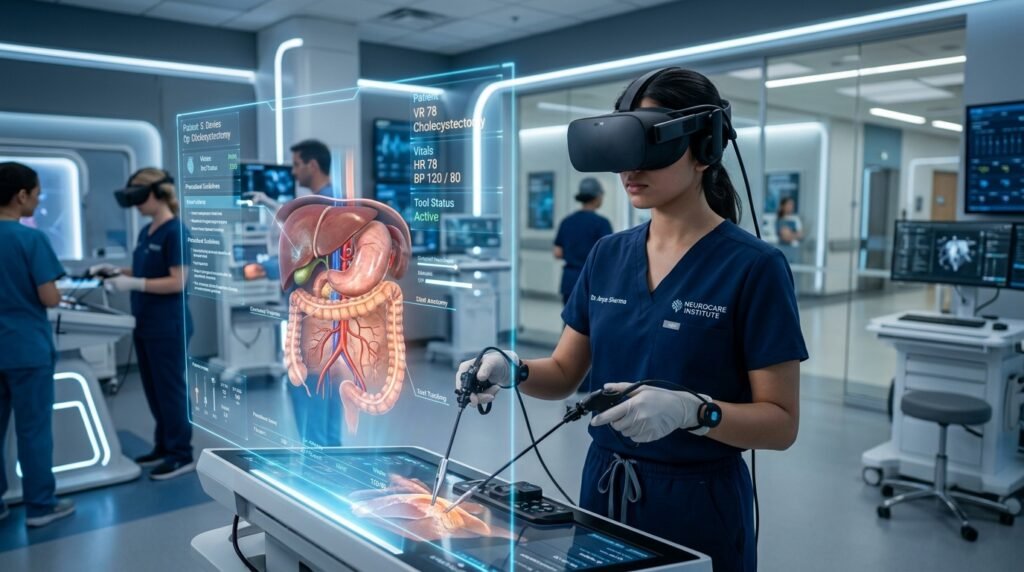
Notes: VR for therapeutic treatments, pain management, surgical training.
Education: Virtual realiy generates immersive learning experiences, with everything from virtual field trips to science labs.
Real Estate: Virtual property tours allow buyers to visit properties in the comfort of their own home.
Fitness: Virtual reality-based fitness programs make working out fun and engaging.
Conclusion
VR is revolutionizing how we perceive and engage with the digital world. Whether you are a gamer, a tech enthusiast, or a professional exploring VR technology, understanding how VR headsets work is essential. Virtual Reality Headsets Explained helps users learn about the different types of VR headsets available on the market and the key features to consider before buying one. As VR technology continues to evolve, virtual reality headsets are expected to become an important part of everyday life, creating new opportunities in gaming, entertainment, education, healthcare, and many other industries.
FAQs – Virtual Reality Headsets Explained
1. What is a virtual reality headset?
A virtual reality headset is a device worn on the head that immerses users in a computer-generated 3D environment using displays, sensors, and spatial audio.
2. How do VR headsets work?
VR headsets use stereoscopic displays, motion sensors, and tracking systems to create an immersive digital environment that responds to the user’s head and hand movements.
3. What are the different types of VR headsets?
The main types include PC VR headsets, standalone VR headsets, mobile VR headsets, and mixed reality headsets.
4. What features should you consider when buying a VR headset?
Important features include display resolution, field of view, refresh rate, motion tracking accuracy, comfort, and audio quality.
5. What are VR headsets used for?
VR headsets are used in gaming, education, healthcare training, virtual tours, remote collaboration, and fitness applications.



GL Pro is a natural dietary supplement formulated to help maintain steady, healthy blood sugar levels while easing persistent sugar cravings.
GL Pro is a natural dietary supplement formulated to help support healthy blood sugar levels and reduce persistent sugar cravings.
MounjaBoost is a next-generation, plant-based supplement created to support metabolic activity, encourage natural fat utilization
Thanks for sharing! MounjaBoost is a plant-based supplement designed to support metabolic function and promote natural fat utilization as part of a healthy lifestyle.
Backbiome is a naturally crafted, research-backed daily supplement formulated to gently relieve back tension and soothe sciatic discomfort.
BackBiome is a naturally crafted, research-backed daily supplement designed to help gently relieve back tension and support comfort from sciatic discomfort.