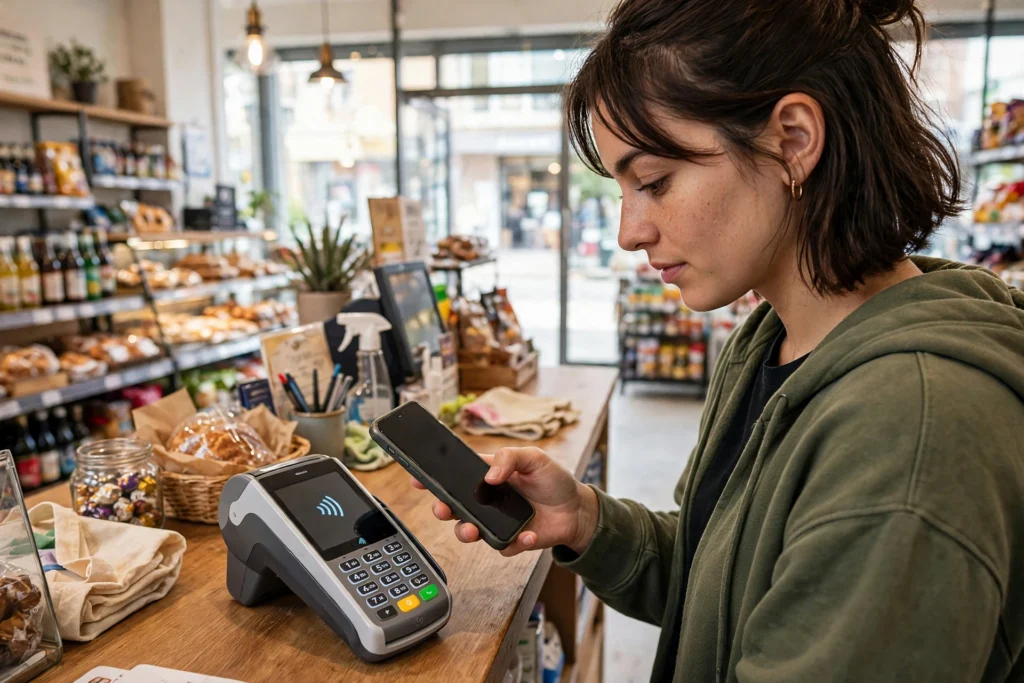
NFC, short for near-field communication, lets two devices swap a small amount of data when they are held very close together. Your phone creates a magnetic field, a tag or reader responds inside that field, and the exchange is done in a second or two. That is why a tap feels instant, and why it stops working the moment you pull the devices apart.
Key Takeaways
- NFC works at 13.56 MHz over a few centimetres, not across a room.
- A passive tag has no battery: it draws power from the reader’s magnetic field.
- The short range is a feature, not just a limit — it makes accidental connections unlikely.
- Tap-to-pay, transit gates, door access, and smart tags all use the same basic idea.
- NFC is slow compared with Wi-Fi or Bluetooth, so it is best for short messages, not files.
What exactly is NFC?
NFC is a set of standards for short-range wireless communication between two devices, usually a phone and a tag, card, or reader. It grew out of the contactless card technology already used for bank cards and travel cards, with extra rules so phones could act as both readers and cards. Wikipedia’s overview of near-field communication describes it as communication over a distance of a few centimetres, which matches everyday experience: you tap, you do not wave from across the counter.
Think of it as a very short conversation. One side, the initiator, starts the exchange. The other side, the target, answers. In many everyday cases the initiator is your phone and the target is a passive tag or a payment terminal. In a payment, the roles can flip in practice, because the terminal is the powered reader and your phone behaves like a card. Either way, the two sides must be close, and the data exchanged is small — a payment token, a web address, a ticket, or a Wi-Fi password, not a video file.
How does a phone power a tag with no battery?
This is the part that surprises most people. An NFC tag is little more than a small chip attached to a flat coil of wire, often printed on a sticker. It has no battery and nothing running while it sits in a drawer. So how does it answer at all?
When your phone’s NFC reader switches on, it drives an alternating current through its own coil at 13.56 MHz. That creates an alternating magnetic field around the phone. Hold a tag inside that field and the tag’s coil picks up energy from it, much like the two windings of a transformer separated by air instead of an iron core. Once rectified, that energy is enough to power the tag’s tiny chip for the brief moment of the exchange.
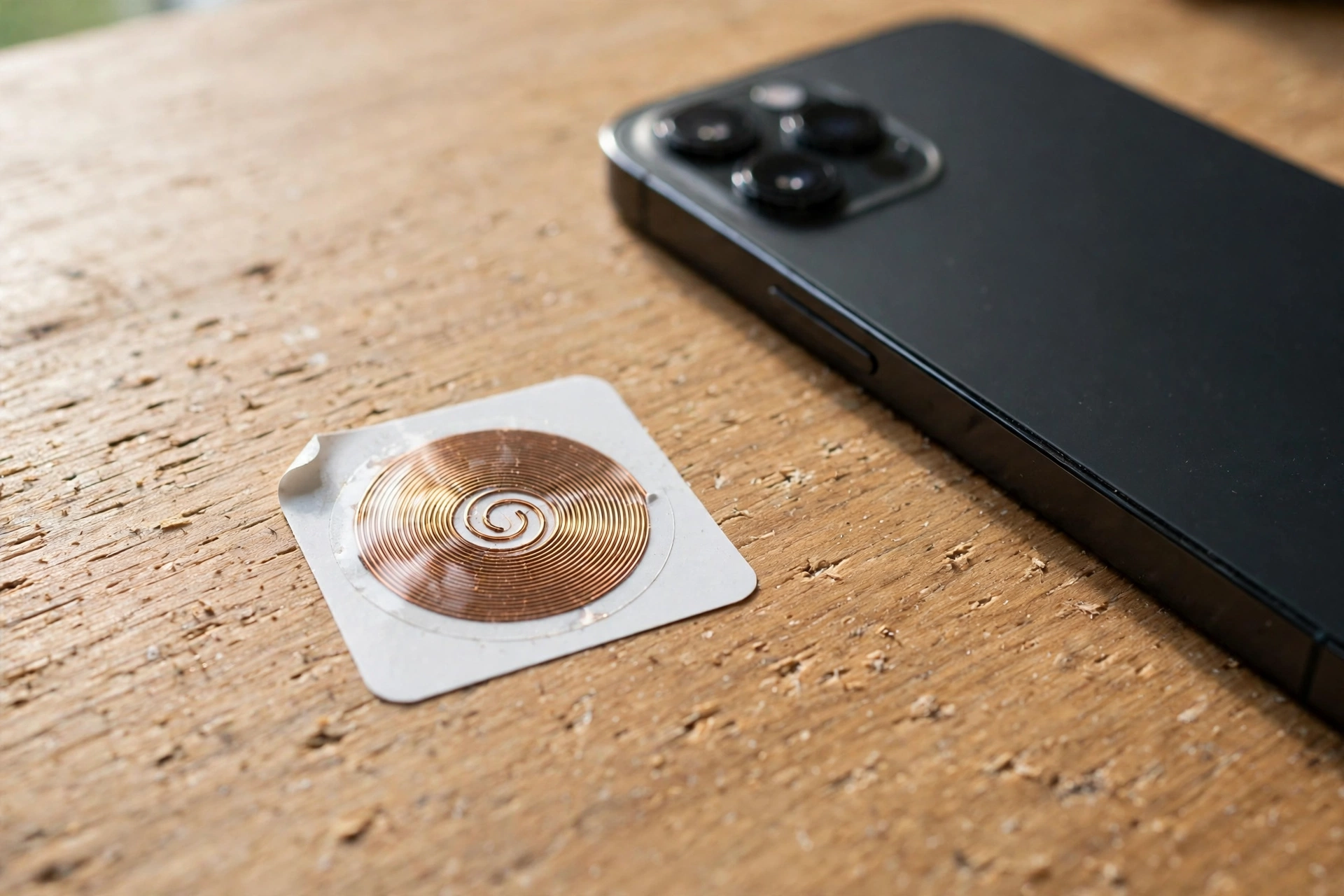
The tag does not then broadcast a signal of its own. Instead, it changes how much energy it draws from the reader’s field, switching a load across its coil in a pattern the reader can detect. Engineers call this load modulation. It is a neat trick: the tag answers while consuming almost nothing, because the reader is supplying the energy all along. That is also why a tag can survive for years unused and still work the first time you tap it.
Why is the range only a few centimetres?
Inductive coupling weakens very fast with distance. Double the gap between the coils and the coupling does not simply halve — it collapses. Past a certain point the tag never gets enough energy to start its chip, so the failure is abrupt: it either reads or it does not, with little in between.
Antenna size matters more than phone brand. A card-sized tag has a large coil that catches more of the field, so it reads from further away than a tiny sticker. Where the phone’s antenna sits matters too, and it is not in the same place on every model. If a tap keeps failing, sliding the phone slowly across the reader often works better than holding it still in the wrong spot, because you are lining the two coils up.
Metal is the other enemy. A tag stuck flat on a metal surface usually stops working, because the metal distorts the field. Tags made for metal surfaces include a ferrite layer to separate the antenna from the surface, and they cost more for that reason. A thick case can also cost you range, though plastic, leather, and fabric normally let the field through without trouble.
What are the three NFC modes?
NFC devices can work in three modes, though most people only meet the first two in daily life.
In reader/writer mode, your phone powers a passive tag and reads or writes its content. This is what happens when you scan a tag on a poster, program a sticker to open a website, or store a Wi-Fi password on a tag by the front door.
In card emulation mode, your phone behaves like a contactless card in front of an external reader. This is the mode behind tap-to-pay and many transit gates: the terminal powers the exchange, and your phone presents a payment or ticket credential. The details are handled by the phone’s operating system and its secure element, so you rarely see them.
Where do you actually meet NFC every day?
Payments are the most familiar use. When you hold your phone near a terminal, the phone presents a token that stands in for your card details, rather than sending the card number itself. The terminal checks that token, and the payment goes through. If a payment ever fails, the usual culprits are mundane: NFC switched off in settings, the phone held in the wrong spot, or a case with a metal plate getting in the way.
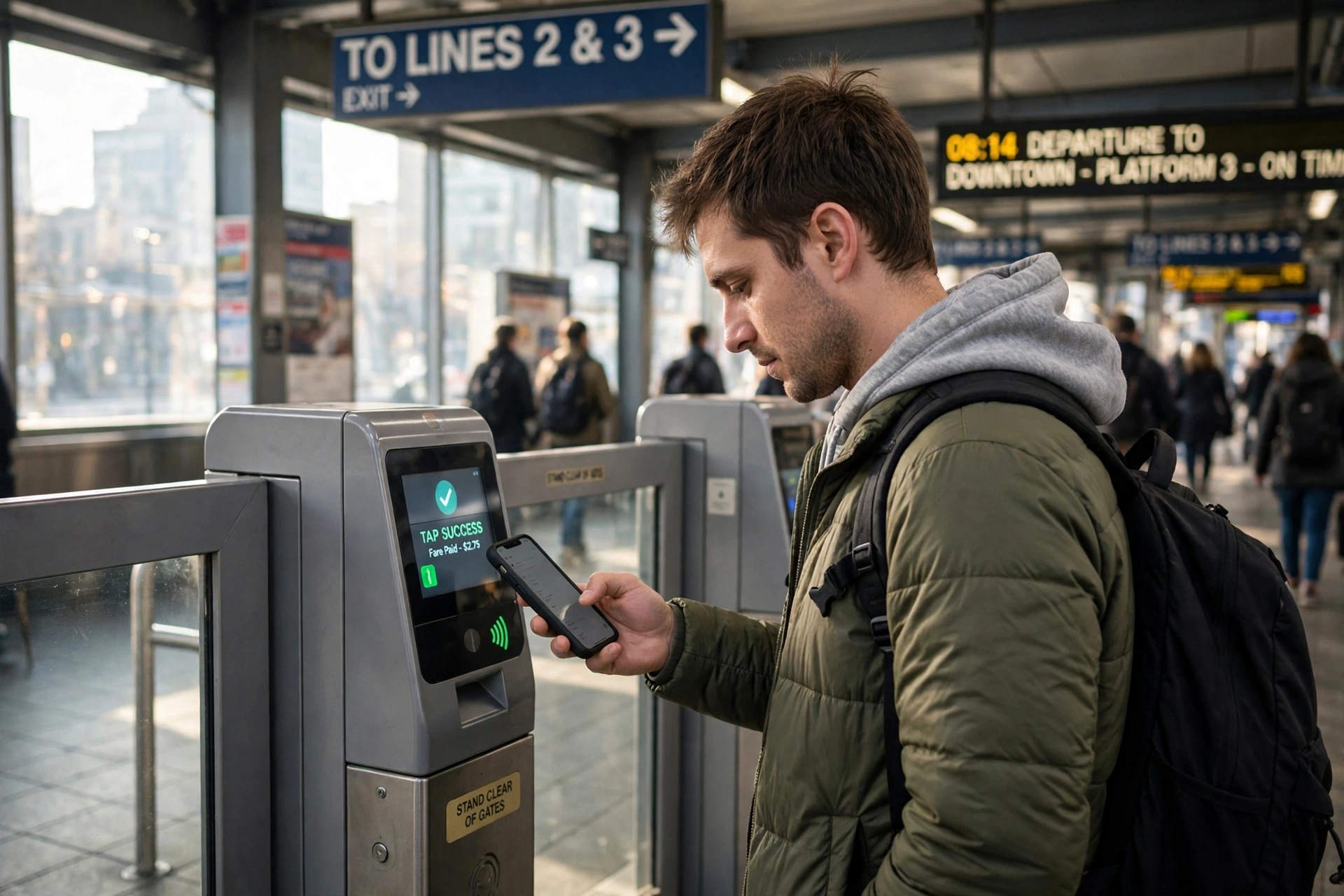
Transit is the second everyday case. Many travel cards and phone wallets work the same way at a gate: tap, the gate reads the credential, and you walk through. The speed matters here — a gate that took several seconds per person would hold up a rush-hour crowd, so the short, simple exchange is a good fit.
Then there are the quieter uses. Hotels and offices use NFC cards and phones for door access. Museums and shops stick tags on exhibits and products so a tap opens more information. At home, a tag by the door can switch on the lights, set the phone to silent, or join the Wi-Fi network — the same kind of short instruction, delivered by touch. Wireless charging, which also uses coils and magnetic fields, is a close cousin in hardware but a different job: it moves power, while NFC moves data. If you want the wider picture on short-range wireless at home, our guides to Wi-Fi, Bluetooth, and wireless charging explain where each one fits.
How does NFC compare with Bluetooth and Wi-Fi?
The three technologies answer different questions. Wi-Fi moves a lot of data over tens of metres, which is why it carries your video calls and downloads. Bluetooth moves a moderate amount of data over a few metres, which suits headphones and speakers. NFC moves a tiny amount of data over a few centimetres, which suits a tap.
FAQs
Is NFC the same as RFID?
Not quite. NFC is a subset of RFID, restricted to 13.56 MHz and very short distances, with extra standards for phones acting as readers and cards. Most RFID systems, such as the warehouse tags that read from several metres away, are not NFC, and your phone cannot talk to them.
Does an NFC tag need a battery?
No. A standard passive tag draws all its energy from the reader’s magnetic field and is inert outside it. That is why tags last for years in a drawer and stop working the instant you pull the phone away.
How close do the devices need to be?
In practice, touching or nearly touching — usually within about 4 centimetres, and sometimes a little more for a large card-sized tag. If a tap fails, try moving the phone slowly over the reader to line up the antennas.
Can I use NFC through a phone case?
Usually yes. Plastic, leather, and fabric are transparent to the field. Metal is the problem, including a metal plate for a magnetic car mount, and a very thick case can also cost you range.
Should I leave NFC switched on all the time?
For most people, yes, it is fine to leave on: it only activates when another NFC device is very close, and payments still need your phone unlocked and confirmed. If you rarely tap to pay and prefer to minimise exposure, switching it off in settings and turning it on only when needed is a reasonable, low-effort habit.
Conclusion
NFC works because it keeps things deliberately small: a short-range magnetic field, a tiny exchange of data, and a tag that needs no battery of its own. That simplicity is what makes a tap feel effortless, whether you are paying for coffee, passing through a station gate, or programming a sticker by the front door.
If you want to try it yourself, start with something low-stakes. Buy a couple of inexpensive NFC stickers, write a simple web address or a Wi-Fi join instruction to one of them, and test it on your own phone before sticking it anywhere permanent. And for a deeper technical explanation, the NFC guide to how the technology works walks through the same ideas — coils, fields, and modes — in more detail. Once you have felt one tap work, the rest of the technology stops feeling mysterious, and starts feeling practical.