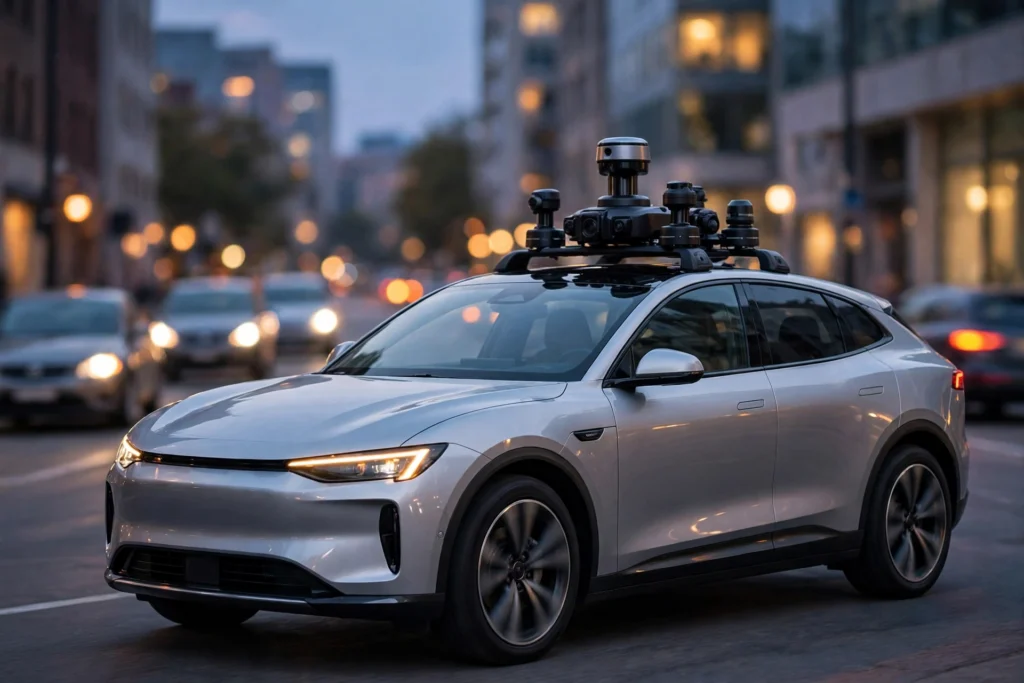
AI works in self-driving cars by turning sensor data into driving decisions, many times a second. Cameras, radar, and lidar build a live picture of the road, machine-learning models work out what each object is and where it is heading, and a planning system chooses the speed, steering, and braking — while a safety layer watches for anything the main system might have missed.
Key Takeaways
- A self-driving car sees the road through cameras, radar, and lidar, fused into one live picture.
- Machine learning models identify objects, predict what they will do, and help the car choose a safe path.
- Automation comes in levels, from driver assistance up to driverless operation in limited areas.
- Detailed maps and precise positioning tell the car where it is, down to the lane.
- No car you can buy today drives itself everywhere — a human still has to stay alert.
What does a self-driving car actually see?
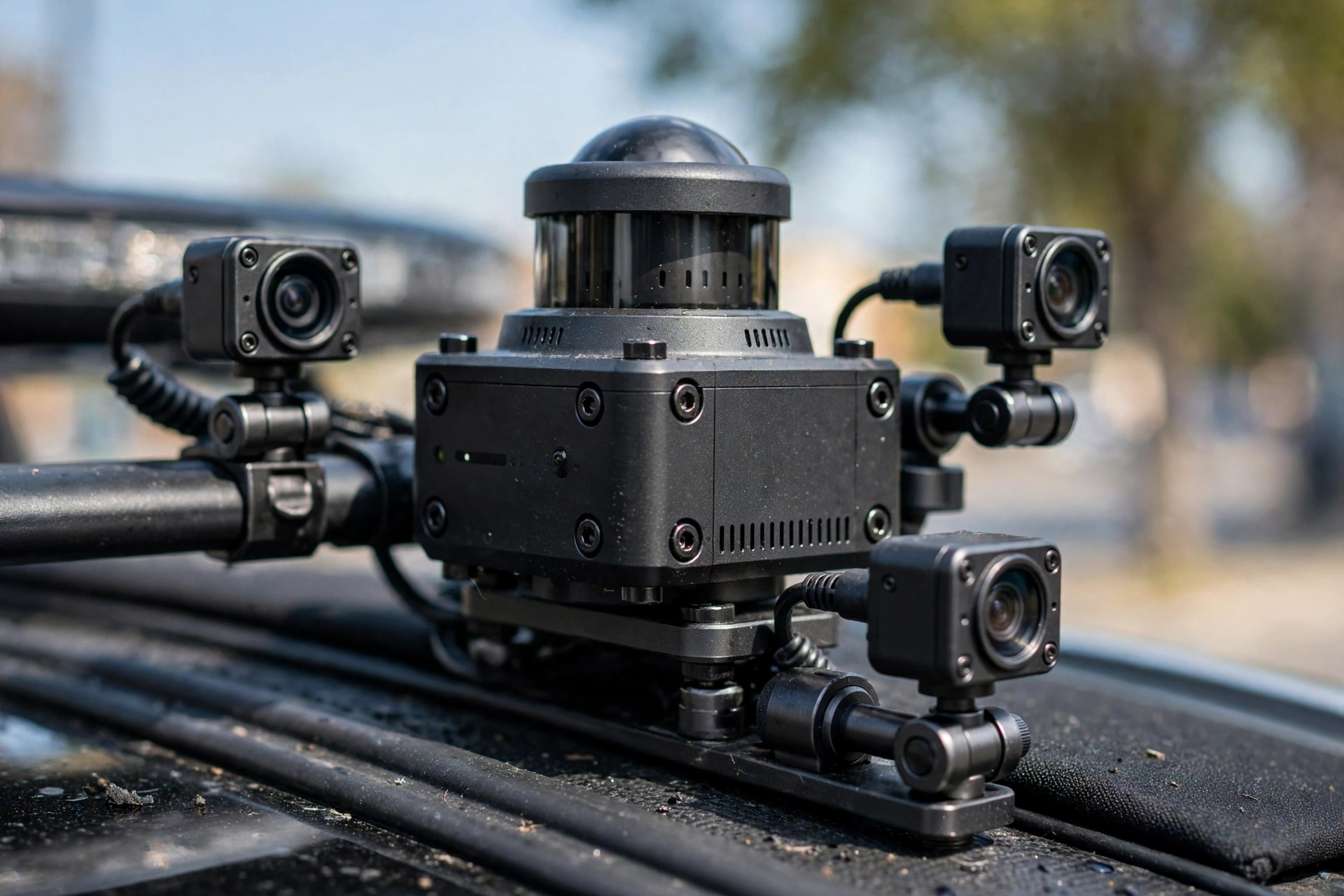
A human driver uses two eyes and a lifetime of experience. A self-driving car replaces that with sensors, each covering a weakness of the others. Cameras read the world in colour: lane markings, traffic lights, road signs, and the brake lights of the car ahead. Radar bounces radio waves off objects to measure distance and speed, and it keeps working in rain and fog when cameras struggle. Lidar fires pulses of laser light and builds a precise three-dimensional map of everything around the car.
No single sensor tells the whole story, so the car’s software combines them — a step called sensor fusion. If the camera sees a shape that might be a pedestrian and the lidar agrees something solid is at the same spot, the car can trust the result. If they disagree, it treats the object with caution rather than guessing. That hardware on roofs and bumpers is redundancy, not decoration.
How does AI turn sensor data into decisions?
Raw sensor data is just numbers. The AI turns it into understanding in three stages. First, perception: computer vision models sort the scene into objects — that blob is a bus, that one is a child on a scooter, that line is the edge of the lane. They learned from millions of labelled images and driving clips, the same training behind machine learning in general.
Next comes prediction: where is everything going? A pedestrian at a kerb might step out, or might be waiting for a bus. The system weighs the clues — body position, walking speed, whether the light is about to change — and estimates the next few seconds for every nearby road user.
Finally comes planning: stay in lane, slow down, change lanes, or stop. Each option is checked against safety rules, such as keeping a safe gap and never entering a junction it cannot clear. The whole loop — see, predict, plan, act — repeats many times a second, so the car can react to a ball rolling into the road almost as soon as it appears.
What are the levels of self-driving?
Not every car that helps you drive is self-driving. The industry uses a scale from 0 to 5. Levels 0 to 2 are driver assistance: the car can help with steering, speed, or braking, but you stay in charge. Most cars with “autopilot” style features sold today sit at Level 2 — hands on the wheel and eyes on the road, whatever the marketing name suggests.
Level 3 lets the car drive itself in specific conditions, such as a slow motorway jam, and asks the driver to take over when conditions change. Level 4 needs no driver at all, but only inside a defined area — the level used by driverless taxis in a handful of cities. Level 5, a car that can drive itself anywhere with no steering wheel, does not exist yet outside research. Knowing the level tells you who is responsible at any moment: you, or the car.
How does the car know where it is?
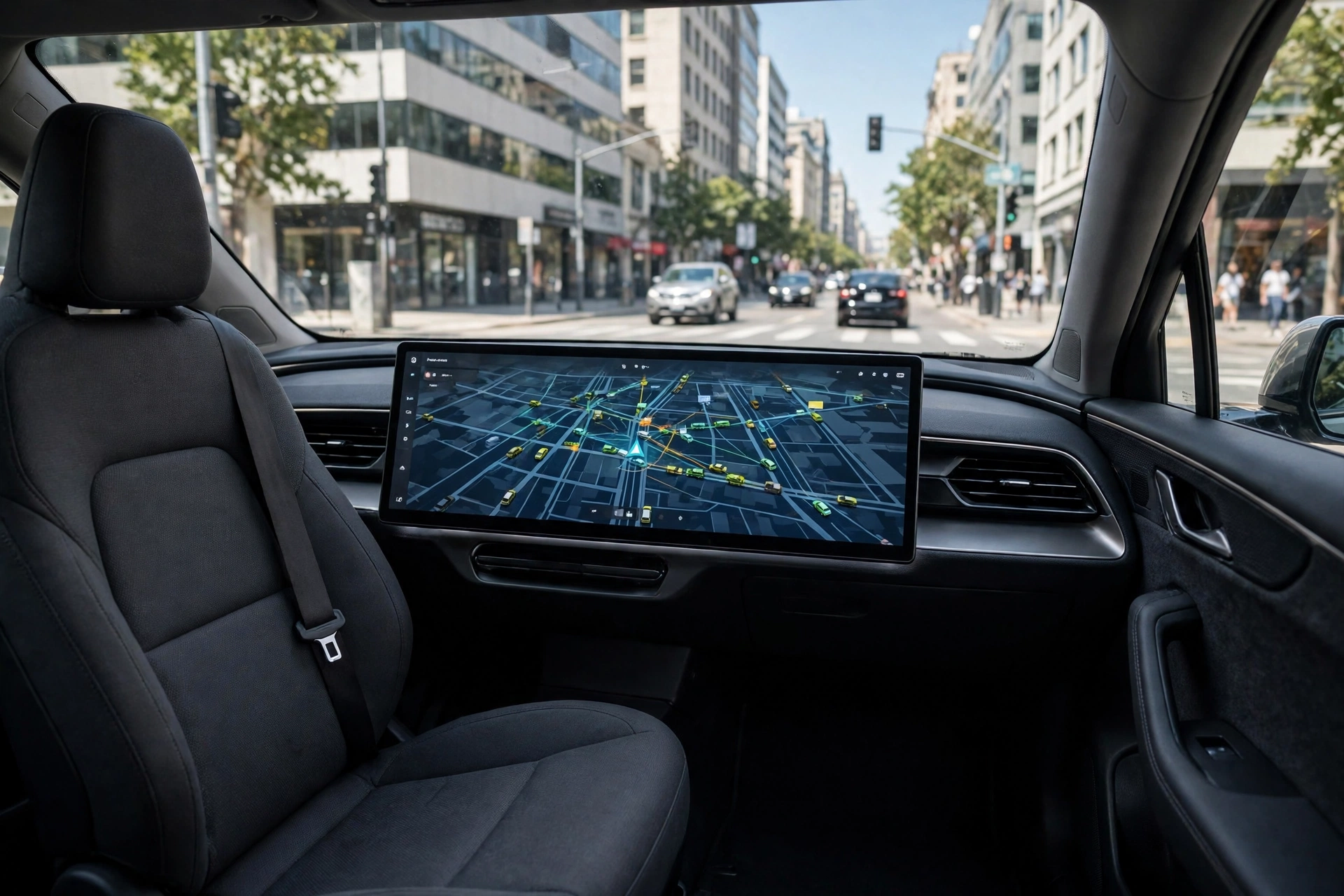
Satellite navigation alone is not precise enough to keep a car centred in a lane, so self-driving cars pair it with highly detailed maps recording lane lines, kerb heights, traffic-light positions, and speed limits, down to a few centimetres. The car constantly compares what its sensors see with the map to pin down its position.
This is also why driverless services launch in one city at a time. Before carrying passengers, the area is mapped in detail and driven over and over again, so the system learns the quirks of each junction. A road that changes has to be re-mapped, or the car treats it as unfamiliar ground and drives more cautiously. The intelligence is not only in the car; it is in the map too.
What happens when something goes wrong?
Self-driving systems assume parts will fail. If a camera is blinded by low sun, the car leans on radar and lidar. If the main computer faults, a backup takes over and brings the car to a safe stop. And if the car meets a situation it cannot understand — roadworks with a worker waving traffic through by hand — the safest move is usually to slow down, pull over, or hand control back to a human.
Cybersecurity is part of the same picture. A car that takes software updates over the air must be protected against tampering, so makers test their systems against attacks and keep safety-critical driving functions separate from entertainment features. Regulators watch this closely too: the US National Highway Traffic Safety Administration tracks automated-vehicle testing and reminds drivers that no car on sale today is fully self-driving.
Where does the technology stand today?
Driverless taxis now run paid services in limited areas of a few American cities, and some car makers sell Level 3 systems for specific motorway conditions. Elsewhere, the most common form of this technology is advanced driver assistance — lane keeping, automatic emergency braking, adaptive cruise control — the same sensing and prediction ideas in a smaller role. Progress has been slower than early predictions suggested, because rain, snow, unusual road layouts, and unpredictable people create a long list of rare cases, and each one has to be handled safely before a system can expand. The honest picture today is a technology that works well inside its limits — and is still very much inside them.
Frequently Asked Questions
Can I buy a fully self-driving car today?
No. No car on sale can drive itself in all conditions without a human paying attention. What you can buy is driver assistance, which helps with steering, speed, and braking but leaves you responsible for the driving.
Do self-driving cars use lidar, cameras, or both?
It depends on the maker. Most systems combine several sensor types: cameras for detail, radar for distance and bad weather, and lidar for precise 3D shapes. Some rely on cameras alone, but the majority use a mix.
How do self-driving cars handle bad weather?
Cautiously, and sometimes not at all. Heavy rain, snow, and fog reduce what cameras and lidar can see, so the car slows down, increases its following distance, or asks the driver to take over. Driverless services often pause in severe weather rather than risk a journey they cannot see clearly.
Are self-driving cars safer than human drivers?
We do not have enough data yet to say for certain. Driverless services report incident rates in limited areas, and early figures look promising, but the comparison is complicated: they drive in mapped areas, in chosen conditions, while human drivers drive everywhere.
What happens if a self-driving car crashes?
It depends on the level of automation and local law. In a driver-assistance car, the human driver is responsible. In a driverless taxi, the company operating the service carries responsibility, and regulators investigate.
Conclusion: A Practical Next Step
AI in self-driving cars is best understood as a loop: sense the road, predict what others will do, choose a safe path, and repeat — with maps, redundancy, and a human fallback filling the gaps. The technology is real and already carrying passengers in limited areas, but the gap between “works well in one mapped city” and “drives itself anywhere” is still wide.
A practical next step: next time you drive a car with lane keeping or automatic emergency braking, notice what it sees and where it hesitates. Those moments show you exactly where the technology helps — and where a human is still the better driver.