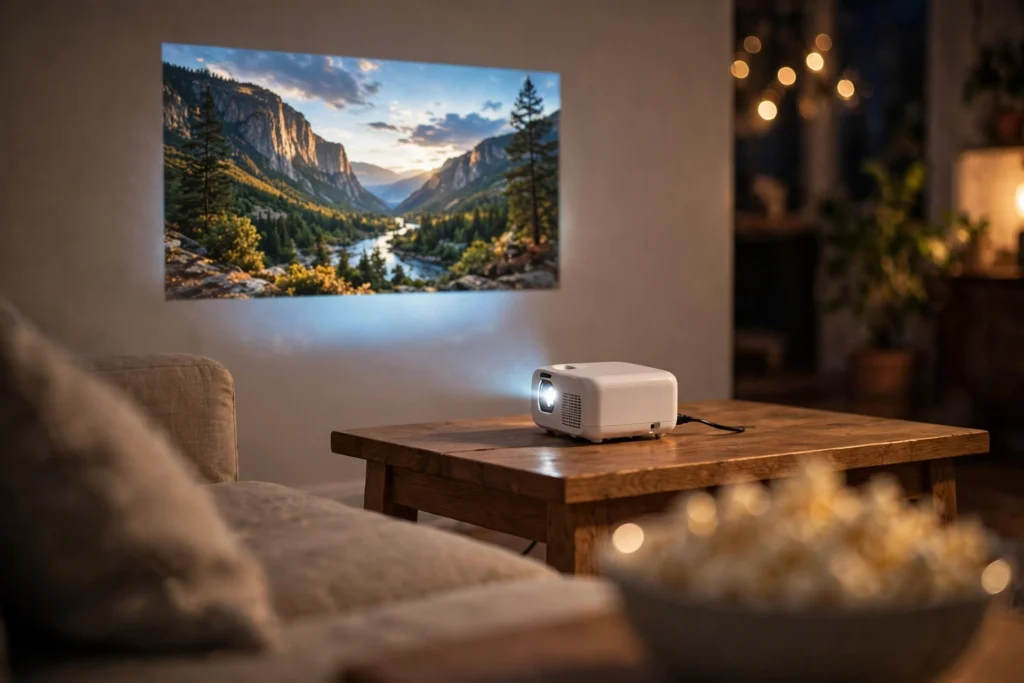
A portable projector turns a tiny image inside a small box into a large picture on a wall or screen. It shines bright light through or off an imaging chip, then enlarges it with a lens. Add a battery, a phone connection, and a small speaker, and you have a cinema you can carry in a bag.
Key Takeaways
- A portable projector creates a small image first, then enlarges it with a lens.
- Most small models use LED or laser light, plus a DLP or LCD imaging chip.
- Brightness matters most in a lit room; a dark room forgives a dimmer projector.
- Wi-Fi, HDMI, and Bluetooth cover most connections, from streaming to separate speakers.
- Distance, focus, and a flat, light-coloured surface decide how sharp the picture looks.
How does a portable projector turn light into a picture?
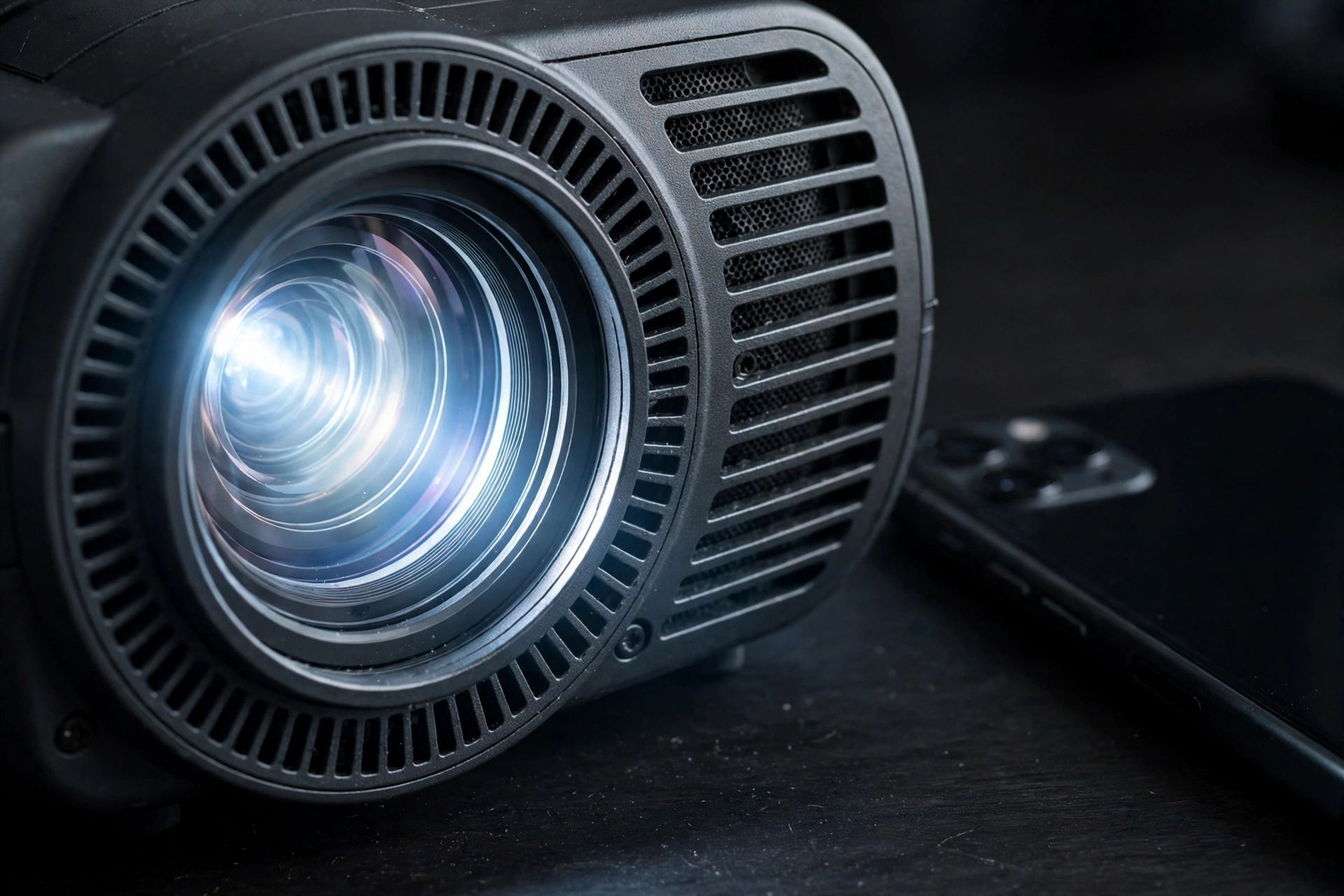
Inside the projector, a light source — usually LEDs, and in pricier models a laser — produces a strong beam. That beam reaches an imaging chip, which forms the picture one frame at a time. In a DLP design, thousands of tiny mirrors tilt to reflect light toward the lens or away from it; in an LCD design, light passes through liquid-crystal panels that control colour and brightness.
That is where the lens comes in. It spreads the light out while keeping the picture in focus, a bit like a magnifying glass held at just the right distance. Move the projector back, and the picture grows; move it closer, and it shrinks. Most models also have focus control and keystone correction to square up a picture projected at an angle.
What is the difference between DLP, LCD, and laser projectors?
The names can sound technical, but the choice is simpler than it looks. DLP projectors tend to be compact, with good contrast and a sharp image, which suits small portable designs. LCD projectors often give bright, colourful pictures and can be good value, though the box may be a little larger. Laser models are not a separate imaging type so much as a different light source: a laser can be brighter, last longer, and start up faster than a traditional lamp.
For everyday film nights, do not get stuck on the label alone. Check brightness, resolution, and battery life together, and think about where you will actually use it.
Why does brightness matter so much?
Brightness is usually given in lumens, sometimes in ANSI lumens, a more standardised measure. More lumens means the picture holds up better when light leaks into the room. A dim projector can look wonderful in a dark bedroom and washed out in a bright room at lunchtime.
That is why makers’ claims need a pinch of salt: a headline number may describe a small, bright test image rather than a large picture in a normal room. For evening viewing, modest brightness may be plenty; for daytime use, look for a brighter model or a darker room.
How do you connect a phone, laptop, or streaming stick?
Most portable projectors offer more than one route in. HDMI is the reliable wired option for laptops, games consoles, and streaming sticks. Many also support Wi-Fi for casting or built-in streaming apps, so you can start a film from your phone without a cable trailing across the room. A USB port may play files from a drive, though app support varies by model.
Audio follows a similar pattern. Built-in speakers suit a quiet room, but a Bluetooth speaker gives a bigger sound. For late-night viewing, wireless earbuds keep the film to yourself. If the projector has no built-in apps, a streaming stick in the HDMI port is often the easiest fix.
What about battery life and sound?
Battery life is the trade-off for portability. Many models run for around two hours, enough for one film, but brightness and volume eat into that time. Turn brightness down a notch, or plug in for a longer session, and the battery will usually last longer.
Sound is the weakest part of most tiny projectors: a small speaker cannot move much air, so dialogue can sound thin. A smart speaker or a small Bluetooth speaker nearby usually makes a bigger difference than any picture setting. In a quiet scene, a noisy fan is also more noticeable than in an action film.
How do you set it up for a sharp picture?
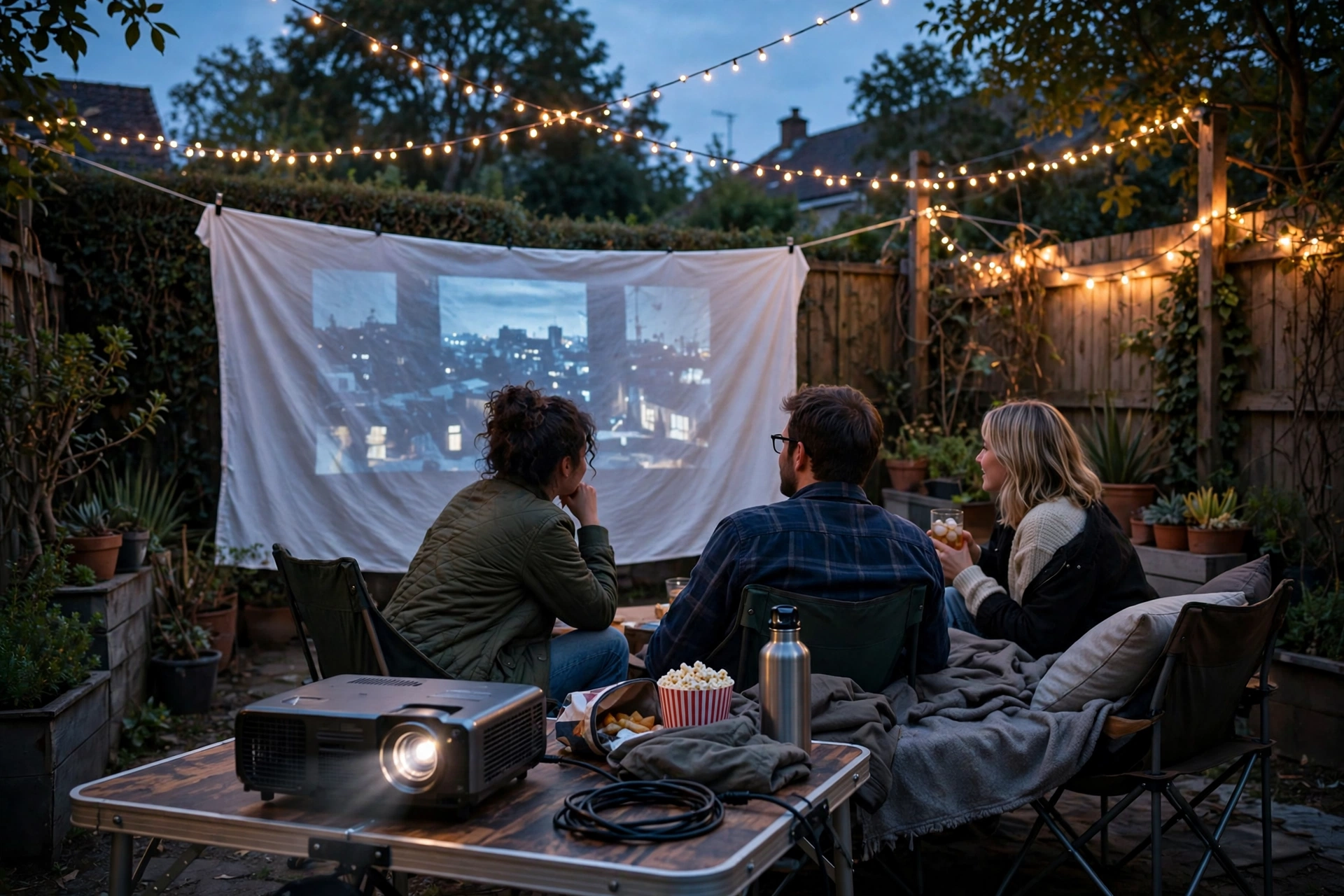
Start with the surface. A plain white or light-grey wall works well; patterned wallpaper or a glossy surface will fight the picture. A simple screen helps outdoors, where a sheet can ripple in the breeze. Keep the projector level with the centre of the picture where you can.
Next, set the distance. Check the maker’s suggested range, then place the projector so the picture fills your wall without going soft at the edges. Focus on text or fine detail, use keystone correction sparingly, and dim the lights if you can.
Frequently Asked Questions
Do I need a screen, or will a wall do?
A wall will do for most casual use, as long as it is flat, smooth, and light-coloured. A screen gives a more even surface and can improve contrast, especially outdoors or on a coloured wall, but it is not essential for a first setup.
Can a portable projector work in daylight?
It can, but the picture will look best in shade or a dimmed room. Bright daylight washes out most portable models, which are made for evening and indoor use. For daytime viewing, choose a brighter model and the darkest spot you can find.
How long does the battery last?
It varies by model and settings, but a common range is about two hours for a film at normal brightness. High brightness, loud volume, and Wi-Fi streaming shorten that time, while eco mode and a wired connection can stretch it.
Is a portable projector good for gaming?
It can be fun for casual games, especially on a big wall with friends. For fast, competitive games, check the input lag in reviews, since some portable models delay the picture more than a TV would. A wired HDMI connection usually gives the most responsive result.
What should I check before buying one?
Check brightness for your room, resolution, battery life, and the connections you will actually use. Also check whether it has the streaming apps you want, how loud its fan is, and whether you will need a separate speaker. A short test in a shop or a careful look at real-room reviews helps more than a single headline number.
Conclusion
A portable projector works by making a small image with light and an imaging chip, then enlarging it through a lens onto a wall or screen. Brightness, connection options, and setup matter as much as the technology inside, and a dark room plus a flat surface will do more for picture quality than chasing the highest number on the box.
A practical next step is to measure your viewing distance, note whether you will watch mainly indoors or outdoors, and shortlist two or three models that fit that distance and your brightness needs.
For general background, see Wikipedia’s projector overview and digital light processing.