
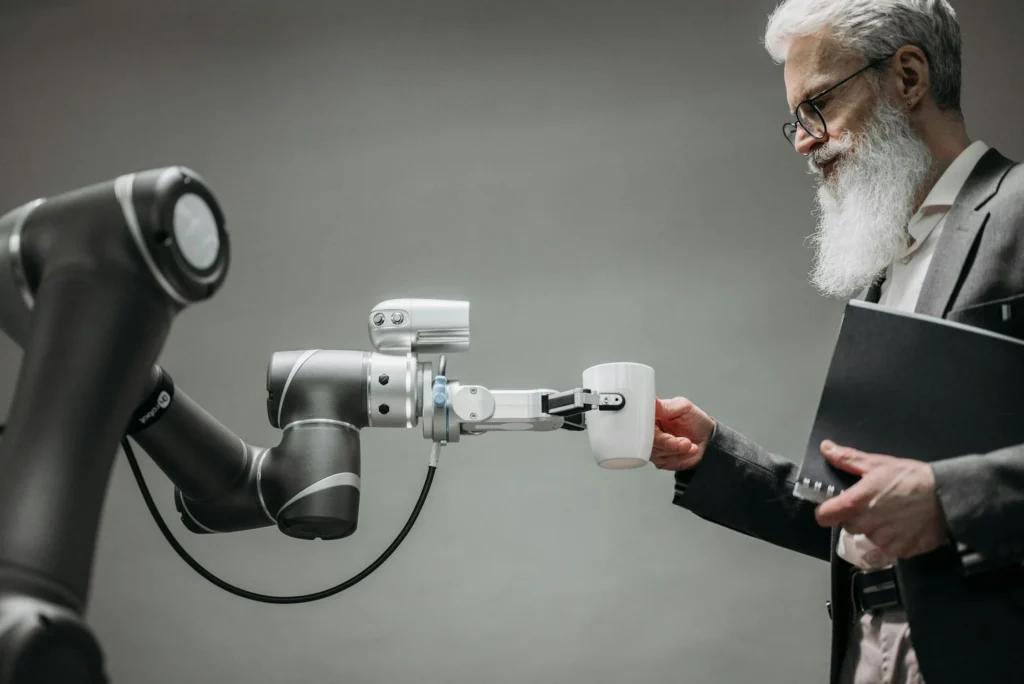
Reinforcement learning is a way for artificial intelligence to learn by trying things, seeing what happens, and adjusting. Instead of being shown the right answers in advance, the system explores, gets feedback in the form of rewards or penalties, and gradually favours the actions that lead to better outcomes. It is how some game-playing programs and robots improve with practice.
Key Takeaways
- Reinforcement learning learns from feedback, not from labelled examples alone.
- An agent takes actions in an environment and receives rewards or penalties.
- Over many attempts, it builds a policy: a strategy for choosing good actions.
- It works best where trial and error is safe, cheap, or simulated.
- It can be slow, unpredictable, and hard to control without careful design.
What Is an Agent, an Environment, and a Reward?
Think of the agent as the learner, the environment as the world it acts in, and the reward as the score that tells it how well it did. A chess-playing program is the agent, the board is the environment, and winning the game is the reward. The agent does not start out knowing the best move. It tries moves, observes the new board position, and updates its strategy based on whether the result helped or hurt. Small rewards along the way, such as capturing a piece, can guide it, but the biggest reward usually comes at the end of the game. That delay means the agent must learn which early moves set up a later win.

How Does Reinforcement Learning Actually Work?
At its core, reinforcement learning repeats a simple loop: observe, act, receive feedback, learn. The agent looks at the current state, chooses an action using its current policy, and the environment responds with a new state and a reward signal. The agent then updates its policy so that rewarding actions become more likely and unrewarding ones become less likely. Early on, the agent explores a lot, trying actions almost at random. Over time it exploits what it has learned, choosing actions that have worked before. Good systems balance the two. Too much exploration wastes time on bad moves; too much exploitation can lock the agent into a mediocre strategy before it has found something better. Training often happens in simulation, where many episodes can run quickly and mistakes cost nothing. That is why games and simulated robots are common testbeds: the agent can fail safely, reset, and try again. For a fuller technical overview, see IBM’s guide to reinforcement learning.
How Is Reinforcement Learning Different from Supervised Learning?
Supervised learning learns from examples that already carry the correct answer, such as photos labelled as cats or dogs. Reinforcement learning, by contrast, has no answer key. It only gets a signal about whether an action was good or bad, and it must work out the rest itself. That makes it suited to problems where the right answer is hard to write down in advance, such as a sequence of moves in a game or the steering decisions of a robot. The trade-off is efficiency. Supervised learning can often learn quickly from a modest dataset, while reinforcement learning may need many more attempts. It also differs from unsupervised learning, which looks for patterns in data without any feedback signal at all. Reinforcement learning is closer to learning a skill through practice than to memorising facts or spotting clusters.
Where Is Reinforcement Learning Used?
The best-known examples are games, where programs have learned to play chess, Go, and complex video games at a very high level through self-play. Robotics is another natural fit: a simulated robot arm can learn to grasp objects or walk by practising in a virtual environment before the policy is tested on real hardware. In industry, similar methods help tune systems that make repeated decisions, such as adjusting settings in a data centre to manage energy use, or choosing recommendations that keep a user engaged over time. These uses share a pattern: the task involves a sequence of decisions, feedback arrives over time, and a simulator or a controlled setting makes experimentation affordable. Where every mistake is expensive or dangerous, reinforcement learning is usually kept in simulation or paired with human oversight.

What Are the Limits of Reinforcement Learning?
Reinforcement learning is powerful but far from plug-and-play. Training can take an enormous number of attempts, which means heavy computing costs and long waits. A reward function that is slightly wrong can produce surprising behaviour: an agent may find a shortcut that earns points without actually doing the job, a problem researchers call reward hacking. The learned policy may also fail when conditions change, because it was tuned to one particular environment. Safety is another concern. An agent that explores freely in the real world could damage equipment or make poor decisions before it has learned better. For these reasons, practical deployments usually combine reinforcement learning with other techniques, constrain what the agent is allowed to try, and test it thoroughly in simulation first. It is a promising tool, not a general-purpose brain.
FAQs
What is reinforcement learning in simple terms?
It is learning by trial and error. An AI agent tries actions, gets rewards or penalties as feedback, and gradually learns a strategy that leads to better outcomes.
Does reinforcement learning need labelled data?
Not in the same way supervised learning does. It needs a reward signal and an environment to interact with, rather than a dataset of correct answers. That said, it often uses large amounts of simulated experience, which can be costly to generate.
What is the difference between exploration and exploitation?
Exploration means trying new or uncertain actions to discover what works. Exploitation means using the best actions found so far. Effective training balances both so the agent neither wanders forever nor settles too early.
Can reinforcement learning be used in the real world?
Yes, but usually with care. Most real-world use starts in simulation, then moves to controlled trials with limits on what the agent can do, precisely because unconstrained exploration can be risky or expensive.
Is reinforcement learning the same as deep learning?
No. Deep learning is a set of methods based on neural networks, while reinforcement learning is a way of learning from feedback. The two are often combined, with a neural network representing the agent’s policy, which is why you may hear the term deep reinforcement learning.
Conclusion and a Practical Next Step
Reinforcement learning shows that AI does not always need to be told the answer: sometimes it can learn by practising, failing, and improving. Its strength is in sequential decisions where feedback arrives over time, and its weakness is the cost, unpredictability, and care that training demands. If you want to understand it better, start with the machine learning and deep learning guides on this site, then look for a simple simulated example, such as a program learning to balance a pole or play a simple game. Watching the agent improve episode by episode makes the ideas of reward, exploration, and policy far more concrete than any definition alone. For a university-level introduction, see Stanford’s CS234 course on reinforcement learning.