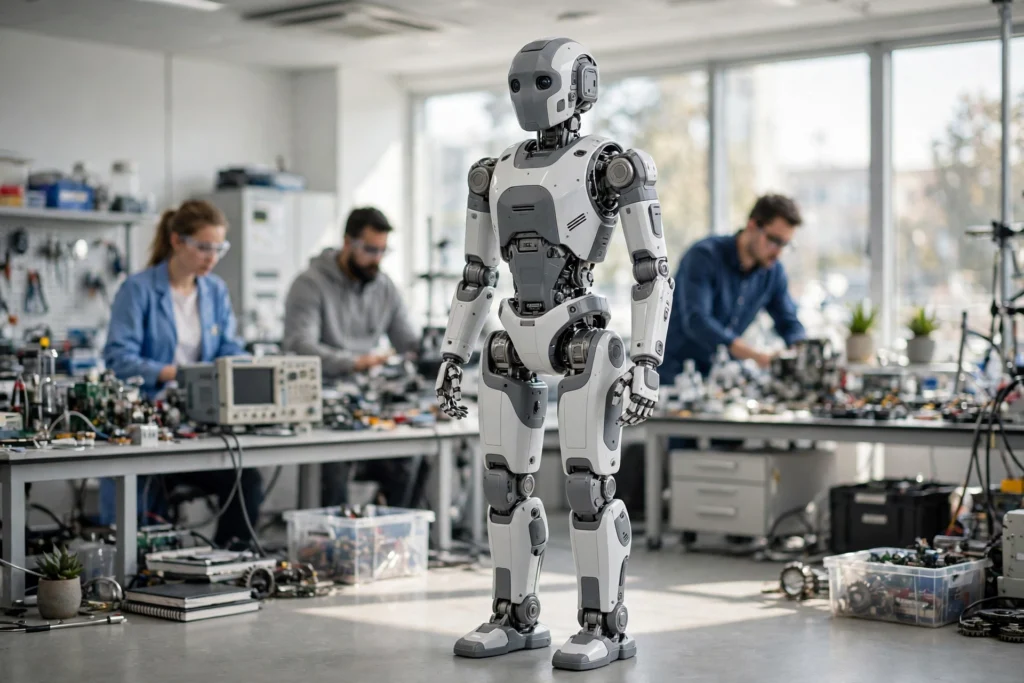
A humanoid robot works by combining a human-shaped body with sensors, motors, and software that constantly adjust its balance and movement. In short, cameras and balance sensors tell it where it is, a control system decides what to do next, and electric motors in its joints carry out that decision — many times every second.
Key Takeaways
- A humanoid robot has a torso, head, two arms, and two legs, so it can use spaces and tools made for people.
- Balance is active, not fixed: sensors and motors correct small tilts before they become falls.
- Hands are the hardest part, because they must be strong enough to lift and gentle enough not to crush.
- Most humanoids today still work best in supervised, structured settings, with people nearby to step in.
- The real test is not a single clever demo, but safe, repeatable work over a full shift.
What exactly is a humanoid robot?
A humanoid robot is a machine shaped roughly like a person. That shape is a practical choice, not just a showpiece. Doors, stairs, shelves, handles, and tools were designed for human height and reach, so a robot with a similar body can, in principle, move through the same world without rebuilding everything around it.
That does not mean every humanoid looks like a person. Some have plain faces or no face at all, and some are only an upper body on a wheeled base. The useful part is the layout: a torso to hold the computer and battery, arms to reach and hold, and legs to move. Researchers also use humanoids to study walking itself, because a machine that must stay upright faces many of the same problems a person does.
It helps to keep humanoids in perspective. A fixed factory arm is far better at repeating one precise motion all day, which is why robot arms remain the workhorse of manufacturing. A humanoid trades some of that precision for flexibility: it can walk to a different spot and pick up a different object in a room that was not built for robots.
How do humanoid robots walk without falling over?
Walking on two legs is a controlled fall, repeated. With each step, the robot shifts its weight onto one foot, swings the other foot forward, and catches itself again. While it is on one foot, it is briefly unbalanced, so timing and correction matter more than raw strength.
Three kinds of feedback keep that cycle going. Inertial sensors, often called IMUs, track tilt and rotation, a bit like the balance organs in the human inner ear. Joint sensors report the angle of each hip, knee, and ankle. Force sensors in the feet report where pressure is landing and how hard. Together, they tell the control system whether the robot’s weight is still over its supporting foot.
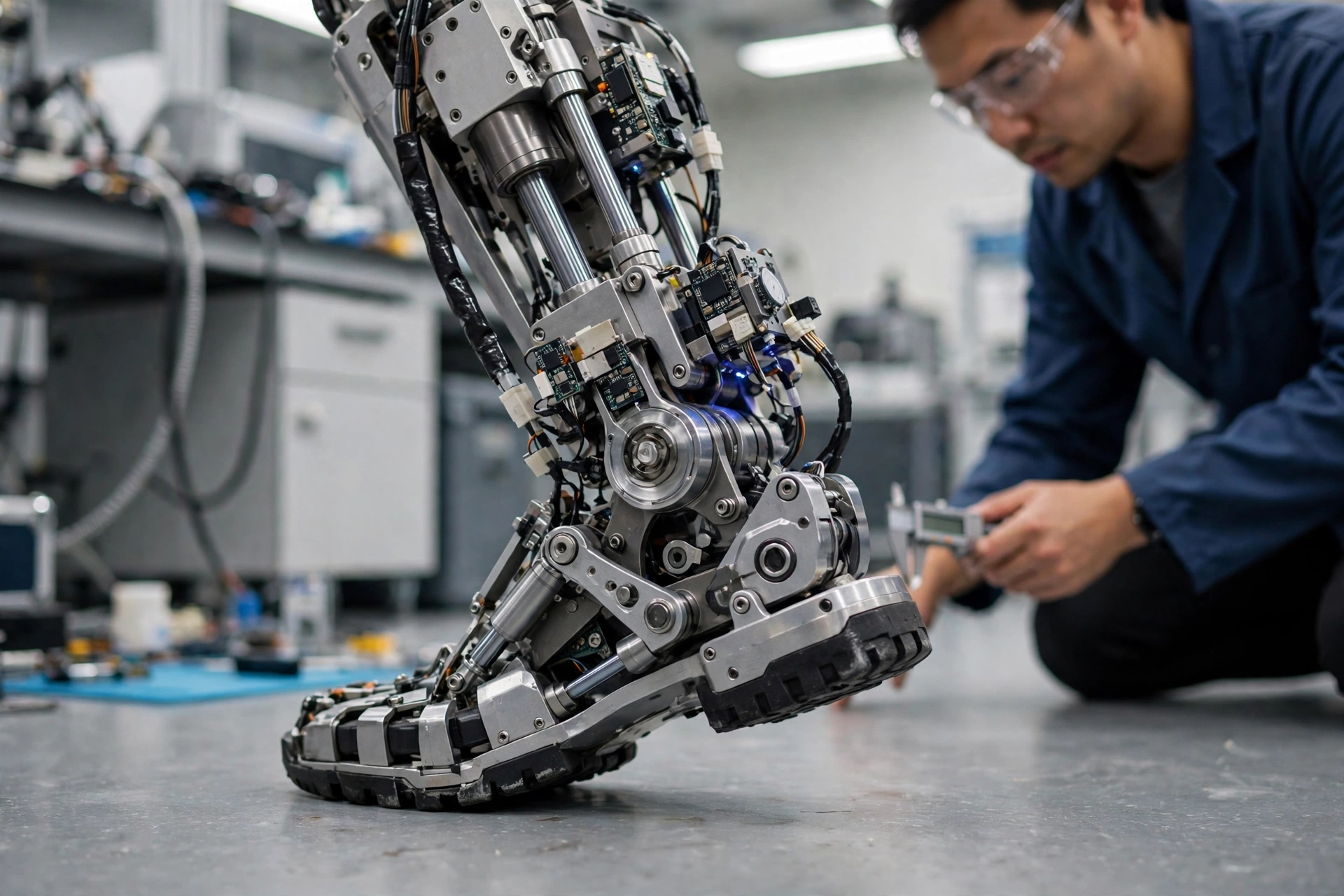
The control system then adjusts motor torque — how hard each joint pushes — to nudge the weight back toward the centre. If the floor is uneven, or someone brushes past, the correction has to happen fast, before the tilt grows. That is why humanoids often walk with slightly bent knees: the bent position leaves room to push in either direction, rather than locking a joint at its limit. A flat, clear floor helps a lot, because a rug edge, a cable, or a wet patch changes grip and timing in ways a lab floor does not.
What sensors help a humanoid robot see and feel its surroundings?
A humanoid does not rely on one sense. Cameras give it a view of the room, depth sensors help judge distance, and microphones pick up speech and nearby sounds. Those are the outward-facing senses. The inward-facing ones are just as important: joint and balance sensors tell the robot what its own body is doing, even without a clear view.
Touch matters most in the hands and feet. In the feet, pressure data shows whether a step has landed flat or on an edge. In the hands, tactile sensors show when contact has been made and how much force is being applied. Without that feedback, a robot would have to guess when it had gripped something, and guessing is how cups get dropped or crushed.
Sensor fusion is the quiet work behind all of this. It means combining several imperfect signals into one steadier picture: a camera says an object is there, a depth sensor says how far away it is, and a hand sensor confirms contact. No single sensor is trusted alone, because each can be fooled — a camera by glare, a depth sensor by a shiny surface, a touch sensor by a loose grip.
How do humanoid robot hands pick things up?
A human hand is remarkably capable, and copying it is hard. Human fingers bend in several places, sense pressure and texture, and adjust grip without much thought. A robot hand must pack motors, gears, and sensors into a much smaller space, while still being strong enough to lift a box and gentle enough to hold an egg.
Most humanoid hands use electric motors and small gearboxes to drive the fingers. The control system starts with a loose grip, then tightens only until the touch sensors report firm contact. If the object slips, the sensors notice the change and the grip tightens a little more. If the object is fragile, the force limit is set lower from the start.
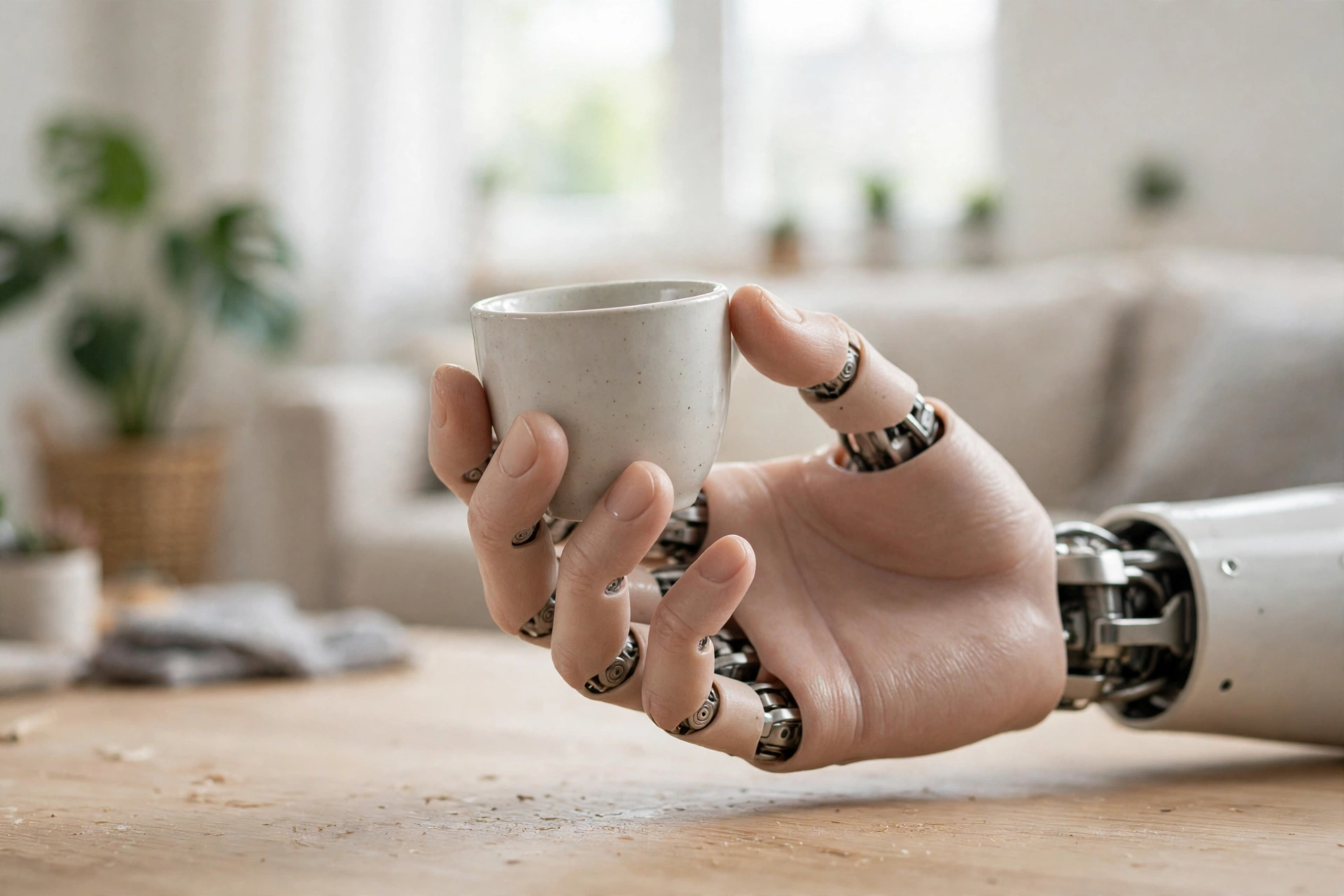
That careful approach explains why many demos look slow. The robot is not just moving; it is checking, adjusting, and re-checking. In a warehouse, that caution can be a strength. Warehouse robots that move shelves do not need delicate fingers, but a humanoid asked to sort mixed items on a table does — and a dropped item costs more time than a careful grip. Tasks like tying a knot or folding a soft shirt neatly still trip up many systems, because they need a mix of vision, touch, and judgement that is easy for a person and hard to program.
Where are humanoid robots actually used today?
Right now, the most honest answer is: in labs, test sites, and carefully chosen workplaces. Research teams use humanoids to study walking, balance, and human-robot interaction. Some companies trial them for repetitive handling jobs, such as moving totes or boxes in a warehouse, where the route is known and a person can supervise.
Homes are a longer-term goal than a current reality. A home robot that also cleans floors already exists in a different form — robot vacuums succeed because they have one job, a low body, and no need to balance on two legs. A humanoid that could tidy a whole living room would need to handle far more variation, and to do it safely around children, pets, and clutter. Public-facing roles, such as greeting visitors, are also common, because they show what the hardware can do without asking it to carry a full workload.
What still limits humanoid robots?
Battery life is a plain, practical limit. A human-sized robot that moves, senses, and thinks all at once uses a lot of power, and a heavy battery makes balance harder. Charging breaks and battery swaps are normal workarounds for now.
Safety is another limit, handled by design, not just by software. Humanoids in shared spaces usually move slowly, stop when a person gets too close, and keep their force limits low. That caution protects people, but it also caps speed and strength. Cost follows from complexity: more joints mean more motors, more sensors, and more parts that can wear out. A wheeled robot with fewer moving parts is often cheaper to run for a single task, which is why humanoids make sense only where their human shape genuinely helps — reaching shelves, using stairs, or working in a people-shaped space.
FAQs
Are humanoid robots already working in homes?
Not in the general-purpose sense. Some homes have single-purpose robots, such as vacuums, but a humanoid that can safely handle varied household chores without supervision is still largely in testing.
Why do humanoid robots walk slowly?
They walk slowly because balance corrections take time and because safety limits cap their speed near people. Faster walking needs faster sensing, stronger motors, and a much larger safety margin.
Can a humanoid robot fall and get back up?
Some can, in a controlled test, but getting up is still a hard problem. It needs strength, a clear floor, and a plan for where each limb goes. Many systems are instead designed to avoid falling, and to shut down safely if they do.
Do humanoid robots learn from experience?
Some systems improve with practice, especially in simulation, where a robot can try thousands of steps without breaking anything. That learning still needs careful real-world testing, because a move that works in simulation may fail on a real floor.
Should I buy a humanoid robot for my business?
Only after a clear trial. Start with one well-defined job, a supervised area, and a measure of success — for example, items moved per hour without damage or intervention. If the robot cannot beat a simpler wheeled or fixed-arm option on that job, the human shape alone is not a good reason to buy it.
Conclusion
Humanoid robots work by turning a human-shaped body into a feedback loop: sensors report balance and contact, software decides the next correction, and motors act on it, over and over. Walking, sensing, and gripping each look simple from the outside, but each depends on that loop running fast and safely.
If you want to follow this field without getting swept up in hype, watch for supervised trials in real workplaces, not just stage demos. Look for robots that complete the same task repeatedly, recover from small disturbances, and work safely beside people. For background on the broader field, see Britannica’s overview of robotics and Wikipedia’s guide to humanoid robots — and if you are considering one for work, start with a single, measurable job and a supervised trial, rather than a promise of general help.