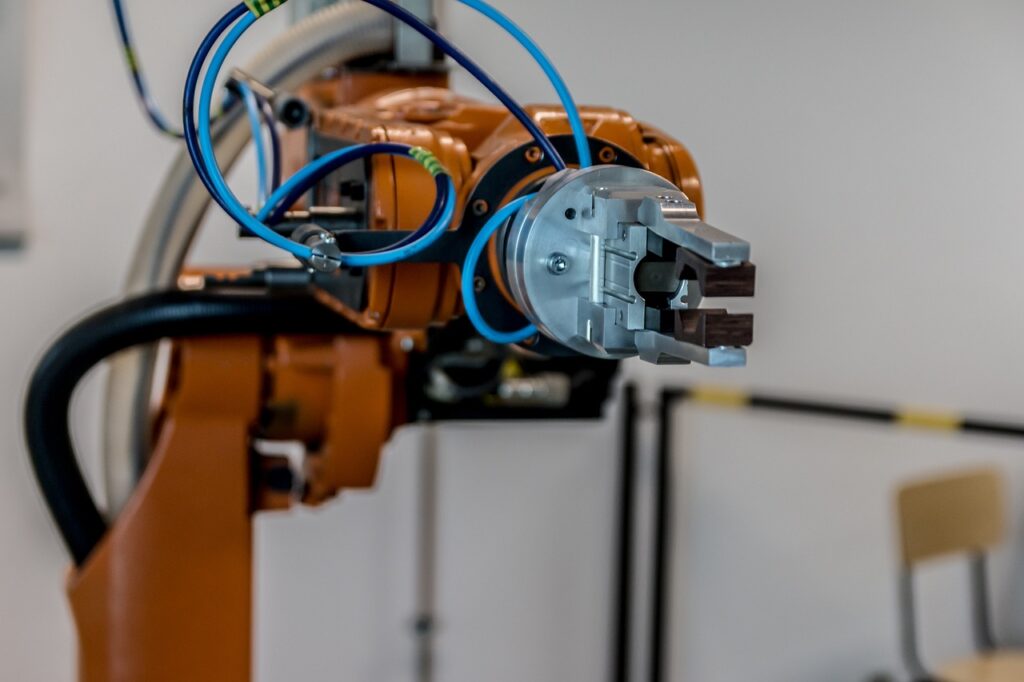
A robot arm works by moving a chain of rigid links around powered joints, much like a human arm bends at the shoulder, elbow, and wrist. Motors drive each joint, sensors report position and force, and a controller coordinates the motion so the gripper lands exactly where it should, time after time.
Key Takeaways
- A robot arm is a chain of links and joints, not one moving part.
- Motors move it, sensors give feedback, and software coordinates it.
- The gripper must suit the job: suction for flat boxes, fingers for bottles and tools.
- Robot arms shine at repetitive, well-defined tasks in a controlled space.
- Reach, payload, safety, and programming effort matter as much as speed.
What are the main parts of a robot arm?
Every robot arm shares the same basic anatomy, from a small desktop model to a large factory unit. The base anchors it to the floor, table, or rail. Links are the rigid segments between joints, usually aluminium or steel. Joints are the pivot points that let links rotate or slide. At the far end sits the end effector: the gripper, suction cup, welder, or camera that does the actual work. A typical industrial arm has six joints, enough to place its gripper at almost any angle within its reach.
How do joints and motors move the arm?
Each joint is driven by a motor, and the motor type shapes what the arm can do. Servo motors are common in smaller arms because they are compact and hold position well. Larger arms often use geared motors that trade speed for torque, the turning force needed to lift a heavy load without stalling. That gearing is deliberate: it slows the motor but multiplies its torque, which is how a modest motor can lift a car door. The controller then works out the angle each joint must reach and drives the motors in sync; if one joint lags, the gripper misses.
What do sensors actually do?
Without sensors, a robot arm would be guessing. Encoders on each joint report how far it has turned, so the controller always knows the arm’s current pose. Force and torque sensors in the wrist tell it whether it is gripping too hard, too softly, or has bumped into something unexpected. That feedback makes an arm useful and safer. In a factory, a force sensor can stop the arm on unexpected resistance; in a laboratory, it lets the arm handle a fragile vial without crushing it. Cameras can also spot a part on a conveyor and tell the arm where to pick it up. The arm does not “understand” the part; it follows measurements and rules.
How does the controller plan a movement?
Planning comes down to two questions. Forward kinematics asks: if each joint sits at these angles, where will the gripper end up? Inverse kinematics asks the more useful question: if I want the gripper here, what angles should each joint take? Most practical programming uses the second approach, then checks that the path to the target does not swing the arm through a table, wall, or person. Some arms are taught by hand: an operator guides the arm through a task once, and it records the positions. Others use code or a visual interface with drag-and-drop waypoints. Hand-teaching suits one repetitive job; coded programs suit tasks that change often.
What kinds of grippers are there, and how do you choose one?
The gripper is the part that touches the work, so it deserves real attention. Two-finger grippers open and close like a hand and suit bottles, tools, and boxes. Vacuum grippers use suction for flat, smooth items such as cardboard sheets or glass panels. Magnetic grippers pick up steel parts, while soft, flexible grippers handle fruit, baked goods, and other delicate items that would bruise under a hard grip. A vacuum cup fails on a rough surface, and a hard gripper dents soft produce, so test the gripper on the actual items, at the actual speed and weight of the job, before committing.
Where are robot arms used in everyday life?
On factory floors, arms weld car bodies, paint panels, pack boxes, and load machines that would be dull or hazardous for people to tend all shift. Hospitals use smaller arms to hold surgical instruments steady and sort samples; warehouses use them to pick items into shipping boxes. Farms are testing arms for picking fruit, although no two pieces of fruit sit in exactly the same place.
What are the limits of robot arms?
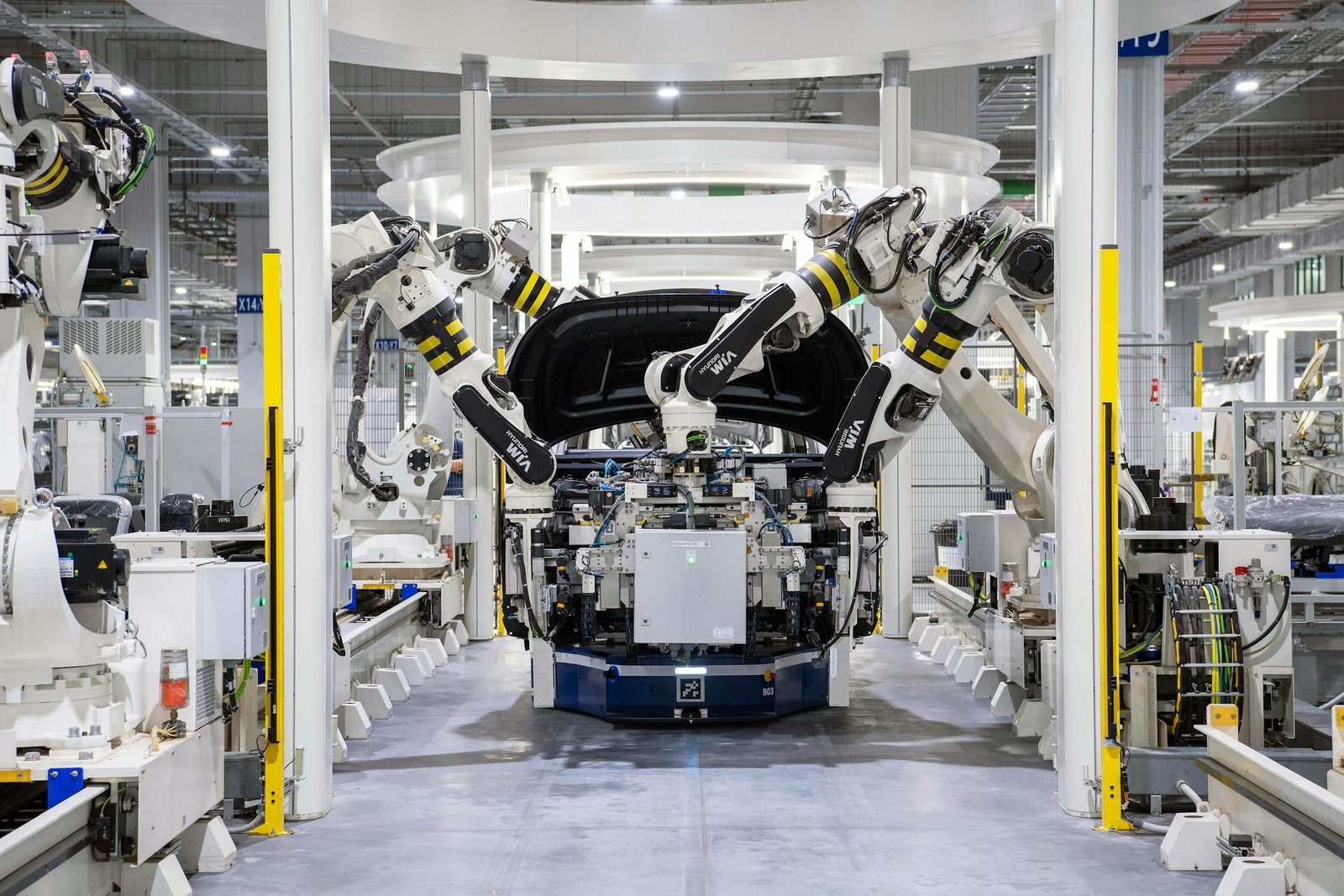
Robot arms are brilliant at repetition and poor at improvisation. Give one a tidy, predictable workspace and it will beat a person on speed and consistency. Give it a cluttered bench, mixed-up parts, and changing light, and it will struggle without extra cameras, sensors, and software — and may still need a person nearby for exceptions. Cost is another limit: grippers, safety equipment, programming, and maintenance all add up, so get a written estimate for the whole system, not just the arm. Industrial arms move fast and with real force, so they usually work behind barriers; smaller collaborative arms work near people but still need a risk assessment for the specific tool and task.
Frequently Asked Questions
How many joints does a robot arm need? Six joints are typical for industrial arms, allowing full positioning and orientation of the gripper. Simpler arms with three or four joints are cheaper and easier to program, but cannot tilt or twist the gripper as freely.
Can a robot arm work safely next to people? Some can, with limits. Collaborative arms use force sensing and rounded designs to reduce risk, and usually run slower near people. They still need a risk assessment for the specific tool and task, while fast industrial arms should stay behind barriers or monitored safety zones.
How hard is it to program a robot arm? For a simple pick-and-place task, a hand-taught or drag-and-drop program can be learned in a day or two. Complex tasks involving cameras, changing part positions, or coordination with other machines take longer and usually need programming experience.
How much weight can a robot arm lift? It varies enormously: a desktop arm may lift a few hundred grams, a typical factory arm tens of kilograms, and the largest industrial arms hundreds of kilograms. Check the payload rating at full reach, not just at the base, because lifting capacity drops as the arm extends.
Do robot arms replace human workers? They replace specific repetitive tasks more often than whole jobs. In practice, they tend to shift people toward supervising, programming, maintaining, and handling exceptions — the parts of work that need judgement and flexibility.
Conclusion
A robot arm is not magic: it is links, joints, motors, sensors, and a controller working together to put a gripper in the right place, at the right angle, again and again. That is its strength, and its limit — it excels at defined, repeatable work and leans on people for everything unpredictable. If you are considering one, start with the task, not the arm: what it must pick up, how heavy it is, how precisely it must be placed, and how often the job changes. Take that list to a supplier, ask for a whole-system estimate, and test the gripper on your real items before you buy.