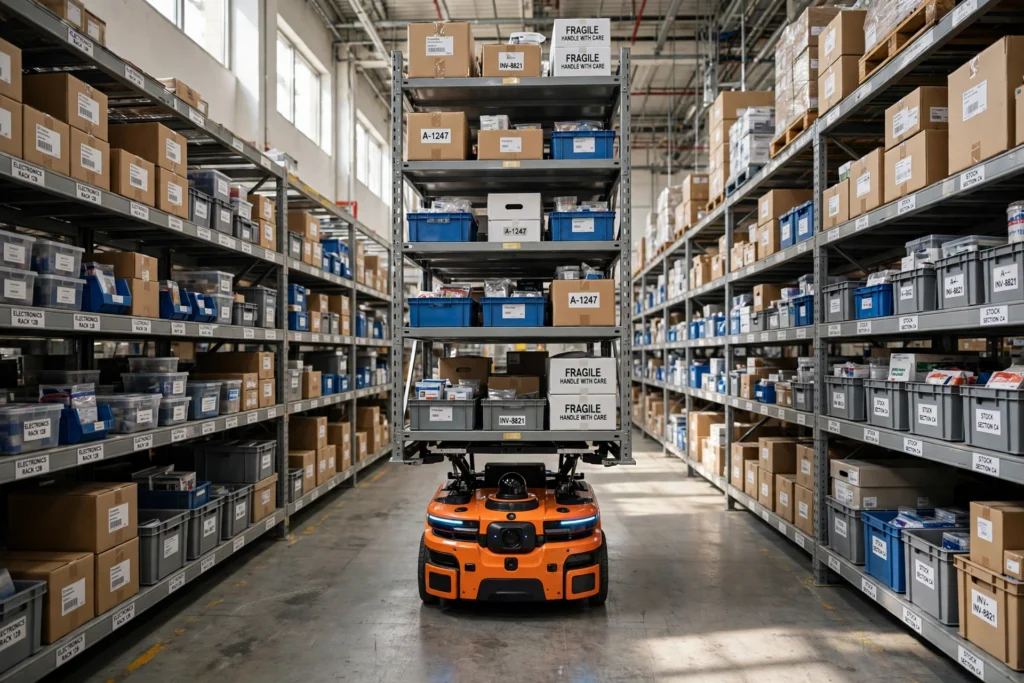
Warehouse robots are machines that move, sort, and lift goods inside a warehouse so orders can be picked and packed faster and with less heavy lifting for people. They follow instructions from warehouse software, sense what’s around them, and work alongside staff rather than replacing the whole warehouse.
Key Takeaways
- Warehouse robots mainly move goods, sort parcels, and bring shelves or bins to people.
- They navigate with maps, cameras, sensors, and floor markers instead of wandering freely.
- Mobile robots, fixed arms, and conveyor systems usually handle different jobs.
- Safety comes from slow speeds near people, sensors, marked lanes, and clear rules.
- Robots still need people for tricky items, checks, maintenance, and decisions.
What does a warehouse robot actually do?
Think of a warehouse as a very large, very organised storeroom. Goods arrive, they are stored, and later they are picked, packed, and sent out. A robot fits into one of those steps. It doesn’t usually do everything.
Some robots carry shelves or bins. Others pick items off a belt. Some lift heavy pallets. The common thread is repetition: the same trip, lift, and sort, again and again. That frees people for work needing judgement, like checking a damaged box or solving a problem when a label won’t scan.
For a broader grounding, see our guide to what robotics covers as a field. What Is Robotics?
How do warehouse robots find their way around?
A warehouse robot doesn’t just guess where to go. Before it starts work, it usually has a map of the building: where the aisles are, where the shelves sit, and where people are allowed to walk. Some robots follow lines or codes on the floor. Others scan walls, racks, and markers with cameras and laser sensors, then match what they see to that map.
As they move, they keep checking. Wheel sensors estimate distance travelled. Cameras read shelf labels and floor codes. Laser scanners watch for obstacles. If a pallet has been left in an aisle, or a person steps into the path, the robot slows down or stops. It may wait, or plan a different route around the blockage.
You can read more about that control layer in our look at control systems in robotics. Control Systems in Robotics and Automation
How do robots pick up and move goods?
There are two main styles, and many warehouses use both.
The first is the mobile robot. A flat, low robot drives under a shelf or rack, lifts it slightly, and carries the whole shelf to a picking station. The person at the station takes the item they need, and the robot returns the shelf. This is sometimes called “goods to person” because the goods come to the worker, instead of the worker walking miles of aisles.
The second is the fixed robot arm. It stands beside a conveyor belt, picks up a parcel, and puts it in the right bin, box, or pallet. Grippers vary: suction cups for flat boxes, two fingers for small items, and a wider clamp for heavier cartons. A camera often checks the parcel’s label first, so the arm knows which bin it belongs in.
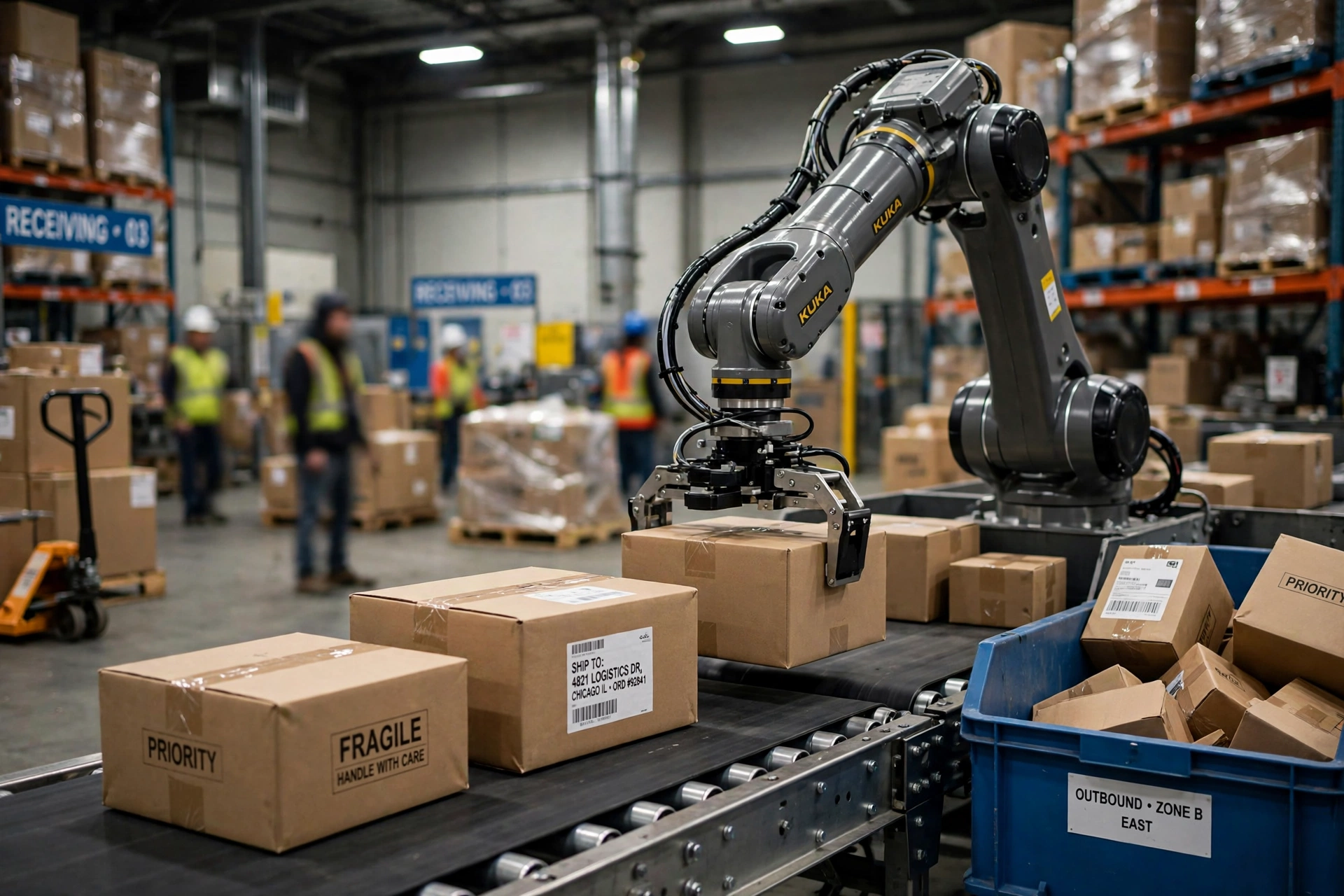
Both styles depend on the same basics covered in our guide to robot arms: joints, motors, and a gripper that matches the job. How Do Robot Arms Work?
What kinds of warehouse robots are there?
- Autonomous mobile robots (AMRs): Drive themselves around the floor, carrying shelves, bins, or totes, and can usually reroute around obstacles.
- Automated guided vehicles (AGVs): Follow a fixed path, often marked by tape, magnets, or wires in the floor. Simpler and very predictable.
- Sorting and picking arms: Fixed arms that sort parcels, place items in bins, or build pallets at a station.
- Pallet and forklift robots: Larger machines that move pallets between receiving, storage, and shipping areas.
- Conveyor and shuttle systems: Move goods along tracks or belts, often working together with mobile robots at each end.
Industrial settings have used similar machines for years, as our industrial robotics overview explains. Industrial Robotics Technology
How do robots and people work safely together?
Safety in a robot warehouse is mostly about separation, speed, and signals — not about trusting a single sensor.
First, speeds drop near people. A robot that moves briskly down an empty aisle will crawl when someone is nearby. Second, sensors act as a second pair of eyes: laser scanners, cameras, and bump sensors tell the robot to stop if something unexpected appears. Third, the floor itself communicates. Painted lanes, crossings, and keep-clear zones show people where robots travel.
There are also rules that have nothing to do with technology. Staff are trained not to step in front of a moving robot, not to reach into a robot’s work area while it’s running, and to use lockout procedures before maintenance. When a robot is being repaired, it should be switched off and isolated so it can’t suddenly restart.
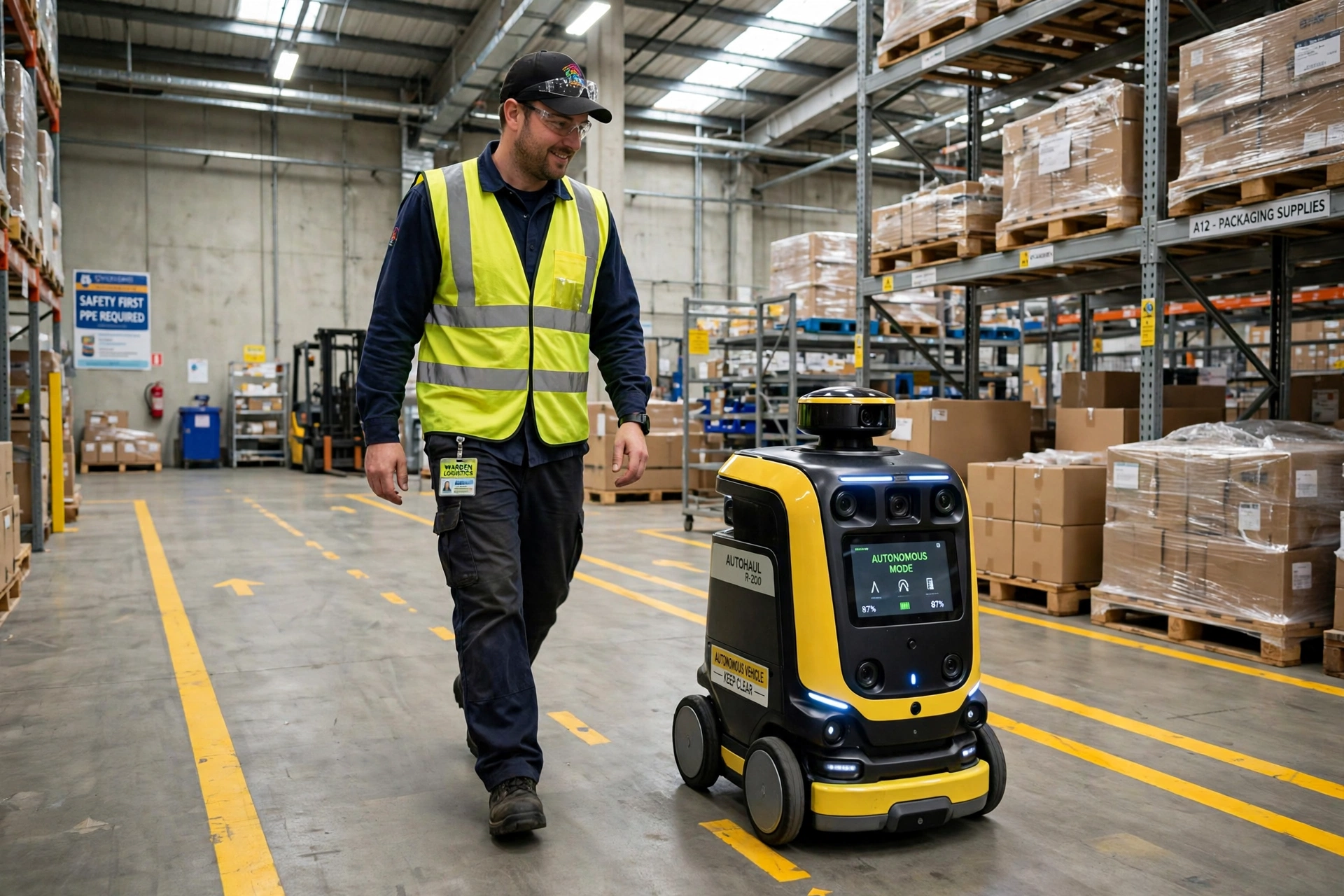
These practices match the general safety ideas for industrial robots, including machine guarding and lockout/tagout, discussed in warehouse safety guidance.
What are the limits of warehouse robots?
Warehouse robots are good at structured, repeated work. They struggle with crushed boxes, loose items, products with no barcode, or untidy shelves. They also need investment in racking, software, floor markings, and training. So they don’t suit every warehouse: the right question is “which specific, repeated job would a robot do well here?”
Frequently Asked Questions
Do warehouse robots replace all warehouse workers?
No. They usually take over walking, lifting, and sorting. People still pick tricky items, check quality, handle exceptions, pack fragile goods, and maintain machines.
How do warehouse robots know where a product is?
Warehouse software records which shelf or bin holds each product. The robot navigates to that location using its map and sensors, and a scanner confirms the right label before it moves anything.
Are warehouse robots safe to work near?
Yes, when rules are followed: slow speeds near people, sensors that stop the robot, marked lanes, and lockout procedures for maintenance. Risk rises when lanes are blocked or safety stops are bypassed.
Can small warehouses use robots?
Yes, in a limited way — for example, a conveyor, a sorting arm, or a couple of mobile robots for its most repeated job, rather than automating everything at once.
What happens if a robot breaks down?
Usually, other robots pick up the work, or the job goes to a manual station until the fault is fixed. Spare capacity and regular maintenance mean one broken robot rarely stops the whole building.
A practical next step
If you’re curious about warehouse robots, start by watching one job, not the whole warehouse. Pick a repeated task — moving bins, sorting parcels, or carrying shelves — and ask: is it heavy, repetitive, and always in the same place? If the answer is yes, that’s the kind of job a warehouse robot handles well.
Then check the basics around it: clear lanes, readable labels, and safe crossing places for people and robots.
For background on the field itself, Britannica’s overview of robotics explains how robots sense, move, and make simple decisions.