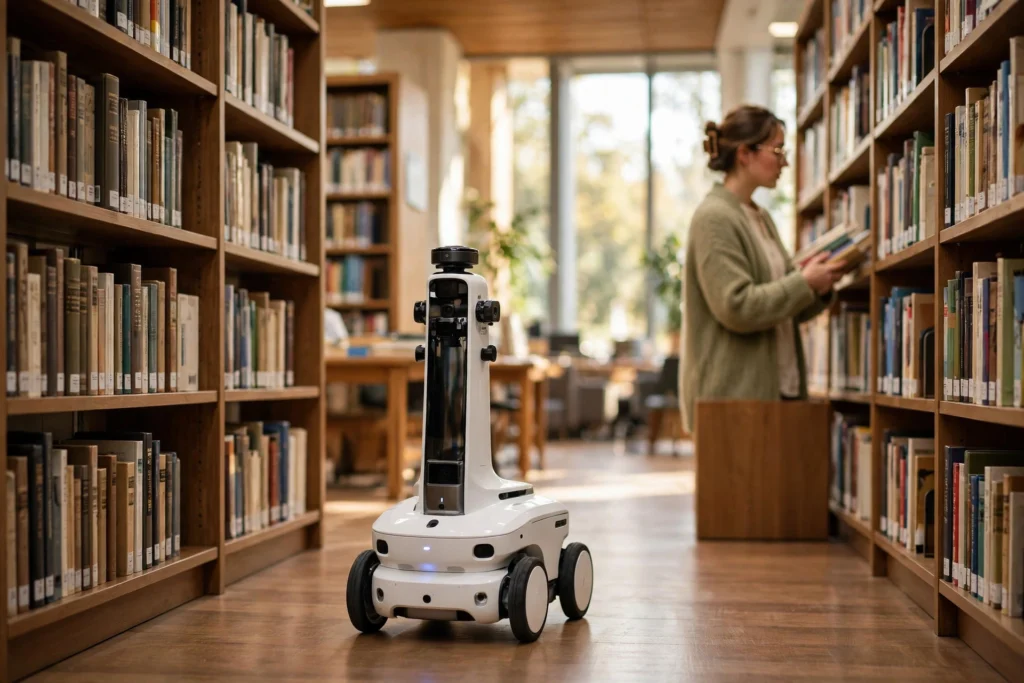
Library robots work by combining maps, sensors, and small grippers or scanners to handle the repetitive jobs in a library: sorting returned books, checking that shelves are in order, and fetching items from storage. They don’t replace librarians. They take over the heavy carrying and checking so staff have more time for readers.
Key Takeaways
- Library robots sort returns, scan shelves, fetch stored books, and carry items between floors.
- Each book carries an RFID tag or barcode, so the robot always knows which item it holds.
- Shelf-scanning robots patrol after hours to find misplaced or missing books.
- Most library robots move slowly, stop for people, and work alongside staff.
- The aim is steadier shelves and faster service, not a library without people.
What do library robots actually do?
A library robot is built for one corner of library work. Some sort the books that come back through the return slot. Others drive along the shelves at night and check that every book sits in the right place. A third kind works in closed storage, fetching a requested book and bringing it to the desk. What they share is a simple idea: a library holds thousands of items that look alike, so a robot needs a reliable way to tell them apart. Most modern libraries stick a tiny RFID tag or a barcode inside each book, and scanners read it without anyone opening the cover. Once a robot can identify a book, it can sort it, find it, or count it. The machines borrow ideas from robotics more broadly, and our guide to robots in general explains the shared parts: sensors, motors, software, and a map of the space they work in.
How does a library robot find a book?
It starts with the catalogue. When you search for a title and place a hold, the library system knows the book’s call number, which shelf it should sit on, and whether it is on loan or in storage. The robot gets that same information as a task: find this item, at this location.
For books on open shelves, the robot navigates with a map built when the system is first set up. It follows the aisles with wheels, cameras, and distance sensors, much like the way robot vacuums map a living room, only on a bigger scale. As it moves, it reads the RFID tags on the spines, so it can confirm each book is where it belongs — or flag it if it isn’t. For books in closed storage, a robotic crane travels along tracks between tall racks, pulls out the bin holding the requested book, and delivers it to a desk.
How do library robots sort returned books?
Returns are where most library robots earn their keep. When you drop a book into a return slot, the system scans its tag and checks it back in. Then the book rides a conveyor to a sorting machine, which reads the tag again and routes the book into the right bin — fiction here, children’s books there, large print in another. A robot arm or a set of flaps and diverters does the physical moving.
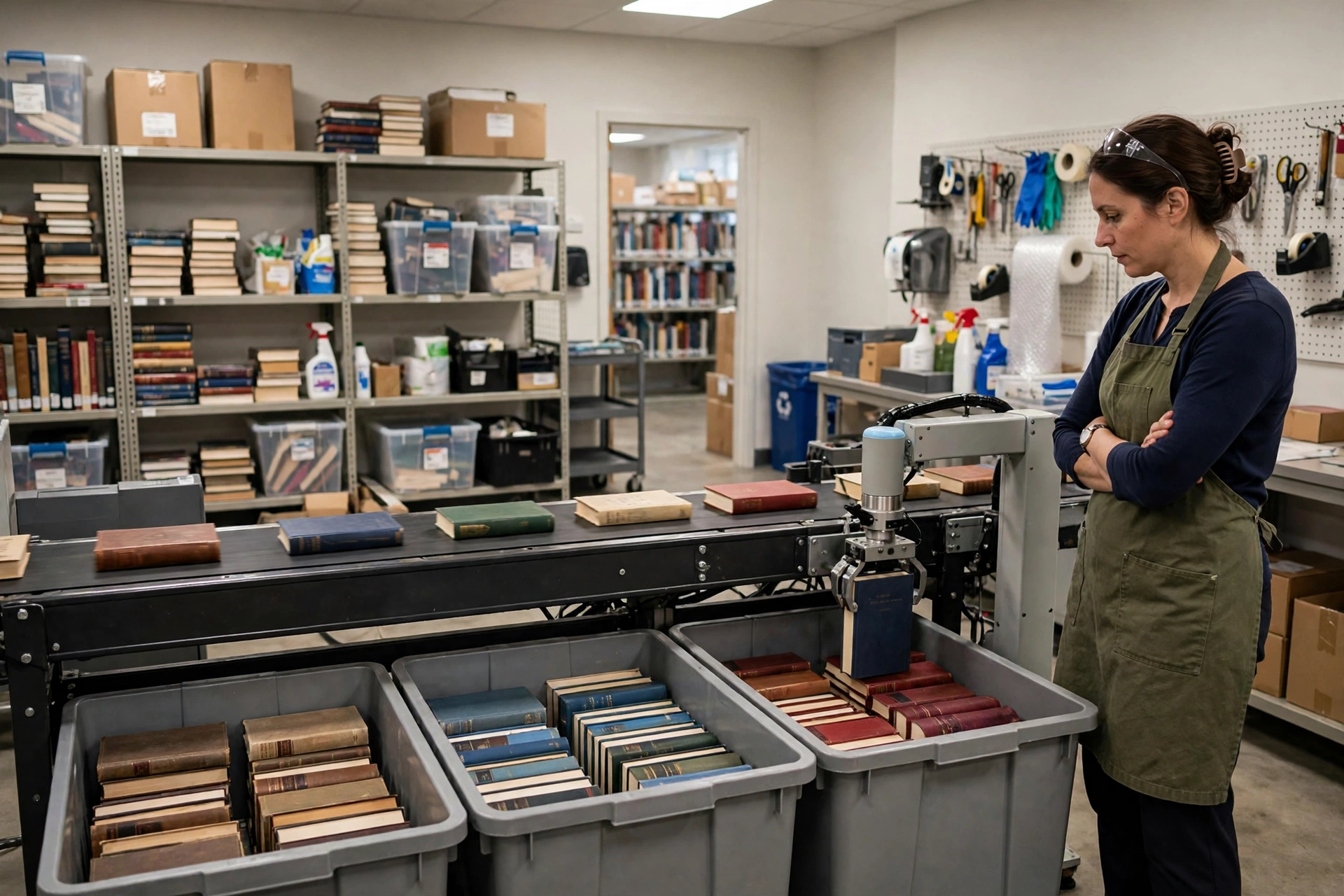
Sorting by hand is slow, repetitive work. A busy library can take in thousands of returns a day, and every one has to be checked in, sorted, and carried back to a shelf before it can be borrowed again. The robot does the sorting in minutes, and staff pick up the filled bins and reshelve them. Helsinki’s Oodi library runs a sorting line like this, with machine vision and a collaborative robot arm handling returned items.
How do shelf-scanning robots check the shelves?
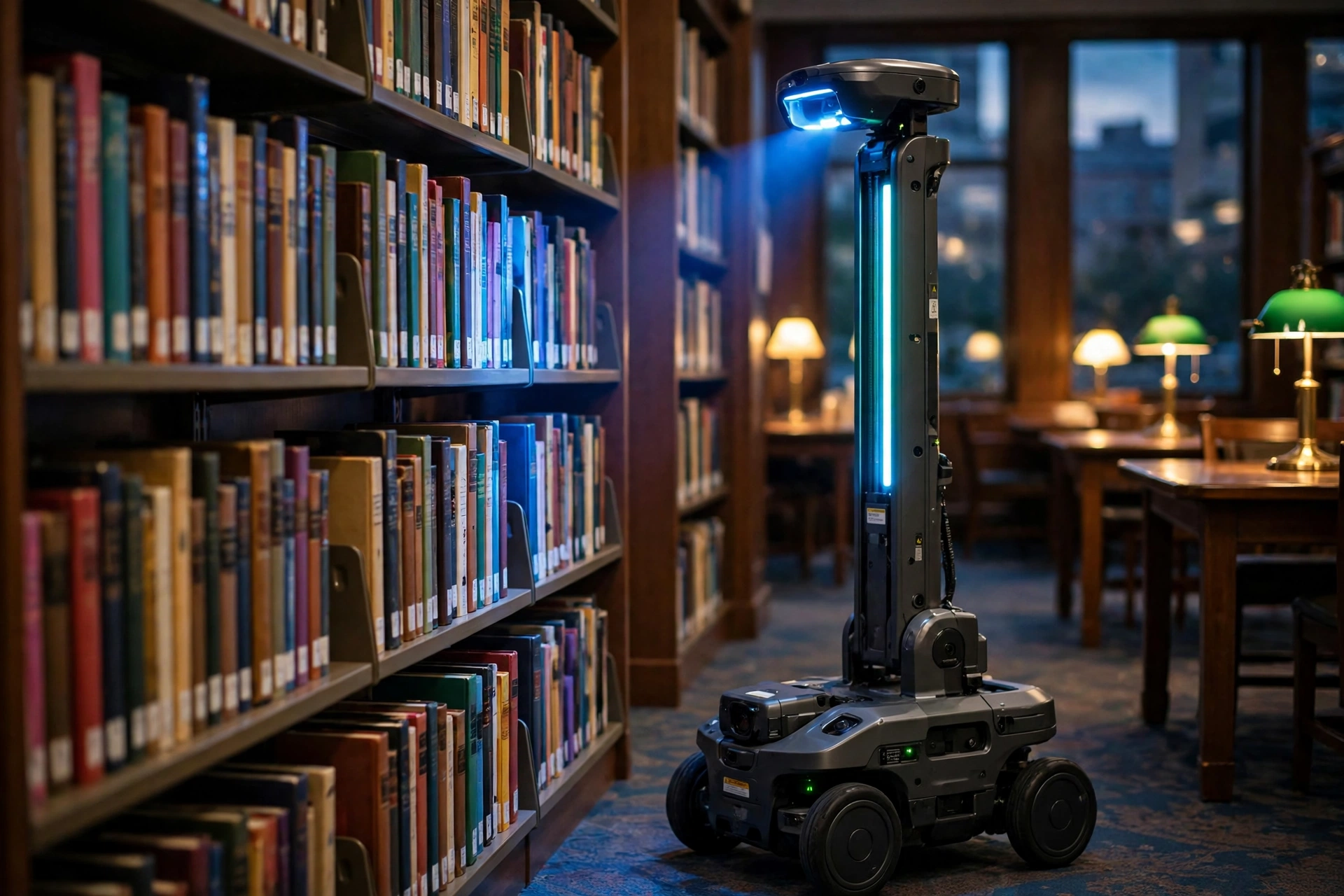
Shelves drift out of order. Readers pull a book out, glance at it, and slide it back one slot along. Multiply that by hundreds of visitors a day and the catalogue slowly stops matching reality. A shelf-scanning robot fixes this by doing a stocktake while the library is quiet.
These robots are usually tall, narrow machines with a scanner mast that runs the full height of a shelf. They glide down each aisle after closing time, reading the RFID tags on every spine. The software compares what it sees against the catalogue: this book is in the right place, that one is two shelves too high, and this one is missing entirely. By morning, staff get a list of misplaced and missing items.
How do library robots move safely around people?
Libraries are public spaces, so safety shapes every design choice. Library robots move slowly — usually at a walking pace or less — and they are packed with sensors that watch for people, bags, prams, and chair legs. If something steps into their path, they stop and wait. Many also play a soft sound or show a light so people notice them coming.
They also keep to predictable routes. A sorting robot stays in the workroom, a shelf scanner works after hours, and a delivery robot follows the same corridor every time. Staff can take control or press a stop button, and the robot halts on the spot. It is the same careful approach used by warehouse robots, adapted for a building full of readers instead of pallets.
What are the limits of library robots?
Library robots are good at repetitive, well-defined jobs, and they struggle with anything that needs judgement. A robot can sort a book by its tag, but it can’t tell that a damaged spine needs repair, or that a reader is looking for something they can’t quite describe. It can scan a shelf, but it can’t reach into a tightly packed row and pull a book out without disturbing its neighbours — most shelf scanners only look, they don’t touch.
Cost is another limit. The machines, the tags, the software, and the staff training all add up, which is why the biggest systems sit in large city and university libraries rather than small branches.
Frequently Asked Questions
Do library robots replace librarians?
No. They handle repetitive tasks like sorting returns and scanning shelves, while librarians keep doing the work that needs people: helping readers, choosing stock, and running events.
How does a library robot know which book is which?
Each book carries an RFID tag or barcode with its identity. Scanners read the tag without opening the book, and the library system matches it to the catalogue record.
Can a library robot put books back on the shelf?
Most can’t, or not well. Sorting and scanning are common, but placing a book neatly between others on a crowded shelf is still a hard gripping problem, so staff usually do the final reshelving.
Do library robots work while the library is open?
Sorting and delivery robots often do, moving slowly among visitors. Shelf-scanning robots usually work after hours, when the aisles are empty and they can move freely.
Are library robots used in many libraries?
They are growing in number, especially in large public and university libraries. Smaller libraries often use only part of the system, such as RFID self-checkout and an automatic sorter.
Conclusion
Library robots are quiet helpers, not showpieces. They sort the returns, check the shelves, fetch the stored books, and carry the heavy bins — the jobs that wear staff out and slow readers down. The next time you return a book and find it back on the shelf the same day, there is a good chance a robot helped it get there.
If your local library has one, ask a librarian what it does. Most are happy to show you the sorting room or the shelf scanner, and seeing the machine at work makes the whole system click.