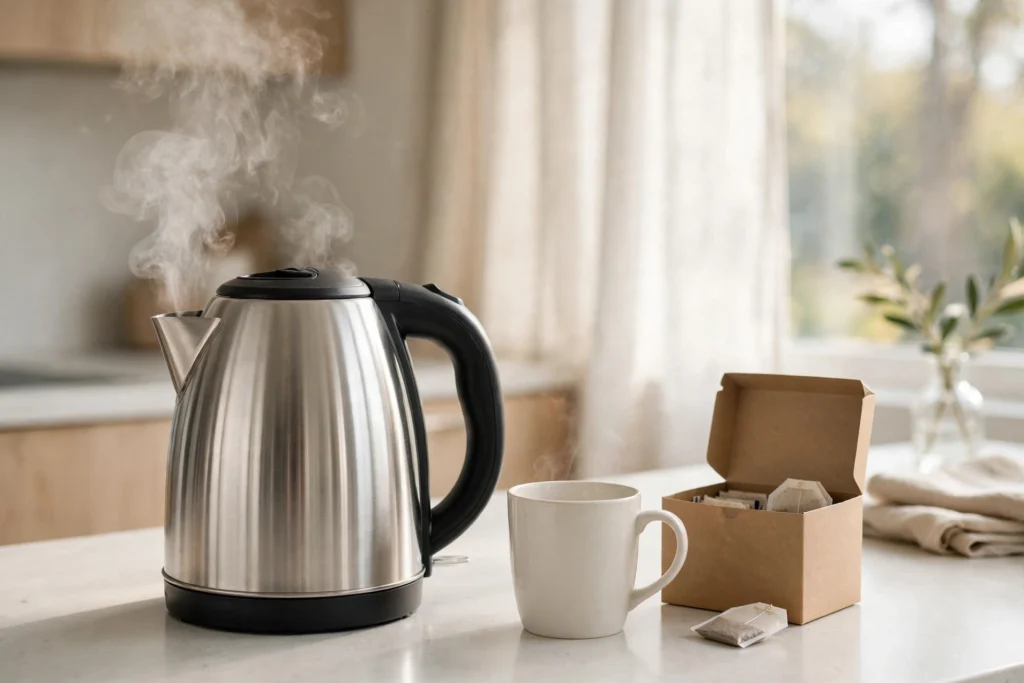
An electric kettle works by passing electricity through a high-resistance heating element, which turns electrical energy into heat and warms the water directly. When the water reaches a rolling boil, steam triggers a thermostat that switches the kettle off on its own. The whole job takes just a few minutes, with no hob or flame involved.
Key Takeaways
- A heating element made from a high-resistance alloy turns electricity into heat, warming the water from below.
- Most modern kettles hide the element under a flat metal plate, easier to clean than an exposed coil.
- A bimetallic thermostat senses the steam from boiling water and clicks the kettle off automatically.
- Boil-dry protection is a second cut-out that trips if the kettle is switched on with too little water.
- Descaling now and then keeps a kettle fast and quiet.
What happens inside an electric kettle when you switch it on?
Fill it, set it on its base, and flick the switch. That closes a circuit, and mains electricity flows into the heating element. The element gets hot very quickly, and because it touches the water directly — or sits just beneath a metal plate that does — heat passes straight into the liquid.
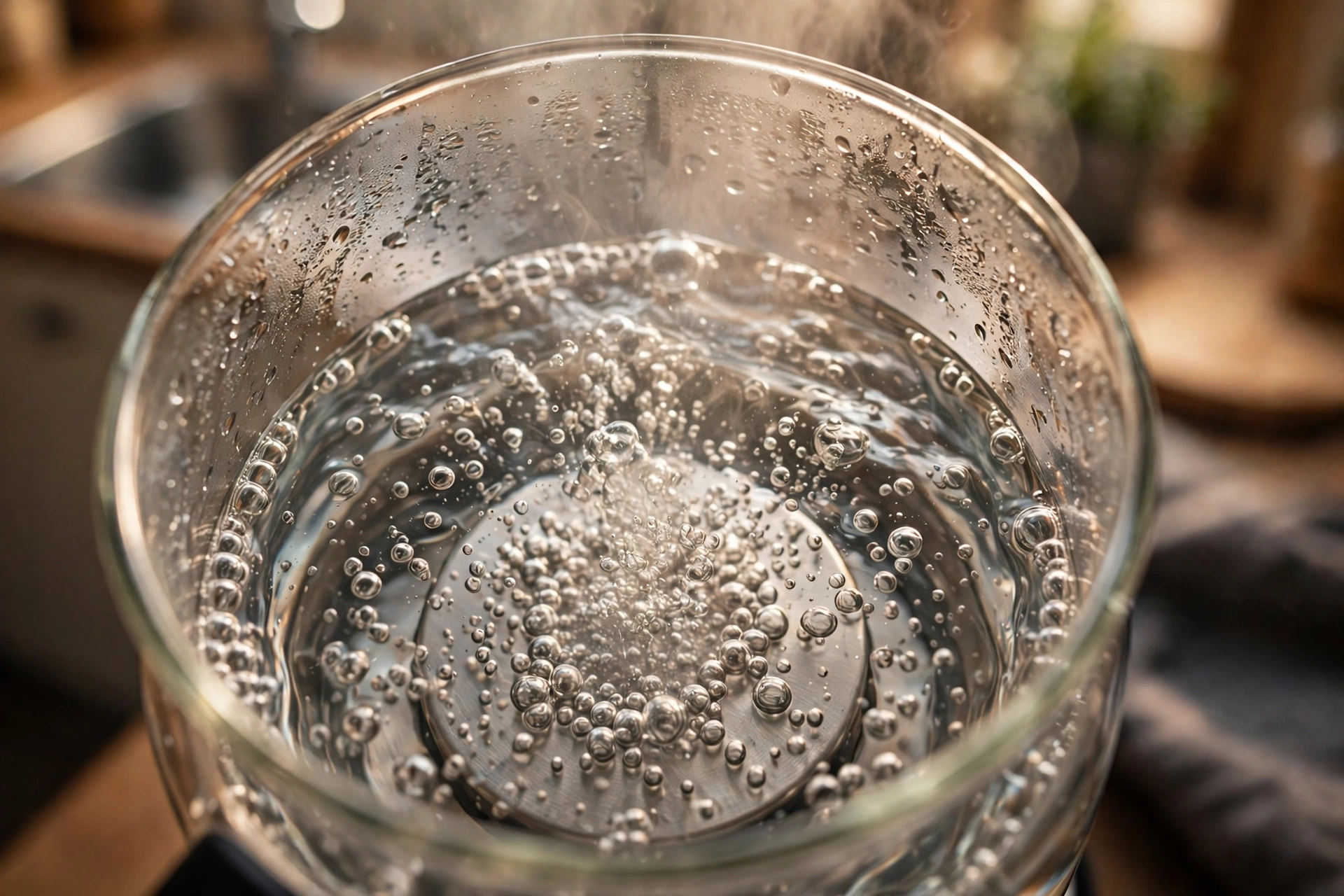
As the water warms, convection currents do the work. Hot water rises from the bottom, cooler water sinks, and the whole jug heats evenly without stirring. Tiny bubbles form on the element first, then larger ones, and finally a rolling boil rattles the lid.
How does the heating element actually make heat?
The trick is resistance: when electricity flows through a wire, the wire resists it, and that resistance turns electrical energy into heat. Kettle elements use nichrome, a nickel-chromium alloy with high resistance that survives being heated and cooled thousands of times.
Older kettles had a bare coil sitting in the water. Most sold today use a concealed element instead — the nichrome wire packed inside a metal sheath under a flat steel plate at the base, which heats the water above it.
Concealed elements are easier to wipe clean, there’s no coil for limescale to cake onto, and you can boil a single mug’s worth because the plate is covered by less water. Most electric kettles are rated at around 2 to 3 kW — far more power than a phone charger or a power bank draws — which is why they boil water so much faster than a pan on the hob.
How does a kettle know when the water has boiled?
This is the cleverest part, and it’s almost entirely mechanical. Inside the base sits a thermostat built around a bimetallic strip — two thin strips of different metals, usually brass and steel, bonded together. Heated, each metal expands at a different rate, so the strip bends.
As the water boils, steam builds up inside the jug. A narrow channel, often hidden inside the handle, guides some of that steam down to the thermostat. The strip bends sharply, then snaps, pushing a lever that trips the switch and cuts power to the element. You hear it as the familiar click.
The first fully automatic kettle to use this idea was the Russell Hobbs K1, launched in 1955, and the basic design has barely changed since. It works even where water boils below 100°C, because the thermostat reacts to steam rather than to one fixed temperature — more on that history on Wikipedia’s electric kettle page, and the Morphy Richards kettle guide walks through the mechanism.
Some newer kettles do the same job electronically, with a temperature sensor and a small microcontroller cutting power at a set reading — that’s how variable-temperature kettles hold water at 80°C for green tea or 96°C for coffee.
There’s also a backup. Boil-dry protection is a second thermostat close to the element itself, and it trips if the element gets far hotter than it should — usually because someone switched the kettle on empty. It doesn’t make running a kettle dry harmless: repeated dry boiling stresses the element and the seals. Glance at the water window before you switch on, and keep the level between the minimum and maximum marks.
Why is my kettle slow, noisy, or switching off early?
Nine times out of ten, the answer is limescale. In hard-water areas, minerals settle on the element plate as a chalky crust that insulates it, so the kettle heats slowly and rattles. Heavy scale can also disturb the steam path and trip the thermostat early.
Descaling fixes it: fill the kettle with water and white vinegar or citric acid, boil it, leave it to sit, then rinse well. Monthly in a hard-water area is about right; every few months elsewhere. The same build-up affects other appliances too — a washing machine faces the same problem on a bigger scale.
Other causes are simpler. Overfilling past the maximum mark can push water into the steam channel, and a loose lid lets steam escape instead of reaching the thermostat. If the kettle is very old, the bimetallic strip can lose its snap, in which case a replacement is usually the sensible answer.
How to look after your kettle
A kettle asks for very little. Don’t overfill it, and don’t boil more water than you need — reheating the same water wastes energy and concentrates minerals. Descale at the first white film, wipe the outside with a damp cloth, keep the base dry, and never immerse it in water. Like an air fryer, a kettle earns its place by doing one kitchen job properly.
FAQs
How long should an electric kettle take to boil?
It depends on how much water is inside and the kettle’s wattage, but a litre in a typical 2 to 3 kW kettle takes a few minutes. A single mug’s worth is noticeably quicker than a full jug, so only heat what you’ll use.
Why does my kettle click off before the water boils?
Limescale is the usual suspect: it can block the steam channel or insulate the element. Try descaling first, and check the lid is seated properly and you haven’t overfilled past the maximum mark.
Can I boil milk or soup in an electric kettle?
It’s best not to. Kettles are designed for water. Milk scalds and sticks to the element plate, and anything thicker can trip the thermostat at the wrong moment. A microwave oven handles reheating soup far better.
Does a kettle use a lot of electricity?
It draws a lot of power while it’s on, but only for a few minutes, so each boil costs very little. Boiling just the water you need keeps that cost down.
Conclusion
An electric kettle is a small masterclass in simple engineering: an element turns electricity into heat, convection spreads it through the water, and a bimetallic thermostat listens for the steam that says the job is done.
If your kettle has been getting slower or noisier, descale it this week — it takes ten minutes and a splash of vinegar. And if you’re shopping for a replacement, check the wattage, look for a concealed element, and make sure the water window is easy to read.