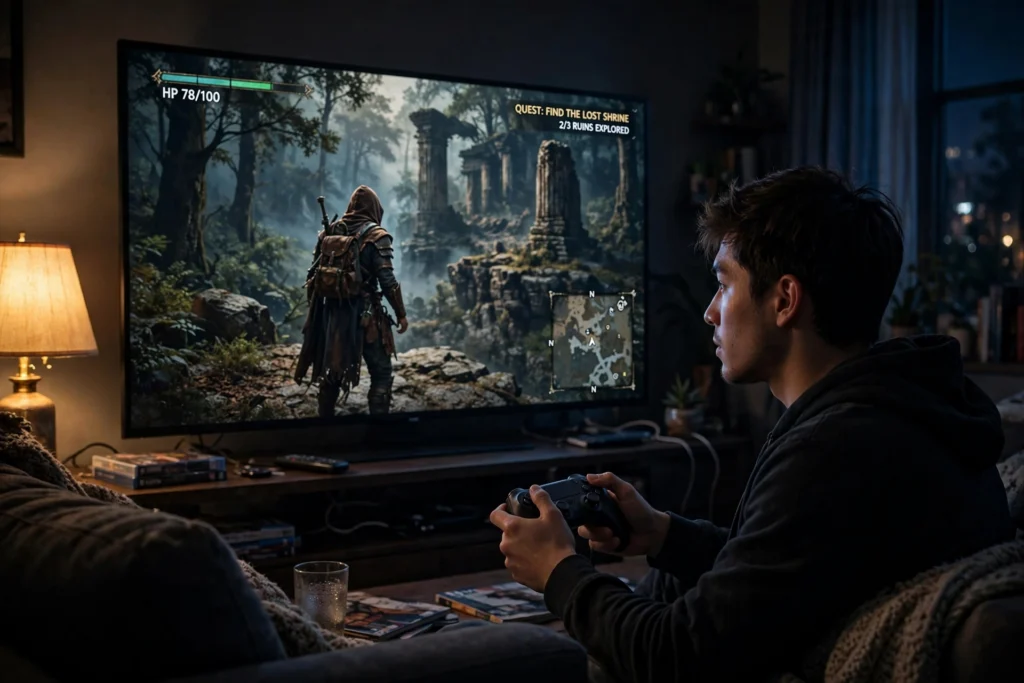
AI in gaming is the set of techniques that lets video games react to you: enemies that flank instead of charging in a straight line, shopkeepers who remember what you bought, and whole landscapes built by algorithms instead of placed by hand. It runs from simple decision trees to language models that let characters hold conversations nobody scripted in advance.
Key Takeaways
- Most game AI is still hand-designed rules: state machines and behaviour trees that tell characters when to patrol, chase, or retreat.
- Procedural generation builds levels and terrain from rules and a random seed, so no two playthroughs look quite the same.
- Dynamic difficulty watches how you play and quietly adjusts the challenge to keep it fair.
- Generative AI characters can improvise dialogue, but designers keep tight guardrails around them.
- Behind the scenes, AI also playtests games, hunts bugs, and animates crowds.
How do NPCs decide what to do?
Every non-player character is answering the same question, several times a second: given what I can see and what my job is, what should I do next? The oldest answer is a finite state machine, a short list of modes with rules for switching between them. A guard might patrol, investigate a noise, chase the player, then return to patrol.
Behaviour trees go further, organising decisions into branches so a character can weigh options: heal a teammate, take cover, or reload. Utility AI scores every possible action and picks the best one, which feels less robotic — an enemy that retreats when outnumbered instead of fighting to the last hit point. Pathfinding then finds the route around walls and fences.
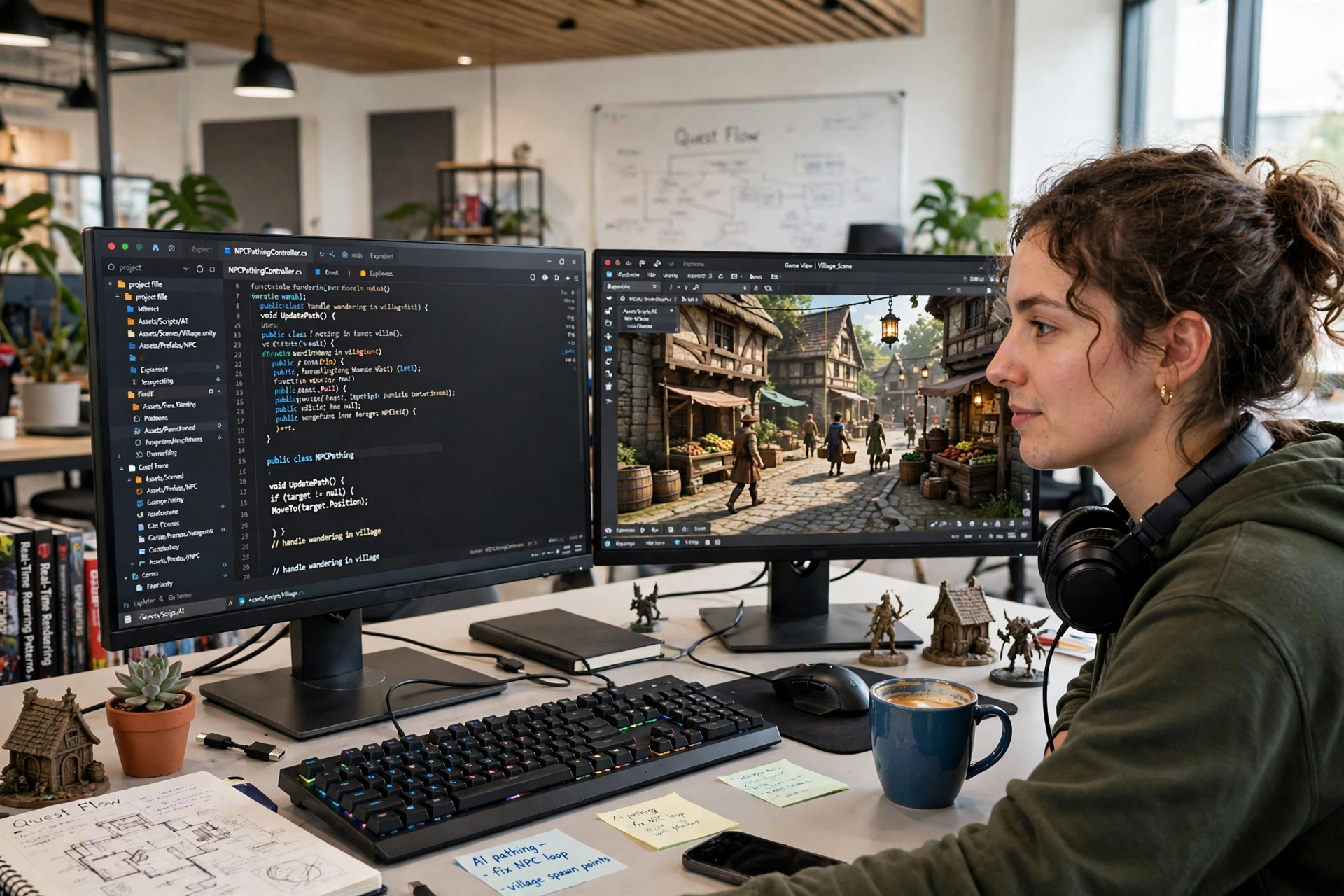
What is procedural generation, and how does it build game worlds?
Procedural generation is the automated creation of game content from rules. Instead of an artist placing every tree, a designer writes rules — trees grow near water, mountains rise where the terrain is steep — and a random seed decides the exact layout. Change the seed and you get a different world.
This is how space games offer thousands of planets without a thousand artists, and how dungeon crawlers give you a fresh layout on every run. The trade-off is control: generated worlds can feel repetitive, or produce odd results like a quest item inside a wall. Designers fix that with validation passes and hand-built landmarks.
How does AI adjust difficulty while you play?
A game that is too easy bores you; one that is too hard makes you quit. Dynamic difficulty adjustment watches your performance and tunes the game in the background: die three times on the same boss and it might quietly lower its damage or drop an extra health item. Win too easily and the next wave arrives a little tougher.
Racing games have done this for decades: rivals that fall behind speed up slightly, and leaders slow down, so the pack stays close. It is called rubber-banding, and players argue endlessly about whether it is fair.
How are generative AI characters different from scripted ones?
A scripted character can only say what a writer wrote. A generative AI character, powered by deep learning, builds its lines on the spot, from a character profile, the current scene, and a memory of what you have said before — so a shopkeeper might answer in character, referencing the sword you sold them last week.
A 2023 study from Stanford and Google, called Generative Agents, showed what this can look like. Twenty-five characters powered by a language model lived in a small simulated town, each with memories and daily plans. Left alone, they formed relationships and even organised a party — a research demo, not a shipped game.
Studios stay cautious: a character that improvises can also say something wrong or break the story, so real games wrap the model in guardrails — a fixed list of actions, a filter on its output, and a scripted fallback. The model adds flavour; the designers keep control.
Where does AI help developers behind the scenes?
Much of AI in gaming works where nobody looks. In automated playtesting, AI agents play a game thousands of times, trying odd routes and button combinations, and flag places where a player can fall through the floor or get stuck. Human testers still do the final pass, but the bots find the repetitive bugs first.
Machine learning also speeds up animation: studios train models on motion-capture data, then blend the results in real time so characters move smoothly over uneven ground. Computer vision helps too — testing bots can “watch” the game screen the way a player does, spotting glitches and unreadable text.
Scripted AI vs machine learning vs generative AI
| Approach | How it works | Strength | Weakness | Best for |
|---|---|---|---|---|
| Scripted AI | Hand-written rules | Predictable, cheap | Repetitive | Enemy patrols, quest-givers |
| Machine learning | Trained on gameplay data | Adapts to the player | Needs lots of data | Difficulty tuning, testing |
| Generative AI | Creates dialogue live | Improvises, remembers | Can go off-script, costly | Companions, dynamic quests |
Most modern games mix all three: scripted rules where the story depends on it, machine learning for balance and testing, generative models where surprise is the point.
What are the limits of AI in gaming?
The biggest limit is control. A scripted enemy always does what the designer intended; a learning or generative system sometimes does not — in a game, that can mean a boss that refuses to fight. That is why the most visible game AI is still the most controlled kind.
Cost is the second limit. Running a large language model for every character in a busy scene would be expensive and slow, so generative characters usually appear one at a time, in quiet moments. Fairness matters too: if an AI learns your habits, should it use them against you? Most designers say only a little — the goal is a game that feels alive, not one that reads your notes.
Frequently asked questions
Does AI in gaming mean the game is thinking like a human?
No. Game AI is a set of techniques for making decisions inside rules, not a mind. Neither a behaviour tree nor a language model understands the game the way you do — the illusion of intelligence comes from good design.
Do AI NPCs learn from how I play?
Usually not during a single session. Most NPCs run fixed rules that never change. Some games adjust difficulty based on your performance, and a few experimental titles let characters remember your choices, but a guard that learns your exact tactics is still rare.
Is procedural generation the same as AI?
Not quite. Procedural generation is any automatic creation of content from rules, and it predates modern AI by decades. AI can improve it, for example by generating textures or quests, but the core idea is rules plus randomness, not learning.
Will AI replace game designers and writers?
It is unlikely to replace them, because games need a vision: a story worth telling and a world worth exploring. AI handles the repetitive parts — variations, testing, crowds — leaving designers more time for the creative decisions only a person can make.
Conclusion
AI in gaming is at its best when you barely notice it: the guard who investigates a sound instead of standing still, the dungeon that is different on your second run, the boss fight that stays tense without feeling unfair.
Next time you play, watch the characters instead of the scenery: notice when an enemy flanks, when a shopkeeper remembers you, and when the game quietly helps you after a tough loss. Once you see the systems at work, you will never play the same way again.
Further reading: Wikipedia’s overview of artificial intelligence in video games and the Stanford/Google Generative Agents paper.