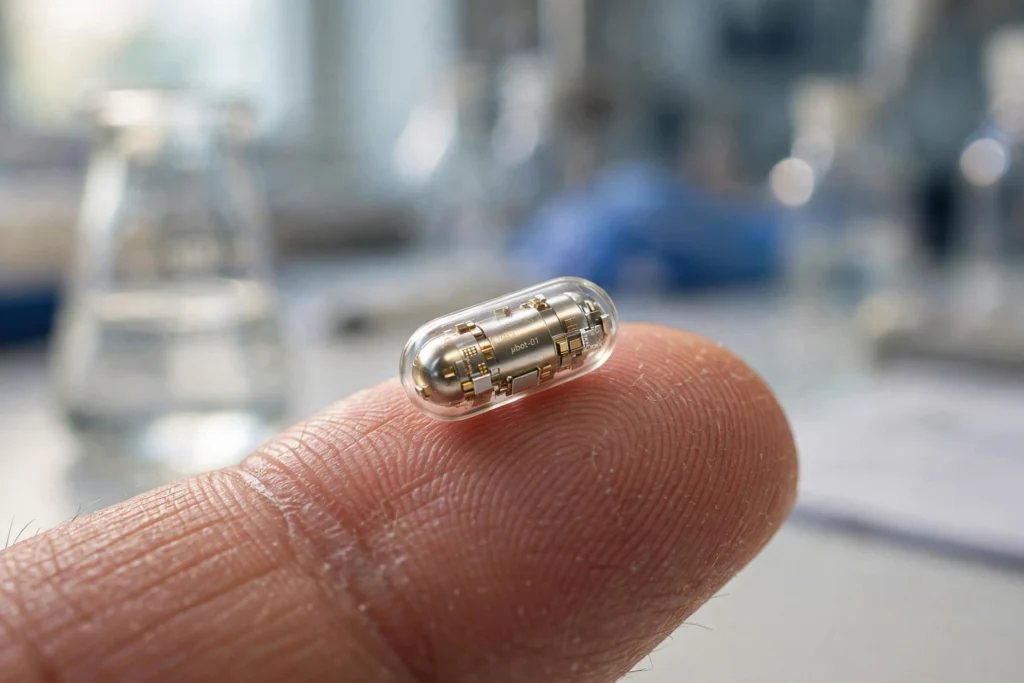
This article is general information about an emerging research field. It is not medical advice, and medical micro-robots are not a treatment you can ask a doctor for today.
Medical micro-robots are tiny machines, some smaller than the width of a human hair, that travel inside the body and deliver medicine exactly where it is needed. Rather than flooding the whole body with a drug, doctors could one day steer a capsule to a tumour, a clot, or an inflamed patch of gut, and release the dose right there.
Most still live in laboratories, not hospitals — but steering, tracking, and drug release have all been shown to work in animal tissue and vessel models.
Key Takeaways
- Medical micro-robots are untethered machines, often well under a millimetre across, built to carry drugs through the body.
- Most are steered by magnetic fields from outside the body, because magnets pass through tissue without wires or surgery.
- The drug is released by heat, acidity, or the capsule dissolving, so it comes out only at the target.
- Doctors track them with X-rays or sound-based imaging, since a machine this small cannot carry its own camera.
- The biggest hurdles are moving against fast blood flow, proving the materials are safe, and winning approval for use in people.
What exactly is a medical micro-robot?
A medical micro-robot is a machine small enough to travel through blood vessels, carrying a payload of medicine. Some are about 0.2 millimetres across — roughly the width of two human hairs — while others are closer to 200 nanometres, far too small to see with the naked eye.
There is no motor or battery inside most of them; there simply is not room. Instead, the robot is usually a soft gel capsule holding the drug and magnetic particles. The particles are the engine and steering wheel in one — a field made outside the body pulls and turns them, and the robot follows.
That sets them apart from surgical robots: large machines with arms, controlled by a surgeon in the same room. A micro-robot has no arms and no cable — once inside, its only link to the outside is the magnetic field.
How do magnets steer something so small?
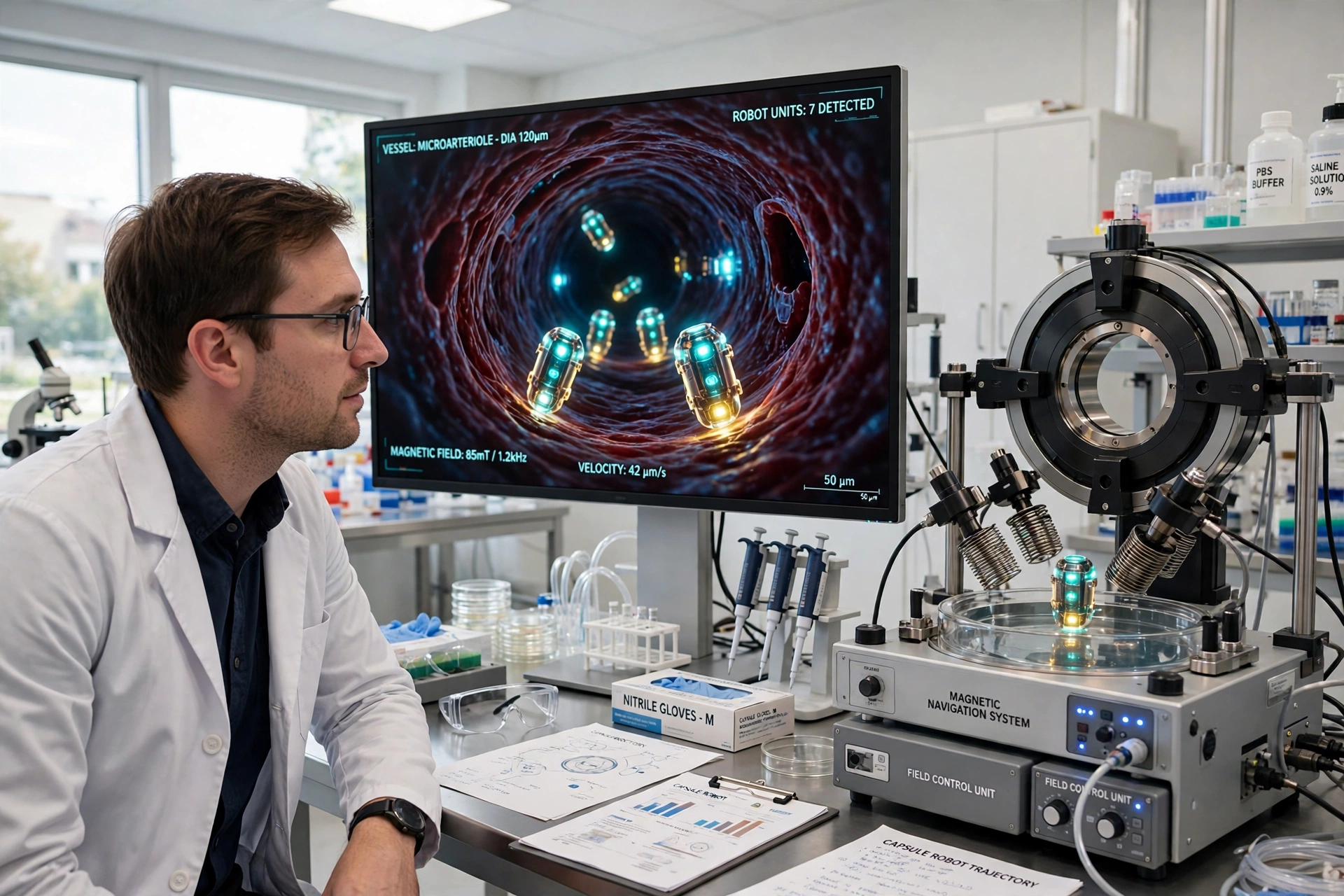
Think of a fridge magnet sliding when you move another magnet behind the door. Magnetic micro-robots work the same way, only far more precise.
A set of electromagnets sits around the patient. By changing the field’s strength and direction, the system can pull a capsule forward, roll it along a vessel wall, or turn it around a bend. In one ETH Zurich design, three steering tricks combined let a capsule be guided through the arteries of the head at a few millimetres per second, even against flowing blood.
Some designs travel in groups. Oxford researchers built droplet-sized robots that link into little chains under a magnetic field, moving in ways the team calls walking, crawling, and swinging. The chains can break apart to squeeze through a narrow passage, then gather again.
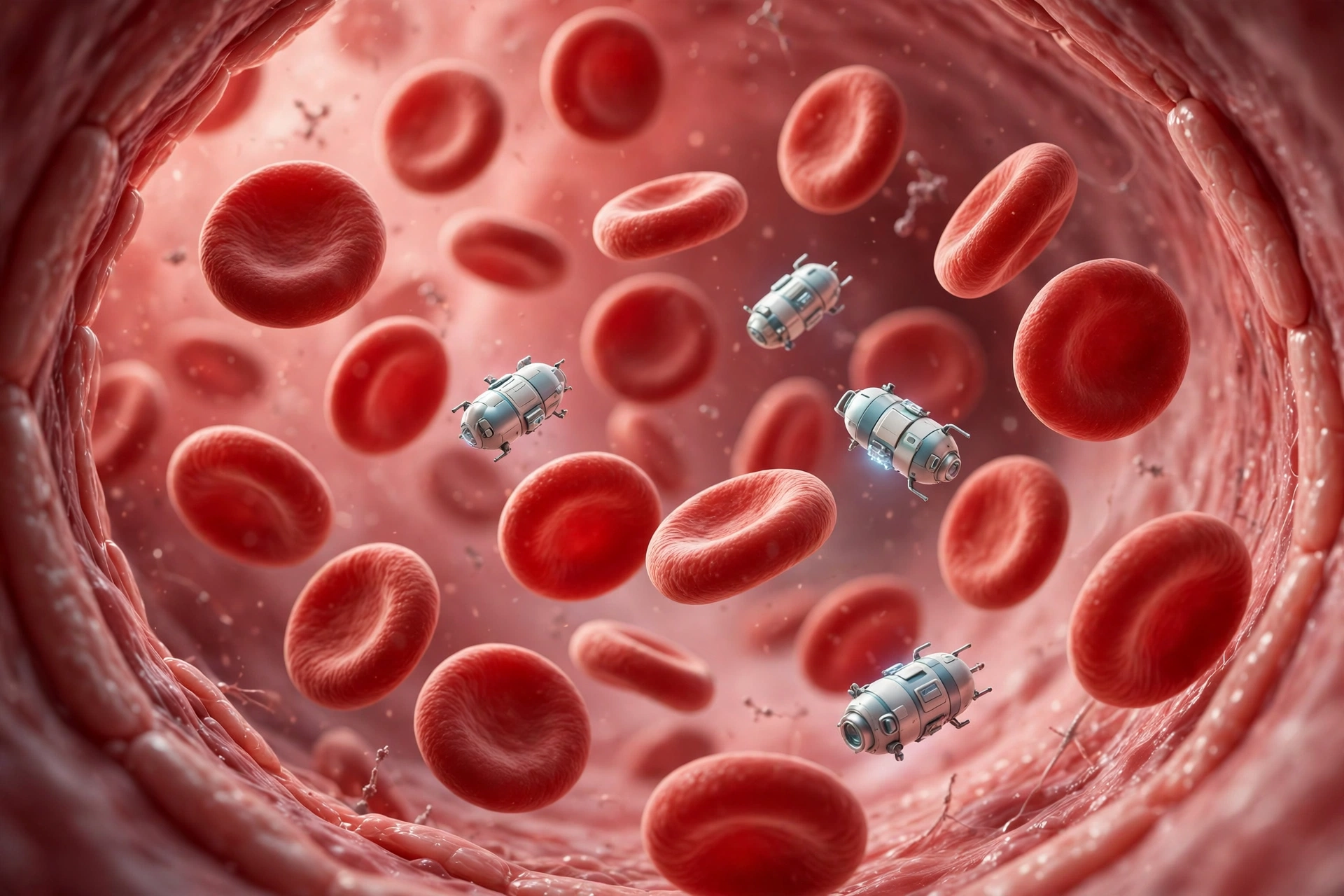
The catch is blood flow. It rushes near the heart and slows to a crawl in the smallest vessels, so steering against a fast current is like swimming upstream — one of the hardest problems in the field. The first real uses will probably be in slow-moving places: the gut, the bladder, or the fluid around the brain and spine.
How does the medicine get out at the right moment?
Carrying a drug is only half the job. The robot also has to let go of it in the right place, and only there. There are three main tricks.
The first is heat. In the ETH Zurich design, the capsule is a gel that dissolves when warm. A short burst of a high-frequency magnetic field heats the magnetic particles inside, the gel melts, and the drug spills out. Switch the field off, and nothing is released.
The second is chemistry. Some capsules break down in acid, and tumours and inflamed tissue tend to be slightly more acidic than healthy tissue. A capsule made from a porous framework called ZIF-8 stays sealed in the bloodstream and opens at the more acidic spot.
The third is dissolving over time. The Oxford team’s droplet robots use a gel that breaks down at a tunable speed; in a pig intestine experiment, it dissolved and delivered a dye to the target area, and the magnetic parts were then steered back to the catheter and pulled out.
Doctors also need a way to see the robot. Some teams add particles that show up on X-rays; others use sound-based imaging that can pick it out deep inside tissue. Without that, a doctor would be steering blind.
What could they actually treat?
The clearest use is targeted drug delivery, and the reason it matters is waste. With a standard IV drip, researchers estimate only around 0.7 percent of a drug reaches the tissue it is meant to treat; the rest circulates everywhere, causing side effects in healthy tissue. A micro-robot that delivers its dose at the target could mean smaller doses and fewer side effects.
| Job | How it would work | Where it has been tested |
|---|---|---|
| Drugs to a tumour | Capsule steered to the tumour, drug released by heat or acid | Lab models, animal tissue |
| Clearing a blood clot | Capsule carries a clot-dissolving drug to the blockage | Lab models of vessels |
| Gut inflammation | Robots delivered by catheter, steered to the inflamed patch | Pig intestine, computer models |
Take the gut: a catheter delivers the robots, a magnetic field guides them to the inflamed area, and the gel dissolves so the drug comes out. Then the magnetic parts are steered back and removed. Each step works on its own; combining them reliably in a living person is the work still ahead.
What is still in the way?
Safety comes first. The materials must be biocompatible — the body must not attack them, and they must not leave anything harmful behind. Designs that dissolve into harmless parts, or that can be steered back out, are ahead for exactly that reason.
Then there is control. Blood flow changes with every heartbeat, and vessels branch and narrow without warning. A robot that works beautifully in a straight glass tube can struggle in a real artery.
Regulation is the third hurdle: a device that travels inside the body and releases drugs faces one of the strictest approval paths in medicine.
These machines are real, they move, and they release drugs on cue in the lab. They are not a treatment yet, and nobody should expect them in a clinic next year.
FAQs
How small are medical micro-robots?
Some are about 0.2 millimetres across, about the width of two human hairs; others are closer to 200 nanometres. The size depends on the job: a gut robot can be bigger than one that must fit inside a tiny blood vessel.
Do medical micro-robots have batteries?
No. There is no room for a battery, a motor, or a radio at this size. They are powered and steered from outside the body, usually by magnetic fields, and most designs carry no electronics at all.
How do doctors see a micro-robot inside the body?
Through imaging. Some designs include particles that show up on X-rays, while others are tracked with sound-based imaging. The robot itself cannot send back a picture, so the imaging system does the watching.
Are medical micro-robots being used in hospitals yet?
Not as a routine treatment. The systems here have been tested in lab models, animal tissue, and simulations; human trials are still ahead. Any clinic offering micro-robot treatment today should be treated with serious scepticism.
What happens to the robot after it delivers the drug?
Some dissolve into harmless parts. Others are steered back to the catheter and pulled out, so nothing stays in the body.
What to watch next
The next few years come down to three questions: can they be steered reliably in a living body, tracked clearly enough for a doctor to trust them, and proven safe? Steering and drug release already work in the lab; the safety evidence is what comes next.
To follow the field, watch for news of human trials rather than lab demonstrations — the step that shows these machines moving from research towards real treatment. And to see robots at the other end of the size scale, read how surgical robots work.
This article is general information about an emerging research field, not medical advice. Micro-robot treatments are experimental and not available as a clinical treatment.