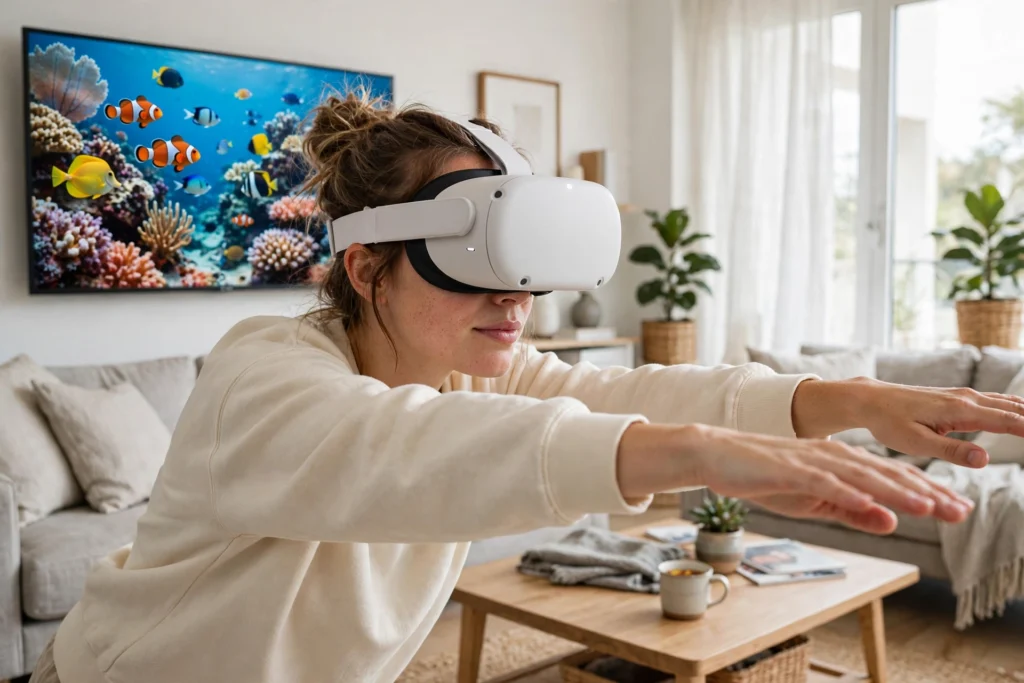
VR scuba diving puts you on a coral reef or beside a shipwreck while you stay dry in your living room. A headset shows you the underwater world in 360 degrees, and your controllers become your hands, so you can swim, look around, and even practise dive skills. It feels surprisingly real — but it cannot teach you everything about diving.
Key Takeaways
- VR scuba diving comes in two kinds: filmed 360-degree dives you watch, and rendered worlds you swim through.
- It is brilliant for exploring reefs and wrecks without the cost, travel, or risk of a real dive.
- Training apps can teach buoyancy, hand signals, and equipment checks — but they do not replace certification.
- Most experiences run on a standalone headset such as a Quest, from a few dollars to about $20.
- Motion sickness is the main spoiler, so start with short, calm sessions and sit down if you feel queasy.
What is VR scuba diving?
VR scuba diving is any underwater experience you explore through a virtual reality headset. The reef wraps all the way around you: turn your head left and a turtle glides past, look down and the seabed drops away beneath your fins. You move by pushing a thumbstick or making a swimming motion with your controllers, and the world responds as if you were really there.
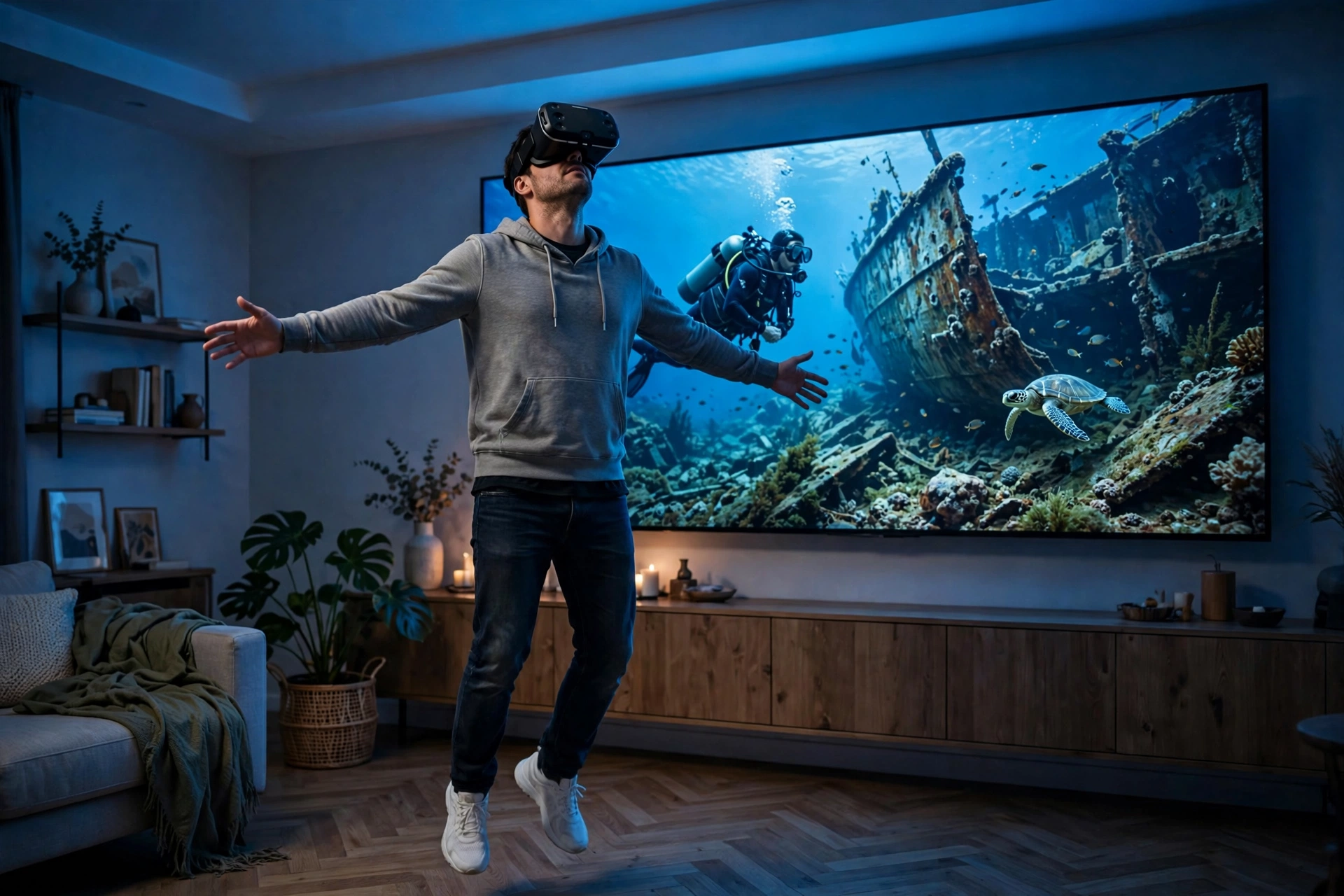
There are two main kinds. The first is filmed 360-degree video, shot by real divers with spherical cameras — projects such as IMMERSIA-VR mount one on a diver’s mask and let you relive a genuine scientific dive. The second is a rendered world built in a game engine, where you are in the dive, free to choose where to swim. Shipwreck Discovery, released in 2026, is a good example: its wrecks are built from scans of real ships off the Florida coast, with realistic dive physics. Cheaper options include guided reef tours such as Ocean Dive VR and treasure-hunting games such as Scuba Diving: Deep Sea Diver.
What does it actually feel like?
The first thing most people notice is the quiet. A good underwater scene pairs the visuals with muffled bubbles, distant boat engines, and the slow rhythm of breathing, and the combination is convincing enough that your brain starts to believe you are underwater. Colours shift toward blue-green with depth, light ripples down from the surface, and small fish dart away as you approach.
What it cannot fake is the water itself. There is no pressure on your chest, no cold on your skin, and no weight pulling at your tank. Swimming is a thumbstick movement, not a kick, so you never get tired — pleasant, but your body never learns the real effort of finning against a current. Motion sickness is the other catch: gliding through a virtual ocean while your body sits still can confuse your inner ear, though most people adjust after a few short sessions.
Can VR scuba diving teach you to dive?
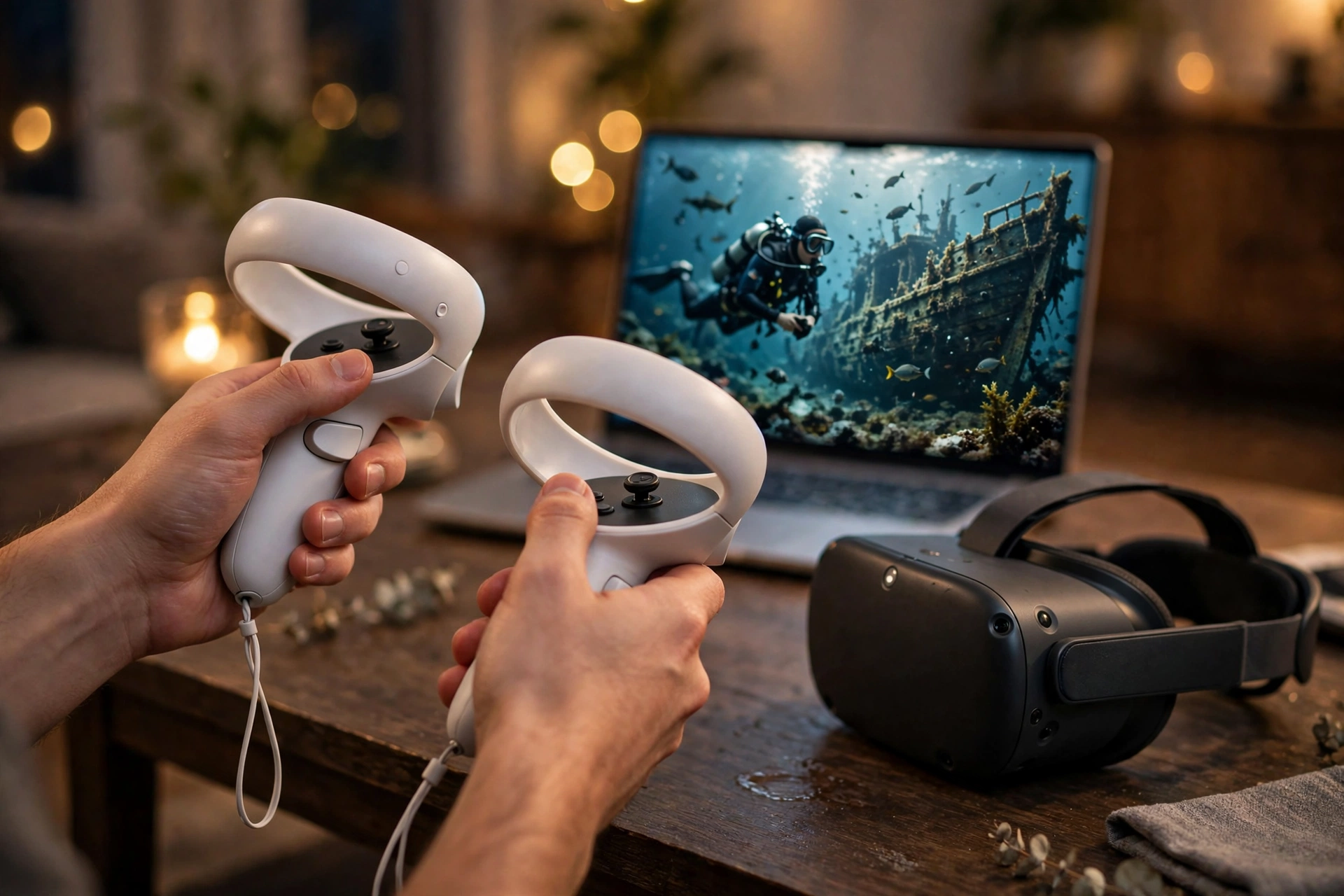
Partly — and the honest answer matters, because diving is a safety-critical skill. Training simulators such as Virtual Divers International let you practise the classroom side: mask clearing, regulator recovery, equipment assembly, buoyancy control, and the hand signals divers use underwater, since you cannot talk with a regulator in your mouth. Repeating those steps in VR builds familiarity, so the first time you do them in a pool they feel less strange. It works a bit like VR sports training, and the same idea as VR table tennis, where virtual rallies sharpen skills that transfer to the real table.
But no headset can certify you. Real diving involves buoyancy you feel in your lungs, equalising the pressure in your ears, managing a real air supply, and staying calm when something goes wrong. Those are physical skills that need a qualified instructor, a pool, and then open water. Think of VR as a rehearsal room, not a replacement for the course.
What are the best VR diving experiences right now?
The scene is still small, but there is something for each mood. Shipwreck Discovery is the most serious option: seven real scanned wrecks, true-to-life dive physics, and conservation tasks such as hunting invasive lionfish and clearing marine debris. It costs $19.99 on Steam and Meta Quest. Ocean Dive VR is a calmer, cheaper guided tour ($3.99 as an add-on to the vJourney travel app), best for a first taste. Scuba Diving: Deep Sea Diver ($4.99 on Quest) is the playful one: explore, find hidden treasure, and meet the marine life. If you would rather watch real dives, search the Quest store for 360-degree dive videos.
VR diving vs real diving
| VR scuba diving | Real scuba diving | |
|---|---|---|
| Cost | A headset you may already own, plus $4–$20 per app | Course, gear hire, and travel, often hundreds of dollars |
| Risk | Motion sickness at worst | Real risks that need training and a buddy |
| What you feel | Sight and sound; no water, pressure, or cold | Buoyancy, weight, temperature, and effort |
| Skills learned | Procedures, signals, buoyancy theory, familiarity | The full physical skill set, with certification |
Try this: your first virtual dive in 20 minutes
Clear a small space, sit in a chair, and pick a calm reef tour rather than a wreck with tight corridors. Spend five minutes just looking around: follow one fish and get used to turning your head slowly. Then try swimming — push the thumbstick gently and practise stopping exactly where you want to, which is harder than it sounds. Next, try the training tasks if your app has them: check your virtual air gauge, try a slow descent, and practise the OK hand signal. Finish by floating still for a minute and just watching the reef.
What kit do you need?
Most VR diving experiences run on a standalone headset, and how VR headsets work is the same here as anywhere else: the headset tracks your head, renders two slightly different images, and your brain reads them as depth. You do not need extra hardware, though a comfortable strap helps. Your VR controllers act as your hands for swimming, grabbing, and signalling. A PC-tethered headset opens up the most detailed simulations, but the standalone Quest versions are the easy starting point.
Frequently Asked Questions
Do I need to know how to swim to try VR scuba diving?
No. You are sitting or standing in your living room, so swimming ability does not matter — people who would never get into open water can still explore a reef.
Can VR scuba diving replace a diving course?
No. It can teach you procedures and hand signals, but certification needs real water, real buoyancy, and a qualified instructor.
How much does VR scuba diving cost?
If you already own a headset, the apps are cheap: tours from about $4, full simulators around $20. If you still need a headset, that is the real cost — a standalone Quest is the usual starting point.
Will I get motion sick?
Possibly, especially at first. Short sessions, slow turns, calm scenes, and sitting down all help, and most people adapt within a few tries.
Is VR scuba diving good for kids?
It can be a lovely introduction to the ocean, but check the headset maker’s age guidance — most recommend ages 10 and up — and keep sessions short.
Conclusion
VR scuba diving is the cheapest, safest way to find out whether the underwater world is for you. It will show you reefs and wrecks you might never visit, teach you the signals divers use, and give you a genuine taste of floating through blue water. It will not make you a diver — only real water and real training can do that. If your virtual dives leave you wanting more, book an introductory dive with a local school.
Further reading: Shipwreck Discovery VR experience (DeeperBlue) and Virtual Divers simulator (Divernet).