AI in logistics is the use of machine learning, computer vision, and route-planning software to move goods faster, cheaper, and with fewer mistakes. It forecasts what customers will order, decides where stock should sit, plans delivery routes as traffic changes, and checks parcels in the warehouse — while people still handle the exceptions, the customers, and the final decisions.
Key Takeaways
- AI in logistics predicts demand, plans routes, and organises warehouses — three jobs that used to run on spreadsheets and gut feel.
- The biggest wins are usually in demand forecasting, route planning, and warehouse picking.
- It only works as well as its data: messy or out-of-date records lead to confident, wrong forecasts.
- It supports dispatchers, pickers, and drivers rather than replacing them.
What does AI actually do in a warehouse?
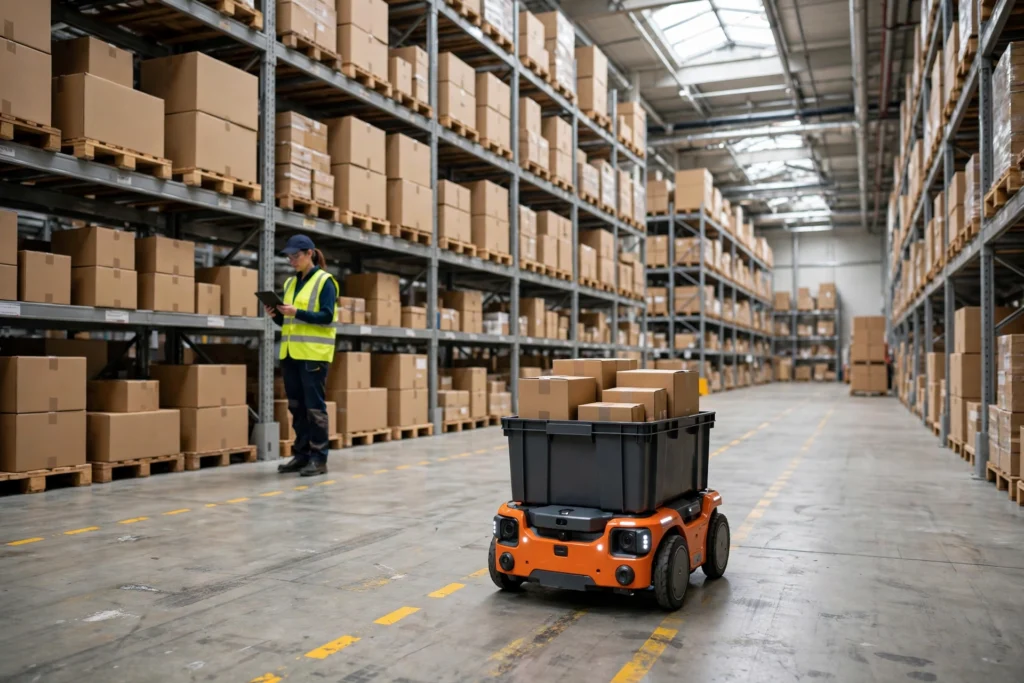
Walk into a modern warehouse and the first thing you notice is how little wandering there is. AI looks at which items get ordered together and how often, then tells the warehouse where to put things so pickers walk shorter routes: the bestselling phone case near the packing bench, the slow-moving spare part at the back. When demand shifts, the layout can be re-planned overnight.
Robots do the heavy carrying. Small autonomous carts ferry shelves to a human picker who stays in one spot, while the AI behind them acts as a traffic controller, re-routing carts the way a sat-nav re-routes a car. Our guide to warehouse robots looks at the machines themselves; the AI is the brain deciding where each one goes next. Cameras add a second pair of eyes, flagging a crushed corner or an unscannable label before dispatch.
How does AI plan a delivery route?
Planning a delivery round used to mean a dispatcher, a paper map, and a lot of experience. AI does the same job with far more information at once: live traffic, road closures, weather, each van’s load, delivery time windows, and how long each stop usually takes. It works out a stop order that keeps vans full and miles low, then keeps re-planning while the vans are out.
The “keeps re-planning” part matters most. A static route is out of date the moment a motorway closes; a good system notices the jam, shuffles the remaining stops between vans, and tells the customer the new arrival time before they think to ask. That live ETA is the part of AI in logistics most of us actually meet, every time a tracking page says “arriving between 2 and 4 pm” and means it.

Can AI really predict what customers will order?
Yes — within limits. A forecasting model studies years of sales, then layers in seasons, promotions, local events, and even the weather. It will not tell you that one specific person is about to buy a toaster. It will tell you that a shop in a rainy city will probably sell more umbrellas next week, and roughly how many — enough to stop the two classic mistakes: shelves full of things nobody wants, and empty shelves where the popular item should be.
Our look at AI in retail shows the same forecasting idea deciding what goes on shop shelves. In logistics the question is slightly different: not just what to stock, but where to stock it. A forecast that says “this will sell in the north next month” lets a company move stock to the nearest warehouse before the orders arrive. McKinsey’s research on early adopters reports gains of around 15% lower logistics costs and a 35% drop in inventory — treat those as what the keenest early movers reported, not a promise for every business.
What happens to a parcel on its AI-planned journey?
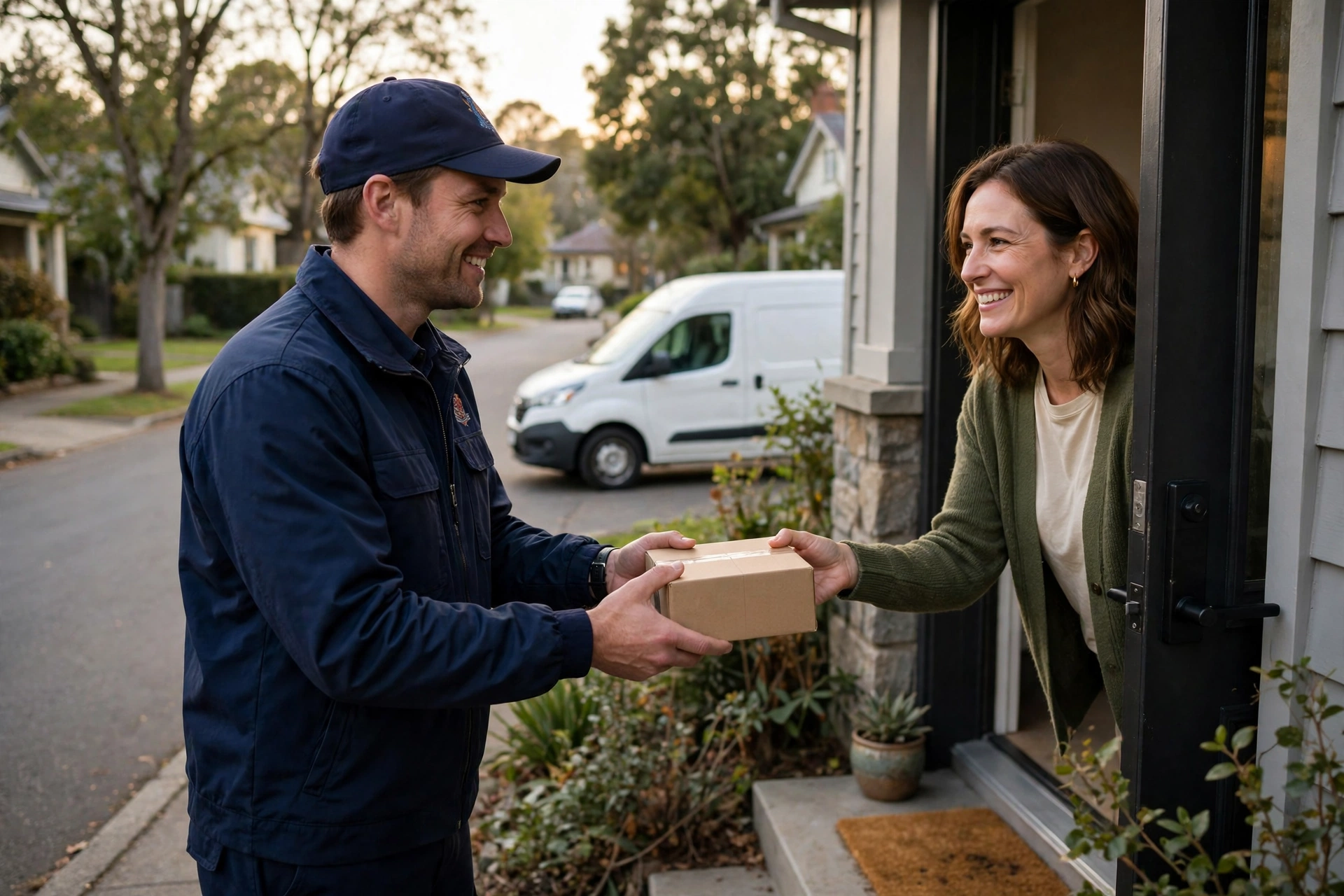
Follow one parcel and the whole system comes into focus. Imagine you order headphones on a Tuesday evening. Before you clicked buy, a forecasting model had already guessed they sell well this month and made sure your nearest warehouse held enough — so the system picks the closest warehouse with the item in stock, not the biggest one. Inside, a robot brings the shelf to a picker, a camera checks the box, and the parcel is loaded onto a van whose route was planned that morning and adjusted twice since. On the road, the route shifts again around a closed bridge, your tracking page updates itself, and the driver gets a new stop order. By the doorstep, the only human decisions left were the ones that needed judgement: a safe place to leave the parcel, and a quick word with you at the door.
Where does AI in logistics still go wrong?
It goes wrong in three familiar ways. First, bad data. If the sales history is full of errors — returns logged as sales, stock counts never corrected — the forecast inherits every mistake and repeats it with confidence. Skip the boring work of cleaning data and you get the worst results, whatever the software costs.
Second, surprises. A model trained on normal years struggles with a port strike, a viral product, or a storm that closes roads for a week. The best systems flag their own uncertainty and hand control back to a human dispatcher; the worst carry on as if nothing happened.
Third, overreach. AI can suggest; it cannot take responsibility. A route that saves ten minutes but sends a heavy van down a narrow residential street is a bad route, and a dispatcher who knows the area will spot that in seconds. The firms that get the most from logistics AI treat it as a very fast assistant, not an autopilot. The techniques are the same ones in our machine learning guide — pattern-finding on data, not magic — and our overview of what artificial intelligence is explains where they fit.
How can a small business start using it?
You do not need a fleet of robots. Most small firms start with one pain point and one tool: live ETAs for customers, a forecasting add-on inside software they already use, or a route planner for a handful of vans. Ask any vendor three plain questions: what data does it need, what happens when the data is wrong, and can a person override it in seconds? Start small, measure honestly over a month — fuel used, late deliveries, driver feedback — and keep the human in the loop.
| Job | The old way | With AI in logistics |
|---|---|---|
| Demand forecasting | Last year’s sales plus a guess | Sales history plus weather, seasons, and promotions |
| Route planning | Fixed rounds drawn up by hand | Live re-planning around traffic and closures |
| Warehouse picking | Pickers walking the whole floor | Robots bring shelves to the picker |
| Delivery ETAs | A wide time window, often missed | Self-correcting ETAs updated as vans move |
| Damaged parcels | Found by the customer | Cameras flag damage on the belt before dispatch |
Frequently Asked Questions
Is AI in logistics only for big companies?
No. Big firms were first, but route planners, forecasting add-ons, and delivery-tracking tools are now sold to small fleets and single warehouses too. The entry point is one tool for one problem, not a whole new system.
Will AI replace delivery drivers?
Not in the near term. AI plans the route and the stop order, but driving, carrying parcels, and dealing with customers at the door still need a person. The jobs change — less guesswork, more exception-handling — rather than disappearing.
How accurate is AI demand forecasting?
More accurate than a spreadsheet guess, and still wrong sometimes. It is best at steady, repeating patterns and worst at sudden events. Good teams treat forecasts as a guide and keep safety stock for the surprises.
What data does a logistics AI need?
At minimum, clean records of past orders, stock levels, delivery times, and addresses. Traffic and weather feeds help routing; returns data helps forecasting. The cleaner and more recent the records, the better the results.
Conclusion
AI in logistics is not one invention but a set of practical tools: forecasts that stop shelves going empty, routes that adapt to traffic, warehouses where robots do the walking, and ETAs customers can trust. Its limits are real — it needs clean data, it stumbles on surprises, and it still needs people for judgement. If you run deliveries or a warehouse, try a small trial on your biggest headache, measured over a month, with a person always able to override it.
Further reading: IBM — AI in logistics and ITPro — driving efficiency in distribution and logistics through AI.