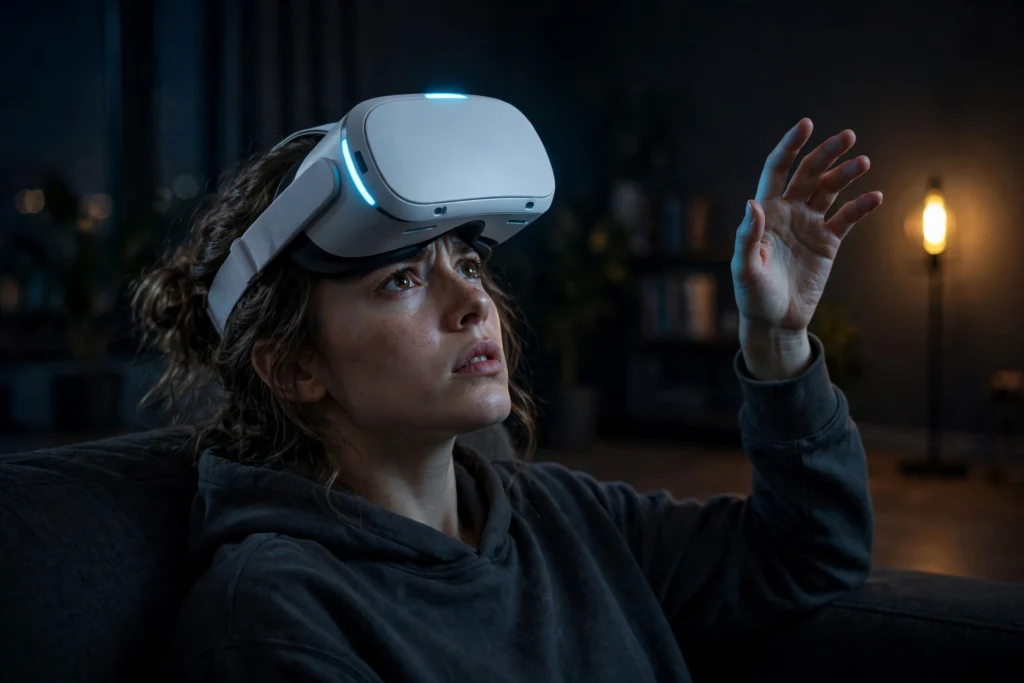
VR horror games feel scarier than flat-screen games because the headset takes away the safety nets a monitor gives you. There is no frame to look past, no room to glance at, and no pause button your eyes can reach. Your brain treats the virtual hallway as a real place, so your body reacts as if the danger were real.
Key Takeaways
- Presence is the difference: a headset convinces your brain you are inside the scene, not watching it.
- Scale, spatial sound and the loss of an easy escape each remove a safety net flat-screen play keeps.
- VR horror asks your body to move, turn and hide, which makes fear physical.
- Comfort settings, a clear play space and short sessions keep the scare fun.
- If a game feels too intense, take the headset off.
What makes VR horror different from flat-screen horror?
On a television, horror is something you watch. The monster lives inside a rectangle, and the edges of the screen remind you where the game ends and your living room begins. You can glance at your phone or look at the wall, and the spell breaks in a second.
A headset removes all of that. The image fills your whole field of view, so there is nowhere safe for your eyes to rest. Turn your head and the world turns with you, exactly how the real world behaves. That match between what you see and how you move is what researchers call presence: the stubborn feeling that you are standing in the place the headset shows you.
Presence is not about prettier graphics. A flat game can look stunning and still feel like a picture. VR horror works with modest visuals because the feeling of being there does most of the work. A dark corridor feels long when you are standing in it.
Why does your body react as if the danger is real?
Fear is one of the oldest systems in the brain, and it does not wait for permission. When a shape lunges at you in VR, the part of your brain that watches for threats fires before the thinking part can say “this is only a game”. Your heart rate rises and your hands tighten on the controllers.
Three things make that reaction stronger in a headset. First, scale: virtual rooms are built at roughly human size, so a threat can be taller than you and closer than a television allows. Second, sound: spatial audio gives every noise a direction and a distance, so a whisper behind your right shoulder feels like it comes from a real spot in the room. Third, movement: you duck, lean and turn with your whole body, and each action ties the fear to something you did.
None of this means VR horror is dangerous. It means the medium is unusually good at its job, so treat the first session as a test drive, not a marathon.
Flat screen vs VR: what actually changes?
| Element | Flat screen | VR headset |
|---|---|---|
| View | A rectangle with visible edges | Fills your field of view |
| Sound | Comes from fixed speakers | Has direction and distance |
| Scale | A small world inside a frame | Roughly human size |
| Movement | Mouse, keys or a gamepad | Your head, hands and body |
| Escape | Pause, glance away, look at the room | Turn your head or remove the headset |
| Fear | You watch the character get scared | Your body reacts first |
Every row removes one safety net. On a monitor you can always look at the edge of the screen and remember where you are. In a headset, the only way out is to lift the visor or close your eyes. That is why a jump scare that would make you laugh on a television can make you tear the headset off in VR. The tricks horror games use to build dread on a flat screen, like hiding the interface and keeping you in the dark, are things VR does by default.
A worked example: one hallway, two ways to play
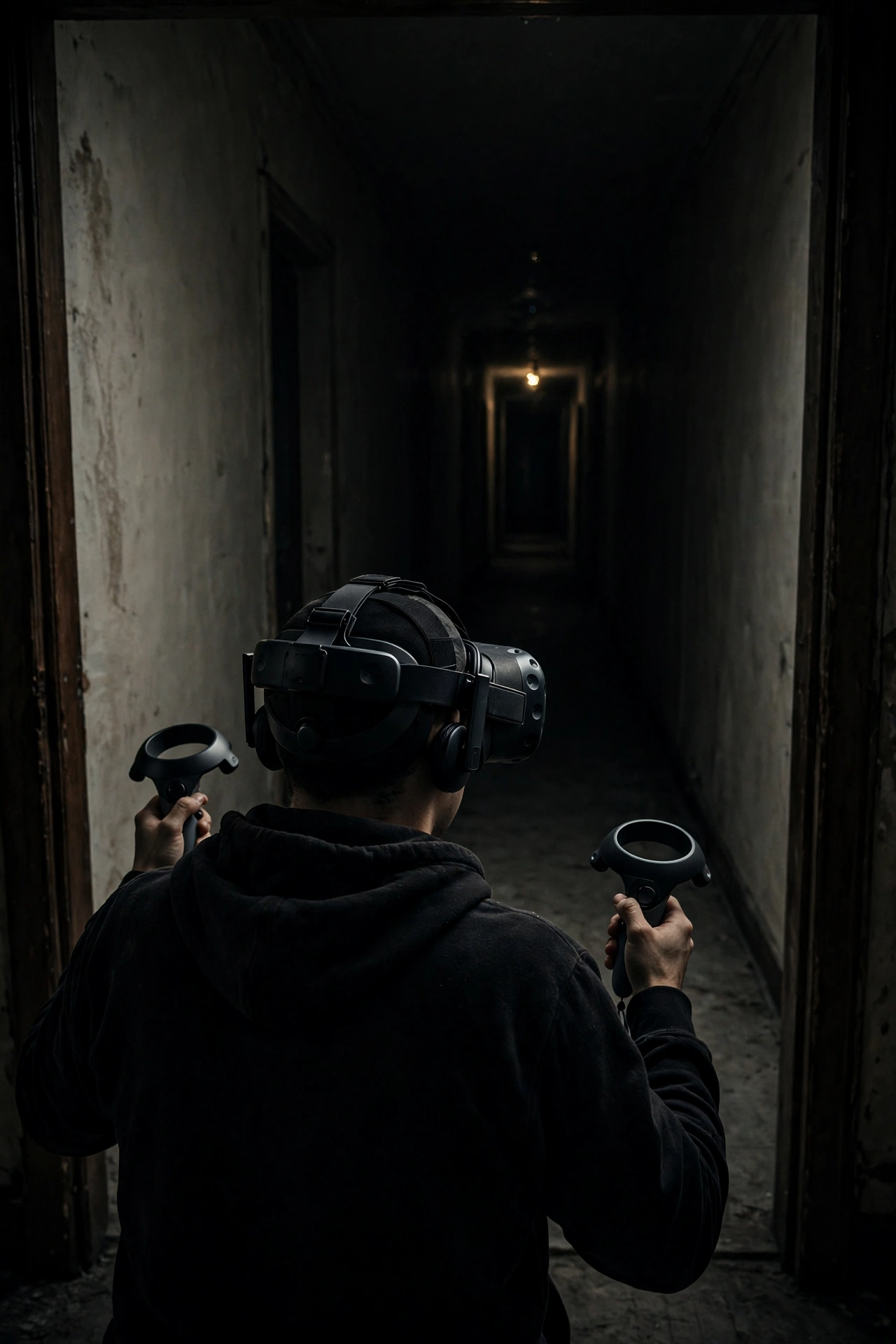
Take a scene every horror fan knows: a long, dim hallway with a door at the far end. On a flat screen, you walk down it with a stick or a mouse. You see the whole corridor at once, the door is a small rectangle in the distance, and your hands stay still. It can be tense, but you are steering a character.
In VR, the same hallway plays differently. The walls are beside your shoulders, and you have to turn your head to check the doors. Resident Evil 7 in VR is the classic example: players who strolled through the Baker house on a television found themselves crouching behind furniture in the headset version, because hiding felt like something they were doing, not watching. Phasmophobia shows the same idea with friends: on a monitor it is a funny, chatty ghost hunt, but in VR the voice in your ear sounds like it is standing next to you. The rules have not changed. Your body has.
How do you play VR horror safely?
Start with the settings, not the scariest game you own. Most headsets let you choose between smooth movement and teleport movement, and teleport is kinder to a new stomach. If you have ever felt queasy in VR, read our guide to how VR motion sickness happens before a horror session, because nausea and fear are a miserable combination.
Set up your guardian boundary with care and clear the floor. Horror makes people step backwards without thinking, so a clear play space matters more here than in any other genre. Keep a lamp on low, and keep a drink and a chair within reach. Twenty to thirty minutes is plenty for a first night.
Play with someone nearby for your first few sessions, even if they are only watching on the television mirror. A shared laugh after a jump scare turns a frightening game into a good evening. And if a game ever feels too much, take the headset off. Nobody keeps score.
A word of caution for younger players: most VR horror games carry age guidance for a reason, and a headset makes frightening content harder to step back from than a television does. Start children with something gentle and keep sessions short; our guide to VR for kids covers age guidance and safe first steps.
FAQs
Can VR horror games actually hurt you?
No, the danger is not real, but your body can react as if it were. A racing heart and a startled jump are normal. Take breaks, sit down if you feel dizzy, and stop if you feel unwell. If you have a heart condition or anxiety that flares with sudden shocks, check with a clinician first.
Why do I feel more scared in VR than on a television?
Because the headset removes the frame, the room, and the distance between you and the scene. Presence makes your brain treat the virtual place as real, spatial sound gives threats a direction, and your own movements tie the fear to your body.
What is the best VR horror game for a beginner?
Start with something slow and atmospheric rather than a game built on jump scares. Short, story-led horror with a clear save system is kinder than a long survival game. Phasmophobia with friends is a good middle ground, because talking to other players breaks the tension.
Do I need a powerful headset for VR horror?
No. Presence depends on tracking, sound and a comfortable fit more than on raw graphics. A standalone headset runs most horror games well. What matters more is a good pair of headphones, which make spatial sound far clearer than built-in speakers.
Can VR horror help with real fears?
There is a real therapeutic idea behind this, called exposure therapy, where people face fears gradually in a controlled setting. Some clinics use VR for exactly that. But a horror game is entertainment, not treatment. If fear is affecting your daily life, our guide to VR exposure therapy explains the clinical version.
Conclusion
VR horror games feel scarier because the headset takes away the frame, the distance, and the easy escape a flat screen gives you. Presence, scale, and spatial sound work together so your body reacts before your mind can explain the danger away. Start with a short, gentle game, set up a clear play space, turn on comfort settings, and keep your first session to half an hour. If you enjoy the thrill, the scariest hallway in gaming is waiting for you, one careful step at a time.
Further reading: Meta’s round-up of VR horror games and films (https://www.meta.com/blog/trick-vr-treat/?intern_source=blog&intern_content=halloween-2025-meta-horizon-quest-vr-horror-movies-games) and VR.org on why VR is the perfect horror machine (https://vr.org/articles/why-vr-is-the-perfect-horror-machine-2026).