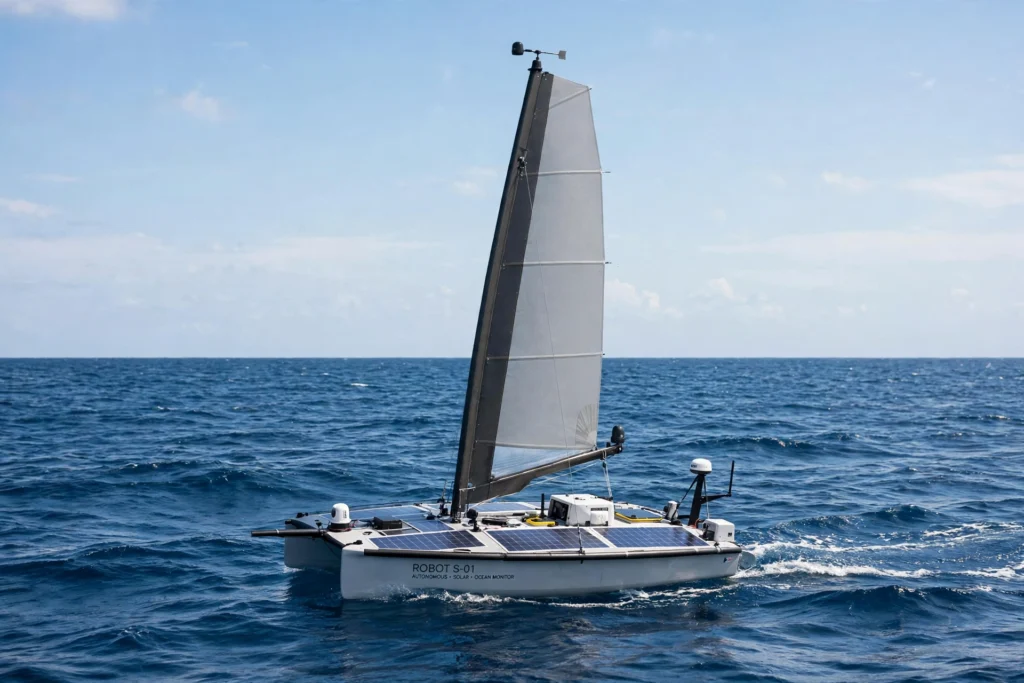
Yes — a boat can sail itself across an ocean. In June 2022, the Mayflower Autonomous Ship crossed the Atlantic with no crew aboard, travelling about 3,500 miles from Plymouth in England to Halifax in Canada over 40 days, making its own steering decisions the whole way. Here is how robot boats work, and what they still cannot do.
Key Takeaways
- A robot boat is an uncrewed surface vessel: it carries sensors, a computer, and a power supply, but no people, cabins, or food stores.
- Most run on wind and sun — a rigid wing sail for propulsion and solar panels for the electronics — so they can stay at sea for months.
- GPS, radar, cameras, and satellite links let them steer around ships, follow a planned route, and send data home in real time.
- They are built to survive storms: sealed hulls, self-righting designs, and software that turns the bow into the waves.
- They do not replace crewed ships — they do the long, dull, and dangerous data-gathering jobs that people should not have to.
What exactly is a robot boat?
A robot boat, properly called an uncrewed surface vessel or USV, is a boat with the crew taken out. What is left is a hull, some form of propulsion, a set of sensors, a computer to make decisions, and a satellite link back to shore. There is no single design. As NOAA’s ocean exploration team puts it, a USV “may resemble a motor boat, sailboat, spaceship, surfboard, or even a large bathtub toy” — the shape follows the job.
The best-known design is the Saildrone: a kayak-shaped hull with a tall, rigid wing sail, like an aeroplane wing stood on end, and solar panels across the deck. The wind pushes the boat along, the sun powers the instruments, and the whole vessel is monitored by satellite while it sails itself. They range from the 23-foot Explorer to the 72-foot Surveyor, and NOAA has used them in the Arctic, Pacific, Atlantic, and Southern oceans to track fish, measure ocean acidification, map the seafloor, and even observe a hurricane from the inside.
Other robot boats look more like small ships. The Mayflower Autonomous Ship is a 50-foot trimaran driven by a solar-powered electric motor with a diesel backup.
The idea will feel familiar if you have read about drone robots: the same thinking — sensors, software, and a radio link — applied to the sea instead of the sky.
How does a robot boat steer itself?
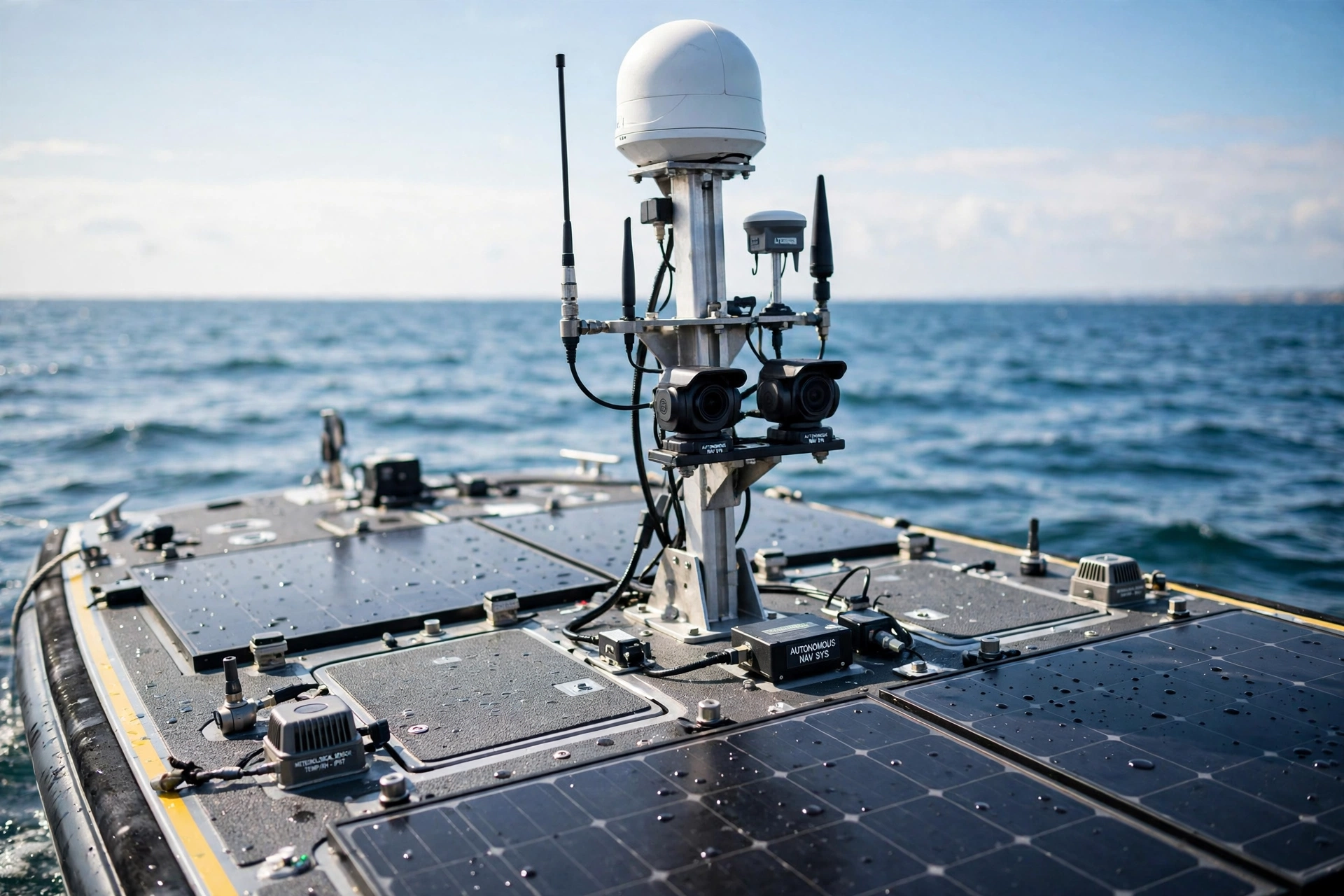
Steering a robot boat is a loop: sense, decide, act, repeat. GPS tells the boat where it is. A compass and motion sensors tell it which way it is pointing and how the waves are pushing it. Radar and cameras watch for other vessels, buoys, and debris. The onboard computer compares all of that with the planned route and works out the next move: adjust the wing sail, change the rudder angle, or speed up the motor.
The route itself is planned before the boat leaves shore. Operators draw a course on a map, mark areas to avoid, and set rules — stay this far from shipping lanes, slow down in fog, head for shelter if the wind passes a set speed. Out at sea, the boat follows that plan on its own, and humans can take over by satellite link if something unusual happens.
Collision avoidance is the hardest part. Modern systems use camera images and radar tracks to spot other vessels and predict where they are heading, then change course early. That is also why these boats carry bright colours and radar reflectors: they want to be easy for crewed ships to see.
How does it stay at sea for months?
Endurance is the whole point of a robot boat, and it comes down to energy. A crewed research ship burns fuel every hour and carries food, water, and people who need rest. A robot boat needs none of that. The wind does the pushing, the sun does the powering, and the only thing that runs out is patience.
Saildrone’s boats are the clearest example. The rigid wing sail catches the wind, a trim tab on the tail adjusts the sail angle automatically, and solar panels charge batteries that run the sensors, computers, and satellite radio. NOAA says these vessels can work for three months to a year with minimal supervision. One Saildrone circumnavigated Antarctica in 196 days, covering nearly 12,000 nautical miles and enduring waves of around 50 feet.
Motor-driven robot boats are different: they carry fuel or large batteries, so their range is set by the tank. The Mayflower crossed the Atlantic on solar power with a diesel generator as backup, and still had to divert to Halifax to fix a faulty generator starter. Fuel is the weak link, which is why wind and sun dominate long-distance designs.
How does it survive a storm?
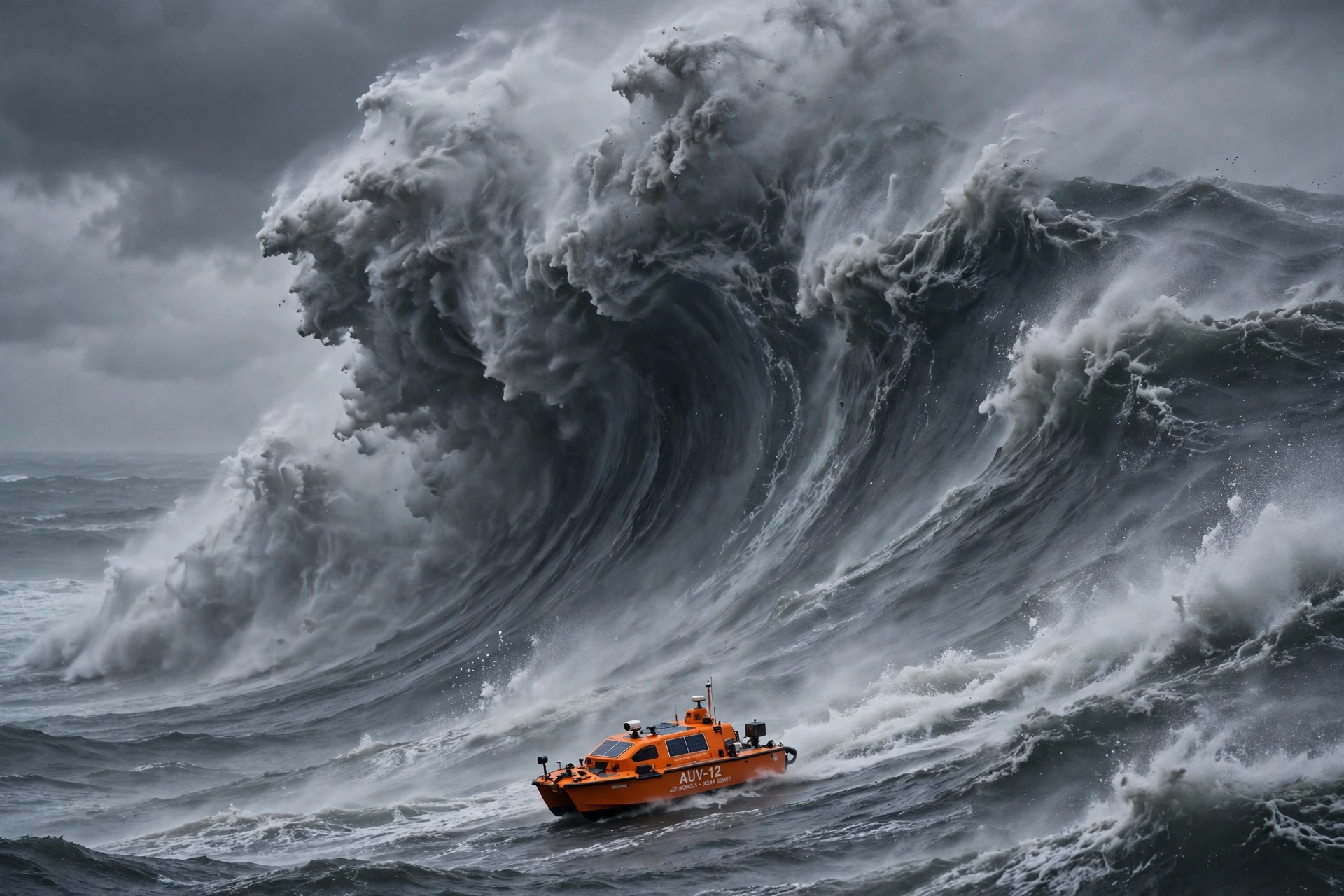
A robot boat survives bad weather by being small, sealed, and stubborn. There are no windows to break, no crew to keep safe, and no cargo to shift. The hull is watertight, the electronics sit in sealed boxes, and the design is made to right itself if a wave rolls it over. Sensors measure the boat’s angle twenty times a second or more, and the software corrects course constantly.
Strategy matters as much as strength. When a storm builds, the boat turns its bow into the waves, slows down, and rides it out rather than fighting it. Some boats simply stop and drift with their sea anchor out until the weather passes. The Saildrone that sailed inside a hurricane did exactly this kind of patient riding — and came back with data no crewed ship could safely have gathered.
What do robot boats actually do?
Most robot boats are data collectors. Their decks carry the same instruments a research ship would: sensors for water temperature, salinity, dissolved oxygen, currents, and wave height, plus weather stations above the waterline and echo sounders below it to map the seafloor. The data goes ashore by satellite in real time, so scientists can watch the ocean change as it happens.
That data has real uses. NOAA uses Saildrones to track fish and mammals, measure how much carbon dioxide the ocean absorbs, and study how storms build. Survey boats map the seafloor for charts and cables, and other robot boats patrol harbours or watch for illegal fishing. Because they cost a fraction of a crewed vessel to run, they can go places — and stay there — that would never justify a full ship.
The same trade-offs show up underwater, too. Our guide to how underwater robots work looks at the submersibles that inspect pipelines and wrecks, and robot boats often work alongside them, acting as a relay station between the deep machines and the shore.
Robot boat vs crewed research ship vs buoy
| Vessel | Crew | Endurance | Best for |
|---|---|---|---|
| Robot boat (USV) | None | Months, wind and solar | Long ocean surveys, storms, remote water |
| Crewed research ship | Dozens | Weeks, limited by fuel and stores | Complex science, repairs, heavy equipment |
| Moored buoy | None | Years, fixed in one place | Continuous data from a single spot |
A robot boat sits between the other two: it moves like a ship and endures like a buoy, but it cannot fix itself or handle heavy gear. Fleets now mix all three — the robot boat gathers the data, the buoy watches one place, and the ship does the jobs that need hands.
FAQs
How fast can a robot boat go?
Not fast. A wind-driven Saildrone averages one to three knots — walking pace. The Mayflower’s crossing took 40 days for 3,500 miles. Speed is not the point; staying out there is.
Who is in charge if something goes wrong?
The boat is, first. Its software handles steering, collision avoidance, and storm riding on its own. Operators on shore watch over the satellite link and can take remote control when needed.
Can a robot boat carry cargo or passengers?
Passengers, no — there is nowhere for them to sit. Cargo, sometimes: small robot boats have carried supplies and scientific equipment between ships, but they are data gatherers first, not freighters.
Are robot boats safe for other ships?
They are designed to be. They follow the same collision rules as crewed vessels, carry radar reflectors and lights, and broadcast their position. Operators keep them clear of busy shipping lanes where possible.
What happens when a robot boat breaks down at sea?
It sends an alert by satellite, and operators decide what to do. Often the boat can limp home on backup power. If not, a crewed vessel is sent to recover it — the same way a broken-down yacht would be towed in.
Conclusion: the ocean’s patient observers
A robot boat earns its keep by doing the ocean jobs nobody wants: months alone at sea, in storms, gathering data no crewed ship could afford to collect. Wind and sun give it endurance, sensors and software give it judgement, and a satellite link keeps it in touch with shore. Its limits are honest ones — it is slow, it cannot fix itself, and it cannot carry people.
If you want to follow one, the NOAA guide to uncrewed surface vessels explains the designs and the missions in detail, and the Fast Company story of the Mayflower crossing shows what a single crossing taught the people who built it. And for the wider picture, our What Is Robotics? guide and the story of robot lifeguards show where sea-going robots fit in the bigger field.
Further reading: NOAA Ocean Exploration, “Uncrewed Surface Vessels” — https://archive.oceanexplorer.noaa.gov/technology/usv/usv.html ; Fast Company, “How the Mayflower became the first autonomous ship to cross the Atlantic Ocean” — https://www.fastcompany.com/90758518/how-the-mayflower-became-the-first-autonomous-ship-to-cross-the-atlantic-ocean