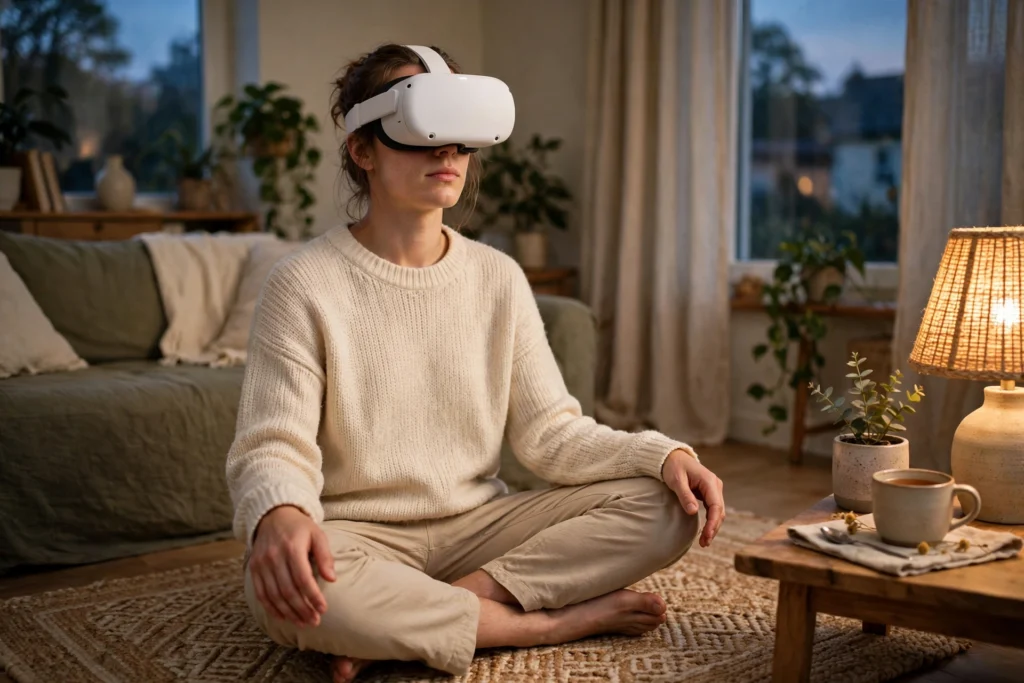
VR mindfulness is meditation practised inside a virtual reality headset. You put the headset on and find yourself somewhere calm — a forest clearing, a beach at dawn, a quiet mountaintop — while a voice guides your breathing. The headset blocks out your actual surroundings, so your attention has far less to fight against.
It is a relaxation and focus tool, not a medical treatment, and it does not replace professional help for anxiety or other health concerns.
Key Takeaways
- VR mindfulness places you inside a calm virtual scene so distractions from your real room disappear.
- A session mixes a guided voice, slow breathing cues, and spatial sound that moves as you turn your head.
- Ten to fifteen minutes is enough; longer sessions suit people who already meditate.
- Best-known apps include TRIPP, Guided Meditation VR, and Maloka, most running on a standalone headset such as a Meta Quest.
- VR helps beginners focus, but it is still meditation — the headset does the setting, not the practising.
Why is it so hard to meditate in a normal room?
Anyone who has tried a meditation app on their phone knows the story. The first minute goes well. Then the fridge hums, a neighbour’s dog barks, and a thought about tomorrow’s emails barges in. Traditional meditation asks you to hold your focus with nothing but willpower, and for a beginner that is a lot to ask.
VR changes the starting conditions. The headset takes over your sight and hearing, the two senses that carry most distractions into your head. Your living room is gone, replaced by a scene built to be still: slow water, soft light, a gentle breeze through virtual trees. That feeling of being somewhere else has a name — presence — and it is why VR mindfulness feels different from closing your eyes and listening to an audio track.
What does a VR mindfulness session actually look like?
It is nine in the evening, the day has been long, and you have ten minutes before bed. You clear a small space on the floor, sit down, and put on the headset. A menu floats in front of you with a handful of scenes: a pine forest, a desert at sunset, a platform above the clouds. You pick the forest.

Sunlight comes through the trees, a pond sits still in front of you, and birdsong moves around you as you turn your head — that is spatial audio, sound that behaves as if it comes from a real place. A calm voice suggests you breathe in for four counts and out for four. A soft ring of light grows as you inhale and shrinks as you exhale, so your eyes have something gentle to follow. Most sessions run like this for ten to twenty minutes. When it finishes, you take the headset off. Your room is exactly where you left it — but your breathing is slower, and the day feels a little further away.
How do the breathing exercises work?
Breathing is the part of VR mindfulness that does the most practical work. Many apps show a visual cue that moves with your breath: a glowing orb that swells, a ring that expands, a field of light that brightens. You breathe in as it grows and out as it shrinks. Your eyes, your ears, and your lungs all follow the same slow rhythm, which leaves little room for the mental chatter that usually derails a session.
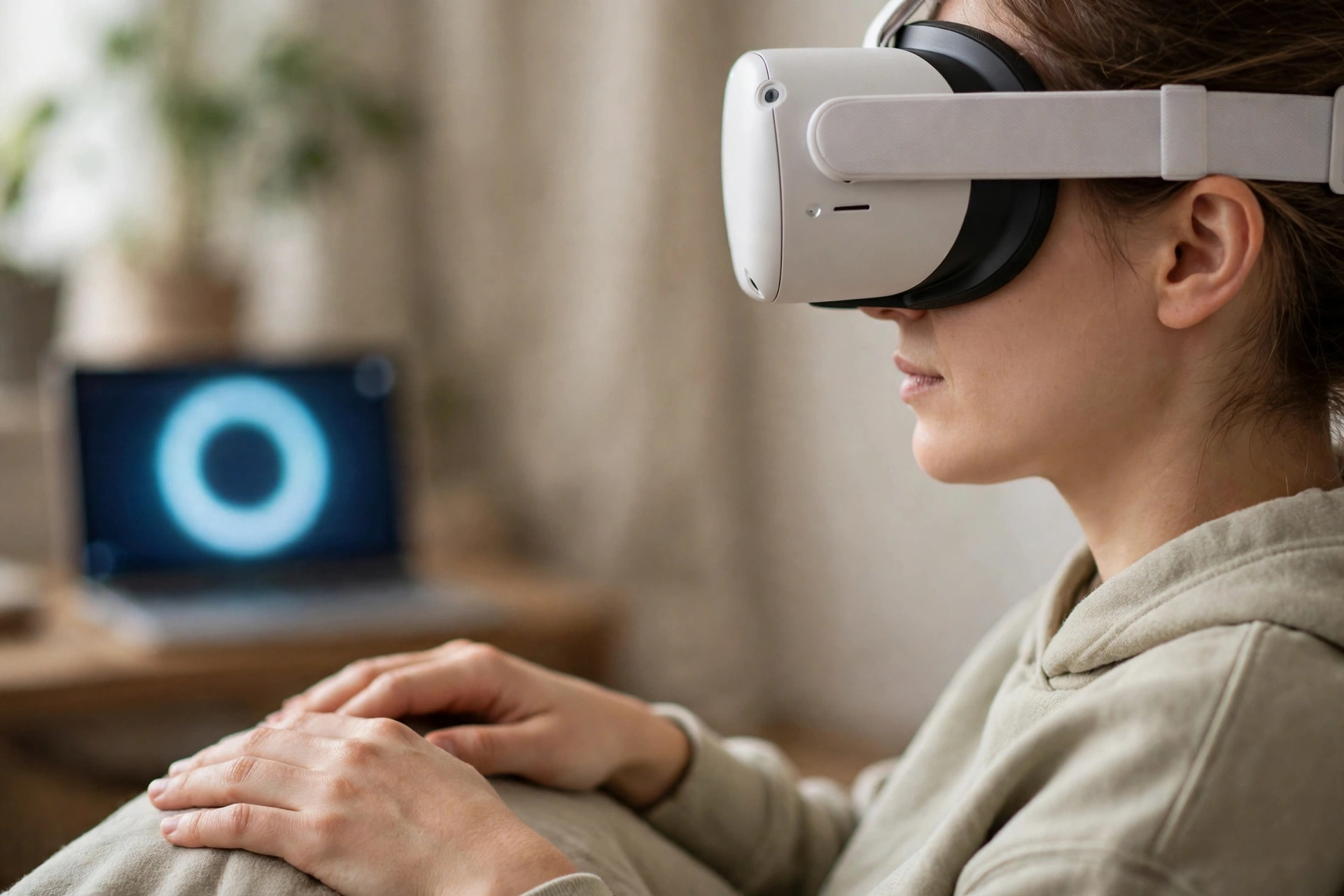
Some apps add biofeedback: a sensor watches your heart rate or breathing, and the scene responds as you slow down. Early studies have found that people often report feeling calmer after VR meditation than after audio-only sessions, and some research has measured lower stress markers. But the evidence base is still young, samples are small, and results vary. Treat VR mindfulness as a helpful habit, not a proven therapy.
VR mindfulness vs traditional meditation
Neither one wins outright. They suit different people and different days.
| VR mindfulness | Traditional meditation | |
|---|---|---|
| Getting started | Easier for beginners — the scene holds your attention | Harder at first — focus comes from practice alone |
| Cost | Needs a headset and sometimes a paid app | Free — a quiet corner is enough |
| Where you can do it | Anywhere with a bit of clear floor space | Anywhere, including a train or a park bench |
| Distractions | Blocked by the headset | You learn to notice them and let them pass |
| Best for | People who struggle to focus or unwind at home | People who want a portable, screen-free habit |
Think of VR mindfulness as training wheels for attention. Some people keep the training wheels because they enjoy the experience. Others use VR for a few weeks, build the habit, and then find they can sit quietly without it. Both outcomes are fine.
Which apps are worth trying first?
You do not need to buy anything on day one. Most headsets come with a free trial or a free starter scene. TRIPP is the best-known name, with guided sessions that mix breathing, visuals, and sound, and it runs on Meta Quest, PlayStation VR2, and phones. Guided Meditation VR is simpler: pick a place — a beach, a waterfall, a mountain lake — and sit in it with a guided voice. Maloka builds a small virtual island that grows as you practise, and Liminal VR focuses on short experiences for calm and focus. Before you pay, check whether it runs on your headset and whether the voice suits your taste — an irritating voice will ruin a beautiful scene.
What do you need to get started?
A standalone headset such as a Meta Quest is the usual starting point, because it needs no computer and no cables — you can read how the hardware itself works in our guide to How Do VR Headsets Work? You also need a clear patch of floor about the size of a yoga mat. Your headset’s guardian or room-mapping system draws that safe area for you; our explainer on How Does VR Room Mapping Work? covers how that boundary is set up. Controllers are mostly optional: many mindfulness apps start with a single button press, and some support hand tracking — see How Do VR Controllers Work? for what they do. Sit rather than stand for your first few sessions, keep the volume low, and pick ten minutes. Short and finished beats long and abandoned.
Are there any downsides?
Some people feel queasy in VR, especially in scenes where the view moves while their body stays still. Meditation scenes are usually gentle — you sit still and the world stays still — so motion sickness is less common here than in VR games, but if you are prone to it, start short and stop if you feel unwell. Headsets are also heavier than headphones, and wearing one for half an hour can leave a mark on your forehead or a stiff neck. Ten to fifteen minutes is the sweet spot. And a headset is a real purchase, so try one at a friend’s house or a demo station before committing, if you can.
Frequently asked questions
Do I need an expensive headset for VR mindfulness?
No. A standalone headset such as a Meta Quest is the most common choice, and older models work fine because the scenes are simple. A phone-based viewer can give you a taste, but the experience is much weaker.
Is VR mindfulness as good as real meditation?
It depends on what you mean by good. For building a regular habit and learning to focus, many beginners find VR easier. For depth and portability, traditional meditation has the edge. The best practice is the one you actually do.
Can VR mindfulness help with stress?
Many people say it helps them unwind, and some early research supports that. It is a general wellness tool, not a medical treatment — if stress is affecting your health, sleep, or daily life, speak to a doctor or a qualified professional rather than relying on an app alone.
Will VR mindfulness make me dizzy?
It can, though meditation scenes are among the gentlest VR experiences because you sit still and the scene stays still. If you feel unwell, take the headset off, sit quietly, and drink some water.
Conclusion
VR mindfulness will not change your life in one session, and anyone who promises that is selling something. What it does, quietly and reliably, is remove the hardest part of starting a meditation habit: the first five minutes, when your mind is still buzzing and your room is full of distractions. The headset gives you a calm place to land, a voice to follow, and a rhythm to breathe to. For a wider look at what else the technology is used for, see Virtual Reality Beyond Gaming.
If you already own a headset, try a ten-minute session tonight — pick a forest, breathe with the light, and see how you feel afterwards. If you do not own one yet, borrow a friend’s first. And if VR mindfulness turns into a regular habit, you may find you need the headset less and less. That is not a failure of the technology. That is the technology doing its job.
Further reading: PsyTech VR’s guide to virtual reality meditation (https://psytechvr.com/vr-meditation) and Woke Waves on how VR meditation is reshaping wellness (https://www.wokewaves.com/posts/virtual-reality-meditation-transforming-wellness).