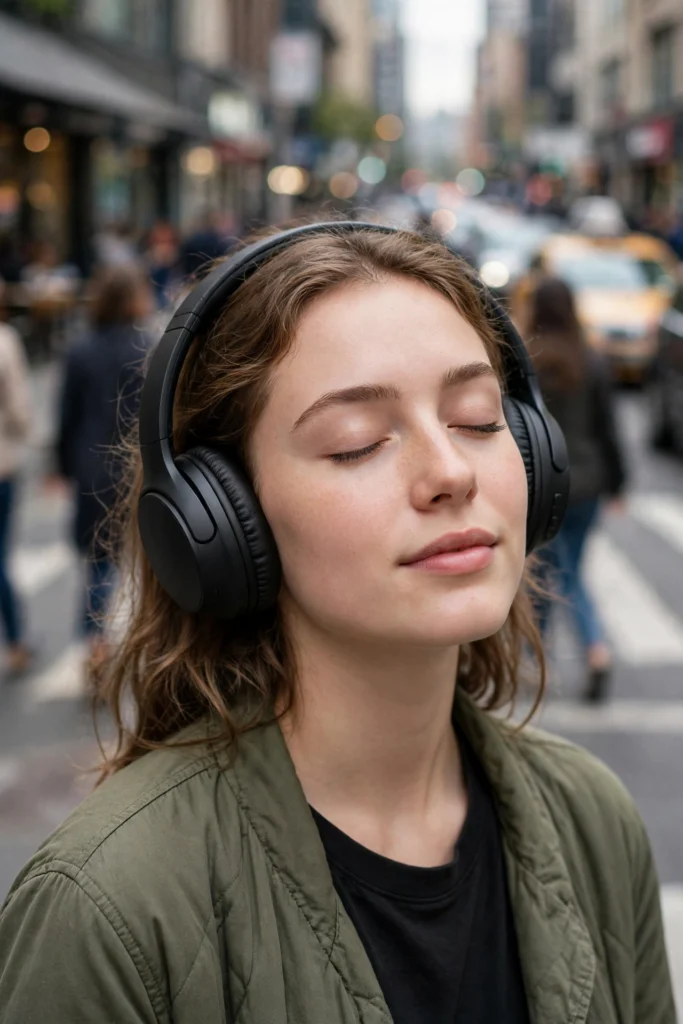
Active noise cancellation is a trick your headphones play on sound. Microphones listen to the noise — the engine hum on a plane, the chatter in a café — and the headphones play back a mirror-image sound wave that cancels much of it out before it reaches your ears. The result isn’t total silence, but the world gets noticeably quieter.
Key Takeaways
- Active noise cancellation (ANC) plays “anti-noise”: a mirror-image sound wave that partly cancels the noise around you.
- Microphones, a processor, and the speaker repeat the job hundreds of times a second.
- ANC is strongest on steady, low sounds such as engine hum, weakest on sudden sharp sounds.
- Feedforward, feedback, and hybrid ANC describe where the microphones sit.
- Ear cushions still matter: they block the high sounds ANC can’t reach.
What does active noise cancellation actually do?
Switch ANC on in a noisy room and the background hum drops away within a second, while your music stays put. Nothing in the room has changed. What changed is what reaches your ears.
Sound travels as waves of pressure, and when two waves meet they add together. If a peak meets a trough of the same size, they cancel out — like adding 1 and −1 to get zero. ANC exploits that: the headphone listens to the noise, works out its mirror image, and plays it into your ear as the real noise arrives.
The key word is “partly”: cancellation only works at your eardrum, and only if the mirror image lines up precisely. That is why ANC can hush a plane cabin and still let a nearby conversation through.
How do headphones create anti-noise?
Three parts do the work, running in a loop many hundreds of times a second.
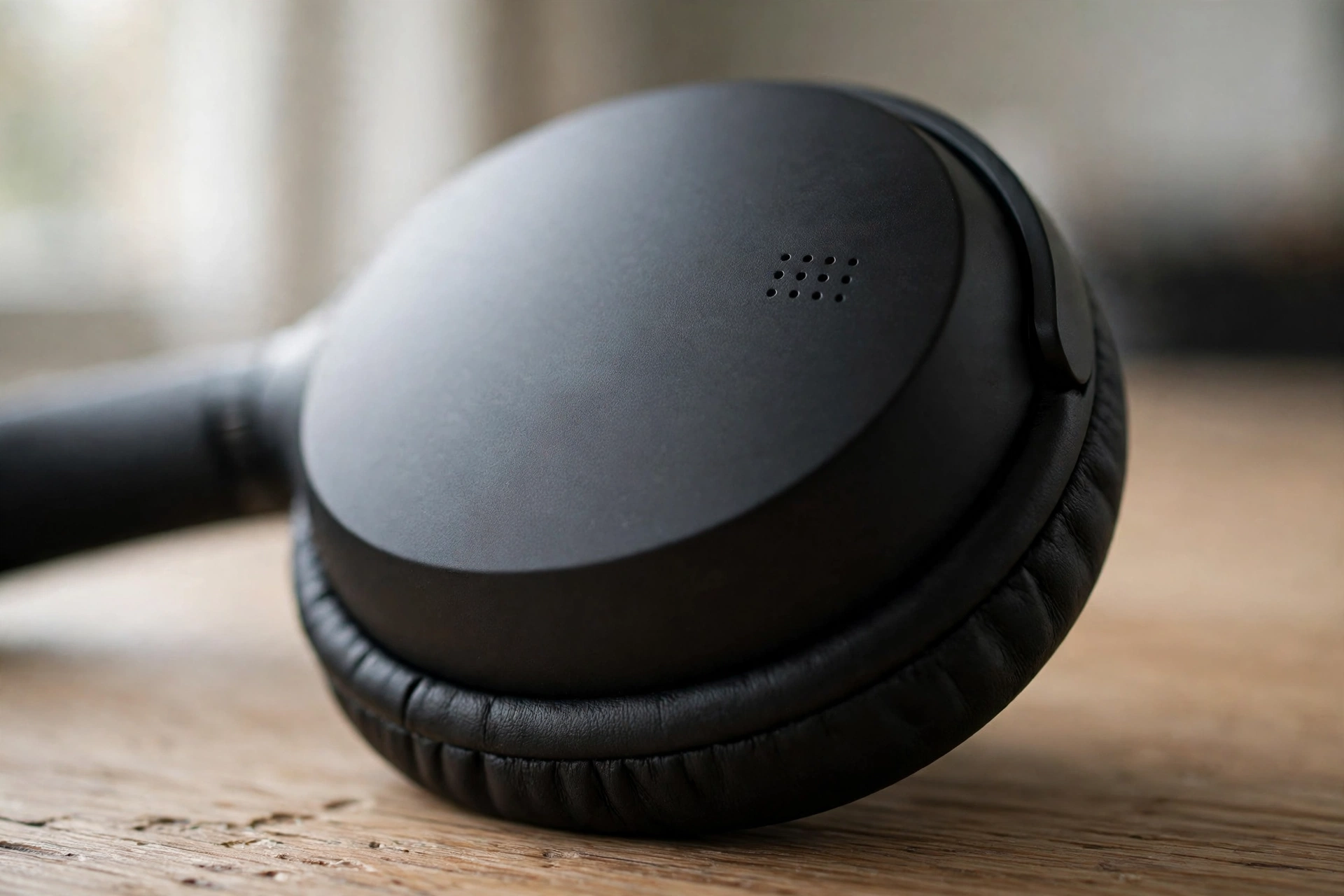
First, the microphones. Tiny microphones sit on the outside of each ear cup, listening before the sound reaches your ear. On better models, a second one sits inside the cup, checking what got through.
Second, the processor. A small digital signal processor flips the microphone signal into its mirror image, adjusted for the tiny delay before the sound reaches your ear. This must happen in well under a millisecond — any slower, and the mirror image arrives out of step and makes things worse.
Third, the speaker. The same driver that plays your music also plays the anti-noise, mixed in with your song. You never hear the anti-noise on its own — you only notice the noise it removed.
What are feedforward, feedback, and hybrid ANC?
The three types differ in where the microphones sit. Feedforward ANC puts them outside the ear cups, so they hear the noise first and the processor gets a head start. The risk: if the headphone shifts, what the microphone hears no longer matches what your ear hears.
Feedback ANC puts the microphone inside the ear cup, close to your ear. It measures what is actually getting through and corrects the anti-noise until the result is right — self-correcting, but a fraction slower and narrower in range.
Hybrid ANC uses both, combining the two readings. Most mid-range and premium headphones today use it, because it covers the weaknesses of each approach.
Active noise cancellation vs passive isolation
ANC is only half the story. The other half is passive isolation: the ear cushions sealing around your ears. The two handle different parts of the noise, and a good headphone needs both.
| Active noise cancellation | Passive isolation | |
|---|---|---|
| How it works | Microphones and anti-noise waves | Ear cushions sealing out sound |
| Best at | Steady low sounds: engines, fans, traffic hum | Higher sounds: voices, clatter, hiss |
| Needs power? | Yes — battery or USB power | No |
| Weak spot | Sudden sharp sounds | Low rumbles pass through cushions easily |
That table explains a common disappointment: someone buys ANC headphones expecting silence, then hears the office conversation next to them as clearly as ever. The ANC did its job on the air conditioning hum. The voices were never its job — that is what the cushions are for.
What can’t ANC block?
Sudden sounds are the biggest gap. A door slamming, a dog barking, a dropped tray — by the time the microphone hears it and the processor builds the mirror image, the sound has already reached your ear.
High voices are another: speech sits at higher frequencies than engine hum, and short sound waves are harder to line up. ANC takes the edge off a crowd, but it will not erase the person beside you. Wind is a similar problem — across the outside microphones it sounds like loud low noise, and the system can overreact with a rushing sound of its own.
And ANC needs power. When the battery dies, most models either keep playing passively with ANC off, or stop working entirely. A headphone that still plays over a cable with a flat battery is worth having on a long trip.

A worked example: one flight with ANC on
At cruising altitude, the cabin hums at a steady drone — exactly the sound ANC handles best. Independent testers commonly measure reductions of 20 to 40 decibels for steady low-frequency noise like this: your ears hear it as the background dropping to between a quarter and a sixteenth of its original loudness.
With the drone pushed down, you can listen at a lower volume and still hear every word of a podcast. The announcements still come through, and so does the baby two rows back — ANC is not a mute button. Try the same headphones in a busy café and the picture flips: the espresso machine softens, but the conversation at the next table stays readable.
What to check before buying ANC headphones
Five checks will tell you more than any spec sheet. First, fit: if the cushions seal well, passive isolation is doing its share — but glasses arms break the seal, so try them on with your glasses. Second, the modes: look for a transparency mode, which lets the outside world in when you need it. Third, battery life with ANC on, since makers often quote life with ANC off. Fourth, wired backup: a 3.5 mm cable that works with a flat battery turns a dead headphone into a working one. Fifth, call quality: some models keep your voice far clearer on calls.
Frequently asked questions
Does active noise cancellation damage your hearing?
No evidence suggests ANC harms hearing. It reduces the noise reaching your ears, and most people listen at lower volumes with it on. If you feel ear pressure, switch it off.
Can ANC block out voices completely?
No. Voices are high-frequency and unpredictable, so ANC can only soften them. A good seal muffles them further, but no headphone makes a nearby conversation vanish.
Do noise-cancelling earbuds work as well as over-ear headphones?
Over-ear models usually cancel more, because their cushions seal better and they hold more microphones. Good earbuds still handle steady low sounds such as engines well, and they are far easier to carry.
Why do my ANC headphones sound different when ANC is on?
ANC changes the sound slightly, because the anti-noise signal affects what reaches your ear. Some hear a faint hiss or a slight bass change, but makers tune their headphones with ANC on, so the difference is small.
Is ANC worth paying extra for?
It depends on where you listen. If you fly often, commute on trains, or work in a noisy office, ANC is usually worth it. If you mostly listen in a quiet room, spend the money on sound quality instead.
The bottom line
Active noise cancellation is a neat piece of physics hiding in an everyday gadget: microphones hear the noise, a processor builds its mirror image, and the two cancel each other out at your ear. It is at its best with steady, low sounds — the engine, the fan, the traffic hum — and it leans on the ear cushion for the rest. Try a pair where you will use them: five minutes of real noise beats any review.
Further reading: SoundGuys guide to ANC types and How-To Geek explainer. Related on Techserps: Bluetooth headphones, Wi-Fi, wireless charging and cloud gaming.