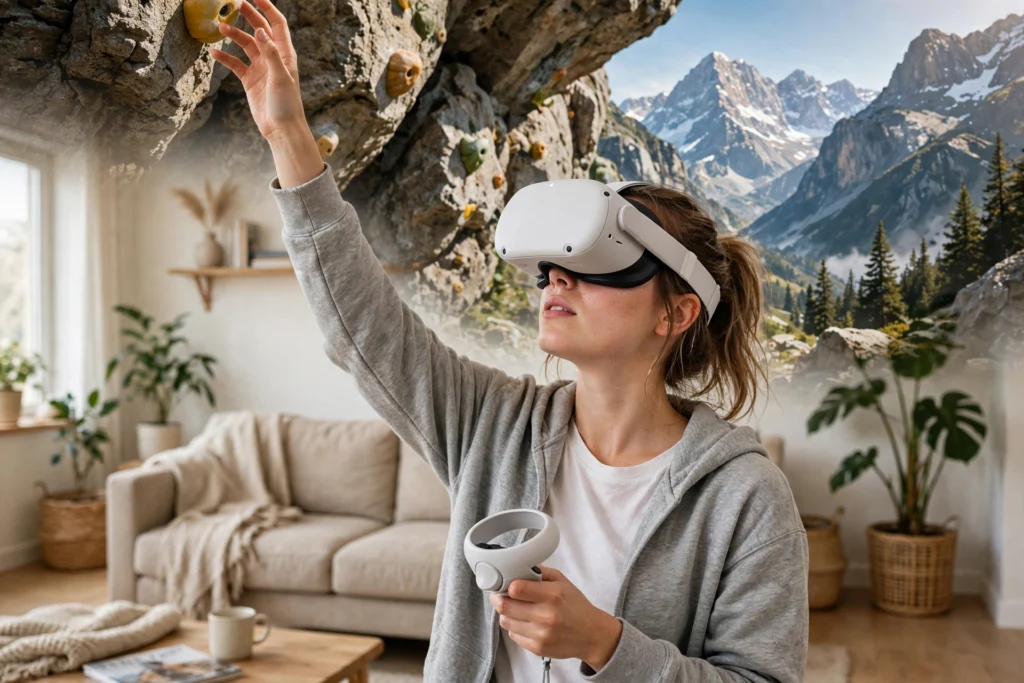
VR rock climbing turns your living room into a mountain face. You put on a headset, reach for handholds that only exist in software, and pull yourself up a cliff while your feet stay on the carpet. There is no rope and no real drop below you — but your arms will still ache by the top.
Key Takeaways
- Your real hand movements map onto a virtual wall: grip, reach, and pull yourself up hold by hold.
- Each hand has a stamina meter. Hang on one hand too long and your grip slips.
- The best-known climbing game is The Climb 2, with five locations and three routes each.
- You need a VR headset, two controllers, and a clear patch of floor.
- It is a genuine arm and shoulder workout, but a game first and a training tool second.
How does VR rock climbing actually work?
Your headset tracks your head, and your controllers track your hands. Squeeze a grip button and the game treats that as grabbing a hold; let go and your hand is free to reach for the next one. Holds vary like on a real wall: some big and friendly, some small crimps, some that crumble if you linger.
What makes it feel like climbing is the stamina system. Each hand carries a grip meter, shown on your wrist. Hanging from one hand drains it; holding on with both hands lets it refill. Run out and that hand lets go, ready or not. Chalk slows the drain: twist your wrists to re-chalk and buy more time on each hold. That loop — grip, reach, rest, re-chalk — forces the same decisions real climbers make.
Your body sells the illusion. To grab a hold above your head, you genuinely reach up. Some games add hazards: holds that crumble after a few seconds, grips on panels that appear and disappear, and ledges you have to jump for.
What do you need to start?
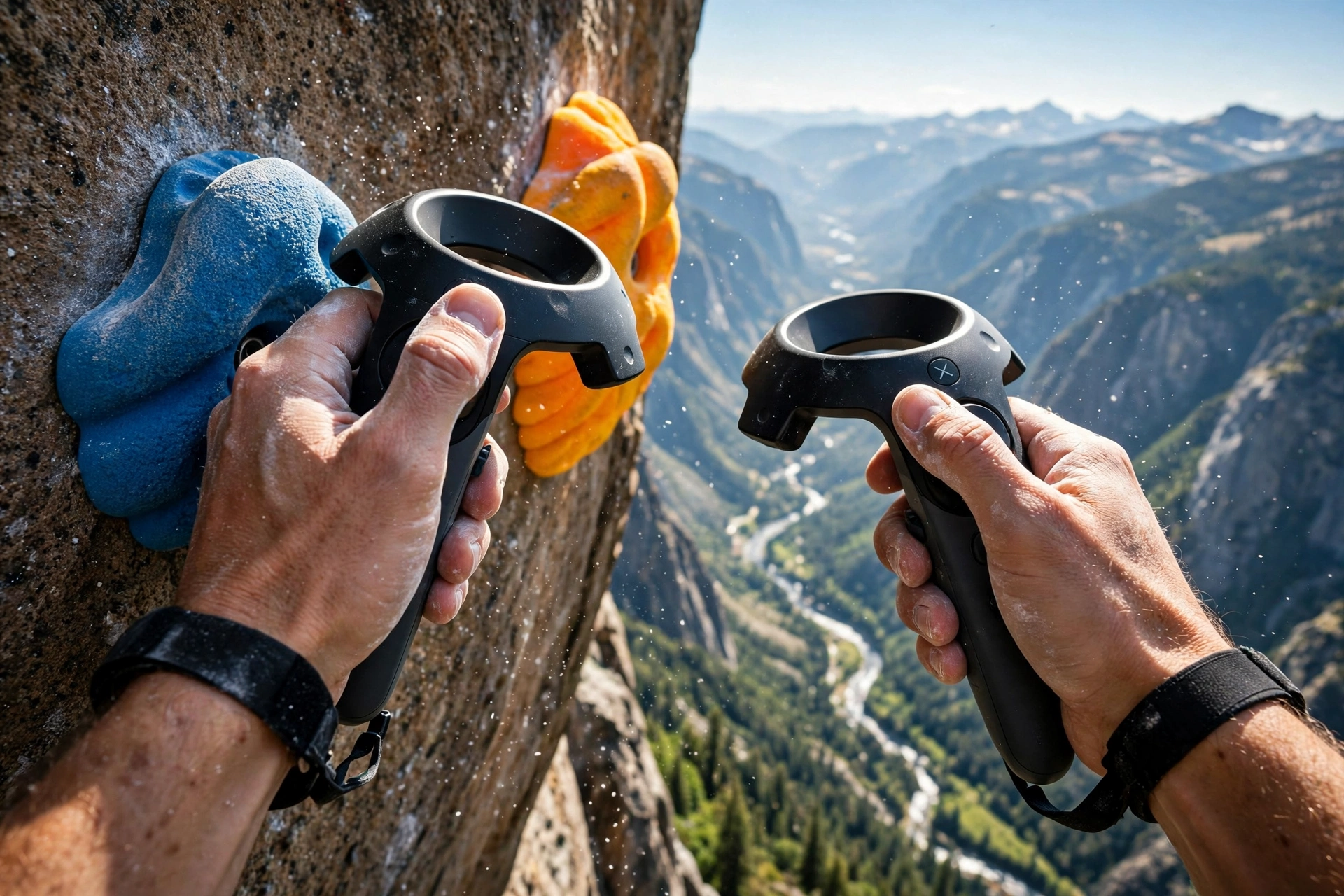
The shopping list is short. A standalone headset such as a Meta Quest works on its own, with no PC or console, and that is how most people climb. You need the two controllers that come with it, since they are your hands on the wall. Controllers are the reliable option: the grip buttons give a clear grab and release, and the wrist straps keep one from flying across the room mid-climb.
Space matters more than gear. Clear about two metres square of floor, push the coffee table aside, and draw your guardian boundary before you start — the headset warns you if you drift toward a wall or lamp. If you are new to VR, stand still rather than pacing around the room; the climbing asks enough of your balance already. Start in casual mode, which drops the stamina and chalk rules.
Which VR climbing games are worth trying?
The Climb 2 is the one most people start with. Made by Crytek, it offers alpine peaks at dawn, glass skyscrapers, caves, and hidden shortcuts. It has five locations with three routes each, graded easy, medium, and hard, plus a casual mode and a professional mode where stamina and chalk matter. A free Freestyle mode lets you practise without a clock, and ghost races let you chase your own best time or a friend’s. The original The Climb (2016) covers similar ground with fewer locations.
| Game or mode | Where to play | Best for |
|---|---|---|
| The Climb 2 | Standalone Quest headsets | The full experience: five locations, casual and professional modes, ghost races |
| The Climb (original) | PC VR and older Rift headsets | A cheaper first taste of virtual climbing |
| Freestyle mode (inside The Climb 2) | Same as The Climb 2 | Practising routes with no timer and no pressure |
Is VR rock climbing a real workout?
Yes, in the way that matters for a living-room game. Your shoulders, arms, and grip do the work, and your core stays busy while you reach and lean. A twenty-minute session leaves most people with tired forearms and a light sweat — the same kind of effort our guide to VR fitness describes, for your upper body instead of your legs. It pairs well with leg-heavy VR rowing.
What it is not is a substitute for real climbing. Your legs never push, your feet never find a foothold, and the grip strength it builds is the endurance of squeezing a controller, not the finger strength of hanging from a real crimp. Think of it as a fun way to move.
How do you stay safe while climbing in VR?
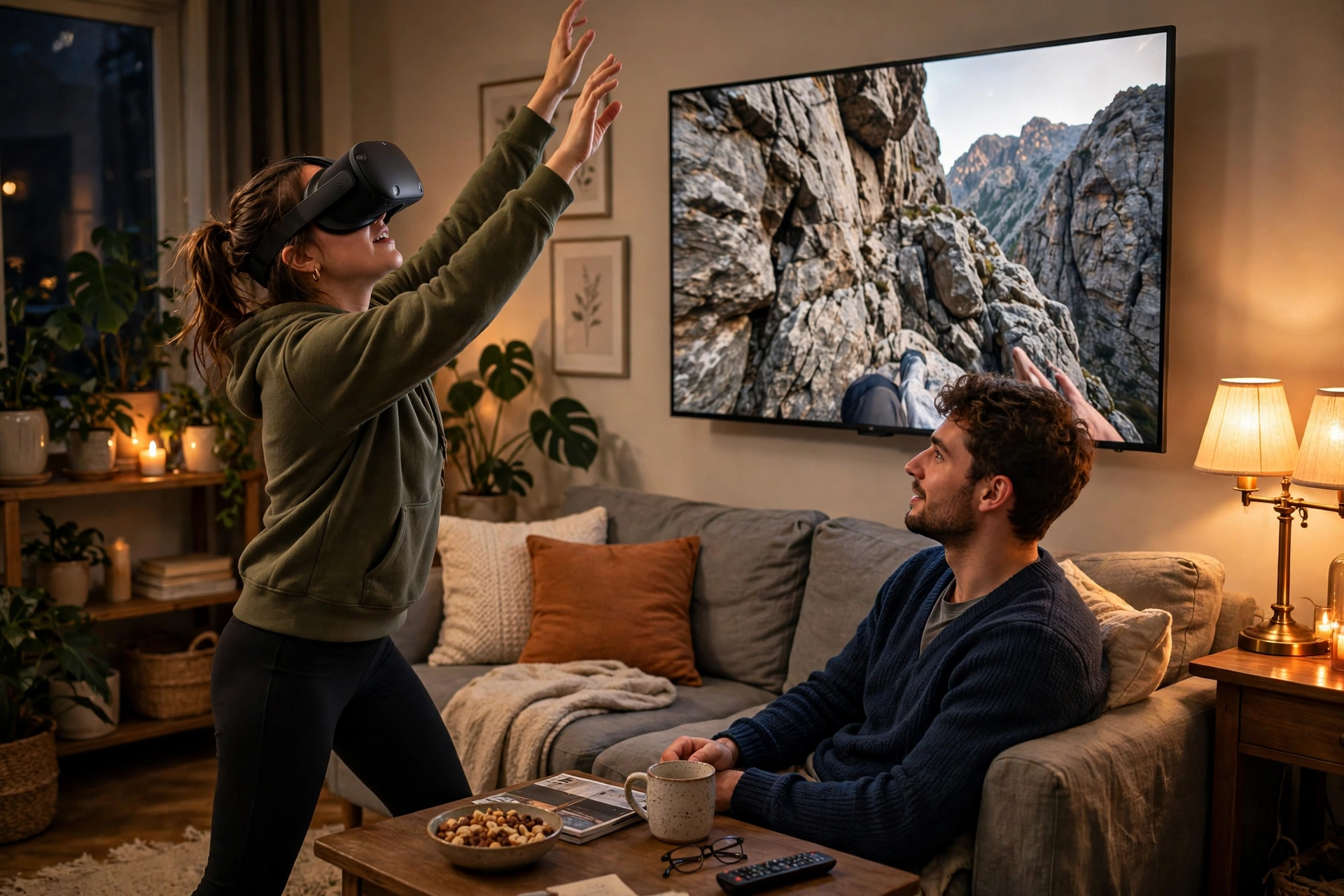
The dangers are ordinary, not dramatic. You will not fall off a real cliff, but you can walk into a bookshelf. Clear the floor, keep the guardian boundary on, and wear the controller straps. If someone else is in the room, ask them to watch your space — the photo below shows how that works, with one person climbing and another keeping an eye on the room.
Take breaks, too. The routes are short, the next one looks easy, and suddenly you have been reaching overhead for half an hour. Rest your arms between routes and stop if your shoulders complain. If heights bother you in real life, casual mode or a seated position takes the edge off.
A first climb, step by step
Clear your space, draw the guardian boundary, and put the wrist straps on. Open The Climb 2 and pick the easiest Alps route in casual mode. Spend five minutes finding the holds and practising grabbing, releasing, and chalking. Then climb slowly, resting on two hands whenever your grip meter drops below half. Finish the route, try it once more in professional mode, then cool down in Freestyle, take the headset off, and stretch.
Frequently asked questions
Do I need to be fit to try VR rock climbing?
No. The easy routes ask for little more than reaching and holding on for a few seconds, and casual mode removes the stamina rules entirely.
Can I play seated?
Yes, most climbing games work seated, and it is a sensible choice if you are new to VR or short on space. You lose some of the reaching and leaning, but the grip and route-planning stay the same.
Does VR climbing help with real rock climbing?
A little, in the soft skills: reading a route, planning moves ahead, and staying calm when a hold looks far away. It will not build finger strength or teach footwork.
Will I get motion sick?
Some people do, especially on routes with big drops. The feeling usually fades with short, regular sessions. If it hits, stop straight away and try again another day rather than pushing through it.
What headset do I need?
Any modern standalone headset with tracked controllers will do — a Quest is the most common choice, since The Climb 2 runs natively on it.
Conclusion
VR rock climbing is the closest most of us will get to scaling a cliff face before breakfast: a real wall and a real workout for your arms. Start on the easiest route, in casual mode, with a clear floor and a friend nearby. If you enjoy the first climb, try the same route in professional mode tomorrow.
Further reading: The Climb 2 on Wikipedia and the AR/VR Guide review of The Climb 2.