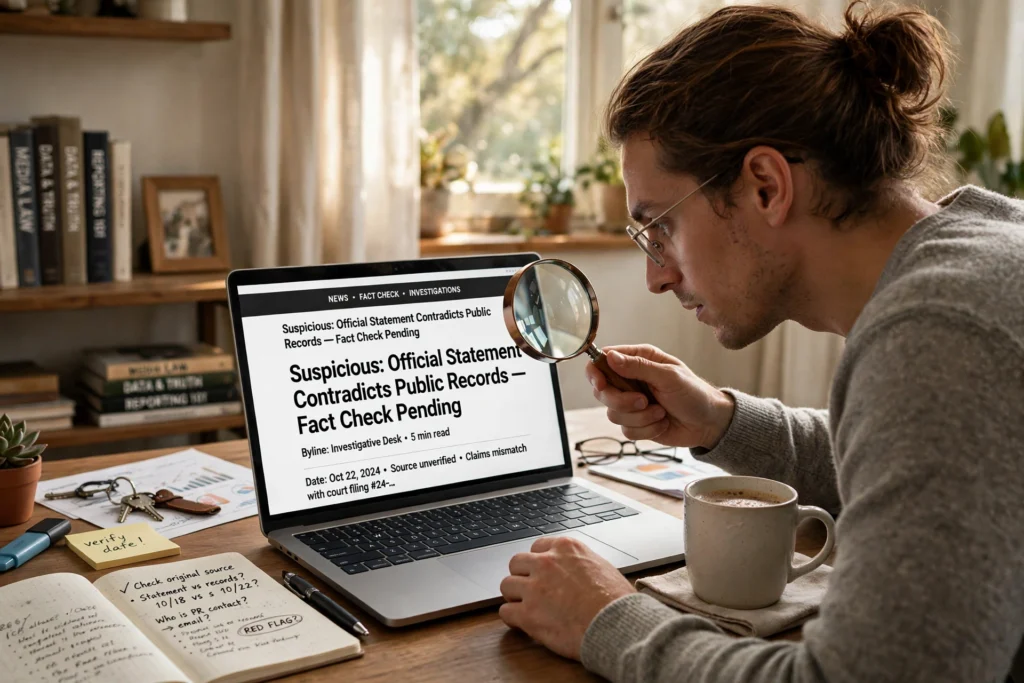
AI detect fake news tools don’t read a story the way you do. They scan its claims, check where it came from, and look for writing patterns common in made-up stories, then flag the ones that look suspicious. They are a useful first filter, not a final verdict — and they still miss plenty.
Key Takeaways
- AI fake-news detection combines claim checks, source reputation, language, and image checks.
- No single signal proves a story false; systems weigh several clues and give a score or warning.
- Satire and genuinely new events are the hardest cases.
- Human fact-checkers still make the final call on important stories.
- Borrow the same checks yourself: look at the source, search the claim, check the date.
What does “fake news” actually mean?
At its simplest, fake news means a story that is false or misleading but dressed up to look like real reporting. Sometimes the facts are invented outright. Sometimes a real event is twisted — a genuine photo attached to the wrong story, or a real quote taken out of context.
It helps to separate three kinds. Misinformation is false information shared by someone who believes it. Disinformation is spread on purpose, to mislead people or earn money from clicks. Then there is satire, meant as a joke but shared as if it were real.
How does AI spot a suspicious story?
There is no single trick. Most tools combine several checks, each catching a different kind of problem.
Checking the claims. Systems break an article into claims — who did what, when, where — and search fact-checking databases and trusted sources. If a claim contradicts a well-documented record, the story gets flagged. This works for claims already checked, and poorly for claims about something that happened an hour ago.

Checking the source. A story from a site with a long record of accurate reporting starts with the benefit of the doubt; one from a site registered last week, which copies articles and hides who runs it, starts with a warning. The source check is fast, which is why platforms run it first — but it is crude: a reliable outlet can still publish a bad story.
Reading the writing style. Made-up stories often share a style: emotional language, ALL-CAPS headlines, and phrases meant to make you angry or afraid. They may repeat one claim several times or skip small details — dates, names, places — that real reporting includes. Language models learn these patterns from thousands of real and fake articles. It is a useful clue, not proof.
Checking the pictures. A growing share of fake news travels as an image or video. AI tools can run a reverse image search to see whether a photo is old, taken elsewhere, or already attached to a different story, and newer tools look for signs an image was generated or altered.
Where does the training data come from?
A detection model is only as good as the examples it learned from: articles fact-checkers have already rated as true or false, plus posts moderators have reviewed.
The catch is that these datasets go stale quickly: a model trained on stories from two years ago has never seen this week’s rumours, so tools are retrained regularly and accuracy drops on unseen topics. There is also a balance problem: real news vastly outnumbers fake news, so training must flag rare bad stories without drowning honest posts in warnings.
What are the limits of AI fake-news detection?
First, context is hard. “The mayor resigned” might be true of one town and false of another. Satire is the classic failure: a joke article saying a celebrity bought the moon trips most detectors, because the words look exactly like a false news story.
Second, brand-new claims have no record to check against. When something happens for the first time, a model falls back on style and source signals — the weakest evidence. False stories spread fastest in the first hours after a big event.
Third, detectors can be fooled: writers who know how detection works can soften the emotional language and publish through a site with a clean-looking history. Detection is a moving target, not a solved problem.
Finally, there is bias: a model trained mostly on one country’s stories may judge others unfairly, so builders must keep checking whose stories get flagged.
How can you check a story yourself?
Start with the source. A quick search of the outlet’s name will usually tell you whether it is an established newsroom, a blog with a clear point of view, or a site nobody seems to have heard of.
Then search the claim itself. Copy a distinctive sentence into a search engine and see who else reports it. If only one obscure site carries the story, be cautious; if several independent outlets report the same facts, it is on firmer ground.
Check the date and the picture. Old stories resurface as if they were new, and photos get reused with new captions. A reverse image search takes seconds and often shows the photo is from a different year or place.

Finally, pause before you share. The stories most likely to be false are the ones that make you feel strongly. Waiting a few minutes and checking one other source is the cheapest fact-check there is.
FAQs
Can AI detect fake news perfectly?
No. Tools flag suspicious stories well on familiar topics, but they miss satire, brand-new claims, and well-disguised falsehoods. They work best as an early warning.
Why do some false stories get no warning label?
A story may be too new to have been checked, may come from a source the system trusts, or may be written in a style the model does not recognise. Some simply slip through.
Is satire the same as fake news?
Not in intent — satire is meant as a joke. But shared without context, readers can take it as fact, so detectors treat it cautiously.
Can AI-generated images fool detection tools?
Sometimes, yes. As generated images improve, the visual clues get subtler. Reverse image search still helps, because a generated image of a fake event has no earlier history.
What should I do if I shared a story that turned out to be false?
Delete the share if you can, and post a short correction. Corrections travel the same way the original did, and they help the people who saw your post first.
Conclusion
AI fake-news detection is a practical helper, not a truth machine. It scans claims, sources, writing style, and images, and catches many low-effort falsehoods. But satire, new events, and careful disinformation still slip past it — so the final check is always yours.
The next time a story feels too shocking to be true, give it the same treatment a detector would: check who published it, search the claim, check the picture, and wait before sharing. The five minutes it takes are worth far more than any warning label. For the wider picture, start with our guide to what artificial intelligence is, then see how the same pattern-matching powers AI spam detection and AI hallucination, and how AI helps defend against online threats. Britannica’s history of fake news is a good primer, and Poynter’s fact-checking archive shows how professionals verify claims every day.