
Generative AI is a type of artificial intelligence that creates new content — text, images, audio, video, or code — rather than just analyzing existing data. It learns patterns from large datasets during training, then uses those patterns to produce original outputs that resemble the data it learned from. Chatbots like ChatGPT are the most familiar examples.
Key Takeaways
- Generative AI creates brand-new content from patterns it learned during training — it predicts the most likely output rather than copying from memory.
- Most generative AI is built on machine learning and deep learning, especially large language models powered by the transformer architecture.
- Everyday uses include drafting text, writing code, generating images, and answering questions through conversational chatbots.
- Outputs can be inaccurate, biased, or misleading, so human review and fact-checking remain essential.
- Data privacy, copyright, and heavy computing costs are among its most discussed limitations.
What Does “Generative” Mean in AI?
Traditional AI systems are mostly analytical. They classify images, sort email into spam or not spam, or predict which customers are likely to leave. They work with what already exists. Generative AI flips that around: it produces something new.
The word “generative” describes a model that has learned the underlying structure of a dataset and can generate fresh samples that follow the same patterns. A text model learns how sentences are built; an image model learns how objects look. When you give it a prompt, it creates an answer that fits those learned patterns. That answer may combine ideas in ways no one has written before, which is why the output can feel surprisingly creative.
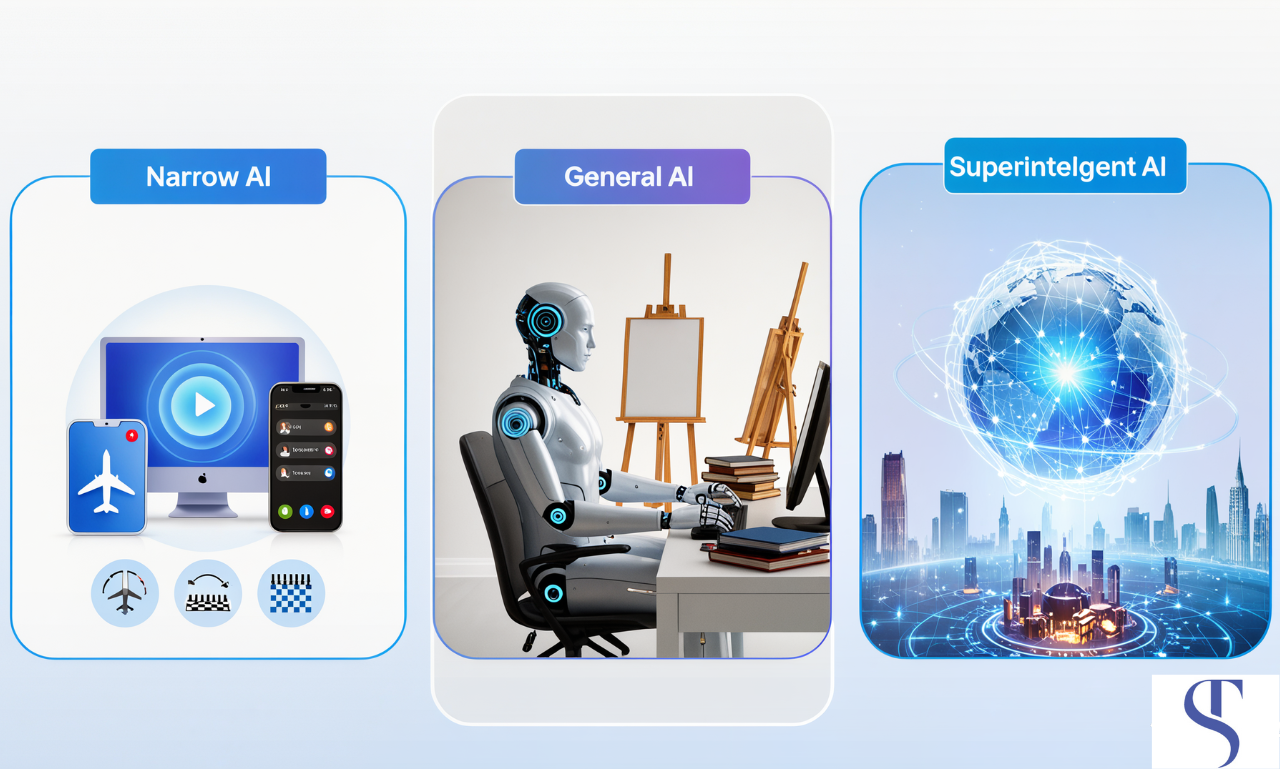
It helps to place this in the broader AI family. Earlier systems, such as narrow AI, were designed to do one specific job, like recognizing faces or translating short phrases. Generative AI is broader and more flexible — a single model can write an essay, summarize a document, and brainstorm business names. That flexibility is why it has drawn so much attention.
How Does Generative AI Actually Work?
Behind the impressive demos sits a surprisingly straightforward idea: learn from a huge number of examples, then predict what comes next.
Training: Learning Patterns From Massive Datasets
Training is the stage where a generative model studies its data. A text model reads through enormous collections of books, websites, and articles and gradually builds a statistical map of language — which words tend to follow which, how sentences connect, and how ideas are structured. An image model studies millions of captioned pictures and learns how visual concepts relate to words.
This stage takes enormous computing power, which is why only large organizations usually train the biggest models from scratch.
The Transformer and Large Language Models
Most modern generative AI runs on an architecture called the transformer, introduced by researchers in 2017. The transformer’s strength is attention: it weighs which parts of the input matter most when producing each piece of the output. That ability to consider context over long stretches of text is what lets today’s generative AI write coherent paragraphs instead of disconnected sentences.
When you chat with a tool like ChatGPT, the model predicts one piece of output at a time, checking each prediction against everything that came before. To learn more about how these conversational tools fit into everyday life, see our overview of ChatGPT’s impact on everyday conversations.

What Are the Main Types of Generative AI?
Generative AI is not one technology but a family of approaches:
- Text generation: Large language models write articles, emails, summaries, translations, and code from text prompts.
- Image generation: Diffusion models create pictures from written descriptions, and can also edit or extend existing images.
- Audio and voice generation: Models synthesize realistic speech, music, and sound effects from text or samples.
- Video generation: Newer models assemble short clips from descriptions, combining visual and motion patterns.
- Code generation: Tools trained on software repositories suggest functions, debug errors, and translate between programming languages.
Many products now combine several of these. A single prompt can produce a blog draft, an illustration for it, and a voice-over reading the result.
Where Is Generative AI Used in Everyday Life?
Generative AI has quietly moved into many daily routines:
- Writing assistance: Drafting emails, reports, resumes, and social media posts, then polishing them.
- Programming: Autocompleting code, explaining errors, and converting snippets between languages.
- Customer support: Answering common questions through chatbots before a human agent steps in.
- Creative work: Brainstorming slogans, designing mockups, and composing music drafts.
- Learning: Explaining difficult topics, generating practice quizzes, and summarizing long documents.
Businesses are adopting these tools quickly because they compress time-consuming work into minutes.
What Are the Limits and Risks of Generative AI?
Generative AI is powerful, but it has real limits that every user should understand:
- Hallucinations: Models can state false facts with complete confidence. Always verify important claims against reliable sources.
- Bias: Training data reflects human society, including its biases, and models can repeat or amplify them.
- Privacy and copyright: Anything typed into a public AI service may be stored or used for future training. Avoid entering sensitive personal or business information, and be thoughtful about who owns AI-generated work.
- Cost and energy use: Training and running large models consumes significant computing resources and electricity.
- Over-reliance: Skills can fade when the machine does the thinking. Use AI as an assistant, not a replacement for your own judgment.
Organizations such as NIST publish research and guidance on measuring and managing these risks as the technology develops.
Frequently Asked Questions
Is generative AI the same as ChatGPT?
Not quite. ChatGPT is one product built on generative AI — a chatbot powered by a large language model. Generative AI is the broader category that also includes image generators, voice synthesis, video tools, and code assistants.
Can generative AI create truly original work?
It creates outputs that are new combinations of learned patterns, so the results can feel original. But everything it produces is ultimately derived from its training data, and it does not understand or intend meaning the way people do.
Is generative AI free to use?
Many tools offer free tiers with limits, while advanced models and business features usually require a subscription.
Will generative AI replace human workers?
It is more likely to change jobs than eliminate them. Roles that involve routine drafting, summarization, or coding may shift toward supervising and refining AI output, while skills like judgment, creativity, and personal communication remain hard to automate.
How can I tell if content was made by generative AI?
Detection tools exist, but they are unreliable and often wrong. The safest approach is transparency: creators should say when AI helped, and readers should treat anonymous or unverified content with healthy skepticism.
Conclusion: A Practical Next Step
Generative AI is best understood as a pattern-learning engine that turns prompts into new text, images, audio, video, or code. It can save real time, but its outputs need checking, and its limits deserve respect.
If you are just getting started, pick one well-defined task — such as summarizing meeting notes or drafting a first pass at an email — and use AI for that single job. Keep a human in the loop: read everything it produces, verify facts that matter, and stay away from sharing private data.