
Supervised learning is a way of teaching an AI model with examples that have the right answers attached. You show it a photo labeled “cat,” another labeled “dog,” and hundreds more like them, and it learns what tends to separate one group from the other. Once trained, it can guess at new examples it has never seen before.
Key Takeaways
- Supervised learning trains a model on labeled examples, where each input comes with its correct output.
- Classification sorts things into categories, while regression predicts a number, like a price or a temperature.
- The quality of the labels matters more than the size of the dataset: messy labels teach messy lessons.
- A model that only memorizes its training data will often fail on new data, which is why testing matters.
- Most everyday AI that sorts, filters, or estimates something uses supervised learning somewhere under the hood.
What does supervised learning actually mean?
Think of it like studying with an answer key. In ordinary machine learning, a model looks for patterns in data. Supervised learning is the version where someone has already marked up the practice material. Each training example has two parts: the input, such as a photo, an email, or a house’s size and location, and the label, which is the correct output for that input.
The label is the supervision. Without it, the model would have to guess what matters. With it, the model can check its own work, see where it went wrong, and adjust. That’s the whole trick, and it’s also why this approach is so widely used: when you can define the right answer, you can measure progress in a straightforward way.
A helpful way to picture it is a teacher marking homework. The student tries an answer, the teacher says right or wrong, and over many rounds the student gets better at spotting the pattern behind the right answers. The model isn’t understanding the world the way a person does, but it is getting better at mapping inputs to outputs.
How does training work, step by step?
First, someone gathers examples and labels them. That labeling step is often the slowest and most expensive part, because it usually needs human judgment. A photo app needs people to confirm which pictures show cats; a spam filter needs examples of messages that really were spam.

Next, the data is split. Most of it goes to training, and a smaller, separate set is held back for testing. That held-back set is important, because it shows whether the model has learned a general pattern or has simply memorized the examples it was shown.
Then training begins. The model makes predictions, compares them with the true labels, and tweaks its internal settings to reduce its mistakes. It repeats this many times. Finally, it is tested on the held-back examples. If it does well there, there’s a reasonable chance it will do well on genuinely new data too. If it doesn’t, something needs fixing: maybe the data is too small, the labels are inconsistent, or the model is too complicated for the job.
Is it classification or regression?
Supervised learning problems usually fall into one of two buckets, and the difference is just about what kind of answer you’re asking for.
Classification means sorting into categories. Is this email spam or not? Is this photo a cat, a dog, or something else? Does this customer review sound positive or negative? The answer is a label, not a number.
Regression means predicting a number. How much might this house sell for? What temperature will it be tomorrow afternoon? How long might a delivery take? The answer sits on a sliding scale, so being close counts for more than in classification, where you’re either right or wrong.
Some everyday tasks mix the two. A streaming service might classify whether you’ll like a film, then rank its suggestions by a predicted score. Knowing which bucket you’re in helps you pick the right model and the right way to judge it.
What algorithms are used?
You don’t need to memorize algorithm names to understand supervised learning, but a few come up so often that they’re worth knowing by sight.
Decision trees work a bit like a flowchart. They ask a series of yes-or-no questions — is the animal bigger than a certain size, does it have stripes — and follow the branches until they reach an answer. They’re easy to explain, which makes them a good teaching example, though a single tree can be a bit jumpy with new data.
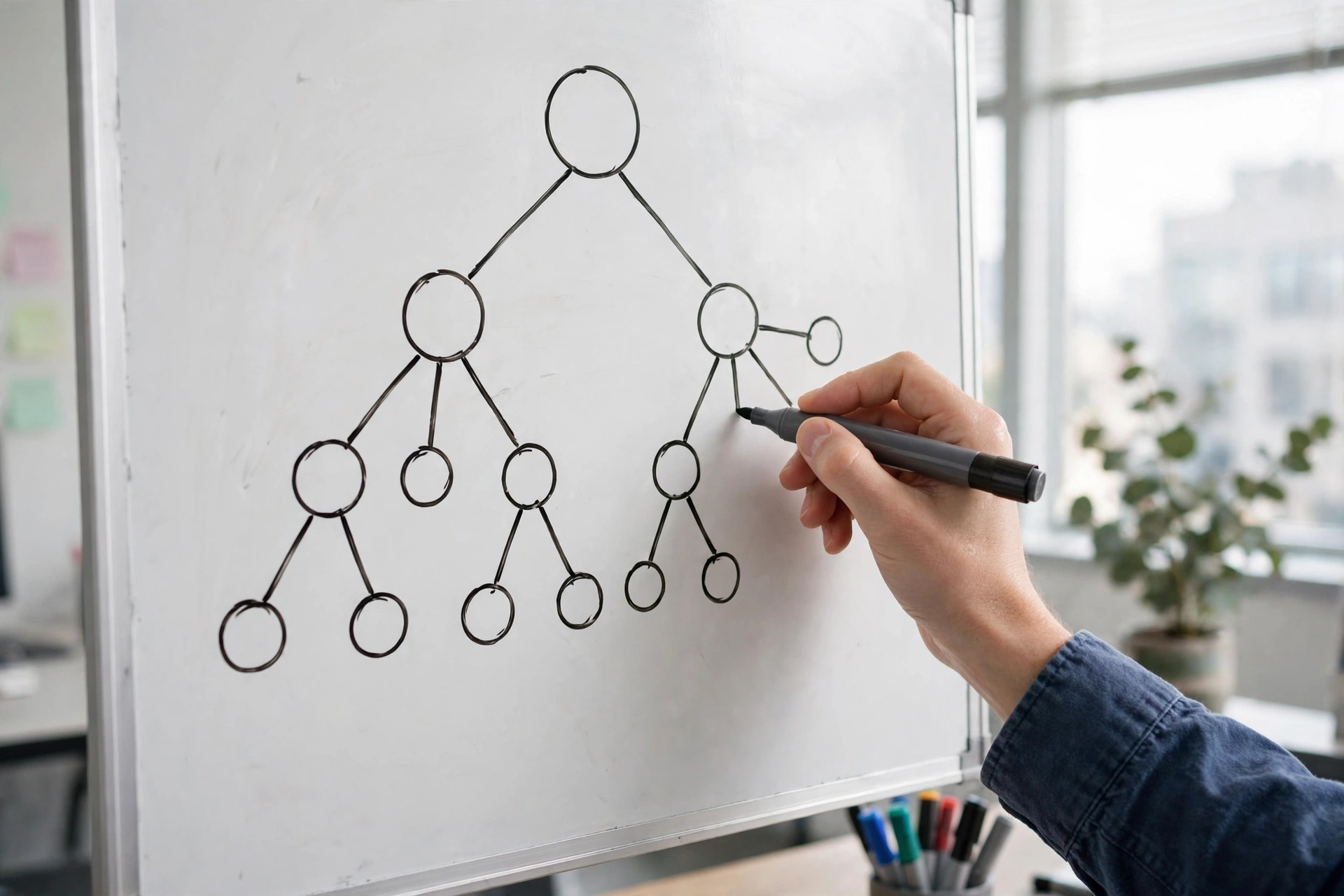
Random forests fix that jumpiness by growing lots of trees on slightly different slices of the data and letting them vote. Support vector machines draw boundaries between groups, which works well when the groups are cleanly separated. Linear regression fits a line through number data for regression problems, and logistic regression, despite its name, is used for classification. Neural networks can handle more tangled patterns, and they show up a lot in image and language tasks, but they need more data and are harder to explain.
IBM’s overview of supervised learning runs through these types with more detail, and it’s a solid next read if you want the technical side.
Where is supervised learning used every day?
You’ve probably used it today without noticing. Spam filters learn from messages marked as spam or not spam. Photo apps sort pictures by what’s in them. Voice assistants learn to recognize wake words from labeled recordings. Online shops use it to suggest products based on past purchases, and banks use similar models to flag transactions that look unusual, though a flag is only a starting point for a human check, not a final verdict.
It’s also used for estimates rather than yes-or-no answers. A delivery app’s arrival time, a weather app’s temperature forecast, and a used-car site’s price guide all lean on models trained on past examples with known outcomes. None of these are perfect, and that’s worth remembering: a prediction is a well-informed guess, not a guarantee.
What can go wrong?
Supervised learning is only as good as its labels. If the training data is biased, incomplete, or just wrong, the model will faithfully learn those flaws. A model trained mostly on photos of one type of dog, for instance, may struggle with breeds it rarely saw. That’s not the model being difficult; it’s doing exactly what it was taught.
Overfitting is another classic trap. That’s when a model memorizes its training examples, quirks and all, instead of learning the broader pattern. It aces the practice test and stumbles on the real one. The fix is usually a mix of more varied data, simpler models, and honest testing on data the model hasn’t seen.
When labeled data is scarce, data augmentation can help by creating sensible variations of existing examples, like flipped or slightly cropped photos. It doesn’t replace good labels, but it can stretch a small dataset further.
How is it different from other kinds of learning?
Supervised learning isn’t the only way to train a model. Unsupervised learning works with unlabeled data and looks for structure on its own, like grouping similar customers together without being told the groups in advance. Reinforcement learning, covered in our broader artificial intelligence guide, learns by trial and error, with rewards for good moves and penalties for bad ones.
In practice, these approaches often mix. A model might first learn general patterns from unlabeled data, then get fine-tuned on a smaller labeled set for a specific job. Supervised learning is usually the part that makes a model useful for a concrete task with a clear right answer.
Frequently asked questions
Does supervised learning need a lot of data?
It helps, but quality beats quantity. A smaller set of carefully labeled examples often beats a huge set full of mistakes. For a simple task, a few hundred good examples can be enough to start; for a harder one, you may need thousands.
Is supervised learning the same as machine learning?
No, it’s one branch of it. Machine learning is the wider field, and supervised learning is the branch that uses labeled examples. Unsupervised and reinforcement learning are other branches.
Can a supervised model be wrong?
Yes, regularly. It can misread an unusual example, reflect bias in its training data, or fail when the world changes after training. That’s why important decisions should keep a human in the loop rather than trusting a model’s output blindly.
Why is labeling so expensive?
Because it takes human time and judgment, and because getting it wrong poisons the training data. Some teams use several labelers per example and check where they disagree, which improves quality but adds cost.
Do I need to code to understand supervised learning?
No. The ideas — labeled examples, training, testing, and honest evaluation — make sense without code. If you do want to try it, the scikit-learn supervised learning guide is a friendly place to see working examples.
A practical next step
If you want this to click, try a tiny version yourself. Pick a simple sorting task, like separating photos of cats from photos of dogs, and label twenty of each by hand. Notice how quickly you start relying on shortcuts — ear shape, size, fur pattern — and how a tricky photo can break your rule. That’s supervised learning in miniature: labels, patterns, and the occasional confident mistake.
Then, when you use an app that sorts, filters, or estimates something, ask one question: what was it trained on? The answer usually explains both why it works well and where it might go wrong.