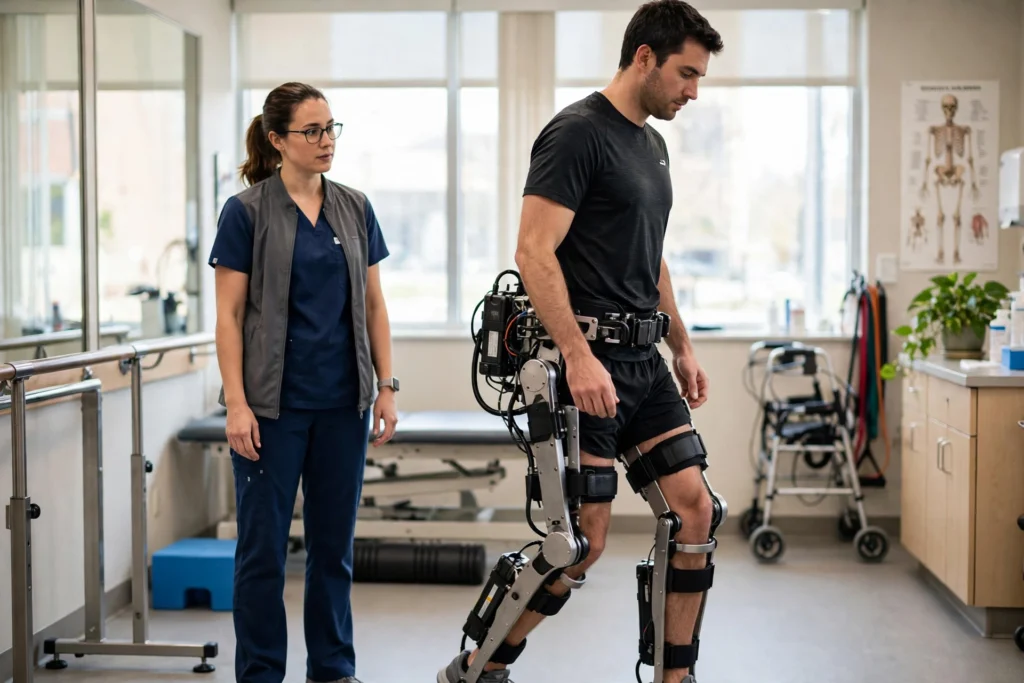
An exoskeleton robot is a wearable frame that supports your body and, in powered versions, adds force at the right moment. Sensors detect how you are moving, a controller decides how much help to give, and motors, cables, or springs deliver that help at the hips, knees, shoulders, or back. The aim is not to replace your muscles, but to share the load, steady a movement, or make a repeated task less tiring.
Key Takeaways
- Exoskeletons support movement; they do not take over the body completely.
- Powered models use motors and batteries, while passive models use springs and elastic parts.
- Sensors and software decide when help should start, stop, or change.
- A good fit matters as much as the motor: a frame that rubs will not be used for long.
- Rehabilitation, warehouse work, and overhead jobs use different designs.
- Weight, battery life, cost, and training still limit where exoskeletons make sense.
What is an exoskeleton robot?
Think of it less like a suit from a film and more like a well-fitted tool you wear. Some exoskeletons cover the legs, some support the back or shoulders, and a few cover the whole body. The frame follows your joints, straps hold it in place, and the working parts sit close to the joints they assist.
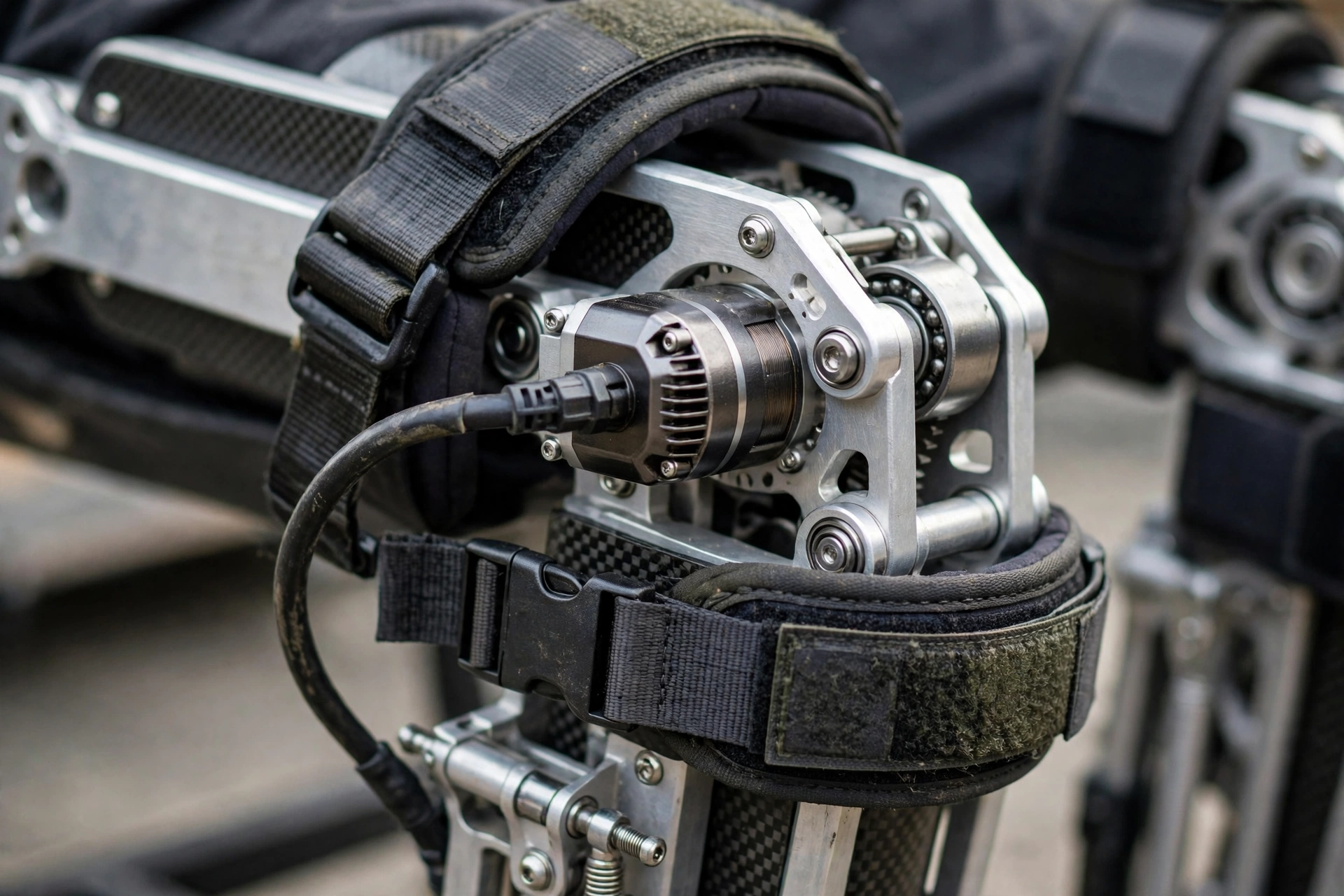
If a motor sits far from your knee, it cannot help your knee cleanly. Designers therefore place actuators — the parts that create movement or force — near the joint they serve, and keep the frame light enough that wearing it does not cancel out the help it gives.
There is also a useful distinction between assistance and replacement. A rehabilitation device may guide a leg through a step a person cannot yet manage alone. A warehouse device may simply take some strain off the lower back during lifting. In each case, the person is still part of the movement.
How do powered exoskeletons move with you?
A powered exoskeleton works in a short, repeated loop. First, sensors read what is happening: joint angles, pressure under the feet, muscle activity, or motion. Together, they build a picture — are you standing, starting a step, bending, or lifting?
Next, a controller interprets that picture. It compares the readings with the movement the device is set to support, then decides how much turning force to apply, and in which direction. The decision has to be quick. Help that arrives late can feel like a push at the wrong moment, and help that is too strong can feel unnatural.
Then the actuators act. Electric motors are common because they can be controlled precisely. Some designs use cables pulled by a motor at the waist, keeping weight away from the legs. Others use hydraulic or pneumatic parts where a larger force is needed, though those tend to be heavier.
Finally, the loop repeats many times a second. As your movement changes, the readings change, and the controller adjusts. That is why a good exoskeleton feels like support that follows you, rather than a machine dragging you along a fixed path.
What is the difference between powered and passive exoskeletons?
Powered exoskeletons need a battery and a controller. They can change their help as the task changes, support a heavier load, and assist movements that need active force, such as standing up. The trade-off is weight, charging, cost, and complexity. A battery that runs out mid-shift is not a minor detail; it turns a useful tool into a heavy frame.
Passive exoskeletons have no motor and no battery. They use springs, elastic bands, or clever linkages to store energy when you bend and return it when you straighten up. A passive back support can reduce the effort of bending forward repeatedly, and a passive shoulder support can hold some of the weight of your arms during overhead work.
Passive designs are usually lighter, cheaper, and simpler to maintain. They cannot, however, adapt as flexibly, and they cannot power a step on their own. For many everyday jobs, that simpler help is enough. For rehabilitation, or for a person who cannot initiate a movement, a powered design may be the only useful option.
How does an exoskeleton know what you intend to do?
Intent is the hard part. The simplest systems follow a set pattern: when the foot lifts, the knee bends; when the hips move forward, the device steps. That works well for steady walking on a flat floor.
More flexible systems watch for signals that come just before movement — a shift in weight, a change in joint angle, or a small muscle signal. In rehabilitation, a therapist may set the level of help and the pattern of movement in advance, so the device guides practice in a planned way.
None of this means the device reads your mind. It reads measurable signals and follows rules set for that task. That is also why training matters. A person usually needs time to learn how the device responds, and the device may need adjustment as the person learns to move with it.
Where are exoskeleton robots used?
In rehabilitation, exoskeletons are used in clinics and, in some cases, at home under supervision, to support walking practice, balance training, and upper-limb movement after injury or illness. Repeated, supported practice can help a person relearn movement patterns, and sensors can record how movement changes over time. This is general information, not medical advice for any individual condition, and suitability should be discussed with a qualified clinician.
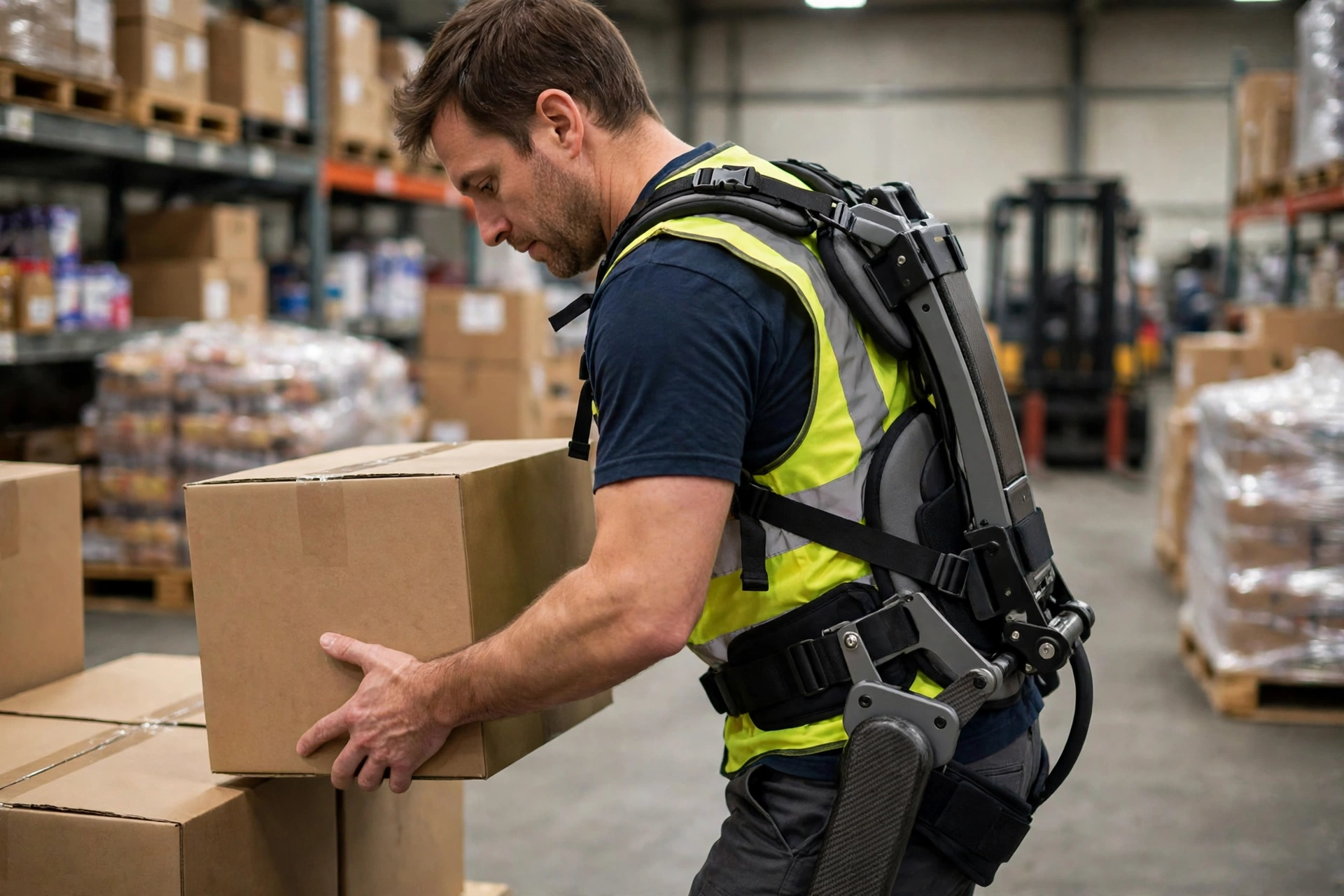
In warehouses, factories, and construction, exoskeletons are mostly about strain. A back support can ease repeated lifting, and a shoulder support can ease overhead work such as fitting or wiring. The goal is usually fewer aches at the end of a shift, rather than superhuman strength.
Other uses are growing more slowly. Hikers and older adults may use light, lower-body devices to walk further with less fatigue. Related robot types show the same pattern of matching the machine to the job: a robot arm stays in one place and works with precision, warehouse robots move goods along predictable floors, and humanoid robots try to copy whole-body movement. An exoskeleton is different again — it must move with a person, not instead of one.
What are the limits of exoskeleton robots?
Weight is the first limit most users notice. A frame, motors, and a battery add load, even when the device is helping. Designers fight this by moving heavy parts close to the body’s centre and using lighter materials, but there is still a balance to strike.
Battery life is the second limit. Powered devices need charging, and a device that must be charged often needs a charging routine built into the working day. Passive devices avoid this problem, but they give up flexibility in return.
Fit and comfort come next. Bodies differ in height, leg length, and strength, so a device that fits one person well may pinch another. A device that is uncomfortable will be left in a cupboard, however clever its software is.
Cost and maintenance also matter, and exoskeletons work best in predictable tasks. Stairs, uneven ground, tight spaces, and sudden changes in direction are harder than flat, steady walking or a repeated lift.
FAQs
Can an exoskeleton make you stronger?
It can reduce the effort of a specific movement, but it does not build your muscles for you. In rehabilitation, the aim is usually to support practice so that strength and control can improve over time, under professional guidance.
Do you need training to use an exoskeleton?
Yes, in most cases. Even a simple passive support needs correct fitting and a short period of adjustment. Powered devices need more training, both to learn how they respond and to learn their limits, such as battery range and safe use on stairs.
Are exoskeletons safe?
They can be, when fitted correctly, used for the task they were designed for, and maintained properly. Risks include skin pressure from straps, tripping if a movement is mistimed, and overconfidence about lifting heavier loads than the body can safely handle.
How long does the battery last on a powered exoskeleton?
It varies widely by design and task. Some light devices last a full working shift with careful use, while heavier devices may need charging sooner, especially during continuous walking or lifting. Always check the battery figure for the actual task, not just for standing still.
Will exoskeletons replace wheelchairs or other mobility aids?
No, not generally. They suit different needs and different users. Some people may use an exoskeleton for therapy or for specific tasks and a wheelchair for longer distances. The right choice depends on the person, the task, and professional advice.
Conclusion
Exoskeleton robots work by sensing movement, deciding how much help to give, and delivering that help at the right joint at the right moment. Powered models offer flexible, active support at the cost of weight and charging. Passive models offer simpler, lighter help for repeated strain. Neither is a general-purpose superpower; each is a tool matched to a movement.
If you are considering one, a practical next step is to pick a single, repeated task — a lift, an overhead job, or a walking practice session — and trial a device made for that task, with a proper fitting and a clear plan for charging and maintenance. That focused trial will tell you far more than a general search for the strongest exoskeleton, and it will show whether the help it gives is worth its weight, cost, and upkeep.
Further reading
For more on related robot types, see How Do Robot Arms Work?, How Do Warehouse Robots Work?, How Do Humanoid Robots Work?, and How Do Delivery Robots Work?. For wider background, see Britannica’s overview of robotics and Wikipedia’s powered exoskeleton article.