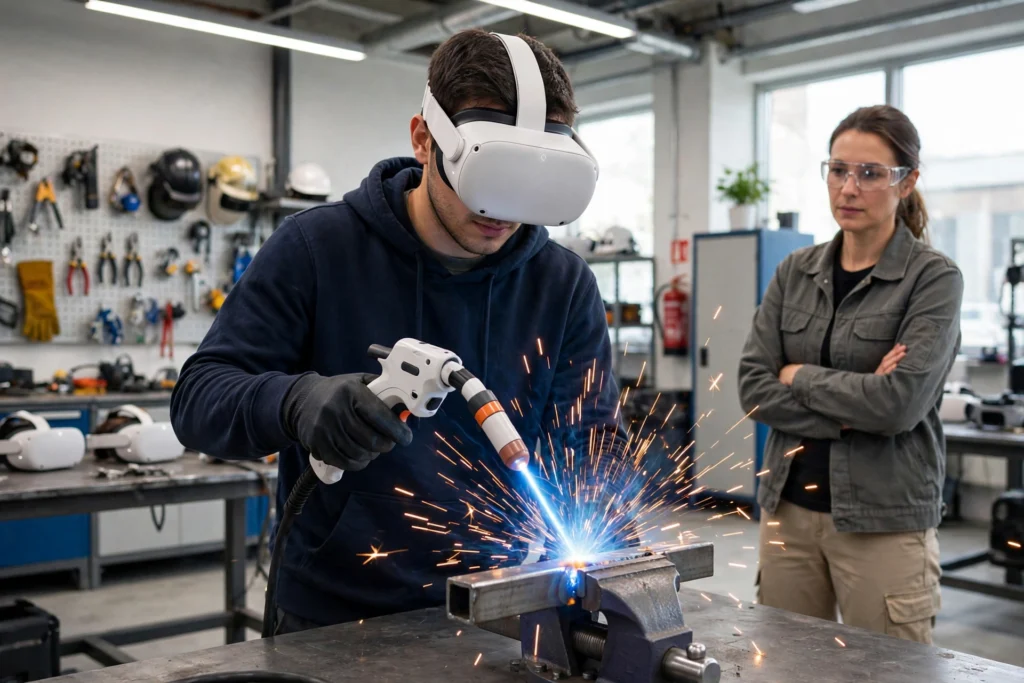
VR welding training puts a beginner inside a virtual workshop, where a headset and hand controllers stand in for a real torch, helmet, and workpiece. The trainee practises torch angle, travel speed, and arc length on simulated joints, while the software scores each weld and flags mistakes — all without hot metal, fumes, or wasted material.
Key Takeaways
- VR welding training recreates the look, sound, and feel of welding without the heat, sparks, or danger of the real thing.
- Trainees practise the three basics that decide weld quality: torch angle, travel speed, and arc length.
- The software gives instant feedback on every weld, so mistakes are spotted and corrected straight away.
- VR cannot teach the weight of real equipment or the heat of a real arc, so it works best as preparation for hands-on practice, not a replacement for it.
What does a VR welding training setup include?
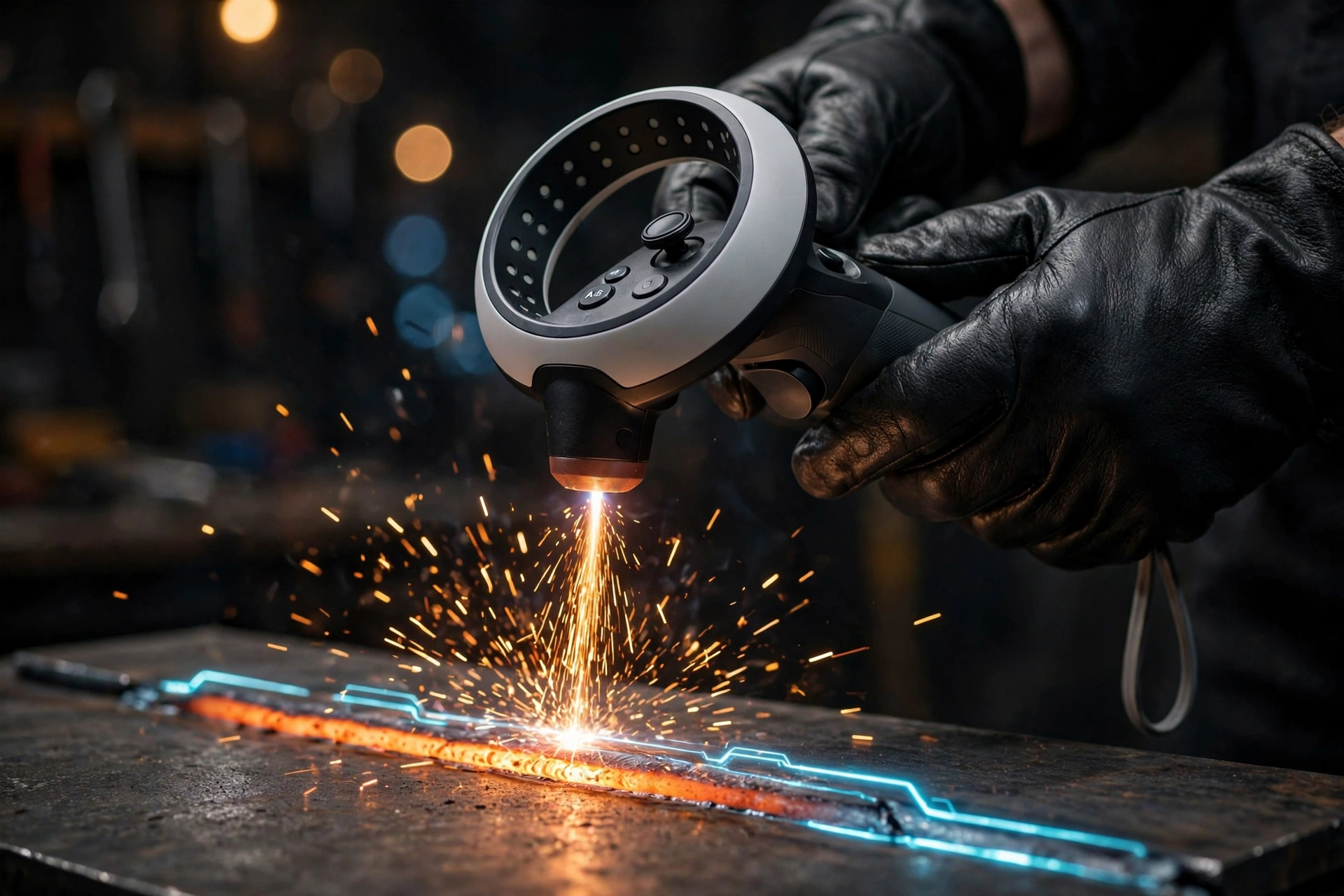
At its centre is a standalone VR headset, the same kind of device used for games and other training, paired with two hand controllers. One controller acts as the welding torch; the other steadies the workpiece or works the menu. Some rigs add a torch-shaped controller that feels closer to the real tool, and a few include haptic feedback, so the hand feels a small vibration when the virtual arc strikes.
The software is where the training lives. It builds a virtual workshop with a workbench, a metal joint, and a welding machine, and it simulates the arc itself: the bright light, the crackling sound, the spray of sparks, and the glowing pool of molten metal that follows the torch. The trainee picks a joint type — a flat butt joint, a corner joint, or a pipe — chooses a process such as MIG or stick, and starts welding, while the instructor watches on a monitor and replays welds to talk through mistakes.
What does the trainee see and hold?
Put the headset on and the workshop disappears. In its place is a virtual bench, a metal joint clamped in a vice, and a torch in the trainee’s hand. Squeeze the controller trigger and the arc strikes with a flash and a hiss. Move too fast and the weld bead goes thin and ropey; move too slowly and the metal overheats and burns through. The view mimics a welding helmet, dimming the arc’s glare so the glowing weld pool stays visible, just as it would behind a real auto-darkening lens.
What the trainee holds matters. A standard VR controller is light and shaped like a game controller — fine for learning the hand movements, but nothing like a real torch. Dedicated simulators often use a torch-shaped controller with the right grip and weight, and some add a real welding helmet with a VR display built in. The closer the kit feels to the real thing, the more of the practice carries over.
What skills can VR welding training teach?
The core skills of welding are hand skills, and they are exactly what VR is good at drilling. Torch angle is the first: hold the torch too upright or too tilted and the weld suffers, so the software shows the angle live and warns when it drifts. Travel speed is the second: the trainee learns to move at a steady pace, watching the weld pool form behind the arc. Arc length — the gap between the torch tip and the metal — is the third, and the simulator shows it as a number or a colour cue until the trainee can judge it by eye.
VR also teaches the habits around welding: setting up a joint, choosing the right settings, inspecting a finished bead, and spotting defects such as porosity or undercut. The same approach is already used in construction training, where VR lets workers practise on virtual sites before stepping onto a real one. Because every attempt is scored, a beginner can repeat the same joint twenty times in an hour and see exactly what changed when the weld improved — repetition that is hard to arrange with real metal, where each practice piece costs material and time.
What can’t VR welding training teach?
VR has honest limits, and good instructors are open about them. The first is weight and heat. A real torch, cables, and helmet have a heft that a plastic controller does not, and a real arc throws off heat you can feel on your skin. A trainee who has only welded in VR may be surprised by how tiring a real session is.
The second limit is the metal itself. In VR, the weld pool always behaves the way the software expects. Real metal is messier: it warps, it has rust or oil on it, and the joint never sits quite as neatly as the virtual one. Virtual reality is already used for safety training in other trades, where trainees practise spotting hazards before facing them for real, and welding training follows the same idea. And the third limit is safety judgement. The training itself is very safe — no ultraviolet light, no molten metal, no fumes — but real welding carries real hazards, from burns and electric shock to fume inhalation. VR can teach the rules, but only a real workshop teaches the habit of checking them every single time. That is why VR welding training is best treated as the first step, not the whole journey.
How does feedback and scoring work?
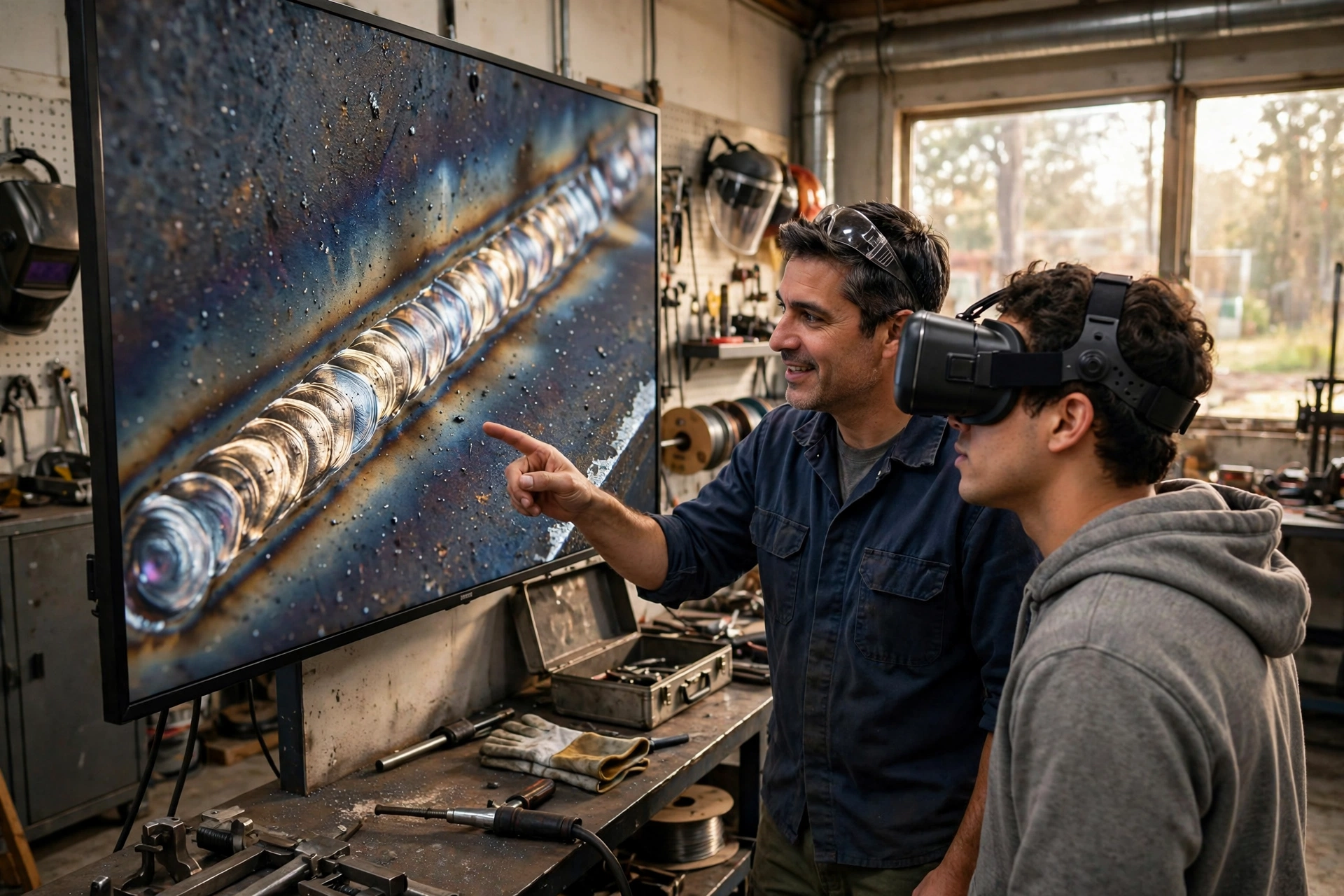
Feedback is what makes VR training more than a game. While the trainee welds, the software tracks torch angle, speed, and arc length many times a second, then turns those measurements into a score at the end of each run. A typical report shows the average angle, how steady the speed was, and where along the joint things went wrong, often with a coloured trace over the weld bead so the trainee can see the wobbly section at a glance.
The instructor sees the same data and can replay the weld from any angle, pointing at the exact moment a trainee sped up or let the arc get too long. Some systems change the scenario on the fly — a thinner plate, a trickier joint, a draft across the arc — so the trainee learns to adapt. For the trainee, the best part is simple: mistakes cost nothing. A bad weld is deleted with a button press, and the next attempt starts straight away.
How much practice comes before real welding?
There is no fixed number of hours, and any course that promises one should be treated with care. What matters is not the clock but the scores: when a trainee can lay down a consistent bead on several joint types, with the angle and speed staying inside the target range, they are ready to try the same welds for real.
The handover should be gradual: repeat in VR the exact joint the trainee will weld for real, then move to the bench with an instructor watching, and keep the VR sessions going alongside real practice for a while. Welding robots already handle some repetitive welds in factories, but a skilled human welder still needs that mix of virtual and real practice.
Frequently Asked Questions
Do I need a VR headset of my own to try VR welding training?
Usually not. Most courses run in a school or training centre that owns the headsets and simulators, so you book a session and use their kit.
Can VR welding training replace a real welding course?
No, and reputable providers do not claim it can. VR builds hand skills, confidence, and judgement cheaply and safely, but a full course still needs real welding time, real materials, and an instructor watching your real welds.
Which welding processes can you practise in VR?
Most simulators cover the common ones: MIG, stick, and TIG. Some also include flux-cored welding. The exact list depends on the software, so check before signing up for a course.
Does VR welding training help experienced welders too?
It can. Experienced welders use it to practise an unfamiliar joint or process before a job, to warm up after time away, or to test a technique without wasting material. It is also used for assessment, since every attempt is recorded and scored.
Is VR welding training expensive?
A full simulator rig costs far more than a single headset, which is why most training happens in schools and centres rather than at home. For the trainee, a course with VR sessions is usually cheaper than one using only real metal, because the practice material is virtual.
Conclusion
VR welding training works because it turns the hardest part of learning to weld — the sheer repetition needed to steady your hand — into something safe, cheap, and endlessly repeatable. It cannot replace real metal, real heat, or a good instructor, but it can make the first real weld far less intimidating. If you are considering a welding course, ask whether it includes simulator time and try a session, watching your scores on angle, speed, and arc length. When those numbers stay steady across several joints, your hands are ready — and the real bench is waiting.