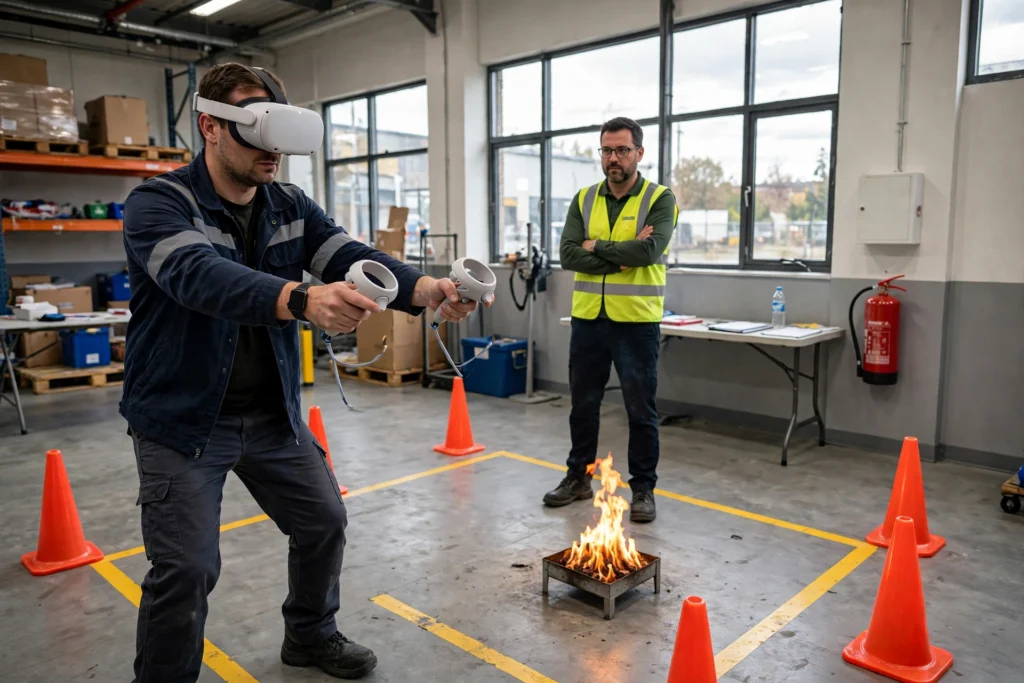
VR safety training puts workers inside a realistic virtual workplace where they can face fires, falls, and machine faults without any real danger. Wearing a headset and holding controllers, they practise the right response, make mistakes safely, and get instant feedback.
Key Takeaways
- VR safety training recreates hazardous situations in a virtual space, so workers can practise without risk of injury.
- Trainees use a headset, controllers, and a mapped play area to move and interact with virtual equipment.
- Common scenarios cover fires, working at height, machine lockout, chemical spills, and evacuation drills.
- Trainers watch a live view and review mistakes with the trainee afterwards.
- VR builds confidence, but it cannot fully recreate heat, weight, or the pressure of a real emergency.
What happens inside a VR safety training session?
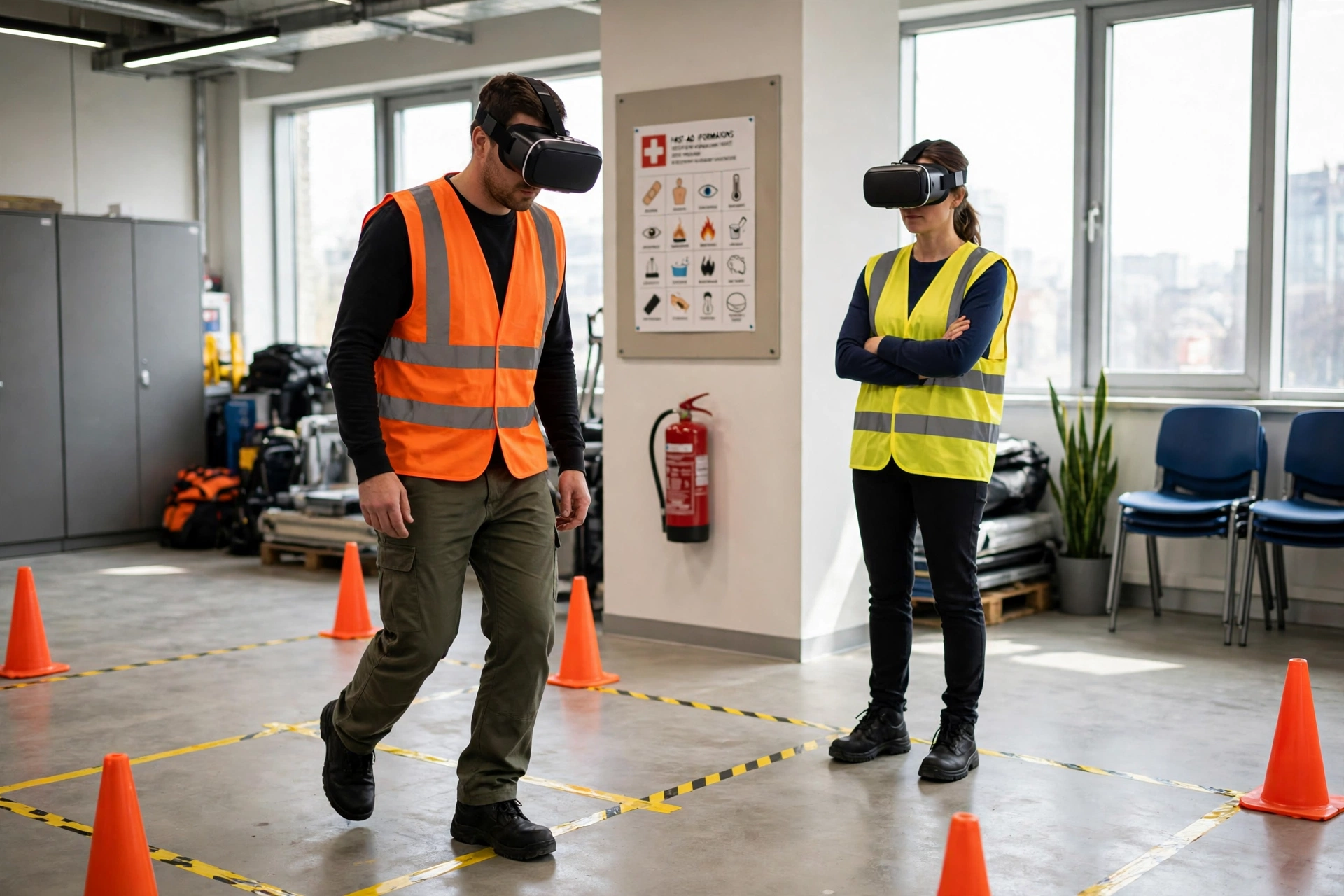
A session starts in an ordinary room. The trainee puts on a VR headset, picks up two controllers, and steps into a taped-off area about the size of a small parking space. That clear floor space matters: the headset tracks where the trainee walks, so the virtual world lines up with the real room. A trainer stays nearby, watching a monitor that shows exactly what the trainee sees.
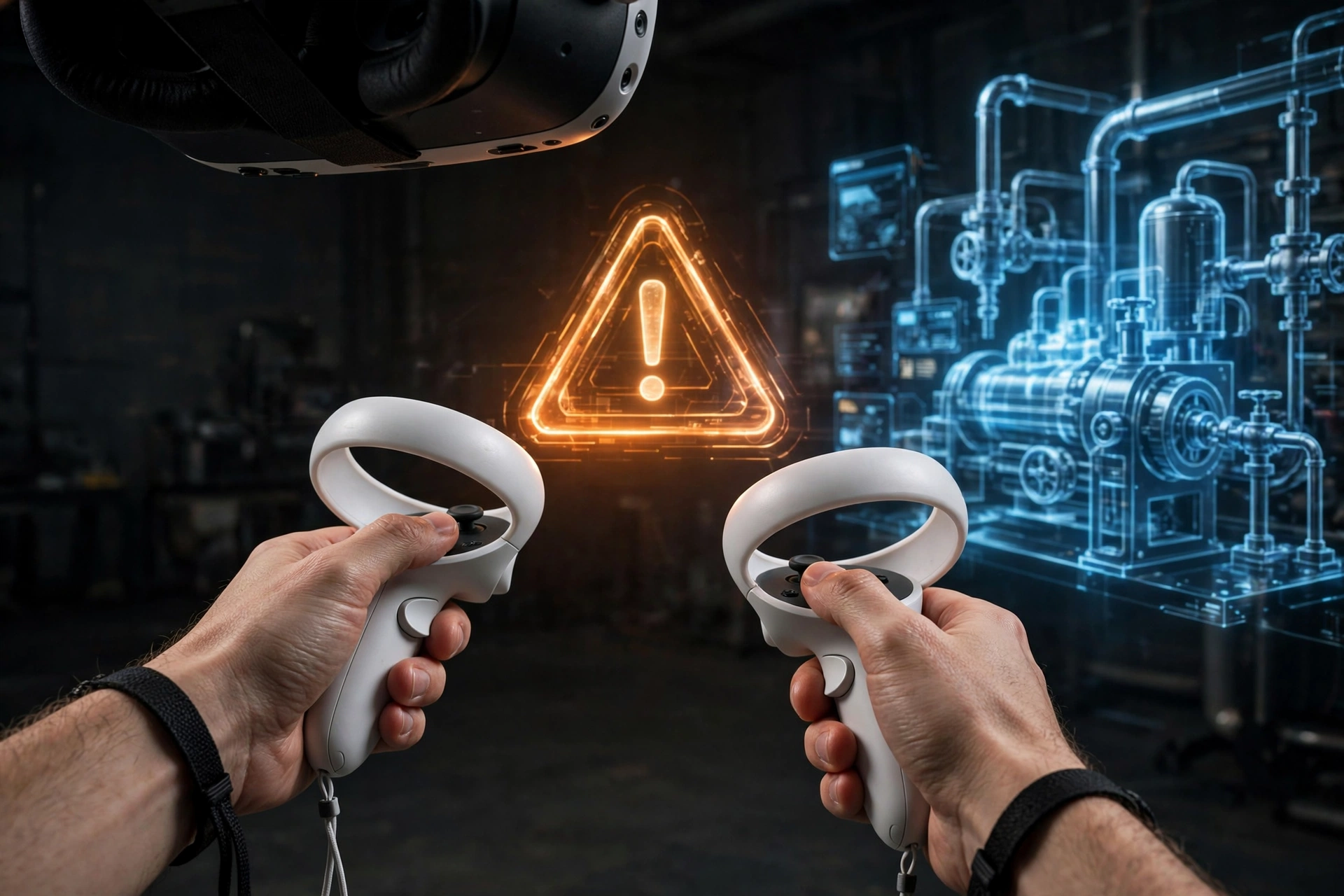
Then the software introduces a problem: a machine starts smoking, an alarm sounds, a chemical drum tips over. The trainee must act in the right order — raise the alarm, grab the right equipment, move to a safe spot. A wrong choice shows its consequence, a fire spreading or a warning flashing, but nobody is hurt. That is the point: a mistake costs a retry, not an injury.
Most sessions last ten to thirty minutes. Then the headset comes off and the trainer talks through what happened — what the trainee spotted first, where they hesitated, what they would do differently next time. That short debrief is where much of the learning settles in. For background, Britannica explains how virtual reality creates these immersive environments, and OSHA publishes the training requirements employers must meet.
What kinds of hazards can workers practise on?
Fire safety is one of the most common scenarios. Trainees learn to pick the right extinguisher, aim at the base of a flame, and decide when a fire is too big to fight and the right move is to leave. Doing that in a real building would mean lighting real fires and clearing the site each time. In VR, the same drill can run ten times in an afternoon.
Working at height is another natural fit. A trainee can stand on a virtual scaffold, clip on a harness, and look down at the ground far below. The fear feels real enough to matter — yet the trainee is standing on a flat office floor the whole time.
Machine safety is a third big area. Trainees practise lockout procedures — shutting down a machine and isolating its power before maintenance — and learn what happens if they skip a step. Chemical spills, forklift near-misses, and evacuation drills are common too: the building fills with virtual smoke, exits are blocked, and the trainee must find another way out, calmly and quickly.
How does VR training compare with classroom training?
Classroom training still has its place. A good instructor, a clear video, and a printed checklist can teach the rules well, and they cost very little to run. The weakness is that knowing the rules and acting on them under pressure are two different things. Most people can recite the steps for using a fire extinguisher; far fewer have actually held one, aimed it, and squeezed the handle while an alarm is sounding.
VR closes that gap by turning a rule into a rehearsal. The trainee does not just hear that they should check a valve before opening it; they walk up to the valve, reach for it, and check it. That physical action matters, because people remember what they have done far better than what they have only heard.
None of this makes classroom training obsolete. The best programmes mix the two: a short briefing first, then the VR drill, then a discussion. The briefing gives the rules, the drill gives the practice, and the discussion gives the understanding.
What does the trainer see while you train?
While the trainee is inside the virtual world, the trainer watches from outside. Most VR training software mirrors the trainee’s view onto a laptop or tablet screen, so the trainer sees the same scene, the same hazards, and the same mistakes as they happen.
That live view lets the trainer step in at the right moment. If a trainee freezes, the trainer can talk them through the next step; if they walk towards a real wall while chasing a virtual one, the trainer can call a stop. Safety in the room still matters, so the play area is kept clear and the trainer stays close. Afterwards, the software produces a short report of how long the drill took and where errors happened, and the trainer uses it in the debrief: “you walked past the alarm and went straight for the extinguisher” beats “be more careful next time”.
What are the limits of VR safety training?
VR is a strong training tool, but it has honest limits. The first is physical. A virtual fire extinguisher has no weight, a virtual valve offers no resistance, and a virtual ladder does not wobble. Workers can learn the steps in VR and still be surprised by the real thing the first time they lift a heavy extinguisher or climb a real scaffold. That is why VR should sit alongside hands-on practice, not replace it.
The second limit is the body itself. Some people feel queasy in a headset, especially in scenes with a lot of movement. Sessions are kept short for that reason, and anyone who feels unwell is told to stop straight away.
The third limit is the most subtle. VR can make people confident, and confidence is not the same as competence. Passing a virtual fire drill does not mean someone will stay calm in a real fire, with real heat, real smoke, and real fear.
FAQs
Do you need any experience with VR to do safety training?
No. Most safety training software is built for first-timers, with a short introduction that teaches you how to hold the controllers and move around. The trainer stays in the room for your first session.
How long does a VR safety training session take?
The drill itself usually takes ten to thirty minutes, depending on the scenario. Add a short briefing before and a debrief afterwards, and a full session often runs under an hour.
Can VR safety training replace real hands-on practice?
Not entirely. VR is excellent for learning steps, spotting hazards, and building confidence, but it cannot recreate the weight of equipment, the heat of a fire, or the feel of a real machine. Use it as a first step, then follow it with supervised practice on real equipment.
Is VR safety training suitable for all workers?
Most workers can use it, but a few need care. People who get motion sickness, have certain eye conditions, or are prone to seizures should check with their employer or a doctor first.
What equipment do you need to run VR safety training?
At minimum, a standalone VR headset, two controllers, and a clear floor space of a few square metres. Many companies also use a laptop or tablet so the trainer can watch the session live.
Conclusion
VR safety training works because it lets people practise the worst day at work on an ordinary day, in an ordinary room, with nothing at stake. A worker can fight a virtual fire, escape a virtual building, and shut down a virtual machine, then take the headset off, talk it through, and try again. That repetition builds the calm, practised response that is hard to get from a slideshow alone.
If your workplace is considering it, start small: pick one hazard your team actually faces and run a short pilot with a handful of volunteers. Keep the classroom briefing and the hands-on practice, and let VR do what it does best — give people a safe place to get things wrong before it matters.
Related reading: How Does VR Work for Physical Therapy?