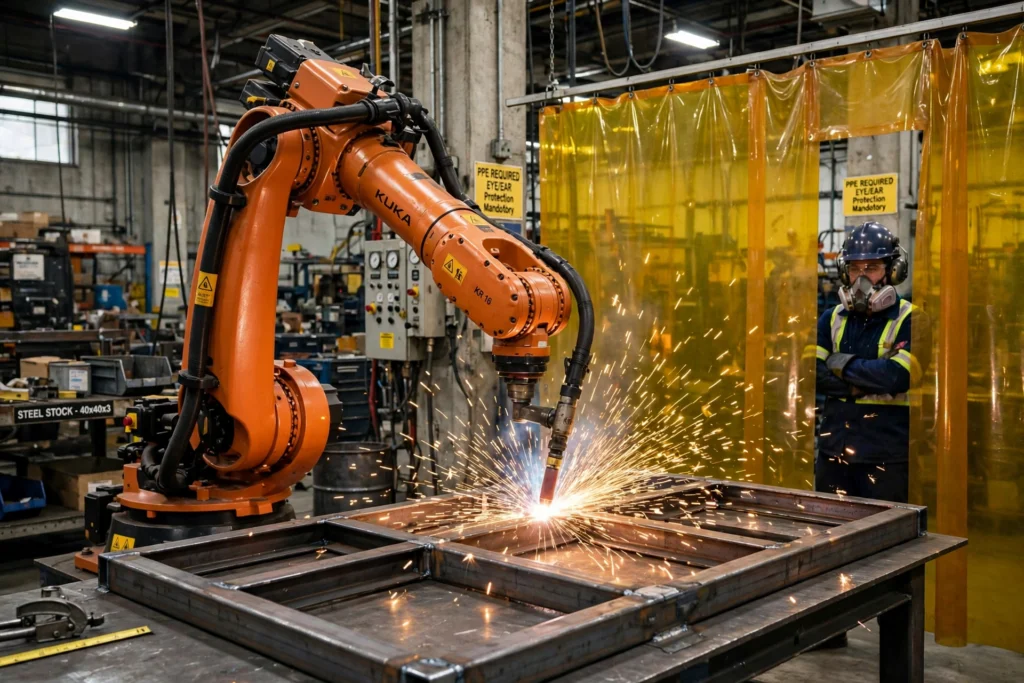
A welding robot is a programmable arm that holds a welding torch, follows a planned path along a metal joint, and repeats that weld with steady speed and timing. A controller stores the path, a power source supplies the arc, and sensors check position as the arm moves.
Key Takeaways
- A welding robot combines an arm, a controller, a power source, a wire feeder, and a torch.
- Arc welding melts the joint and filler wire; spot welding joins sheets with pressure and current.
- The path is taught by hand or built from a digital model, then tested at low speed.
- Sensors and seam tracking help the torch follow small changes in the part.
- Guards, light curtains, fume extraction, and inspection keep the cell safer and catch faults early.
What is a welding robot?
Think of it less as a single machine and more as a small team working inside a guarded cell. The arm is usually a six-axis articulated arm, which means it can bend and turn at several joints to reach a seam from different angles. That flexibility matters because real parts are rarely flat and simple: a car door frame, a trailer chassis, or a pipe joint may need the torch to tilt, weave, or reach around a corner.
The controller is the brain. It stores the program, moves each joint in step, and talks to the welding power source. When the program says “start the arc here, travel at this speed, stop there,” the controller makes sure the arm and the power source act together. If either one runs ahead of the other, the weld can end up too thin, too wide, or in the wrong place.
Around the arm sit the supporting parts. A fixture holds the metal pieces in position so they cannot shift mid-weld. A positioner may turn the part so the robot can reach the next seam without a person stepping into the cell. Between welds, a torch cleaner can clear spatter from the nozzle. None of this is glamorous, but it is what turns a clever arm into a reliable production tool.
How does arc welding work on a robot?
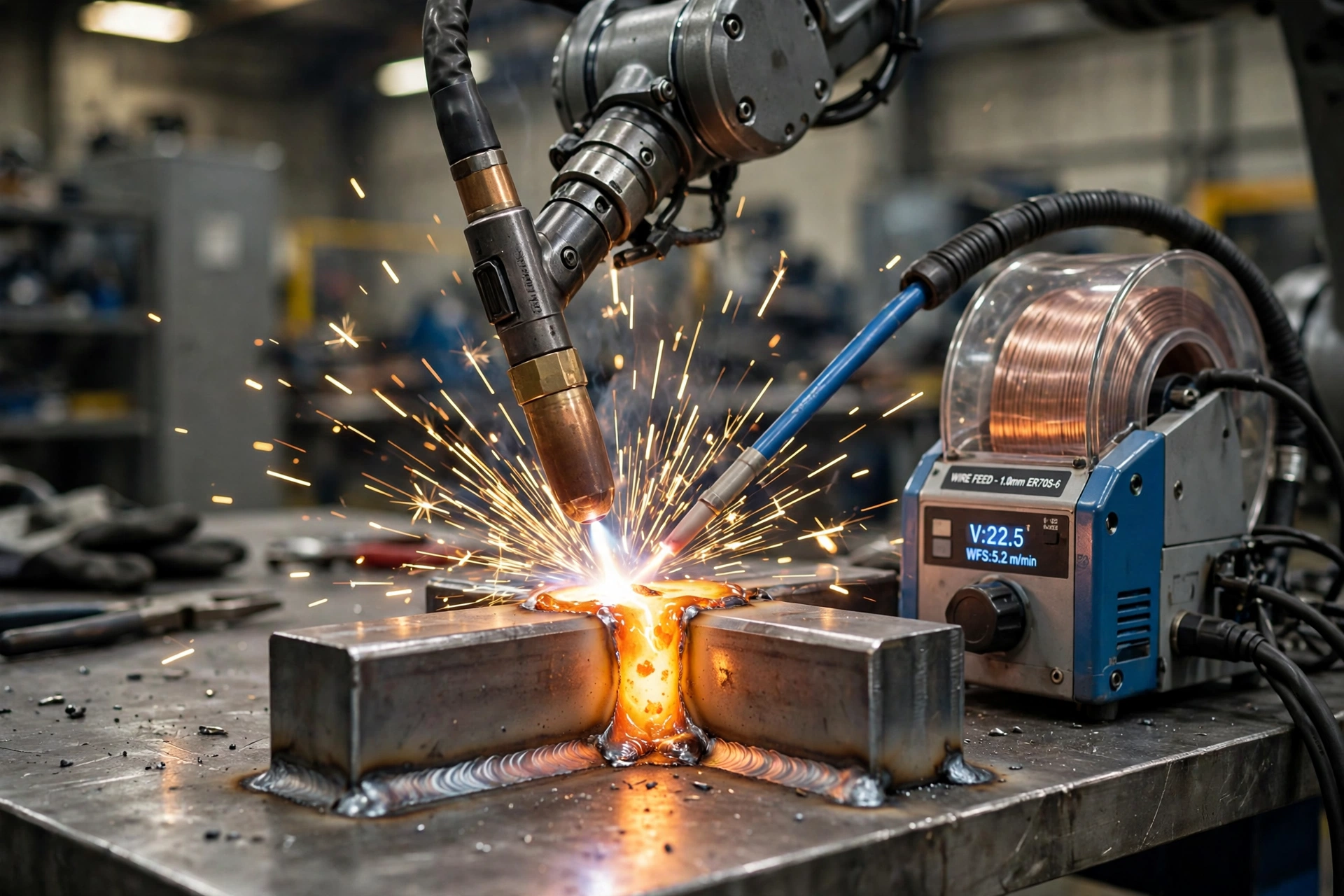
In arc welding, an electric arc creates intense heat between the torch and the metal. That heat melts the edges of the joint and the filler wire, forming a small pool of molten metal. As the torch moves on, the pool cools and solidifies into a weld bead that joins the pieces.
Shielding gas plays a quiet but vital role. It flows from the torch and protects the molten pool from air, which could otherwise leave holes or weak spots in the weld. The wire feeder pushes filler wire at a controlled rate, so the bead stays even rather than starving in one stretch and piling up in the next.
Travel speed, torch angle, and arc length all change the outcome. Move too fast and the weld may not fuse fully. Move too slowly and heat can build up, warp a thin panel, or burn through it. That is why programs are tested carefully before full production: a small change in speed can matter more than it looks from outside the cell.
What about spot welding?
Not every welding robot uses a continuous arc. Spot welding, common in car-body work, presses two sheets together between electrodes and passes a short burst of current through them. The metal melts at that single point, then cools into a strong spot joint. The robot moves from spot to spot, repeating the same pressure and timing.
Spot welding suits thin sheets and high volumes. It is fast, needs no filler wire, and leaves a neat row of joints. Arc welding, by contrast, suits longer seams and thicker sections where a continuous bead gives the strength and sealing a design needs. A factory may use both, on different lines, for different parts of the same product.
How is a welding robot programmed?
There are two main routes, and many shops use a mix of both. In manual teaching, an operator uses a handheld teach pendant to jog the arm slowly to each key point along the seam: start, corners, and end. Each point is saved as a waypoint, along with settings such as travel speed, voltage, and wire feed rate. It is careful, hands-on work, and it works well for parts that will run for a long time.
In offline programming, engineers build the path on a computer from a digital model of the part. The program can be tested in simulation before it ever reaches the shop floor, which means the robot can keep working on today’s job while tomorrow’s program is prepared. Once the program loads, operators still run it slowly first, watching the torch path and checking clearances, before letting it run at full speed.
This is where robot arms earn their keep in a different way: the same arm design that picks, places, and assembles can, with a different end tool, become a welder. The arm itself is general purpose; the torch, power source, and program make it a welding specialist.
What do sensors actually do?
A perfect program still meets imperfect parts. Metal pieces can vary slightly in size, a fixture can wear, or heat from earlier welds can shift a panel by a millimetre or two. Sensors help the robot cope with those small differences instead of welding blindly along an ideal line.
Seam-tracking sensors, often using a laser or camera near the torch, look ahead of the weld and measure where the joint really is. If the seam drifts, the controller nudges the torch path to follow it. Other sensors watch for the arc starting cleanly, monitor current and voltage, or confirm that a part is clamped before welding begins. None of this replaces inspection, but it reduces the scrap that comes from welding a seam that was never quite where the program expected it.
Where are welding robots used?
Cars are the classic example. Body panels, frames, and exhaust parts involve many repeated welds, and robots handle that volume with consistent quality. But the same idea shows up in shipbuilding, farm machinery, trailers, furniture frames, and large steel structures. Anywhere a design needs many similar welds, a robot cell becomes worth considering.
That is also why welding robots sit naturally beside other factory robots. Warehouse robots move parts and finished goods, construction robots handle heavy site work, and welding robots join the metal in between. They are not competing for the same job; they divide a production line into steps that each suit a different machine.
What keeps people safe around a welding cell?
Welding brings bright light, heat, fumes, and moving machinery, so safety is designed into the cell rather than added as an afterthought. Opaque screens or curtains block the arc flash from nearby workers. Interlocked gates stop the robot when a door opens. Light curtains can pause motion if someone reaches into a guarded area. Fume extraction pulls welding smoke away from breathing zones, and ventilation is checked as part of routine maintenance.
People still matter a great deal. Operators load parts, check programs, inspect welds, and handle faults the robot cannot judge. Protective clothing, a welding helmet with the right shade, gloves, and hearing protection are standard where arc welding is done by hand nearby. Training covers lockout steps for maintenance: a robot that cannot move unexpectedly is far safer to clean, adjust, or repair.
How are welds checked?
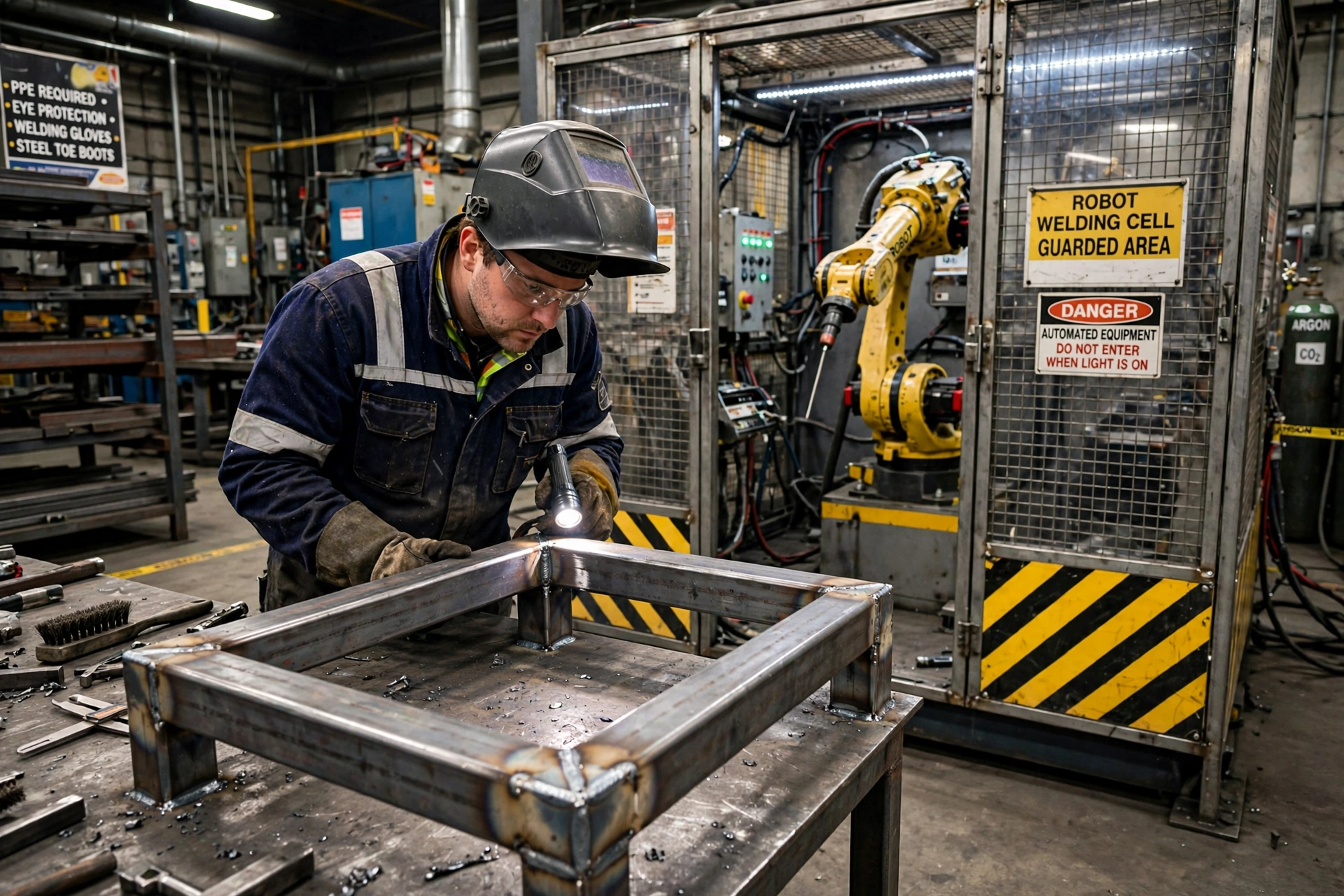
A weld that looks tidy is not automatically a good weld. Shops use visual checks first: is the bead even, are there cracks, gaps, or excessive spatter? Then they may use other methods depending on how critical the joint is. Dye-penetrant testing can reveal surface cracks. Ultrasonic or X-ray testing can look inside a weld without cutting it open. For some parts, a sample weld is cut and examined, or tested to failure, to confirm the process is still producing the strength the design expects.
Robots help here too, because consistency makes faults easier to spot. When every weld follows the same path at the same speed, a sudden change in appearance usually points to a real cause: a worn contact tip, a gas-flow problem, or a part that was loaded slightly out of position. Operators learn to read those clues quickly.
What are the limits of welding robots?
Welding robots are excellent at repetition, but they are not flexible in the way a skilled human welder is. A one-off repair, a badly rusted joint, or a part with no fixture and no program can be slow and costly to set up for a robot. Small workshops with varied, low-volume work may find a human welder faster and cheaper for those jobs.
Robots also need care. Torches wear, wire feeders jam, sensors drift, and programs need updating when a design changes. A cell that is ignored will not stay accurate on its own. The best results come from pairing the robot’s consistency with people who notice small changes early, keep the cell clean, and treat maintenance as part of production rather than a chore to postpone.
Can small shops use welding robots?
Smaller, collaborative systems have lowered the barrier. Collaborative robots are designed to work near people with force limits and safety monitoring, though welding still needs screens and fume control because of the arc itself. A small shop might start with one cell for its most repeated seam, keep hand welding for varied work, and expand only when the volume justifies it.
The practical question is not “robot or human?” but “which welds repeat enough to program well?” If a seam appears hundreds of times with the same material and joint shape, automation usually pays back in consistency and throughput. If every job is different, a skilled welder’s judgement is hard to beat.
FAQs
What is the difference between a welding robot and a robot arm?
A robot arm is the general machine; a welding robot is that arm fitted with a torch, power source, wire feeder, and a welding program. Change the end tool and the program, and the same arm family can do a different job.
Do welding robots replace welders?
They change the work more than they erase it. Robots take over repeated welds, while people program, load parts, inspect joints, and handle repairs and unusual work. Skilled welders are still needed to set up and judge quality.
Why do welding robots use shielding gas?
Shielding gas protects the molten weld pool from air. Without it, oxygen and nitrogen can cause porosity and weakness in the finished joint.
Are welding robots safe to work beside?
Only inside a properly designed cell, with guards, interlocks, arc screens, and fume extraction. People should not enter a running cell, and maintenance must follow lockout procedures.
What is the most common type of robot welding?
Arc welding is the most widely used for continuous seams, while spot welding is common for joining thin sheets, especially in car-body production. The right choice depends on the material, thickness, and joint design.
Conclusion
A welding robot works by combining a precise arm, a timed program, a controlled arc, and sensors that keep the torch on the seam. Its strength is not speed alone; it is doing the same weld, the same way, without tiring, while people stay protected outside the cell.
If you are curious about this field, a practical next step is to compare a robot-welded seam with a hand-welded one: look at the bead, check how even it is, and ask what program settings and checks produced it. For background reading, see Britannica’s overview of robotics and Wikipedia’s article on welding. That comparison tells you more about real welding quality than any single specification ever will.