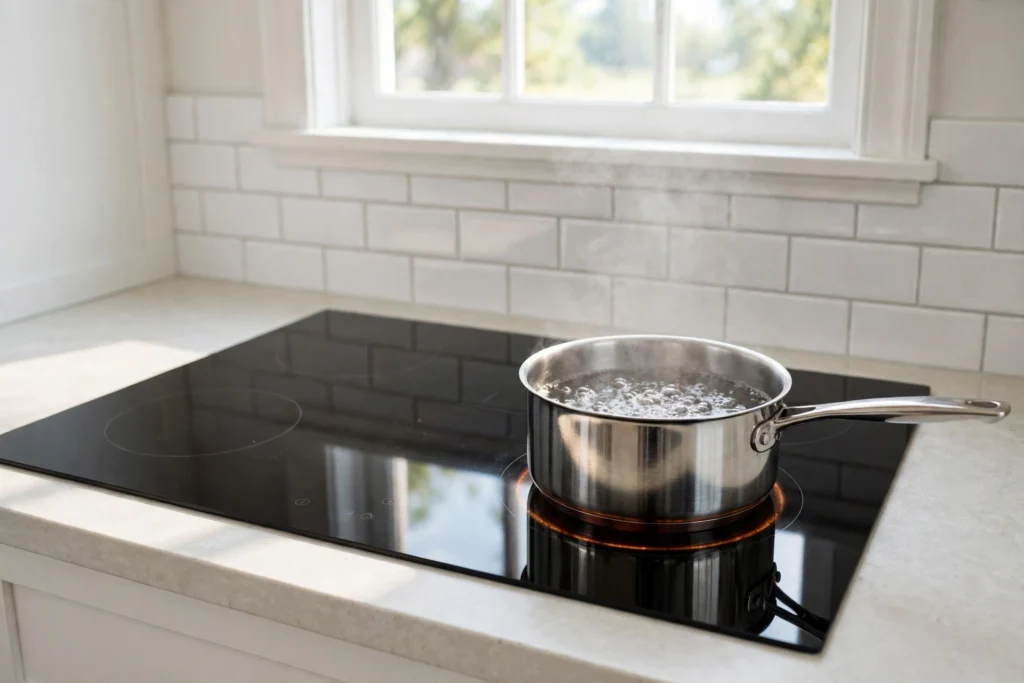
An induction cooktop works by turning the pan itself into the heat source. A copper coil under the glass carries a fast-changing current, creating a magnetic field. That field stirs up small currents inside a magnetic pan, and the pan’s resistance turns them into heat, so food cooks while the hob stays much cooler than a gas flame.
Key Takeaways
- An induction cooktop heats the pan directly with a magnetic field, not the glass.
- Only magnetic cookware works: cast iron, enameled steel, and magnetic stainless steel.
- A fridge magnet stuck firmly to a pan’s base is the quickest compatibility test.
- Heat changes almost instantly, and the surface cools quickly once the pan is lifted.
- Induction uses no flame and makes no fumes, but it needs the right pans and power supply.
What happens inside an induction cooktop?
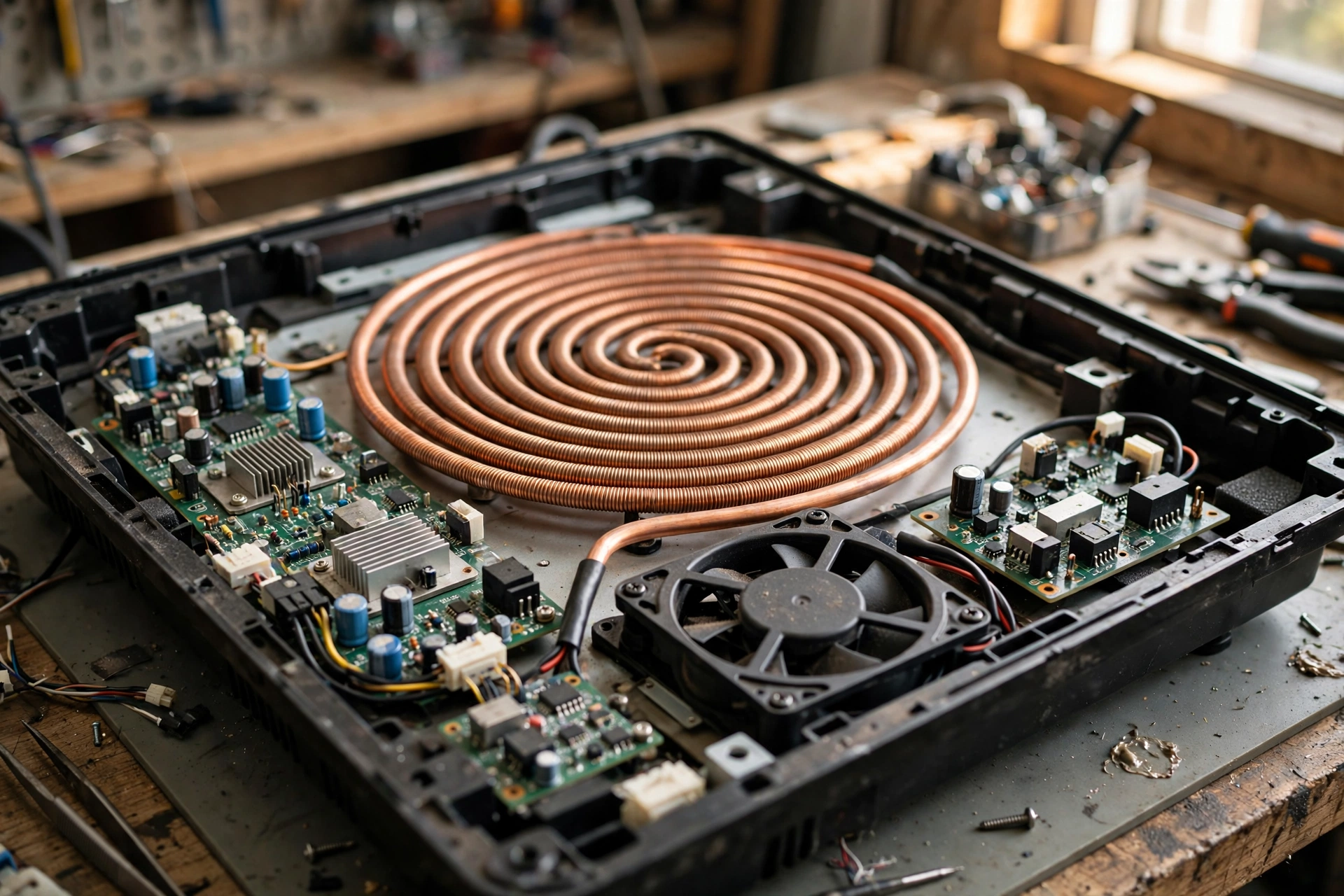
Under each zone sits a flat spiral of copper wire below a smooth glass-ceramic surface. Switch a zone on and alternating current flows through the coil, switching direction thousands of times a second and building a magnetic field above it.
Nothing happens until a suitable pan sits on the zone. The field reaches into the base and stirs up tiny looping currents, known as eddy currents. The metal resists them, and that resistance makes heat, just as a wire warms when current flows through it.
Because the heat starts inside the pan, little energy escapes into the air. The glass only warms from contact with the hot pan, so it cools quickly once the pan is lifted.
Why does only some cookware work on induction?
The field can only stir up currents in a ferromagnetic metal, one a magnet sticks to. Cast iron and enameled steel work well, as does stainless steel with a magnetic-grade base. Pure aluminium, copper, and glass will not heat at all.
That catches plenty of people out. A beautiful copper sauté pan may be perfect on gas, yet stay stone cold on induction. Many makers mark induction-ready pans with a small coiled symbol on the base or packaging.
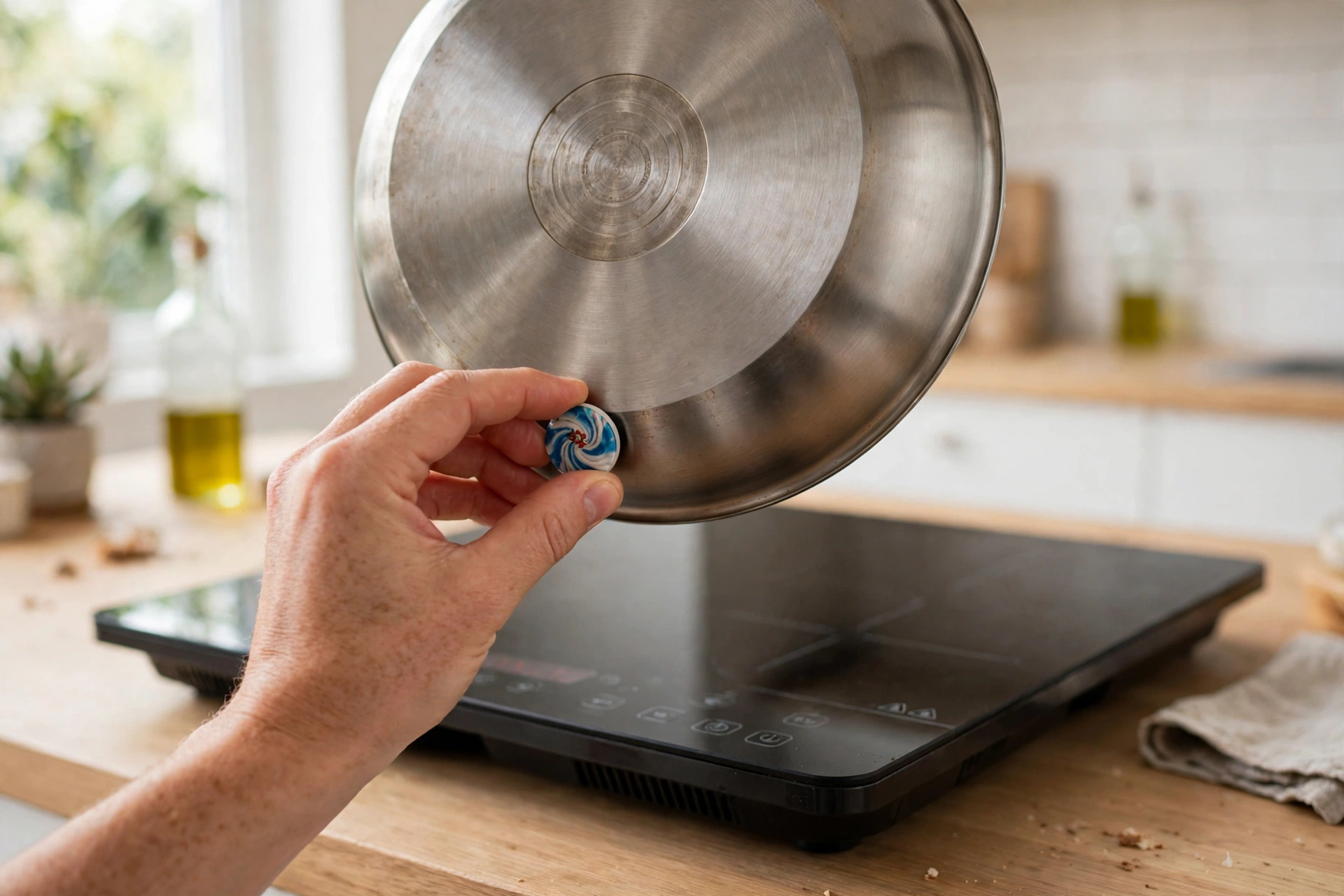
How do you test a pan with a magnet?
Hold an ordinary fridge magnet against the bottom of the pan. If it sticks firmly, the pan will almost certainly work on an induction cooktop. If it slides off or barely clings, the pan will either not heat or will heat too weakly to be useful.
Test your pans before buying a new hob, since replacing a whole set adds to the cost. Flat bottoms matter too: the field weakens quickly with distance, so a warped base heats unevenly. A wok is the classic exception, needing a special curved zone or a wok ring.
Is an induction cooktop faster than gas or electric?
In most everyday cooking, yes. Because the heat starts in the pan rather than travelling through a flame or a hot element, a pot of water usually boils noticeably sooner on induction than on a standard gas or electric ring. Turning the power down works just as fast, so a sauce about to boil over can be tamed in seconds.
That responsiveness is why many cooks compare induction with gas for control, on a flat, easy-to-wipe surface. Low settings stay steady enough for melting chocolate, and a boost setting pours extra power into one zone for a fast boil. Speed depends on the zone’s power rating and the pan, so a thin pan always responds faster than a heavy cast iron one.
Is induction cooking safe?
An induction hob has no open flame, so there is nothing to catch a tea towel alight, and it produces no combustion fumes. The zone only gets as hot as the pan on it, and it cools quickly once the pan is removed.
Most models add safeguards. Pan detection means a zone will not switch on without a suitable pan in place, and many hobs switch off automatically if a pan is lifted and not replaced, or if something spills on the controls. Child locks stop small hands from turning a zone on by accident.
Two cautions are worth knowing. The glass can still be hot from the pan after cooking, so treat it with the same respect as any hob until it cools. People with pacemakers or other implanted devices are generally advised to keep a sensible distance and check their device maker’s guidance, since the hob works with a magnetic field. This is general information, not medical advice.
What are the downsides of induction?
The first is the cookware rule. If your favourite pans are aluminium or copper without a magnetic base, they will not work, and replacing them is a real cost. The second is noise: some hobs hum or buzz at high power, and a pan with loosely bonded layers can rattle.
Induction hobs also need a proper power supply, often a dedicated circuit, so an older kitchen may need an electrician first. The glass is tough but brittle, so dropping a heavy cast iron pan on it can chip or crack it. And techniques that rely on tipping a pan over a flame, such as tossing food in a wok, do not translate to a flat induction zone.
FAQs
Can I use my old aluminium pans on induction?
Not on their own. Pure aluminium is not magnetic, so the field cannot heat it. An induction adapter plate, a flat steel disc that heats up and passes heat to the pan, works, but it is slower and less efficient than a proper induction-ready pan.
Why does my induction hob buzz or hum?
The sound usually comes from the pan, not the hob. At high power the magnetic field can make a pan vibrate slightly, especially if the base has loose layers. A heavier pan with a solid bonded base is usually quieter, and turning the power down often stops the noise.
Does an induction cooktop use a lot of electricity?
It uses electricity efficiently, because most of the energy goes into the pan, not the air around it. A zone may draw similar power to an electric ring while on, but it normally cooks faster and switches off sooner, so the total energy for a meal is often lower than with gas or a conventional electric hob.
Is induction cooking safe for people with pacemakers?
Makers and heart charities generally advise keeping a reasonable distance from an active induction hob if you have a pacemaker or another implanted device, because the hob uses a magnetic field. Check the guidance from your device maker or your doctor first. This is general information, not medical advice.
Conclusion
An induction cooktop works by making the pan the heater: a copper coil creates a fast-changing magnetic field, the field stirs up currents in a magnetic pan, and the pan’s own resistance turns those currents into heat. That simple flip explains the speed, the control, and the cool surface that make induction so appealing.
If you are thinking of switching, start with the magnet test on the pans you already own, then compare running costs and cooking habits with the other appliances in your kitchen, from the microwave oven and electric kettle to the air fryer and hair dryer. For a deeper look, Wikipedia’s guide to induction cooking explains the physics, and the Consumer Reports guide to induction cooking covers performance and cookware choices.