
AI in journalism already writes short, data-based stories, and it helps reporters transcribe interviews, search documents and spot trends. But it cannot truly report: it does not attend events, build trust with sources, or take responsibility for what is published. In every serious newsroom, a human editor still has the final say.
Key Takeaways
- AI handles routine, data-heavy stories well: earnings reports, sports scores, weather updates and election results.
- Behind the scenes it transcribes audio, tags archives, translates copy and suggests headlines.
- AI can invent facts, repeat bias and create convincing fakes, so unchecked AI copy is risky.
- Readers accept AI helping journalists, but few want AI writing the news alone.
- The newsrooms getting most from AI treat it as a research assistant, not a replacement.
Where does AI actually work in a newsroom?
A London School of Economics study of 71 news organisations in 32 countries found newsrooms use artificial intelligence in three areas: gathering news, producing stories and distributing them.
In gathering, AI scans huge document sets, watches social media and pulls public figures. A reporter could ask a tool to read hundreds of pages of meeting minutes and flag every mention of a housing budget — work that once took a week, leaving more time for talking to people.
In production, AI drafts routine stories and handles transcription, translation, tagging and summarising. In distribution, it recommends stories, tests headlines and writes search descriptions. None of this is glamorous — it is back-end work readers never see, and it is where AI earns its keep.
Can AI write a full news story on its own?
For some stories, yes — and it has done so for years. The Associated Press began automating company earnings reports a decade ago; its quarterly earnings stories rose from around 300 to roughly 3,700. The Washington Post’s Heliograf covered the 2016 Olympics and congressional elections the same way, and Bloomberg’s Cyborg has long drafted market stories from financial data.
These examples work because the facts arrive as structured numbers, and editors write the templates and check the output. The machine fills in a form; it does not decide what matters. A story needing judgement — which quote to lead with, whether a source can be trusted — still needs a person in the room. That is the line most newsrooms draw: AI writes the story when it is mostly numbers, a journalist when it is mostly judgement.
What does AI do behind the scenes?
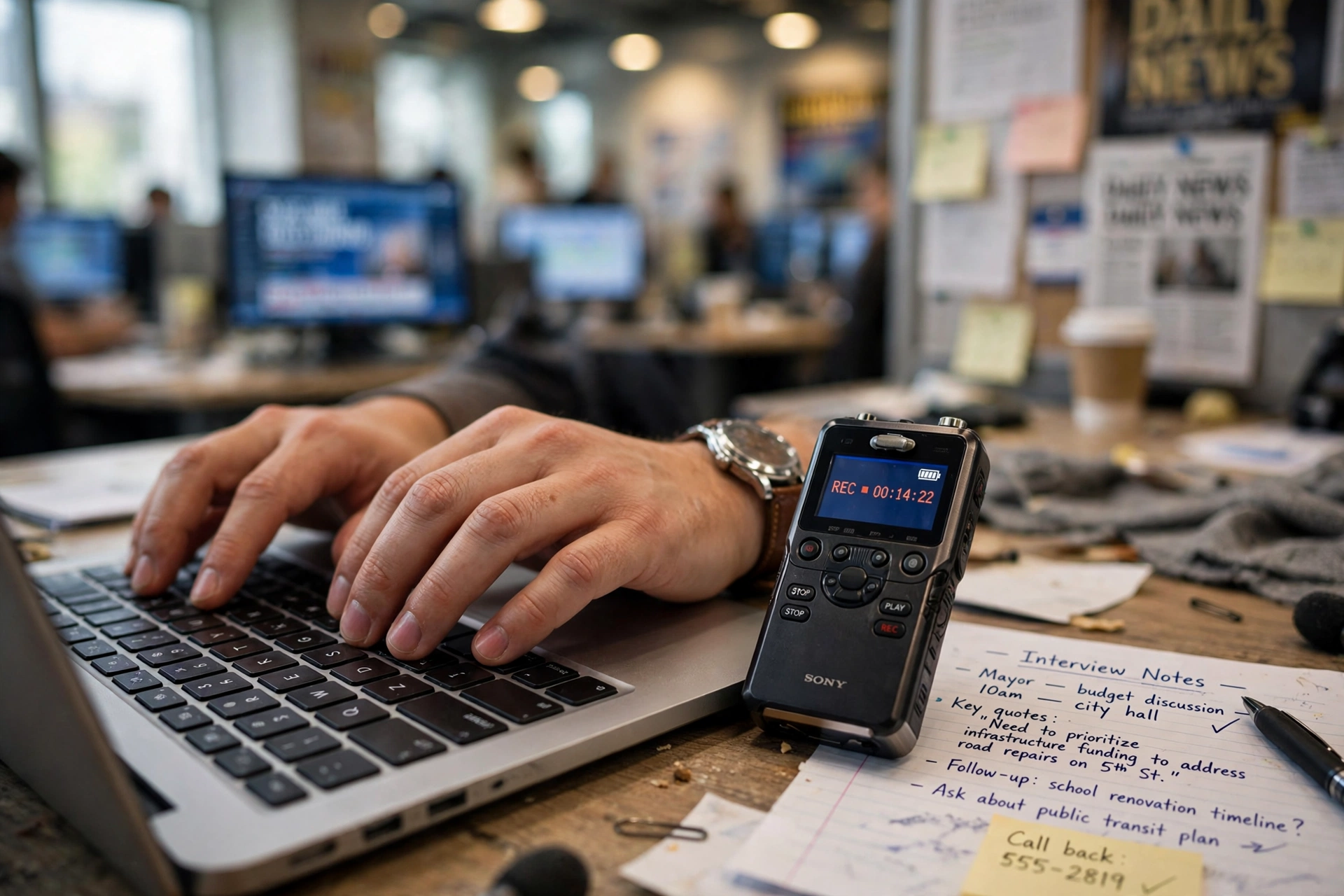
The quiet uses are often the most useful. Transcription is the obvious one: an hour-long interview becomes searchable text in minutes, so a reporter can find the exact quote instead of replaying the recording three times. Natural language processing tools do the same for documents, turning scanned PDFs into searchable text.
Translation is another: a small newsroom can now publish in two languages without a second desk, though a human still needs to check tone and local meaning. Then there is the archive: older stories get tagged with people, places and topics, so a reporter can pull up everything on a subject in seconds. AI also suggests headlines, writes short social-media summaries and helps moderate reader comments, flagging abuse for a human to review.
Where does AI fall short, and what can go wrong?
The biggest problem is that AI can sound confident while being wrong. A language model can invent a quote, a statistic or even a whole event, and present it in polished, publishable prose. That habit, often called hallucination, is dangerous in journalism, where one wrong figure can mislead thousands. Every AI draft needs a human checking facts against a real source.
Bias is the second problem: if an AI’s training data under-represents a community, its story choices can quietly repeat that gap. And scale is the third: one faulty template can publish thousands of wrong stories before an editor spots the pattern. Outside the newsroom, AI makes fakes cheaper to produce, so verifying photos, video and audio takes more effort, not less.
| Task | What AI does well | Where a human must stay in charge |
|---|---|---|
| Earnings reports from company filings | Drafting from structured numbers | Checking figures, adding context |
| Transcribing interviews | A fast first draft of audio | Verifying quotes first |
| Translating a story | A quick rough translation | Checking tone and meaning |
| Investigative reporting | Searching large document sets | Judging and protecting sources |
How can readers tell when AI helped write the news?
Look for disclosure: many publishers now note that a story was produced with AI assistance and reviewed by an editor — and that note is worth reading. A story with a named reporter, named sources and specific numbers is a good sign; one with no byline, no sources and vague claims deserves a second look.
Cross-check too: if a surprising claim appears in only one place, wait before sharing, and check the numbers against the original report. These are old habits, and AI has made them more important, not less.
What should a newsroom do next?
Start with the back-end jobs, not the front page: transcription, tagging and archive search are low-risk places to learn what a tool does well. Measure accuracy on real work before letting AI near anything published under your name.
Publish an AI policy readers can find: what AI is used for, what it is never used for, and who checks the output. Train staff to treat AI drafts as unverified first drafts, and keep the final publish decision with a person — the moment nobody is responsible for a story is the moment trust drains away.
Frequently Asked Questions
Does AI write news articles today?
Yes, short data-based ones: earnings reports, sports results and election tallies are routinely drafted by AI from structured data, then checked by editors.
Will AI replace journalists?
No, not in the reporting sense. AI takes over routine drafting and chores, but interviewing, building source relationships and taking responsibility for publication are human jobs.
Is AI-written news accurate?
It can be, when the facts come from clean, structured data and an editor checks the result. It is risky when the AI has to guess — it can invent details that look plausible.
How do newsrooms check AI output?
The same way they check a junior reporter’s copy: an editor reads it, verifies figures against the source, checks quotes with the people who said them, then approves it.
Should readers trust AI-assisted news?
Trust the publication, not the tool. A newsroom that discloses its AI use, names reporters and sources, and corrects mistakes openly deserves the same trust for AI-assisted stories as for human-written ones.
Conclusion
AI in journalism is best understood as a very fast junior colleague: brilliant at routine work, hopeless at judgement, and in need of constant checking. It will keep getting better at drafting, translating and searching, but the work that makes journalism matter — showing up, asking hard questions, standing behind the answer — still belongs to people.
A practical next step: next time you read a short earnings or sports story, look for the disclosure line at the bottom. It tells you how the story was made — and a publication that tells you that is one you can trust a little more.