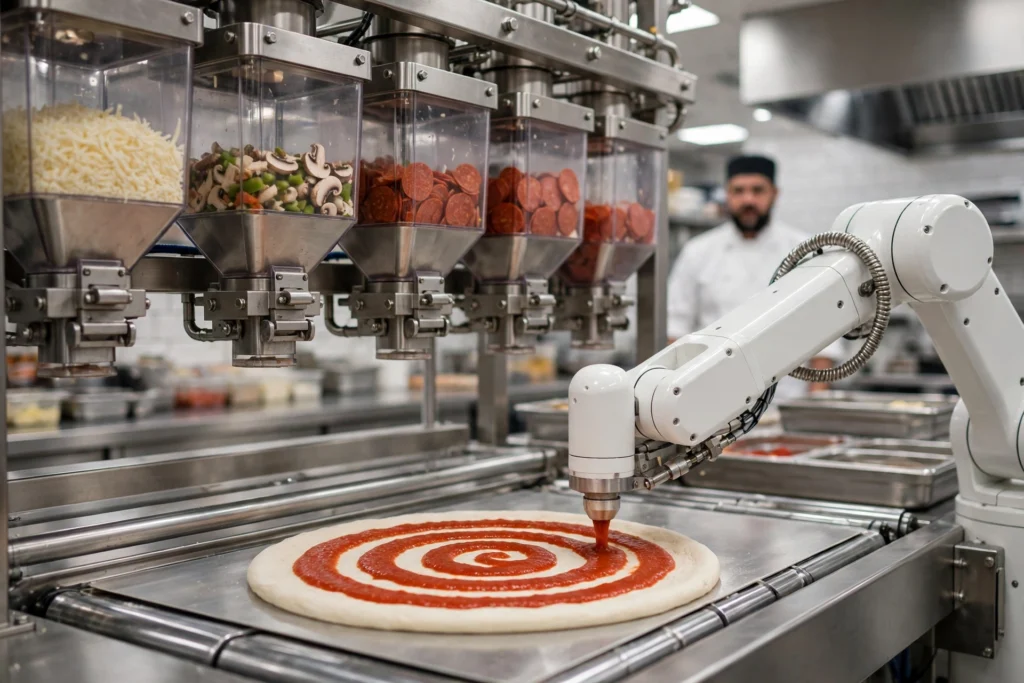
Pizza robots are machines that build pizzas with little or no hands-on help: they press the dough, spread the sauce, scatter the cheese and toppings, bake the pie and slide it into a box. Most are not a single robot chef but a team of modules on a conveyor, each doing one job in turn.
Key Takeaways
- A pizza robot is usually a line of modules, not one human-shaped machine.
- Cameras check the crust so toppings land evenly.
- The fastest systems assemble hundreds of pizzas an hour, but one pie still takes minutes.
- Humans still load dough, refill ingredients and clean the machine.
- Robot-made pizza aims for consistency, not for replacing a pizzaiolo.
What exactly counts as a pizza robot?
Three setups share the name. First, a modular assembly line: a conveyor carries each crust past dispensers, and every station adds one thing. Second, a single robot arm doing several jobs itself: pressing dough, adding sauce, moving the pie in and out of the oven. Third, a vending kiosk: ready-made pizzas kept cold, baked to order and handed through a hatch.
Pizza suits a machine: the steps repeat in the same order, the ingredients come in measured portions, and the product is flat and round — no improvising needed. That is why pizza got its own dedicated automation early, while most restaurant cooking still relies on people.
How does a pizza robot build a pizza, step by step?
It starts with an order: a customer taps their choices into a screen or an app, and the machine reads the recipe.
First, the dough. A dough ball is pressed flat, by a heated press or a spinning plate, into a round base with a raised edge. Cameras check the result; if the crust is off-centre, the machine adjusts the next one.
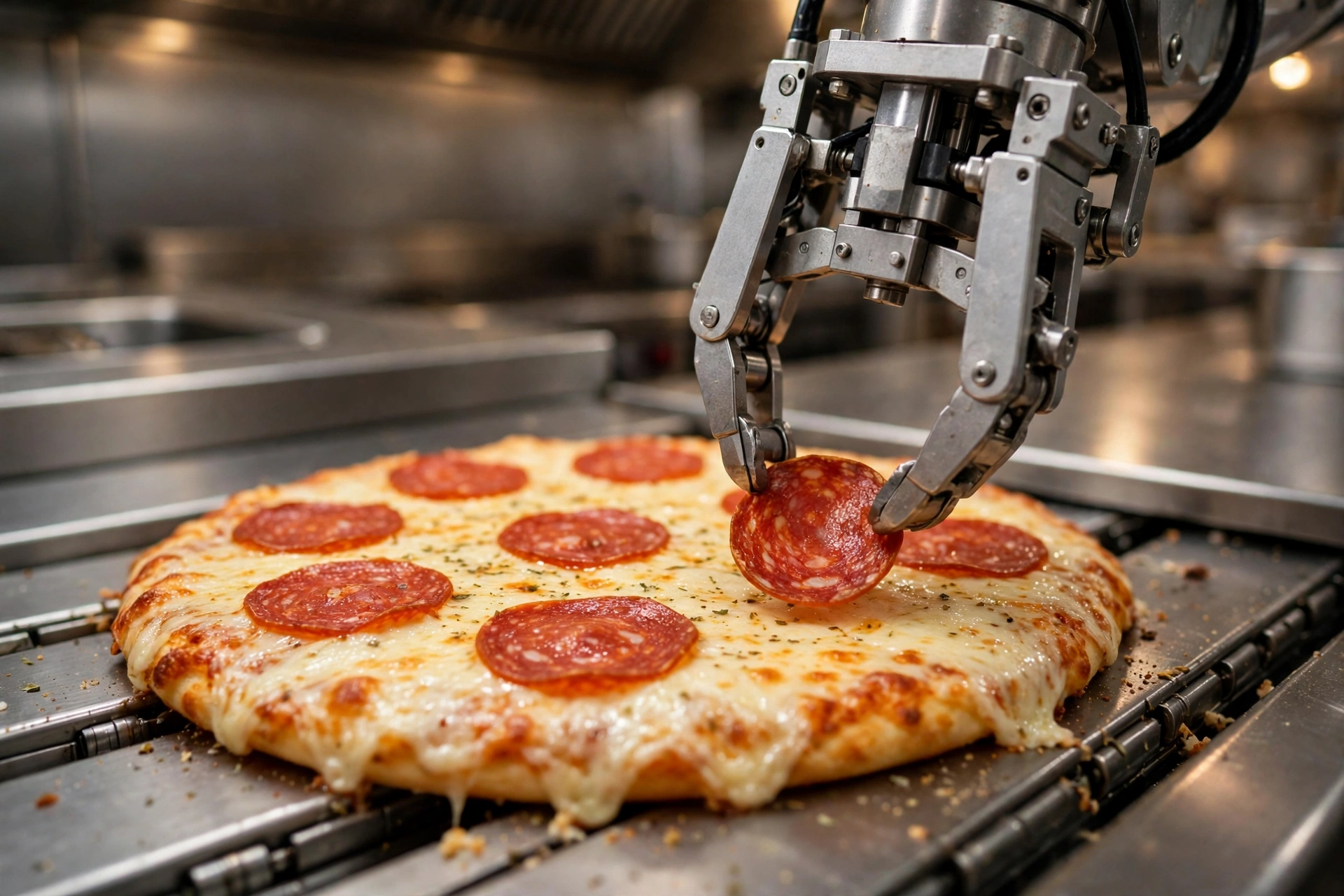
Next, the sauce: a nozzle spirals a measured ring of tomato sauce over the dough, leaving the rim bare. Cheese follows from a grater or hopper; toppings drop from their dispensers in turn. Pepperoni is the fiddly one: some systems scatter slices at random, while others place each slice with a gripper for even coverage.
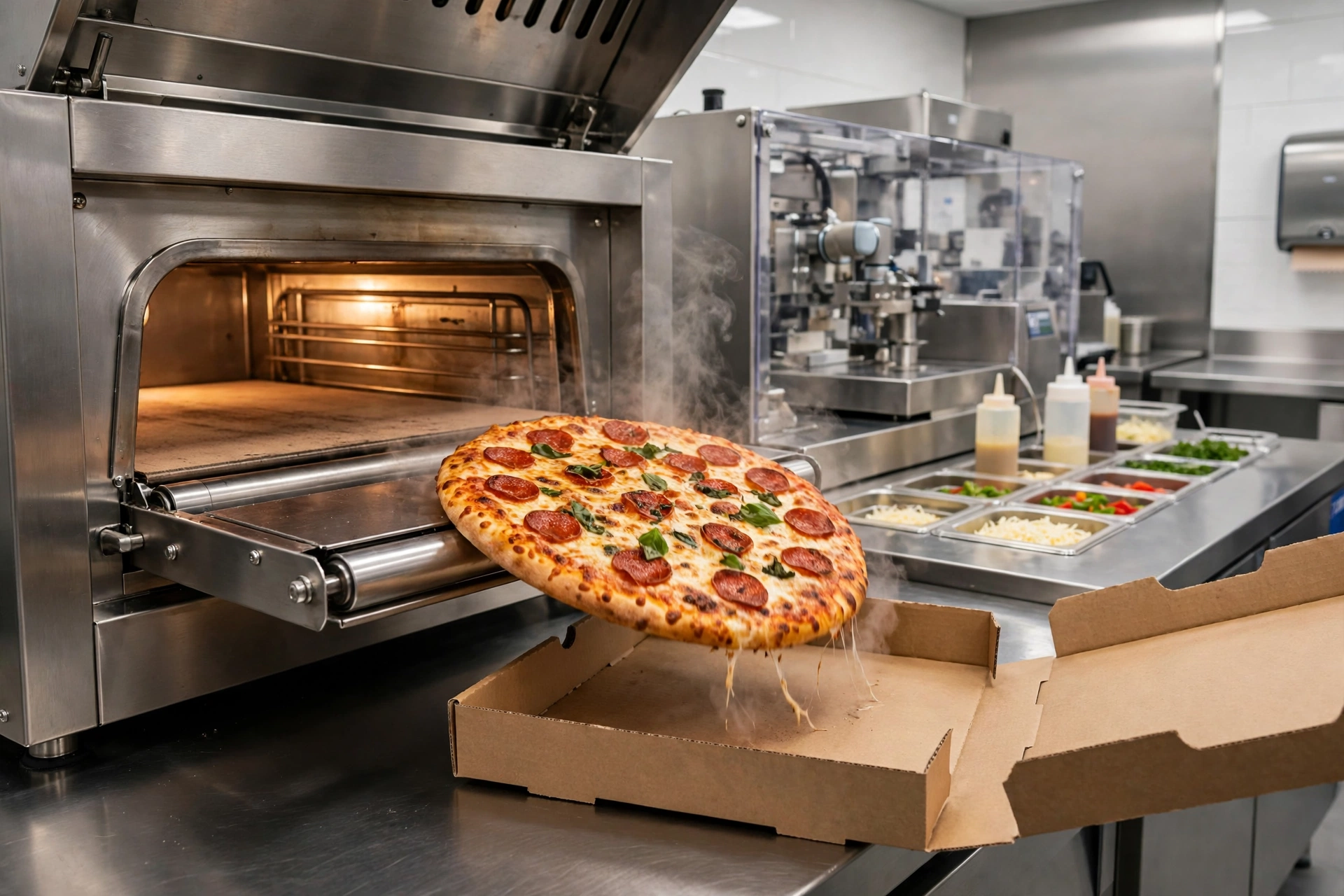
Then into the oven. Most use a conveyor oven, where the pie travels through a tunnel of heat and comes out baked. Finally, a cutter slices it, and an arm or chute drops it into a cardboard box.
What are the three main kinds of pizza robots?
They differ in size, speed and setting: a chain might install a line behind the counter, a cafe one arm, and a campus a kiosk.
| Type | How it works | Best for | Trade-off |
|---|---|---|---|
| Modular assembly line | Conveyor carries crust past sauce, cheese and topping stations | Busy restaurants and chains | Needs floor space and regular refills |
| Single robot arm | One arm presses dough, adds toppings, moves pizzas in and out | Small kitchens and food trucks | Slower than a full line |
| Vending kiosk | Pizzas stored cold, baked to order, handed through a hatch | Campuses, airports and late-night spots | Limited menu and no fresh dough |
The assembly line is the workhorse: Picnic’s modular system can produce up to 300 12-inch pizzas per hour, ASME reports. The single-arm design is the most flexible, since one arm can be reprogrammed for other dishes. The kiosk is the most independent — some need only a power socket and a weekly restock.
A worked example: one margherita, from order to box
Take a plain margherita ordered at 12:30 on a busy lunch shift. The order joins the queue and a dough ball is loaded onto the belt. The press flattens it in seconds; a camera confirms the round shape. A nozzle spirals sauce across the base, a grater dusts mozzarella over the top, a dispenser drops torn basil on last. Minutes later it emerges baked from the conveyor oven, where a cutter slices it and an arm lowers it into a box. Nala Robotics’ Pizzaiola finishes the run in about five to six minutes from order to pickup, the maker says. A human loaded the dough; the robot handled the repetitive middle.
Where do pizza robots still need people?
Everywhere around the edges. Somebody has to make or buy the dough, keep ingredients fresh and chilled, and refill the hoppers before they run dry. Somebody has to taste the product and judge the seasoning — a robot can measure weight but cannot taste. And somebody has to clean the machine, fix a jammed dispenser and deal with the customer whose order came out wrong. The boring middle is automated; the judgement calls stay human.
Are robot-made pizzas any good?
They are consistent rather than exceptional. A pizza robot makes the same pizza every time — exactly what a chain wants at lunchtime, and also the limit. The machine cannot taste a batch of tomatoes and decide they need more salt; a skilled pizzaiolo can, and a robot cannot, at least not yet. Where robots shine is speed and stamina: no tired hands on a Friday night, no miscounted toppings in a long queue, and portions precise enough to cut waste. For a standard menu pizza, most customers could not tell the difference. For a special, the human still wins.
FAQs
Can a pizza robot make any pizza?
Not quite. It handles the pizzas it was set up for: the sizes, sauces and toppings in its dispensers. A new topping usually means a new dispenser and a test run; custom orders only work inside the choices it already knows.
How fast is a pizza robot?
It depends on the design. A modular line can assemble hundreds of pizzas an hour, a single-arm system is slower, and a kiosk bakes one pizza at a time. Baking sets the real pace: dough and toppings are quick, but a pizza still needs its minutes in the oven.
Do pizza robots replace pizza chefs?
They replace the repetitive assembly work, not the chef. Recipes, dough quality and food safety stay with people, while staff move to serving customers and keeping the machine running.
Are pizza robots safe to eat from?
Yes, when they are run properly. Ingredients stay chilled in sealed hoppers, portions are measured, and the oven bakes the pizza through. The risk is the same as in any kitchen — poor cleaning or warm storage — which is why hygiene checks matter more than the robot itself.
Where can I see a pizza robot in action?
Some chains and food halls run them behind the counter, and kiosks appear in airports, universities and shopping centres. Trade shows are the easiest place to watch one work — operators often run live demonstrations there.
What to do next
Next time you order a pizza, ask whether any part of it was made by a machine. Many chains now use a press or a conveyor oven even where a person still adds the toppings, so handmade and machine-made are closer than the menu suggests. If you run a small food business, compare the three designs above against your menu: a kiosk for a fixed menu, a single arm for a small kitchen, a full line only when orders never stop. The robot is not the decision. The menu is.