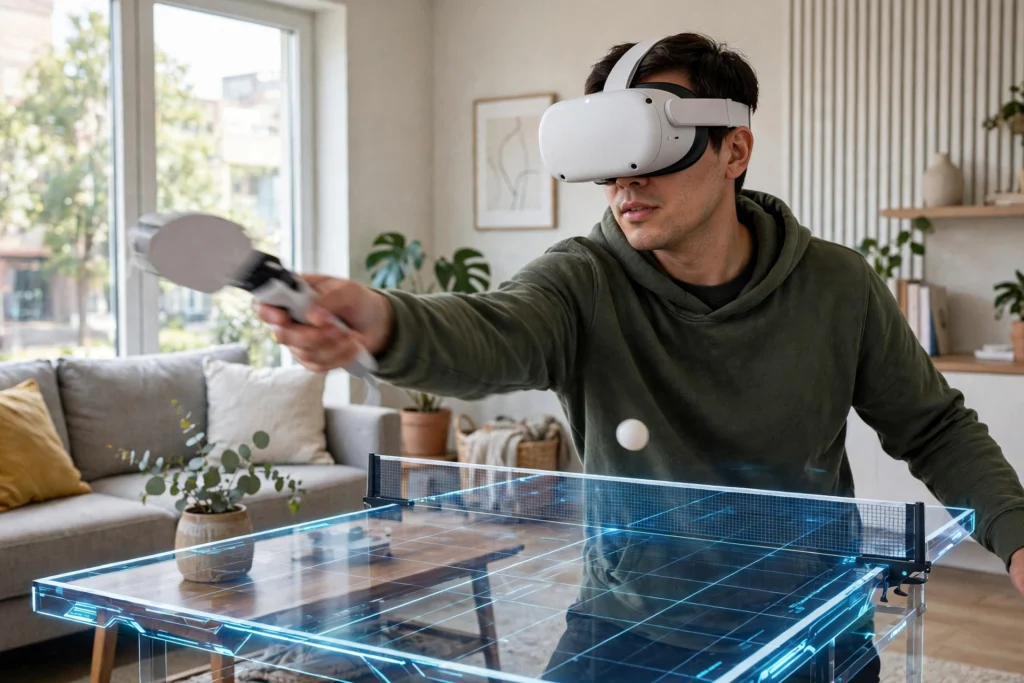
Yes — VR table tennis can genuinely improve your real game, but only for certain skills. Timing, spin reading, and footwork transfer well; the feel of a real paddle does not. Think of it as a practice partner that lives in your living room, not a replacement for a real table.
Key Takeaways
- VR table tennis is closest to the real sport when the physics are realistic — spin, speed, and paddle angle all matter.
- Reading spin, reacting fast, and moving your feet transfer well to a real table.
- The weight of a real paddle and the feel of the ball do not transfer, so keep playing on a real table too.
- Eleven Table Tennis is the best-known realistic option, on Meta Quest and PC VR.
- You need about two square metres of clear floor space to play safely.
Why does VR table tennis feel so real?
The short answer is physics. The leading VR table tennis game, Eleven Table Tennis, has been refined since 2016, and its reputation rests on a physics engine that treats spin the way a real table does. Brush the ball with an angled paddle and it dips; chop underneath it and it floats back with backspin; catch it flat and it flies long.
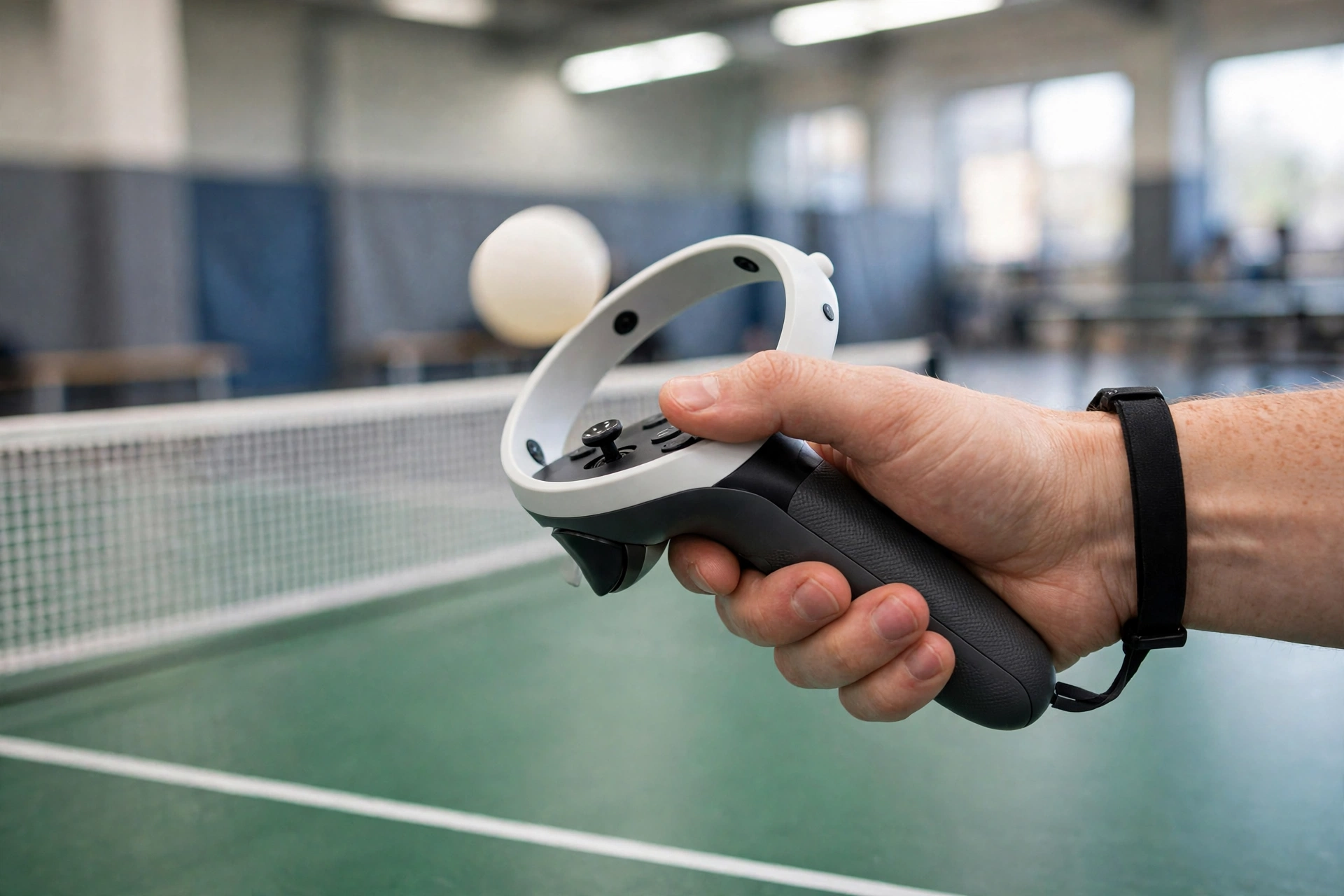
That matters because table tennis is mostly a game of reading the ball. In VR, the ball is right there in front of you, travelling at real speed, and you judge its spin from how your opponent struck it — exactly like the real thing. The headset tracks your controller one-to-one, so your paddle goes where your hand goes, and a small buzz of haptics marks the moment of contact.
How does the spin work in VR?
Spin is calculated from how fast your paddle moves and the angle it meets the ball at. Flick your wrist upward across the back of the ball and the game reads topspin; slice underneath it and it reads backspin. The ball then curves, dips, or kicks as that spin dictates.
This is where the practice value sits. Learning to read spin takes hundreds of rallies, and most casual players never get enough of them. In VR you can face a practice robot that fires ball after ball at you and drill one shot until it clicks. Want to practise returning backspin serves? Set the robot to serve backspin fifty times in a row. That kind of repetition is hard to arrange at a club, where your practice partner gets bored or tired. In VR, the robot never does.
Will it actually make you better at a real table?
For most players, yes, with limits. The skills that transfer best live in your eyes and your feet: reading spin off your opponent’s paddle, reacting to fast balls, and moving into position. Players who put serious hours into Eleven Table Tennis often say their first session back at a real table feels easier — rallies last longer, and they read serves they used to miss.
What does not transfer is touch. A VR controller weighs differently from a paddle, there is no rubber to grip the ball, and nothing in VR reproduces the feeling of a ball sinking into sponge. Delicate shots — a soft drop shot, a feather-light push — are harder to judge in VR, so treat VR as a training ground for timing and reading the game, and keep a weekly session on a real table for touch. There is a fitness bonus, too: an hour of competitive rallies is a real workout, and most players are surprised by how much they sweat.
VR table tennis vs real table tennis
| VR table tennis | Real table tennis | |
|---|---|---|
| Space needed | About 2 square metres of clear floor | A full table plus room to move |
| Opponents | AI at any level, online players, or a practice robot | Whoever is at the club that evening |
| Spin and physics | Very close in the best games | The real thing, every time |
| Touch and paddle feel | Controller weight only; no rubber feel | Full feel of rubber, sponge, and ball |
| Cost to start | Headset plus the game (around $20–$30) | Club fees or a table of your own |
| Best for | Drilling spin reading, reactions, and footwork | Touch, real match play, and coaching |
A 20-minute practice session that actually helps
If you want VR table tennis to improve your real game rather than just entertain you, structure your session:
- Minutes 1–5: warm up against the AI at a comfortable level. Just rally and get your feet moving.
- Minutes 6–12: pick one weakness and drill it. If backspin serves trouble you, set the practice robot to serve backspin and return fifty of them.
- Minutes 13–18: play a match against the AI one level above your comfort zone. Losing points is the point — it forces you to read spin under pressure.
- Minutes 19–20: cool down with slow rallies and focus on footwork.
Do that three times a week and most players notice the difference at a real table within a month: serves become easier to read, and rallies last longer because you are in position more often.
What do you need to start?
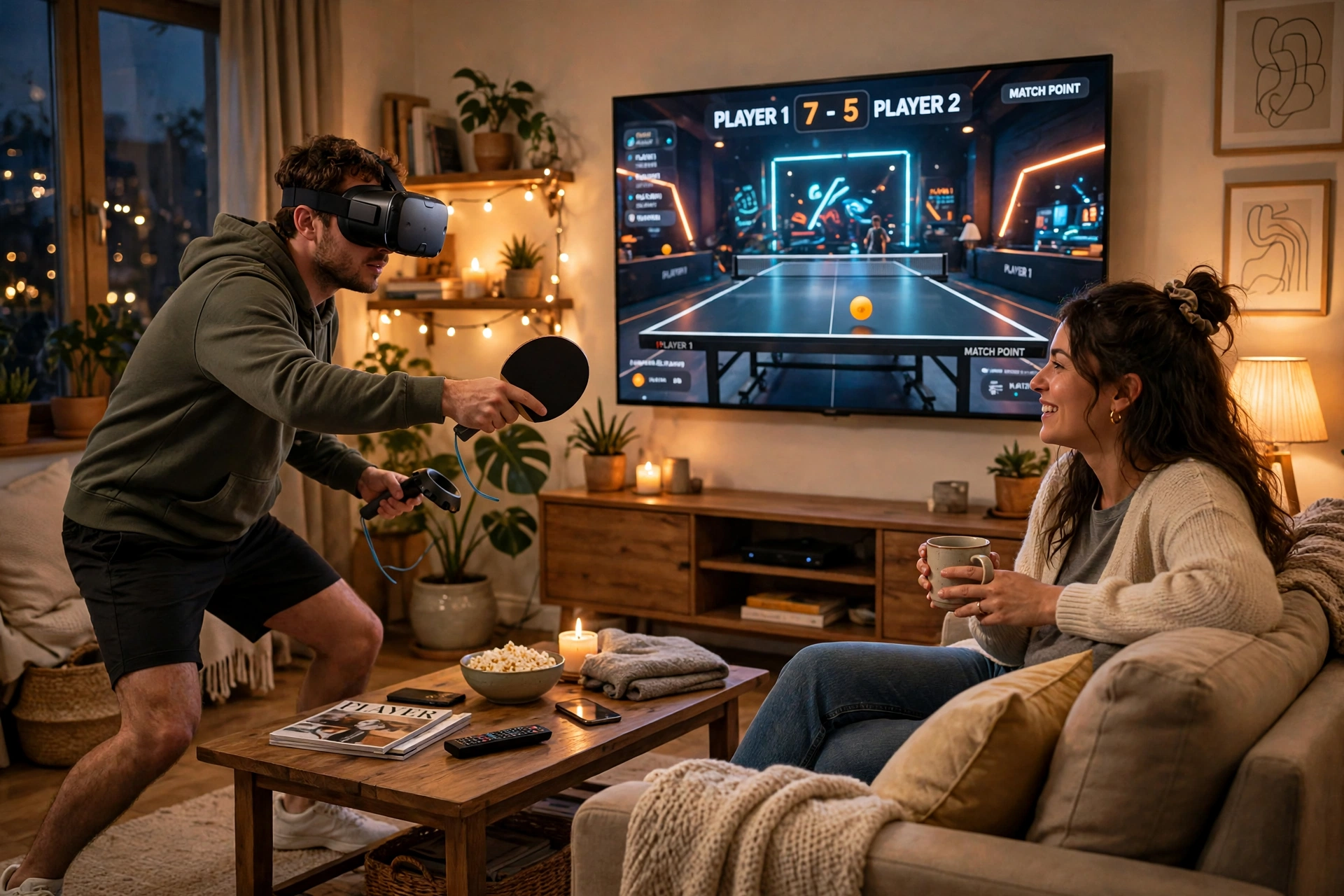
You need a VR headset, the game, and some clear floor space. Eleven Table Tennis runs on Meta Quest headsets and on PC VR, and it is the game most serious players recommend because of its physics. Cheaper, more arcade-style table tennis games exist, but they tend to simplify the spin — exactly the part you want to practise.
Before you play, clear the space. You will lunge for wide balls, and a coffee table at knee height is the enemy of a good rally. Move anything breakable out of arm’s reach, switch the headset’s boundary on, and wear the wrist strap. If you have never played VR before, start with short sessions — some people feel queasy at first.
The game also has a strong online scene, with ranked matches against people all over the world. Real opponents with different styles teach you things an AI never will, like how to handle an awkward sidespin serve from someone who has played for years.
Frequently Asked Questions
Does VR table tennis help beginners?
Yes. The AI opponents start easy, the game teaches you the shots step by step, and you can practise alone without feeling watched. You will still want coaching for proper technique, but VR gets you rallying fast.
Which VR table tennis game is the most realistic?
Eleven Table Tennis is widely regarded as the most realistic, thanks to a physics engine refined since 2016. It runs on Meta Quest and PC VR and costs around $20–$30.
Do I need a lot of space to play?
Not a lot, but you do need clear floor. About two square metres is enough for most rallies, though you should clear a bit more around you because you will lunge for wide balls.
Can I play VR table tennis with friends online?
Yes. Eleven Table Tennis has online multiplayer with ranked matches, so you can play real people around the world. You can also watch a match on the TV while a friend plays.
Will VR table tennis make my real game worse?
It should not, as long as you keep playing on a real table too. The timing, spin reading, and footwork transfer well — just mix in real-table sessions so your touch for delicate shots stays sharp.
Conclusion
VR table tennis is one of the few VR sports that genuinely helps your real game, because it gets the hard parts right: spin, speed, and reading your opponent. It will not teach you the feel of a real paddle, and it will not replace a club, but as a practice tool that is always available, it is hard to beat. If you already own a headset, download Eleven Table Tennis, clear some floor space, and try the twenty-minute routine above. Then book a session at a real table and see how much longer your rallies last.
Further reading: Eleven Table Tennis — https://www.elevenvr.com/ | SpatialAppHub review of Eleven Table Tennis on Quest 3 — http://spatialapphub.com/reviews/meta-quest-3-eleven-table-tennis/