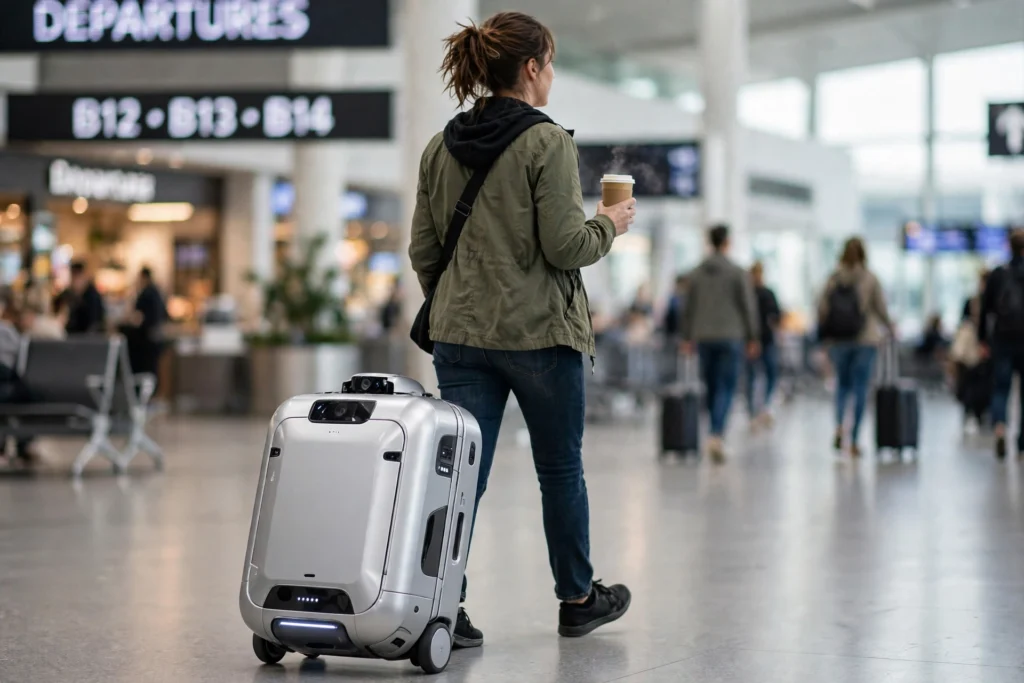
Robot suitcases are carry-on bags that roll along behind you on their own, leaving your hands free for a coffee or a boarding pass. A camera and a distance sensor lock onto you, small motors drive the wheels, and the bag keeps a gap of about two feet as you walk. Grab the handle and it stops following.
Key Takeaways
- Robot suitcases follow you using a camera, a distance sensor, and a phone or wristband link — no remote control needed while you walk.
- They move at walking pace, steer around people, and stop at stairs or when you grab the handle.
- The battery is removable on most models, which matters because airlines generally require smart-luggage batteries to come out before a flight.
- They cost far more than a normal carry-on, hold a little less, and work best on smooth airport floors.
How does a robot suitcase know where you are?
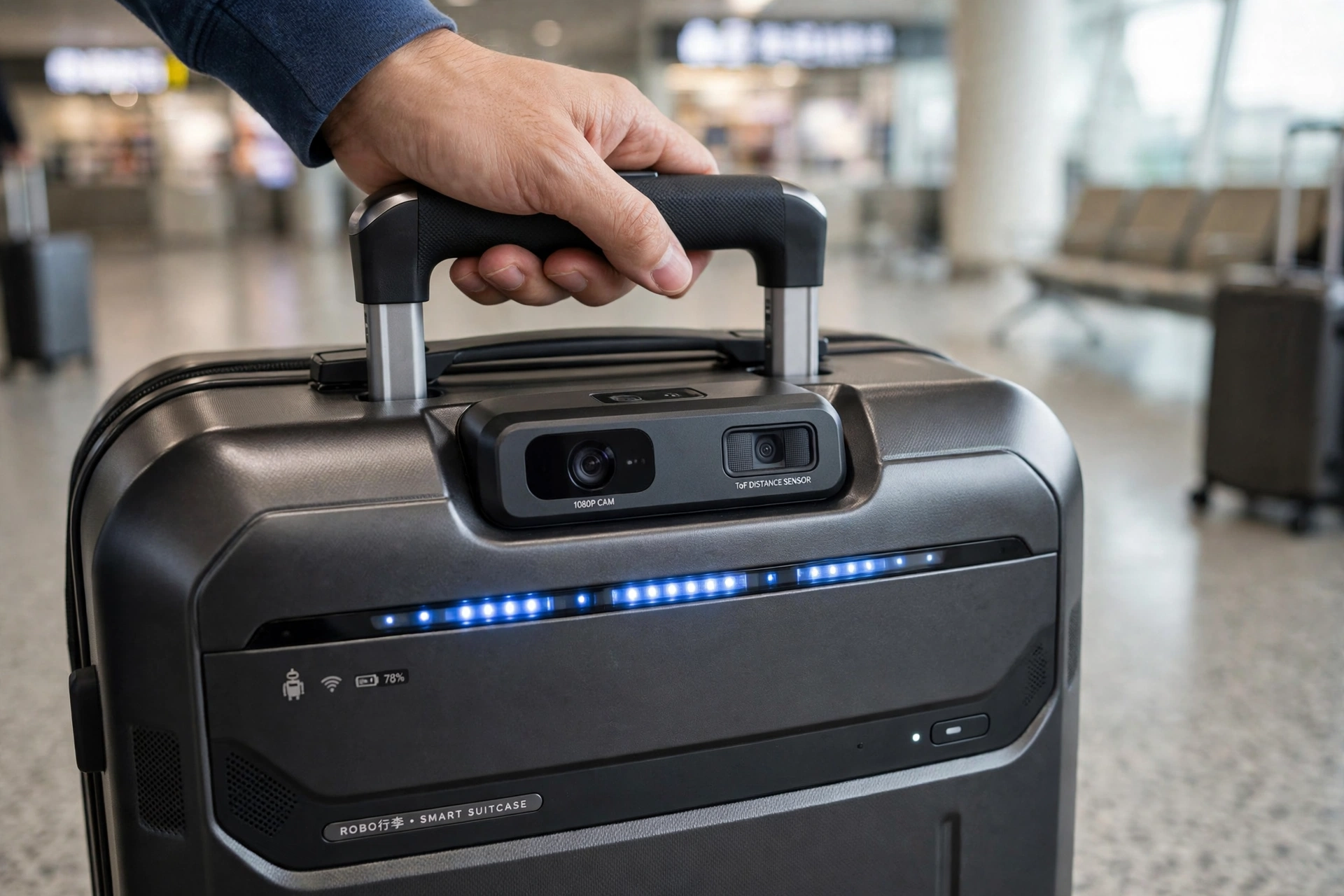
The bag needs to answer one question over and over: where is my owner, and how far away are they? A small camera near the handle watches for you and keeps your shape centred in its view, while a distance sensor measures the gap, usually with infrared light or ultrasound. Together they tell the bag to speed up, slow down, or turn, so it stays roughly two feet behind you.
Some models also pair with your phone or a wristband over Bluetooth and use it as a beacon, which helps when the camera loses sight of you in a crowd. If the signal drops, most models sound an alarm on your phone. It is a small, practical example of everyday robotics — sensors, motors, and a little software, packed into a suitcase.
What makes the wheels move?
Under the shell sits a small electric motor and a battery, much like the ones in delivery robots that roll along pavements. When the sensors say you have moved forward, the motor turns the wheels; when you stop, the bag stops too.
On many models the drive wheels tuck away inside the case when you pull it yourself, then drop down like aeroplane landing gear when follow mode starts. The bag also keeps its four spinner wheels, so it still rolls normally when the battery is flat. Most robot suitcases travel at about 4 to 5 miles per hour, faster than the average walking pace of around 2.7 miles per hour.
How does it avoid bumping into people?
A robot suitcase uses the same basic trick as other machines that move through crowds: sense, slow down, steer around. Its camera and distance sensors spot people, pillars, and other bags ahead of it, and the bag turns slightly to pass them, much like the systems in robots that avoid obstacles.
It is not as smart as a self-driving car, though. It copes well with a flat airport floor and slow crowds, but it struggles with kerbs, thick carpet, and cracked pavements. Bright sunlight can confuse its sensors, and it cannot climb stairs. Grabbing the handle takes over instantly, which is the safety net every design relies on.
What else can a robot suitcase do?
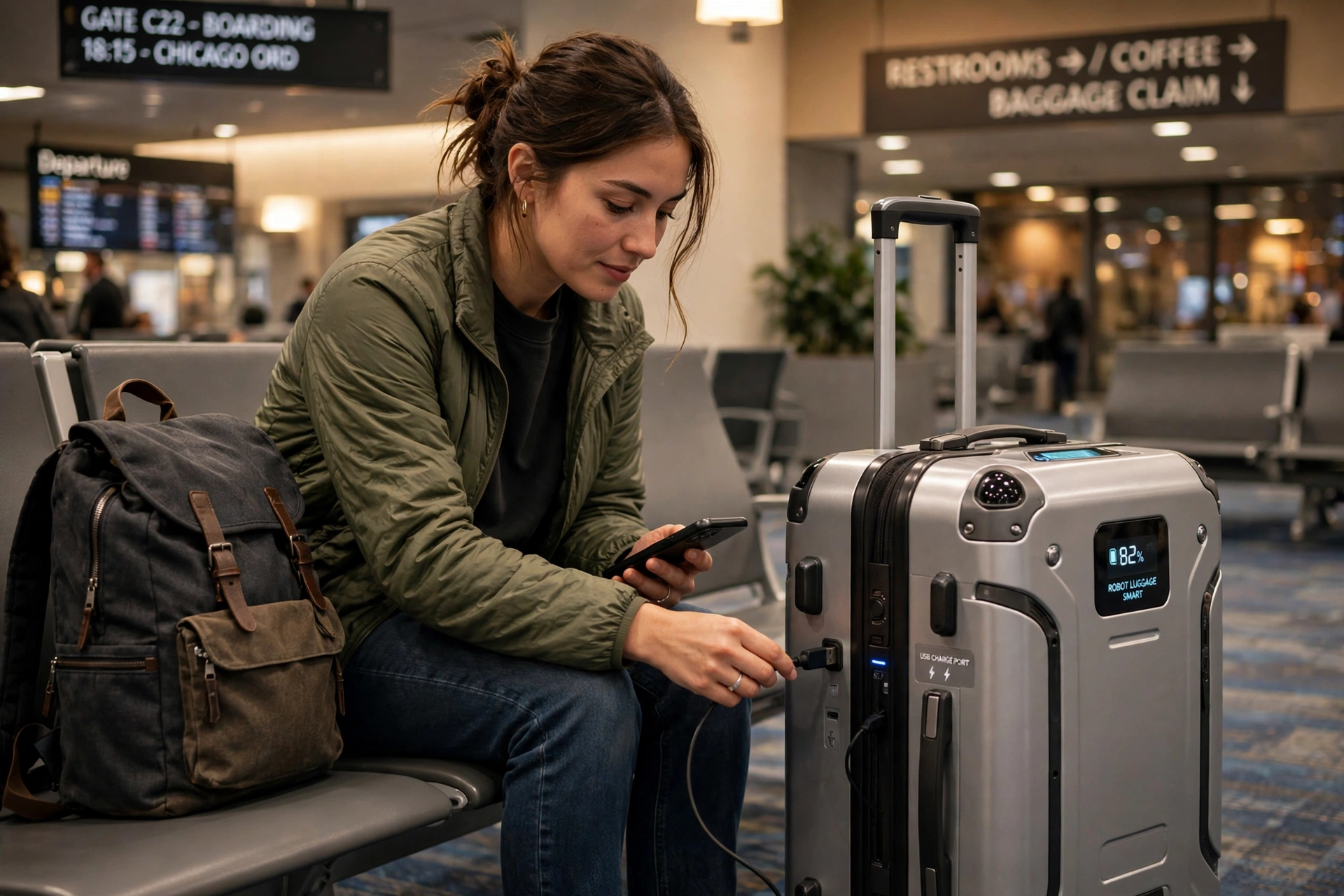
Most models include a removable battery that doubles as a power bank, with USB ports for charging a phone — a full charge typically powers the following motor for around four to five hours. There is usually a built-in scale, a fingerprint or app lock, GPS tracking, and a proximity alarm that warns you if the bag wanders too far. Some models even use LED lights as turn signals.
The trade-off is space. The motor, battery, and sensors take up room, so a robot suitcase usually holds less than a plain bag of the same size, and it weighs more too.
Robot suitcase vs a normal carry-on
| Feature | Robot suitcase | Normal carry-on |
|---|---|---|
| Carrying effort | Follows you hands-free | You pull or carry it |
| Top following speed | About 4–5 mph | As fast as you walk |
| Battery life (follow mode) | Around 4–5 hours | No battery needed |
| Packing space | Less, motors take room | Full use of the shell |
| Weight | Heavier, around 12 lb empty for some models | Lighter |
| Price | Several hundred dollars | Far cheaper |
| Best surface | Smooth airport floors | Anywhere |
A worked example: one walk through the airport
Picture a morning flight. You step out of the taxi, tap the handle to switch on follow mode, and walk into the terminal with a coffee in one hand and your phone in the other. The bag drops its drive wheels, locks onto you, and trails two feet behind, weaving past the same crowds that airport robots navigate every day.
At the gate you sit down, plug your phone into the bag’s USB port, and check the battery in the app. Before boarding, you pop the battery out and slip it into your jacket pocket, as the airline requires — smart luggage with a battery that cannot be removed is banned from the hold on many airlines, so always check your airline’s rules before you fly.
How much do robot suitcases cost?
Early models give a sense of the range. The Cowarobot R1, a 20-inch carry-on, was offered at around $299 when it launched through crowdfunding, with a claimed following time of about five hours. The Travelmate, a larger bag with a fingerprint lock and GPS, was offered for pre-order at $399 to $595 depending on size. Treat those as a guide, not a current price list — some early brands are no longer easy to buy. Expect to pay several times the price of a good ordinary carry-on, and check that the company still sells spare batteries and supports its app before you buy.
Are robot suitcases worth it?
It depends on how you travel. If you fly often, walk long distances through big terminals, and always seem to be carrying a coffee, a laptop bag, and a phone at once, a bag that follows you can feel like a small luxury that pays off on every trip.
But if you mostly take short trips, travel with checked luggage, or walk over rough streets and stairs, the extra weight, smaller capacity, and higher price are hard to justify. A robot suitcase is at its best where it was designed to work: a smooth, flat airport, with you walking ahead and your hands finally free.
Frequently Asked Questions
Can a robot suitcase follow me outside the airport?
It can, on smooth pavements, but it was built for airport floors. Kerbs, cracks, gravel, and steep slopes slow it down or stop it, and bright sunlight can confuse its sensors.
What happens if the battery runs out?
Nothing dramatic. The bag stops following and becomes a normal wheeled suitcase that you pull by the handle. Most models give around four to five hours of following per charge, and the battery is removable.
Can I take a robot suitcase on a plane?
Usually, yes, as a carry-on — but only if the battery is removable and you take it out before boarding. Bags with built-in batteries that cannot be removed may be refused, so check your airline’s rules first.
Will it follow the wrong person?
It should not. The bag locks onto you through its camera and your paired phone or wristband. If it loses track of you, most models stop and alert your phone rather than following a stranger.
Is a robot suitcase allowed in every country?
Not everywhere, and rules change. Some airports and airlines restrict smart luggage, so check the rules for your airline and destination before you buy one for an international trip.
Conclusion
Robot suitcases turn a small daily annoyance — dragging a bag through an airport — into something the bag does for you. A camera and a distance sensor keep it trailing behind you, motors do the rolling, and extras like phone charging, a scale, and GPS tracking make it more than a novelty. They are heavier, pricier, and less roomy than a normal carry-on, and they need smooth floors and a removable battery to be practical. If that sounds like your kind of travel, check your airline’s smart-luggage rules, then look for a model with a removable battery and a company that still supports it.
Further reading: Cowarobot R1 — the carry-on suitcase that follows you · Travelmate robot suitcase