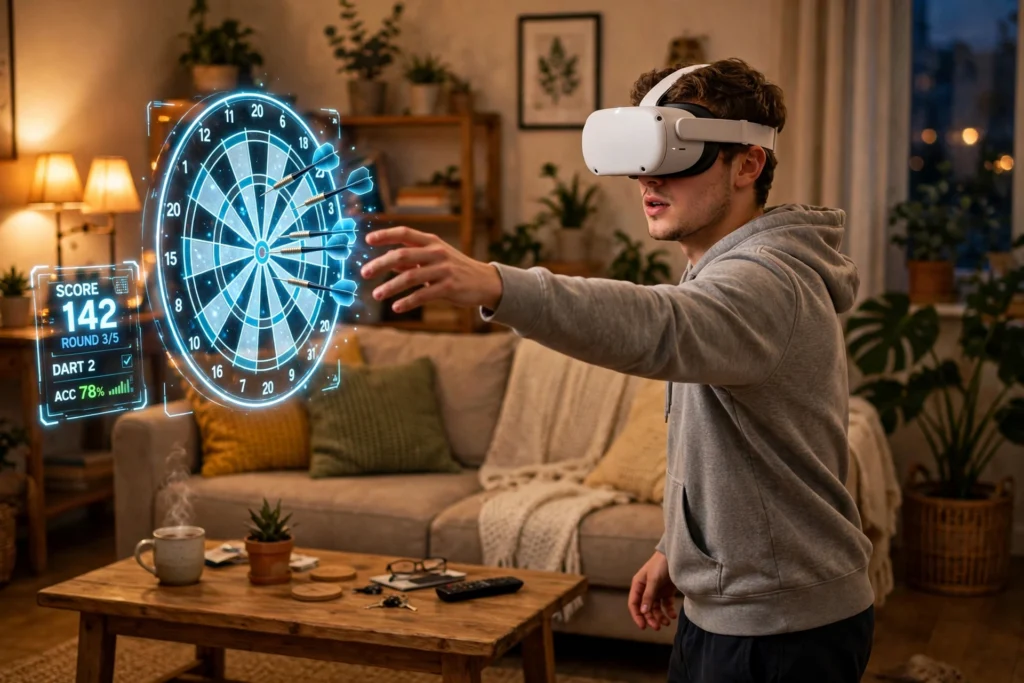
VR darts feels easier than real darts because the game quietly helps you. Aim assist steadies your throw, the board never moves, and the score is worked out for you. That makes bullseyes come quicker — but some of what you learn stays in VR, and the skills that transfer are narrower than the scoreboard suggests.
Key Takeaways
- Aim assist, hand tracking, and automatic scoring make VR darts feel far easier than a night at a pub board.
- ForeVR Darts ($9.99 on Meta Quest) and On Target VR Darts are the two best-known games.
- Your routine, stance, and checkout maths transfer to real darts; the weight of a real dart does not.
- Turn the aim assist down step by step if you want practice that counts.
- Clear the floor, wear the wrist strap, and keep everyone out of your throwing line.
What is VR darts, and how do you throw?
VR darts is darts inside a headset, with a virtual board in a virtual pub hall or in your own living room through mixed reality. You hold a controller — or just your bare hands — and throw as you would a real dart: arm back, aim, release, follow through.
The headset tracks your hand and works out where the dart would land. The board lights up, the score updates itself, and the next dart appears in your hand. A leg of 501 takes a few minutes, alone against computer opponents, passing one headset around, or online.
The best-known game is ForeVR Darts on Meta Quest: $9.99, with 501, 301, Cricket, and Count Up, three levels of aim assist, and hand tracking. On Target VR Darts, on Quest and Steam, leans into practice drills such as Around the Doubles and Bob’s 27.
Why does VR darts feel easier than the real game?
Four things make the virtual board kinder than the cork one.
First, aim assist. On Easy and Medium settings, ForeVR Darts gently pulls your dart toward the segment you were roughly aiming at. You still need a steady arm, but the game forgives the last wobble.
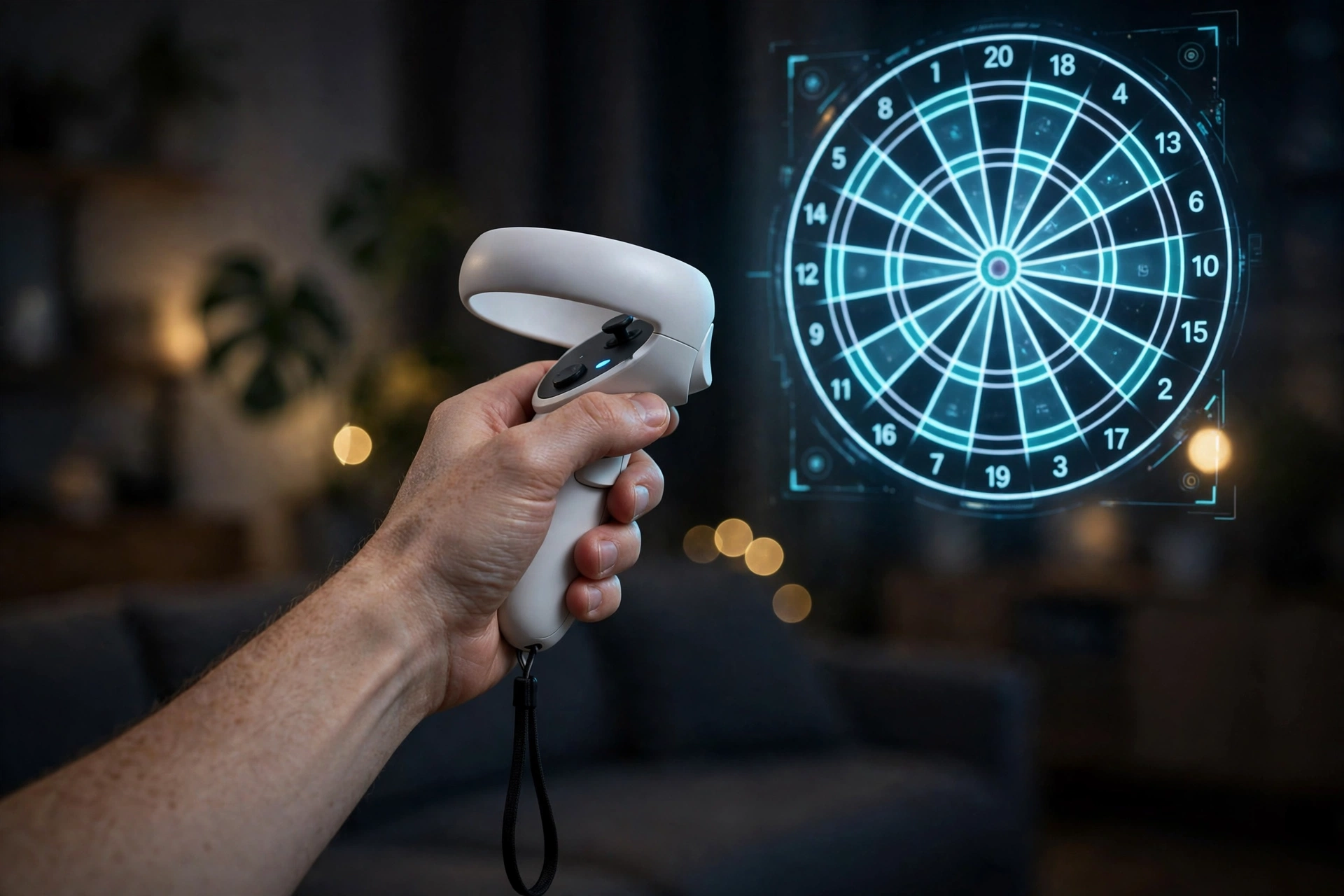
Second, the throw is lighter. A Quest controller weighs around 150 grams; with hand tracking, there is no weight at all. No dart to grip, no flight to catch the air, no bounce-outs. The fiddliest part of real darts — the release — disappears.
Third, nothing distracts you. The board is always at the same height, distance, and light, and nobody chats during your throw. Your routine becomes repeatable very quickly.
Fourth, the game does the maths. Checkout combinations appear on screen and your remaining score is always visible. That is a relief for casual players and a friendly way in for people who have never played.
What actually transfers to a real dartboard?
More than you might expect, if you practise with intent.
Your routine transfers. The stand, the sight line, the pause, the follow-through — VR gives you hundreds of repetitions without a board on the wall, and players who groove a consistent motion there often find their real throw feels calmer.
Your checkout maths transfers too. The game shows you what to aim for — treble 20, then double 16 — so you start to recognise combinations without thinking. That is the same knowledge that wins real legs.
What does not transfer is the feel of the dart. A real dart has weight, a grip, and a flight that responds to your release, and VR cannot teach you how a 22-gram tungsten dart leaves your fingers. The distances are right — the board hangs at regulation height and distance — but the object in your hand is not.
Treat VR darts as a training ground for your habits, not a replacement for the real thing — build the routine in VR, then confirm it on a real board.
How do the two main VR darts games compare?
| ForeVR Darts | On Target VR Darts | |
|---|---|---|
| Price | $9.99 on Meta Quest | Paid, on Quest and Steam |
| Modes | 501, 301, Cricket, Count Up | 501, 301, Cricket, Speed Darts |
| Aim assist | Three levels, plus Hard mode | Adjustable, simulation-style |
| Hand tracking | Yes | Controller-based |
| Drills | Basic; focus is on matches | Six drills, incl. Bob’s 27 |
| Multiplayer | Online, pass-and-play, NPC pros | Online up to 4 players |
| Best for | Casual games with friends | Serious practice |
For a relaxed night with friends, ForeVR Darts is the easy pick. To get genuinely better, On Target VR Darts’ drills are the stronger tool.
A 20-minute VR darts practice session that helps your real game
Warm up for five minutes on your usual assist setting with a casual leg of 501. Do not chase the score — settle your stance and find your rhythm.
Spend ten minutes on one weakness. If your doubles are shaky, run Around the Doubles: one dart at each double in turn. If scoring is the problem, play Bob’s 27 — start on 27 points and lose the value of any treble you fail to hit. Both drills punish sloppy aiming fast, which is what makes them useful.
Finish with five minutes on a harder assist setting than usual, one leg of 501 against a computer opponent. The misses will sting more, and that is the point: you are training the throw that has to work without help.
What should you watch out for before you play?
VR darts is a throwing game, so the safety basics matter. Clear the floor, move the coffee table, and keep children and pets out of your throwing line. Wear the controller wrist strap every time — a controller let go mid-throw can cross a room fast.
Take the headset off between games and rest your eyes. If you feel dizzy or your aim drifts, stop: tired throwing builds bad habits. If you use hand tracking, play in a well-lit room, and re-check your play space before each session — a full throwing motion needs more room than a seated game.
FAQs
Do I need a real dartboard to play VR darts?
No. The board is entirely virtual, so you can play anywhere with room to throw safely. You need a headset: a Meta Quest 2 or newer, or a PC VR setup for the Steam version.
Is VR darts good practice for real darts?
Yes, for your routine, aim, and checkout maths — less so for the feel of a real dart, as the controller weighs nothing like tungsten. Treat it as a training ground and check progress on a real board.
Which VR darts game should I buy first?
ForeVR Darts for casual games with friends — $9.99, easy to pick up, and pass-and-play suits a group. On Target VR Darts for structured practice drills and online matches.
Can you play VR darts with friends?
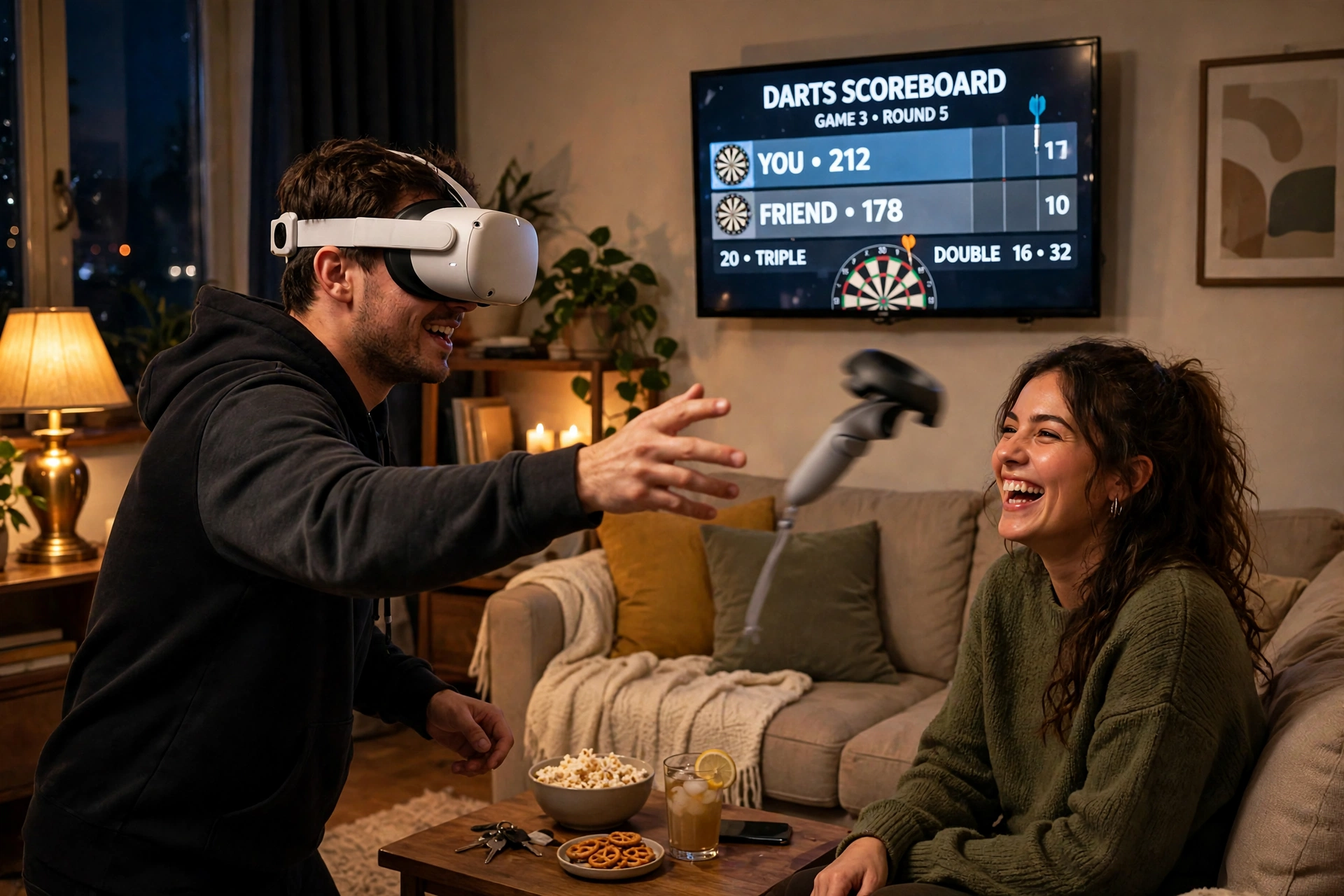
Yes. Both games offer online multiplayer, and ForeVR Darts also has pass-and-play, sharing one headset around the room.
Does VR darts help with doubles?
It can: drills like Around the Doubles give you far more double attempts in ten minutes than a casual game. Practise on a low assist setting, or your VR accuracy will not match the real board.
Conclusion
VR darts feels easier than real darts because it is designed to — aim assist, automatic scoring, and a perfect board every time. That is what makes it fun. But the players who get the most from it use the help as a ladder, not a crutch: turn the assist down, drill the doubles, and build a routine you can trust. Your next step is simple — pick one of the two games, play a leg of 501 tonight, and finish it on a harder assist setting than you started.
Further reading: ForeVR Darts on the official ForeVR Games site and ForeVR Darts on the Meta Quest store. Inside Techserps, see how the hardware works in How Do VR Headsets Work?, How Do VR Controllers Work?, and two more VR sports guides, VR Cricket and VR Table Tennis.