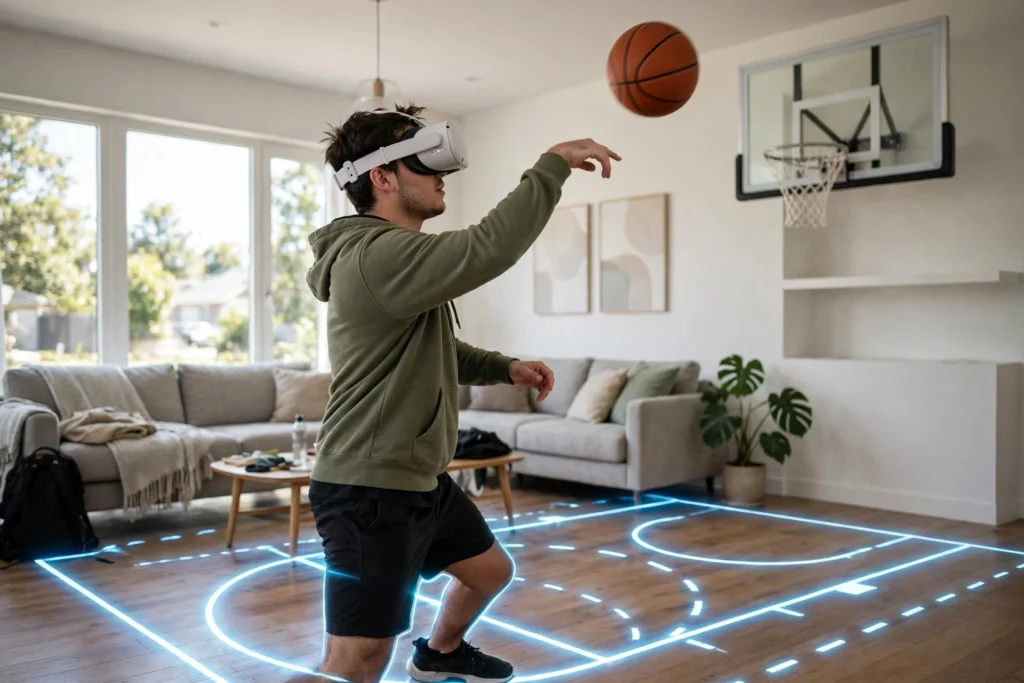
VR basketball puts you on a virtual court in a headset, controllers tracking every shot, dribble and pass. You can practise shooting alone, run drills, or play matches against people worldwide, all from your living room. It feels close to the real game, though it can’t replace the weight of a real ball or the contact of a real match.
Key Takeaways
- VR basketball turns your living room into a court using a headset and motion tracking.
- Shooting and free throws are its strongest part; full five-on-five play is still basic.
- Gym Class VR is the best-known option, free on Meta Quest, with official NBA courts.
- A session can be a genuine workout, so clear the floor and set your play boundary first.
- Shooting form can carry over to a real court, but strength and contact can’t.
What Is VR Basketball?
VR basketball is basketball played inside virtual reality. You put on a headset and find yourself on a court — a streetball court or a packed arena — with a ball in your virtual hands. The headset tracks your head, and the controllers follow your arms, so when you shoot, the game reads your release, arc and timing.
Most games are built around shooting: stand at a spot, take the shot, and the ball drops or clangs off the rim. Some add dribbling, passing and one-on-one defence, and a few offer two-on-two or three-on-three matches online. If you’re new to headsets, our guide to how VR headsets work explains the screens, lenses and tracking behind it.
How Does a Game Play?
A session starts in a virtual gym or lobby. Pick a mode — free shooting, a timed challenge, a drill, or an online match — and the game places you on the court. Your controllers become your hands: hold the trigger, raise your arms, flick your wrists and release at the top, much as you would with a real ball. The game measures the angle and speed of your motion and decides where the shot goes.
One detail catches most first-timers out: there’s no real ball in your hands. Your brain expects weight, and the controllers are light. Most players adjust within a few minutes, but your first dozen shots will probably sail long or fall short while your timing catches up. Your controllers do most of the work here, so it’s worth knowing how VR controllers work before buying extra straps or accessories.
What Can You Practise?
Shooting is where VR basketball earns its keep. Free throws, three-pointers and catch-and-shoot drills translate well, because the motion is close to the real thing and you can repeat it hundreds of times without chasing a ball down the street. Some apps track your makes and misses shot by shot, so you can see whether your percentage is actually improving.
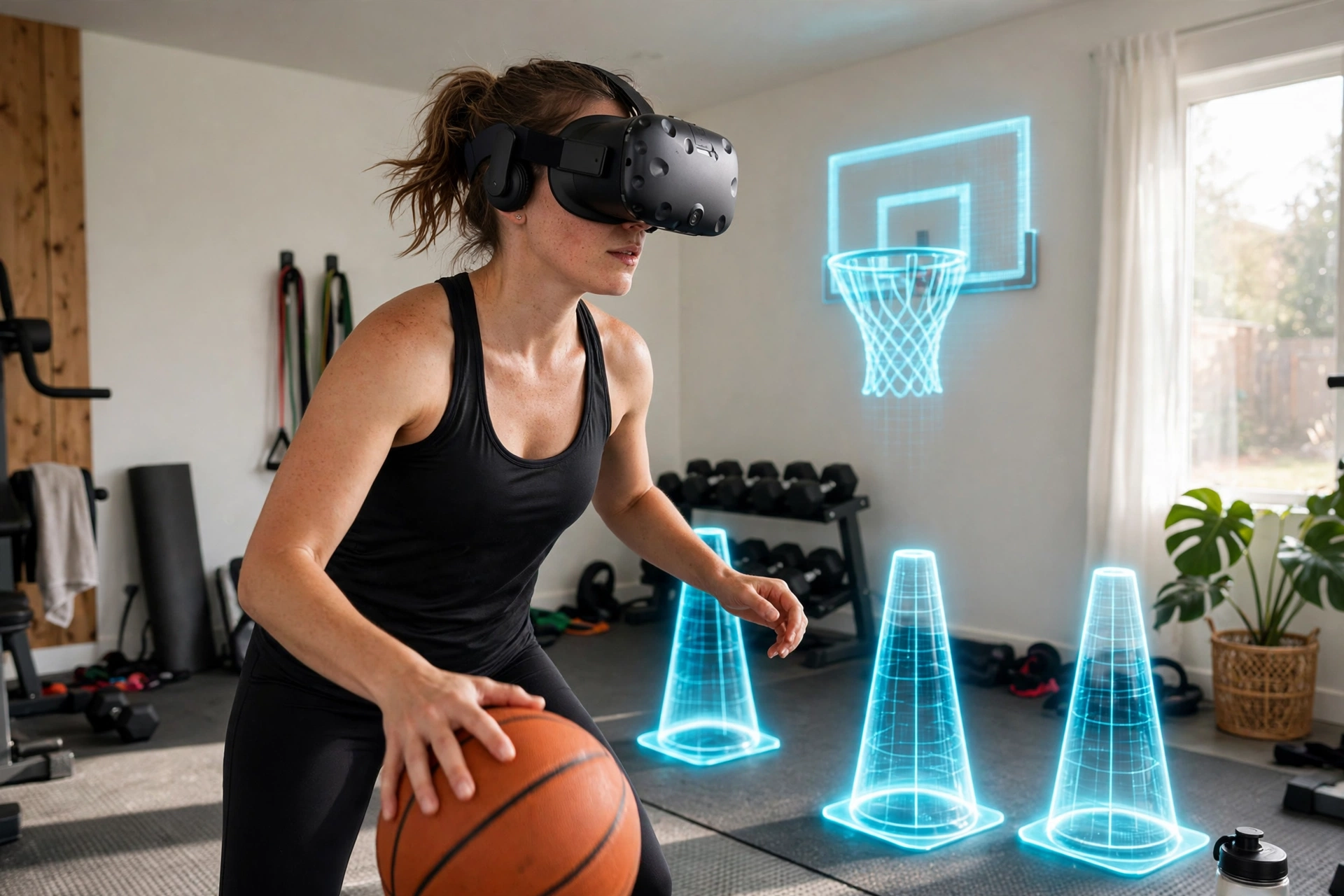
Dribbling is a mixed bag. The best games add cone drills and crossover challenges, but without a real ball bouncing back into your hand, the feel is never quite right — useful for footwork, less so for ball control. Passing and court vision fare better: three-on-three games force you to read defenders and move the ball. Then there’s coaching: The Sixth Man, a VR coaching app for Meta Quest 3, pairs you with a virtual coach who watches your shot and corrects one form issue at a time.
VR Basketball vs the Real Court
| VR basketball | Real basketball | |
|---|---|---|
| Where you play | Living room or garage | Court, gym or park |
| Equipment | Headset, controllers, clear floor | Ball, shoes, hoop |
| Shooting reps | Hundreds per session | Limited by rebounding |
| Dribbling feel | Approximate, no real weight | Full feel and bounce |
| Physical contact | None | Screens, boxing out |
| Weather | Never a problem | Rain ends the game |
The trade-off is plain. VR basketball is brilliant for reps and convenience, and weak wherever another player’s body or the weight of a real ball matters. Treat it as a supplement to real play, not a replacement.
Which Games Are Worth Trying?
Gym Class VR is the obvious starting point. It’s free on Meta Quest, focuses on realistic shooting mechanics, and includes licensed courts from all 30 NBA teams. You can train alone or play one-on-one, two-on-two or three-on-three online, and the physics punish lazy shots — exactly what you want from practice. A detailed overview of Gym Class VR covers its modes, courts and multiplayer in more depth.
For structured coaching, The Sixth Man builds sessions around your level and shooting goal, with a virtual coach reacting to each rep. On PC VR, VR Basketball: Training Challenge on Steam leans into drills, with two-point, three-point and zigzag shooting stages plus a challenge mode against the clock. Start with the free option: a week of short sessions in Gym Class will tell you whether VR basketball is something you’ll stick with.
Does It Make You Better at Real Basketball?
It can help, within limits. Shooting form is the clearest win: the motion of a jump shot in VR is close enough to the real thing that repetition builds muscle memory, and instant feedback helps you notice a flat arc or a late release. Players who use VR for short, regular sessions often feel more confident at the free-throw line.
What doesn’t carry over is anything that needs weight, contact or stamina at full intensity — finishing through contact, boxing out a stronger player, or running a fast break for forty minutes. So the honest answer is: VR basketball can sharpen your shot and your court sense, especially if you can’t get to a court every day, but it won’t make you a better player on its own. Pair it with real games and it works as a useful extra practice tool.
If you enjoy VR sport, the same idea applies elsewhere — our guide to how VR boxing works covers a workout that leans even harder on fitness, and VR cricket shows how another bat-and-ball sport handles the same problems.
What Do You Need, and Is It a Workout?
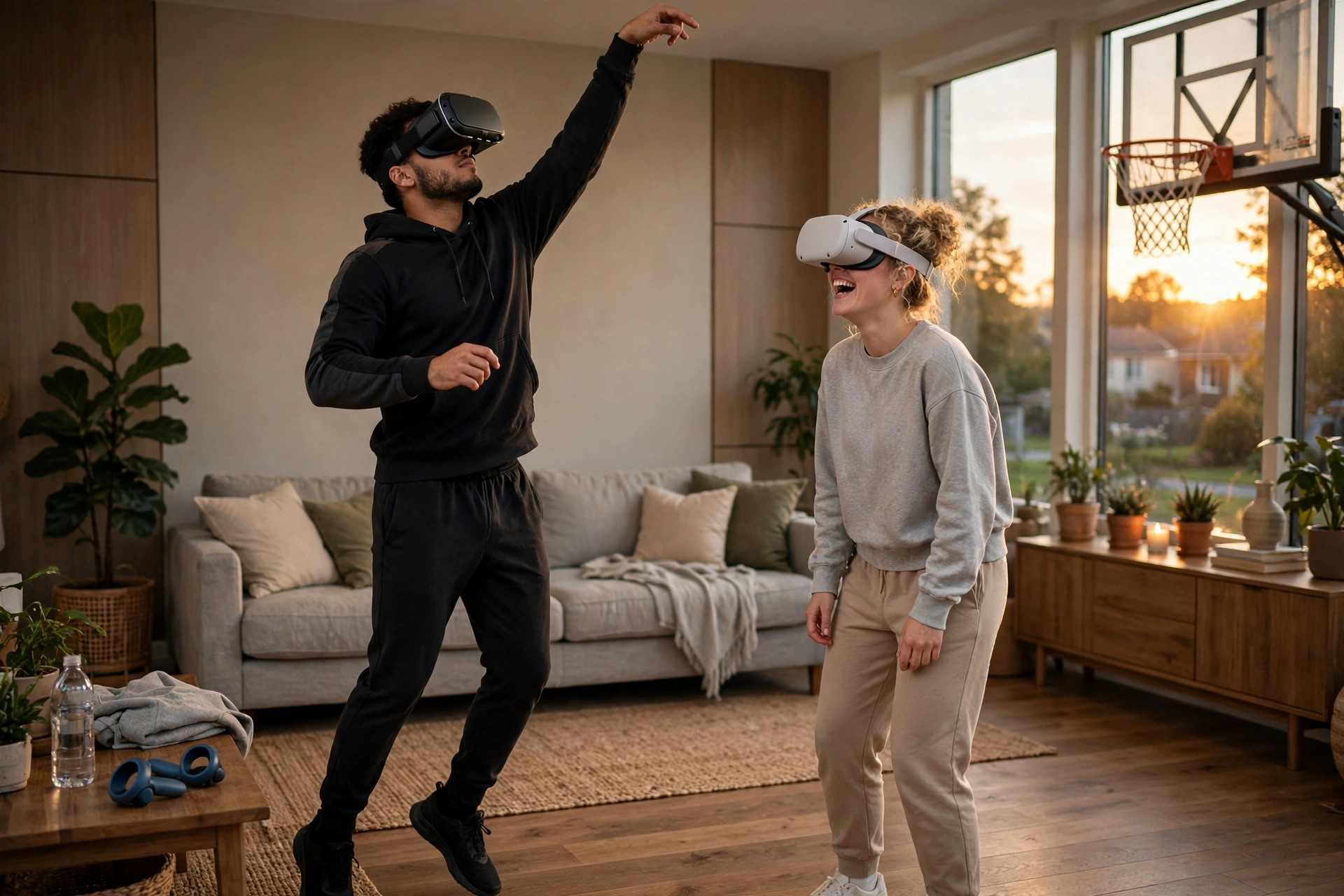
You need a standalone headset such as a Meta Quest 2, 3 or 3S, or a PC VR setup, plus about two metres by two metres of clear floor. Set up your guardian boundary before you start, and take it seriously: the number one cause of VR basketball injuries is a coffee table that was “definitely out of the way.”
And yes, it’s a real workout. A half-hour session of shooting drills and online matches gets your heart rate up, works your legs every time you jump, and keeps your arms moving. It’s mostly short bursts rather than sustained running, so think of it as light to moderate cardio with a basketball flavour.
FAQs
Can you play VR basketball without a real ball?
Yes. Most games use a virtual ball, so you don’t need a real one — your controllers stand in for your hands. A few mixed-reality apps, such as Qourt Vision XR, are built around a real ball instead, but they’re the exception.
Do you need a Meta Quest to play VR basketball?
No, but it’s the easiest route. Gym Class VR, the most popular VR basketball game, runs on Meta Quest. PC VR headsets can run Steam titles such as VR Basketball: Training Challenge, and PlayStation VR has its own smaller selection.
Is VR basketball good for kids?
It can be, with supervision. Headsets are generally designed for ages 10 and up, and younger players need short sessions, a clear play area and an adult nearby. Check the age guidance on the specific game first.
Can VR basketball help with free throws?
Free throws are one of the best things to practise in VR, because the motion is repeatable and the game tracks every make and miss. Take fifty shots at the virtual line and you’ll see your percentage — then work on the one part of your form that keeps letting you down.
How much space do you need for VR basketball?
About two metres by two metres of clear floor is the minimum, and more is better. Shooting needs room for your follow-through and a small jump. Move furniture, rugs and anything breakable out of the guardian boundary first.
The Bottom Line
VR basketball is at its best as a shooting gym that lives in your living room. It’s cheap to start, easy to fit into a busy day, and genuinely useful for shooting reps, free throws and court vision. It won’t replace real basketball — nothing in VR can copy the weight of the ball or the shoulder of a defender — but as a way to get extra shots up when you can’t reach a court, it’s hard to beat.
The practical next step is simple: if you already own a Quest, download Gym Class VR — it’s free — and run a fifteen-minute shooting session tonight. Take fifty free throws, note your percentage, and repeat it three times this week. If your numbers climb, VR basketball is earning its place in your routine.
Further reading: Gym Class VR overview and The Sixth Man VR coaching.