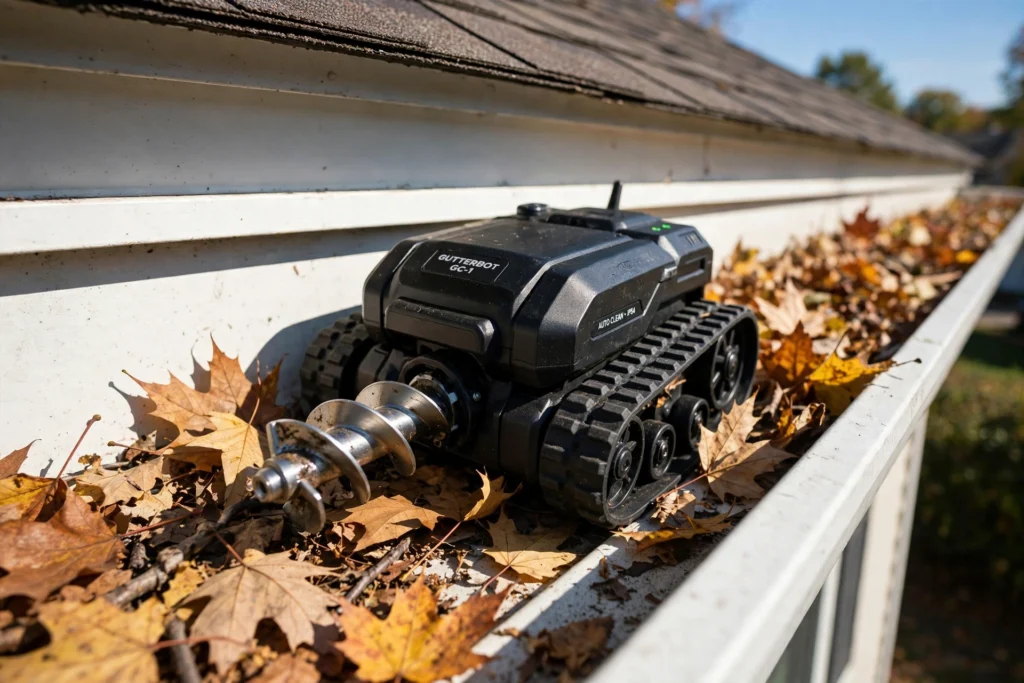
Gutter cleaning robots are small machines that crawl along inside your gutters and throw leaves and sludge out over the edge. The best-known design, iRobot’s Looj, rides on tank treads and spins a rubber auger at 500 RPM to break up clogs, lift the debris, and fling it clear — so you stay on the ground instead of climbing a ladder.
Key Takeaways
- A gutter cleaning robot is a small treaded machine that fits inside a standard gutter and clears leaves with a spinning auger.
- The iRobot Looj spins its auger at 500 RPM and cleans about 200 linear feet per charge.
- Most gutter robots are remote-controlled, not fully autonomous, so you still steer them from the ground.
- They handle dry leaves well but struggle with wet moss, heavy clogs, and gutter guards.
- The Looj was discontinued in 2017, so buyers today mostly find refurbished units or pole tools instead.
What sits inside a gutter cleaning robot?
A gutter cleaning robot has to be small, tough, and happy in the wet. The Looj, the model that defined the category, measures just 2.25 inches tall and 3.25 inches wide, so it slides into most standard K-style gutters. Two long treads run down its sides, like a tiny tank, giving it grip on a wet, leaf-covered surface where wheels would spin uselessly.
Inside sit two motors: one drives the treads, the other spins the auger at the front. A rechargeable 7.2-volt lithium-ion battery powers both, and the machine is sealed against water — the Looj is rated waterproof in up to 8 inches of water. A detachable handle clips on top for carrying, and it doubles as the remote control.
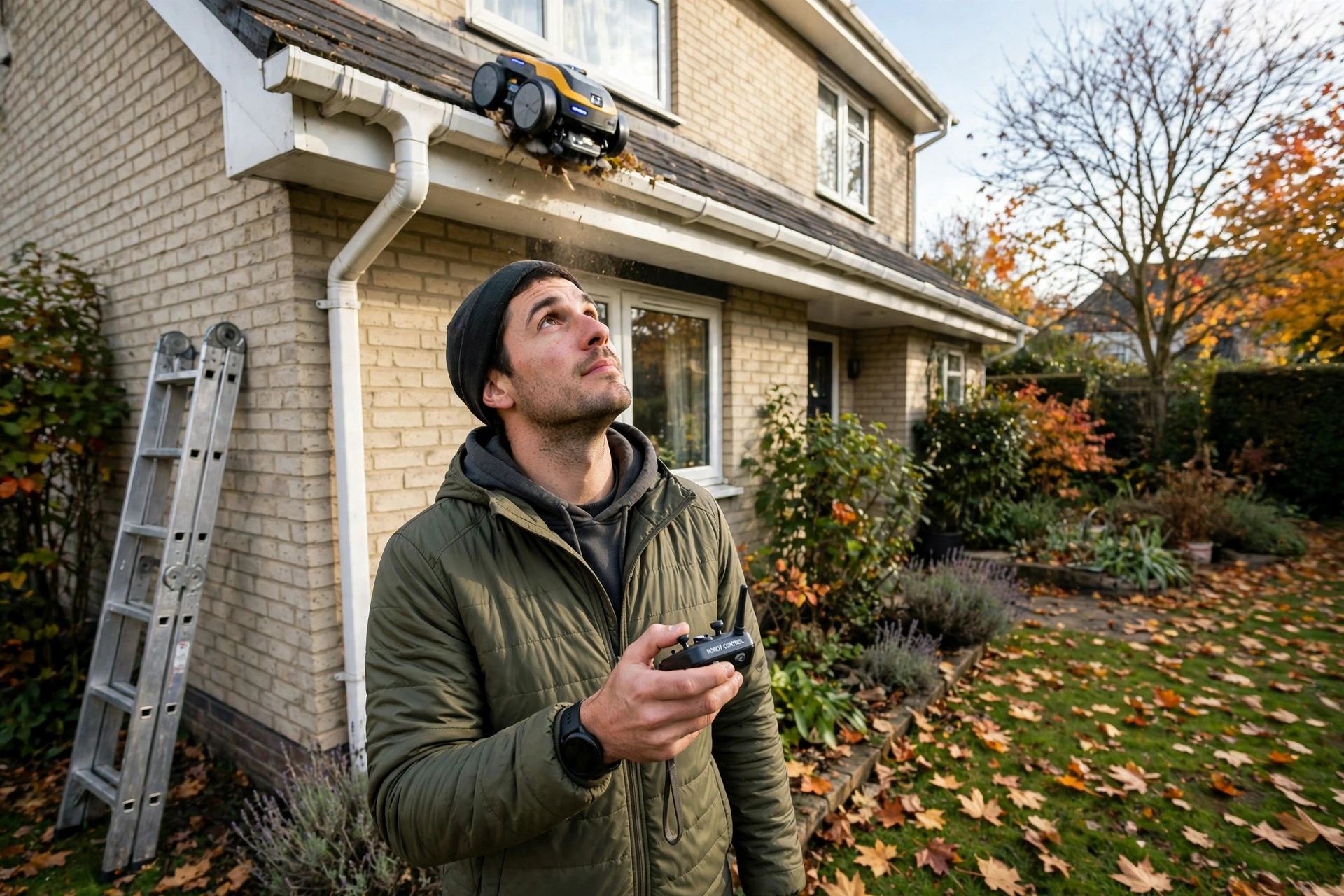
That remote is the part most people find surprising. Unlike a robot vacuum, which maps your rooms and works on its own, a gutter cleaning robot is closer to a remote-controlled car. You place it in the gutter, step back down, and drive it with the handle. Its wireless link reaches about 50 feet, so you can clean a long stretch without moving the ladder — or, on a single-storey home, without one at all.
How does the auger clear a clog?
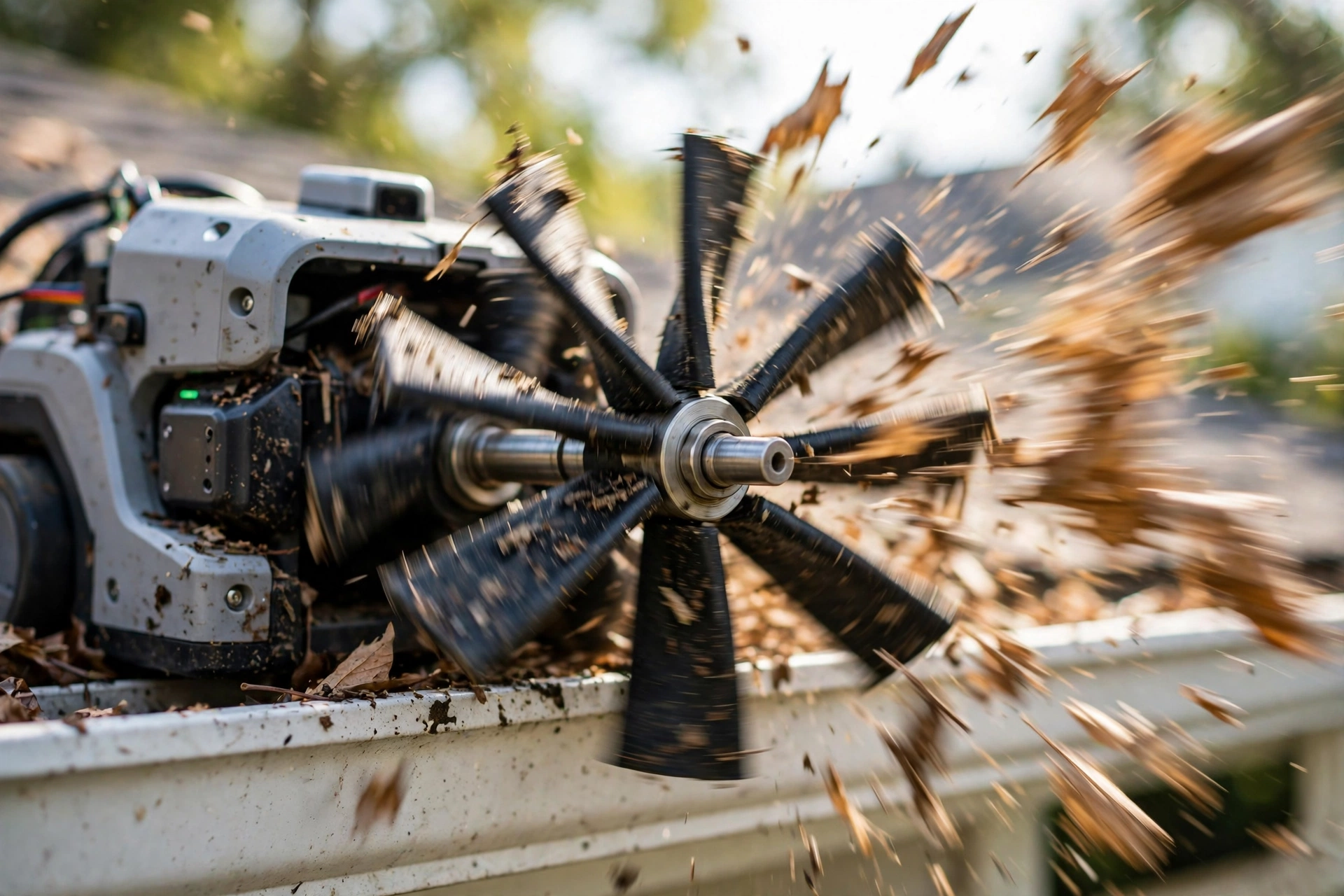
The auger is the whole trick: a short screw-like shaft at the front, fitted with flexible rubber flaps, breakers, and sweepers. The Looj’s version works in four stages as the robot creeps forward. Breaker bars split apart compacted leaves; ejector flaps lift the loosened debris and throw it sideways, out of the gutter and away from the roof; a second set of breakers works on anything stubborn; and polypropylene sweepers brush the gutter floor clean, with a small scraper trailing behind.
The auger spins at 500 RPM — fast enough to fling dry leaves clear, gentle enough, with rubber flaps rather than metal blades, not to gouge the gutter. You can reverse the spin direction from the remote, so debris is always tossed away from the roof. When the auger hits something it cannot shift, a clutch slips and clicks loudly; the manual’s advice is to reverse rather than force it.
Picture a typical autumn job: a 30-foot run of gutter, half full of dry maple leaves. iRobot’s own figures put that at about five minutes, and a full charge covers roughly 200 linear feet — a whole house worth of gutters on one charge, with your feet on the ground.
How do you drive one?
Using one is simple, but it is not quite “press a button and walk away.” Charge the battery, climb the ladder once with the robot in hand, and set it down in the gutter with the auger facing the debris. Detach the handle, climb back down, and press CLEAN. The robot drives itself along the gutter, sensing and adapting to the debris; at the end, double-click reverse and it comes back to you. For tougher patches, switch to manual mode and steer it yourself — forwards, backwards, and auger direction — like a slow remote-controlled car.
One honest limit: you still lift it into the gutter and take it out again, and it cannot climb around corners or downspouts. A long, straight run is its happy place; a house with lots of bends means several short sessions.
What can they not do?
This is where the marketing and the reality part company. Gutter cleaning robots are good at one job — dry and damp leaves in open, straight gutters — and mediocre at several others.
Wet, matted leaves and moss are the first problem. The auger flings loose material well, but a sodden mat sticks to the gutter floor, and the robot can stall or ride straight over it. Large objects are out too: the manual tells owners to remove baseballs, rocks, and branches by hand first. Gutter guards are another snag — the robot needs an open channel, so a mesh or screen cover has to come off first.
The other limit is the market. iRobot discontinued the Looj in 2017, and no big robotics brand has replaced it. That leaves buyers hunting refurbished units, or turning to “robot-adjacent” alternatives: pole-mounted tongs like the Gutter Sense tool, vacuum kits that reach from the ground, and blower attachments. These are not robots in the strict sense, but they solve the same problem — keeping you off the ladder — and they are what most shops actually stock in 2026.
So the honest answer to “should I buy one?” is: if you find a working refurbished Looj and your gutters are long, straight, and full of dry leaves, it does the job well. If your gutters are guarded, bendy, or full of wet sludge, a pole tool or a professional clean is the better spend. Robotics keeps producing machines for awkward jobs like this, but gutters turned out to be one of the awkward ones.
Gutter robot vs ladder vs vacuum kit vs hiring a pro
| Method | Effort | Ladder needed? | Best for | Watch out for |
|---|---|---|---|---|
| Gutter cleaning robot | Low once set up | Once, to place it | Long straight runs, dry leaves | Discontinued; struggles with wet clogs |
| Ladder and scoop | High | Yes, moved every few feet | Any gutter, any debris | Falls are the main risk; slow work |
| Ground vacuum kit | Medium | No | Dry debris, two-storey homes | Useless on wet, matted leaves |
| Hiring a professional | None | No (for you) | Guarded or complex gutters | Costs more per clean |
The table makes the trade-off clear. A robot is the comfortable middle ground for the right house, but not a universal answer. For machines that clean in other awkward places, see how window cleaning robots cling to glass, or how solar panel cleaning robots handle dust on a roof.
How much does one cost?
When the Looj 330 launched, iRobot priced it at $299 — roughly a mid-range robot vacuum at the time. Since production stopped, refurbished units turn up anywhere from around $150 to $300 depending on condition and whether the battery still holds a charge. A manual pole tool costs a fraction of that, and a professional clean is a recurring cost rather than a one-off purchase. The robot only pays for itself if you use it several times a year — two autumn cleans and a spring check on a house surrounded by trees, say.
Frequently Asked Questions
Are gutter cleaning robots fully autonomous?
Mostly no. The Looj has an automatic CLEAN mode that drives itself along a straight gutter, but you still place it in the gutter, steer it through tough patches in manual mode, and bring it back. Think supervised helper, not set-and-forget.
Do gutter cleaning robots work on gutter guards?
No, not while the guards are in place. The robot needs an open channel to travel through, so mesh or screen guards have to be removed first. If your gutters are guarded, a ground vacuum kit or a professional clean is usually simpler.
How long does the battery last?
The Looj’s 7.2-volt lithium-ion battery covers about 200 linear feet per charge — roughly a whole house — and a 30-foot section takes around five minutes. Early models used nickel-cadmium batteries that covered less, so check which battery a second-hand unit has.
Can a gutter cleaning robot clean wet leaves?
It can handle damp leaves, but wet, matted clumps and moss are its weak spot. The auger flings loose material well, yet a sodden mat tends to stick to the gutter floor. For that kind of mess, clear the worst of it by hand first, or use the robot as a finishing pass.
Is the iRobot Looj still sold?
No. iRobot discontinued the Looj in 2017. New buyers will find refurbished or second-hand units through specialist sellers, and the current market is mostly pole tools, vacuum kits, and blower attachments that do a similar ladder-free job without being robots.
Conclusion
Gutter cleaning robots are a neat, narrow solution: a small treaded machine with a fast-spinning auger that turns a ladder job into a ground-level one, as long as your gutters are straight, open, and full of dry leaves. The Looj showed the idea works — 500 RPM, 200 feet per charge, and no ladder moves — but its 2017 discontinuation is a reminder that a clever machine still has to survive as a product. If your home fits the robot’s strengths, a refurbished unit is worth a look. If it doesn’t, check your gutters after the next heavy leaf fall, clear what you can reach safely from the ground, and book a professional for anything that needs a tall ladder.
Further reading: iRobot’s launch announcement for the Looj 330 (link to https://media.irobot.com/press-releases?item=122418) and the Looj entry on Wikipedia (link to https://en.wikipedia.org/wiki/looj).