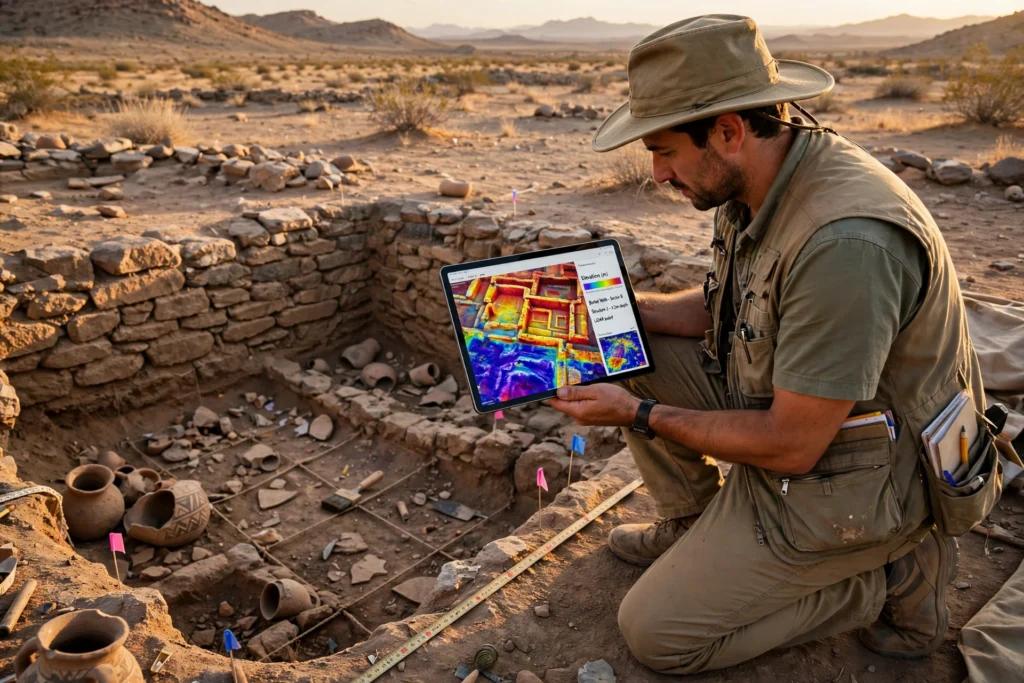
AI in archaeology means using machine learning to spot buried sites, sort artefacts, and read damaged texts that people alone would take years to work through. It does not replace the trowel. It tells archaeologists where to dig, what they are looking at, and which fragile finds deserve the most care.
Key Takeaways
- LiDAR and satellite images let AI scan huge landscapes and flag places where buried walls, roads, and mounds are likely to hide.
- Computer vision can sort thousands of pottery shards and stone tools far faster than hand cataloguing, and it spots patterns a tired eye can miss.
- AI models have helped read scrolls that cannot be unrolled, by learning to spot ink inside X-ray scans of charred papyrus.
- The tools still need human archaeologists: AI suggests, people verify, and every claim is checked on the ground.
How does AI find buried sites before anyone digs?
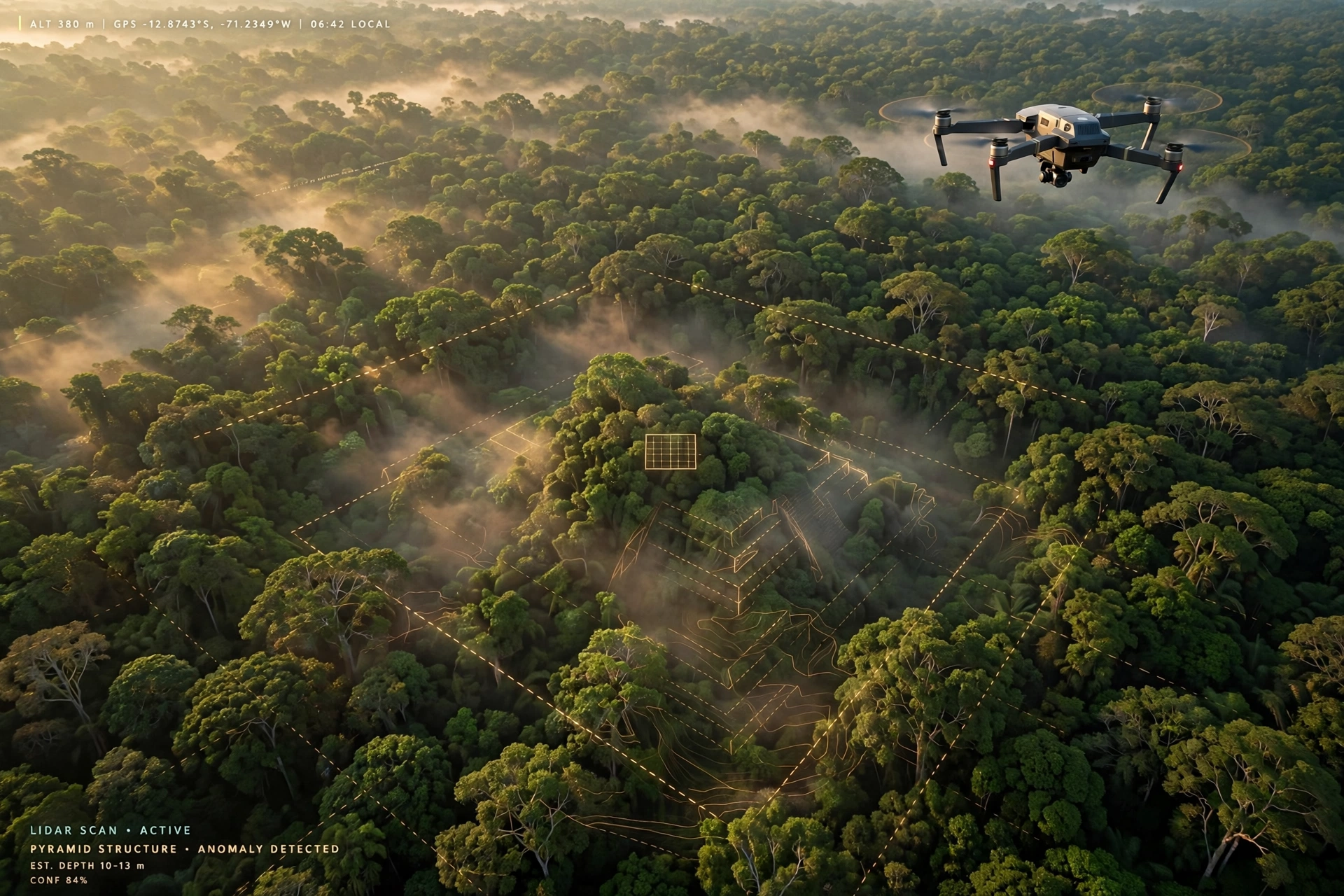
A buried city rarely announces itself. From the ground, a Maya plaza under jungle looks like a low hill. From the air, it can look like nothing at all. That is where AI earns its keep.
LiDAR fires laser pulses from a plane or drone and measures how long they take to bounce back. The pulses slip between leaves, so the scan records the bare ground beneath the trees. A trained model can then read that 3D map for the straight edges and flat platforms that nature seldom makes.
The payoff has been striking. A LiDAR survey in the Yucatán revealed more than 60,000 previously unknown Maya structures hidden under dense vegetation, from houses and causeways to whole settlements. A similar approach in Peru helped researchers find more than 300 previously unknown Nazca Lines in just a few months, by training a model on aerial images and letting it flag faint shapes in the desert.
Satellite images work the same way on a bigger scale, scanning thousands of square kilometres for subtle changes in soil colour and crop growth. None of this proves a site exists — it produces a shortlist, and a team still walks the ground before anyone calls it a discovery.
What can AI tell us from a broken pot?
Digging is only half the job. A single season on one site can turn up tens of thousands of fragments: pottery shards, animal bones, stone flakes, beads. Each one has to be cleaned, photographed, measured, and recorded, and backlogs in museum stores can run to decades.
Computer vision changes the pace. A model trained on thousands of labelled shards can look at a new fragment and suggest what kind of vessel it came from, where it was made, and roughly when, by matching shape, rim profile, and decoration against patterns it has already seen. It keeps going at the same speed on the ten-thousandth object as it did on the first.
The real value is not just speed. Once every fragment carries a consistent label, researchers can trace how styles spread across a region. A human expert still checks the tricky cases, because a model trained on one region’s pottery can misread another’s.
It is the same family of techniques as the computer vision systems used in factories and hospitals — the archaeology version just points those eyes at older things.
How does AI read texts no human can open?
Some of the most exciting AI work in archaeology involves documents nobody can physically open. When Mount Vesuvius erupted in AD 79, it buried a library of papyrus scrolls at Herculaneum under hot ash. The scrolls survived as lumps of charcoal. Unrolling one would destroy it, and for centuries their contents were simply lost.
In 2023, the Vesuvius Challenge invited researchers to read a scroll without opening it. The scrolls had been X-rayed, and the ink inside is slightly denser than the papyrus around it. AI models trained on those scans learned to spot the faint traces of letters, and readable Greek text emerged from a roll sealed for nearly two thousand years.
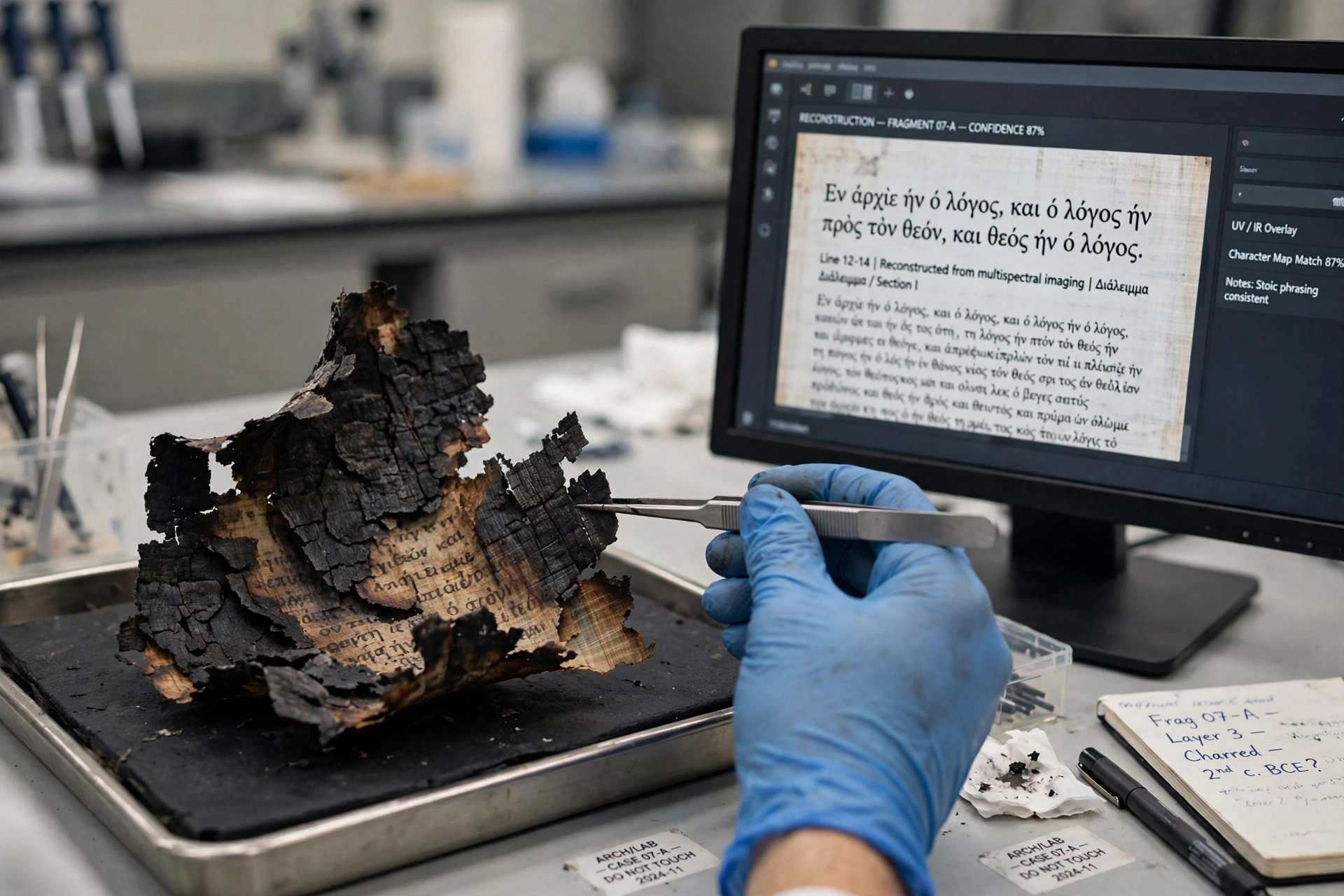
The same idea helps with faded manuscripts. Multispectral imaging photographs a page under different wavelengths of light, and a model combines those views to bring out writing that has vanished to the naked eye. Language models then help fill small gaps by predicting the most likely words, though scholars treat every reconstruction as a suggestion to be argued over, not a fact.
Where does AI fall short on a dig?
For all the headlines, AI in archaeology has firm limits. First, models are only as good as their training data. A site-detection model trained on Maya settlements may miss Roman villas entirely, because it learned the wrong shapes. Every new region needs new labelled examples, and labelling is done by the same experts the AI is meant to help.
Second, AI finds patterns, not meanings. A model can flag a rectangular anomaly and call it a building, but it cannot say whether the building was a temple, a storehouse, or a home. That judgement comes from what is found inside it.
Third, a map of promising sites is also a map for looters, so teams keep precise coordinates private. And digging destroys as it reveals: once a layer is removed, it cannot be put back. Better surveys mean fewer unnecessary trenches, and 3D models let researchers revisit a dig long after the soil has been backfilled.
Traditional digging vs AI-assisted archaeology
| Step | Traditional approach | With AI |
|---|---|---|
| Finding sites | Walking surveys, old maps, local knowledge | LiDAR and satellite scans flag likely sites across huge areas |
| Recording a trench | Hand drawings, photos, written notes | Photogrammetry builds a 3D model of the trench in under an hour |
| Sorting finds | Hand cataloguing, one object at a time | Computer vision gives a first-pass label for thousands of objects |
| Reading damaged texts | Magnifying glass and guesswork | Multispectral imaging plus models recover faded or hidden writing |
| Deciding where to dig | Experience and educated guesses | Ranked shortlists, but humans still make the final call |
FAQs
Can AI really discover a lost city on its own?
No. AI can point to a likely spot, but a “discovery” only counts once people have checked the ground, found artefacts, and dated them. The machine narrows the search; the archaeologist confirms the find.
Does AI mean fewer archaeologists are needed?
Not so far. The tools create new work — training models, checking results, managing huge datasets — and the digging, dating, and interpretation still need trained people. What changes is where their time goes.
How accurate is AI at spotting buried sites?
It varies a lot by landscape and training data. In open, well-surveyed regions the hit rate is high; in dense forest or disturbed ground it drops. Every AI flag is treated as a lead, not a verdict.
What is the most famous AI archaeology success?
The Herculaneum scrolls are the best-known example: AI helped read text inside a scroll that cannot be unrolled. The Yucatán LiDAR survey is the biggest in scale, revealing tens of thousands of Maya structures under the jungle.
Conclusion
AI in archaeology is at its best when it does the searching, sorting, and squinting that humans find slow or impossible, and leaves the judging to people. It has mapped cities under the jungle, sorted mountains of pottery, and read words from scrolls that were never meant to be opened again. The next time you read about a lost city found from the air, look for the AI behind the headline — and then look for the team on the ground who proved it was real. To go deeper, start with our guide to What Is Artificial Intelligence?, then read how machine learning and deep learning make these tools possible.
Further reading: AI in Archaeology: Unearthing the Past (Ultralytics) and The Role of AI in Modern Archaeology (Popular Archaeology)