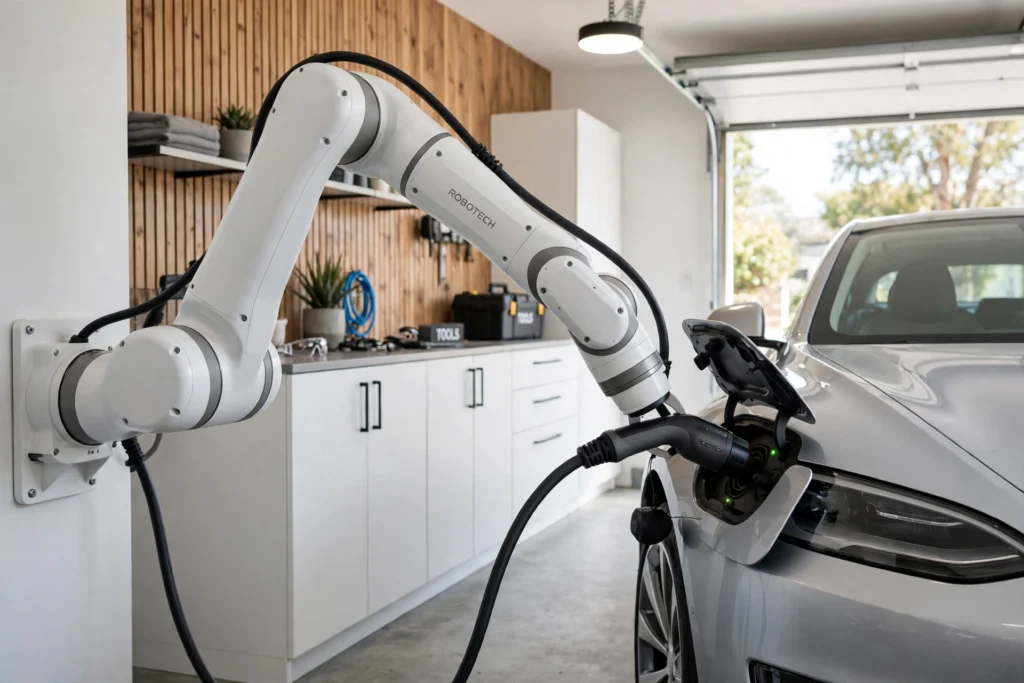
EV charging robots plug in your electric car for you. You park, the robot finds the charge port, pushes the plug in, and pulls it out again when the battery is full — no getting out in the rain, no fumbling with a heavy cable, and no hunting for a free charger in a crowded car park.
Key Takeaways
- An EV charging robot finds the charge port with cameras and sensors, then guides the plug in with millimetre precision.
- Most designs are wall-mounted arms, ceiling-rail units, or underfloor pads, each suiting a different place.
- Force sensors stop the plug if it meets resistance, so the robot cannot bend pins or scratch paint.
- Fleets, car parks, and drivers with limited mobility gain the most from hands-free charging.
- Cost and compatibility are the main limits: most robots only fit certain cars today.
How does an EV charging robot plug in your car?
The job sounds simple — push a plug into a socket — but doing it without hands takes several steps. First, the car parks in a marked bay, and the robot wakes up, either because the driver tapped a button in an app or because the car told the charger it had arrived.
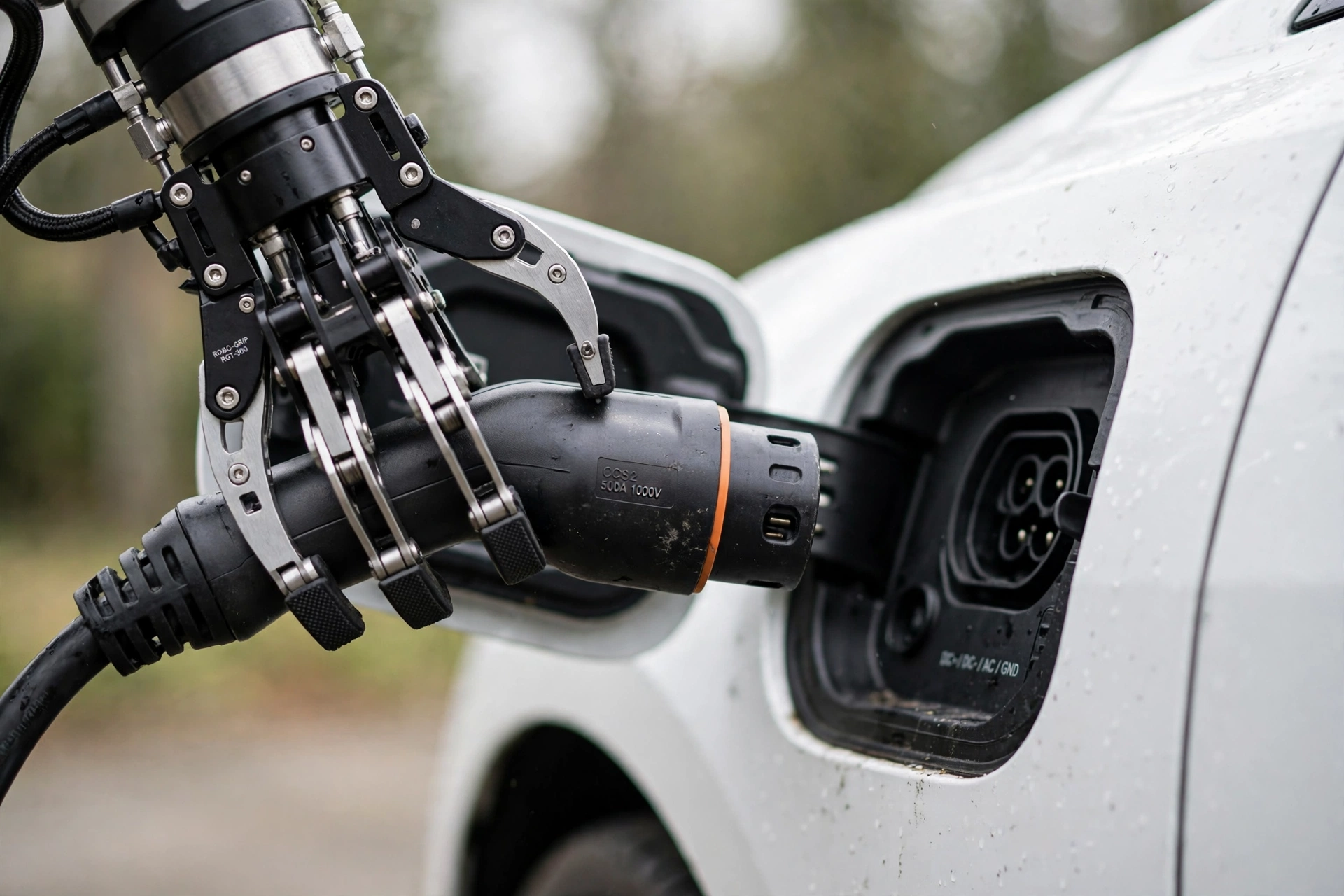
Next comes the hard part: finding the port. Charge ports sit in different places — front wing, rear wing, nose, or behind a flap — and they vary between car models. A camera on the robot looks for the port, and the software matches what it sees against a stored picture of that car’s port. Some robots also talk to the car directly, so the car opens its own port flap before the arm moves. Once the robot knows where the port is, it picks up the plug, lines it up, and slides it in slowly. If the plug meets something unexpected, force sensors tell the arm to stop rather than push harder.
Charging then runs exactly as it would with a person holding the cable. The robot is only the hands; the charger and the car’s battery management do the electrical work. When the battery reaches the level the driver asked for, the robot pulls the plug out and parks itself out of the way. Precision matters throughout: the plug must slide in straight, so the arm pushes gently and watches the resistance, backing off and retrying if the alignment is wrong.
What kinds of EV charging robots are there?
Three designs cover most of what exists today. The wall-mounted arm is the one most people picture: a compact robotic arm fixed beside a parking space, often in a home garage. It folds away into a neat box when idle and unfolds when a car arrives. Xiaomi’s consumer arm, shown working in 2025, follows this pattern, with a three-jointed arm that rises out of a slim base.
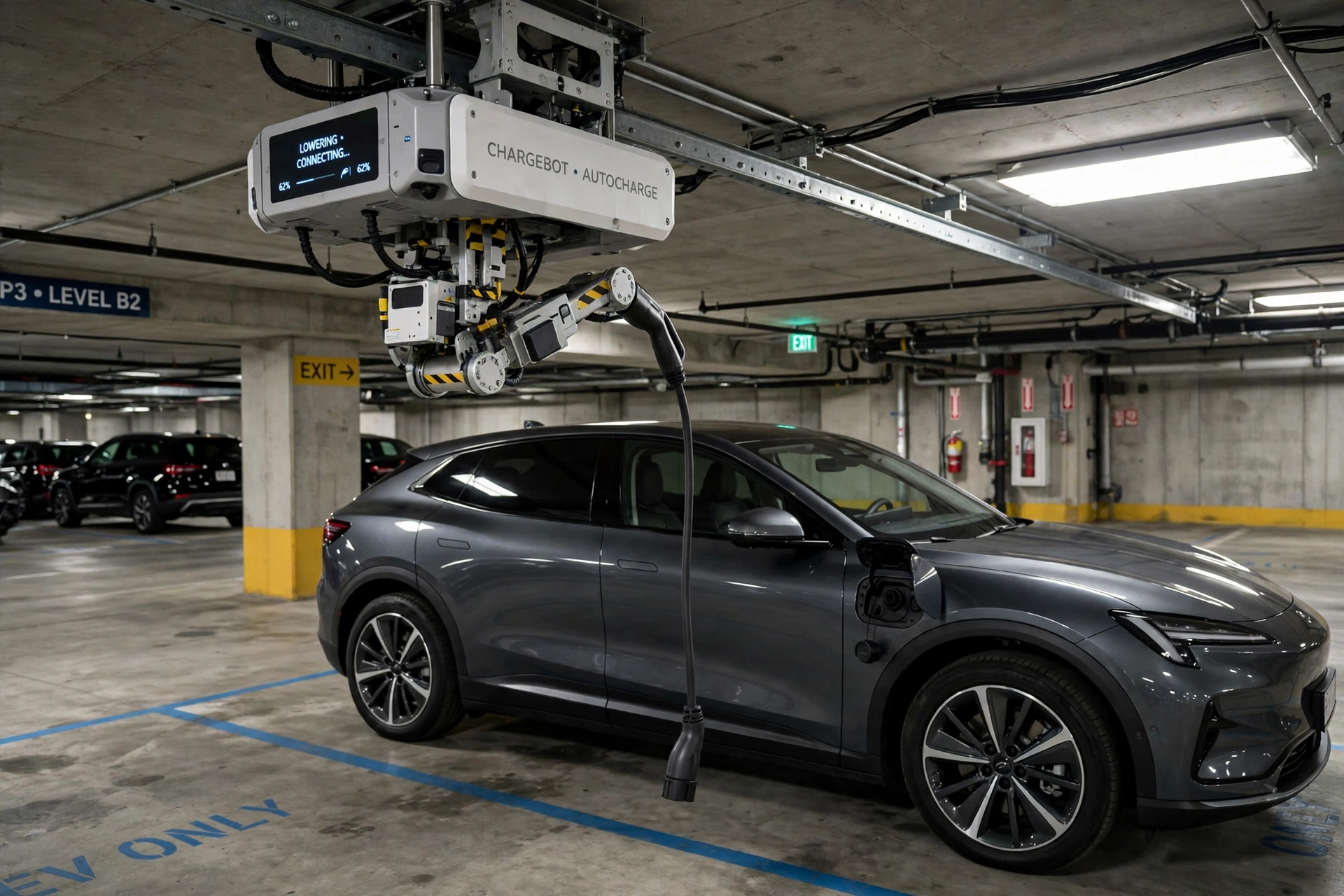
The second design rides on a ceiling rail. A single robot glides along a track above a row of cars and lowers a connector to whichever car asked for a charge. Systems like this are already running in underground car parks in several Chinese cities, where wiring every space would be expensive, though one shared unit usually charges more slowly than a dedicated fast charger.
The third design hides the hardware under the floor. A robot or a powered pad sits beneath the parking space and rises to meet the car, or the car parks over a pad that charges without a plug at all. Underfloor systems keep the garage tidy, but they need building into the floor, so they suit new car parks and depots best.
| Design | Where it fits best | Main strength | Main drawback |
|---|---|---|---|
| Wall-mounted arm | Home garages, small fleets | Compact, serves one car well | Only serves its own space |
| Ceiling-rail robot | Underground car parks, depots | One unit serves a whole row | Slower than a fast charger |
| Underfloor or pad system | New car parks, bus depots | Nothing sticking out | Needs building into the floor |
What happens if something goes wrong?
Safety is built in layers. If the plug does not seat properly, the robot stops and reports an error instead of forcing it. If someone walks into the arm’s path, motion sensors slow or stop it. A big red stop button on the base cuts power at once, and the plug carries no live current until the car and charger have agreed it is safe to start.
Weather is a real test. Rain on the port or snow on the camera lens can confuse the sensors, so most outdoor systems add a cover for the plug and a cleaning pass before insertion. Some simply refuse to start in heavy rain and ask the driver to plug in by hand.
Who benefits most, and what are the limits?
Drivers with limited mobility get the clearest win: plugging in a heavy DC cable, especially in rain or cold, is genuinely hard for some people, and a robot removes that step entirely. Fleet operators come next — a depot with dozens of vans cannot spare a worker to plug each one in at night. Car park operators are third: a single rail robot can turn every space into a charging space without rewiring the whole building.
The limits are compatibility, cost, and speed. A robot has to know your car’s port shape, position, and flap behaviour, and most systems only support a handful of models today. Older cars without a motorised flap need a person to open the port first, which defeats the purpose. These are precision machines, so they cost far more than a wall box — fine for a fleet depot, harder to justify for one home garage. Rail systems also share one power connection across a row, so they suit overnight parking rather than a quick top-up.
Frequently Asked Questions
Do EV charging robots work with any electric car?
Not yet. Most robots support a short list of car models, because the port shape, position, and flap behaviour differ between brands. Check the maker’s compatibility list before buying or booking one.
Are EV charging robots safe in the rain?
Most are built for outdoor use, with sealed connectors and covers, and the plug carries no live current until the car and charger agree it is safe. Some systems still refuse to start in very heavy rain and ask you to plug in by hand instead.
How fast do EV charging robots charge?
The robot does not set the speed — the charger and the car do. A wall-arm robot on a home charger fills the car at normal home speed, while a ceiling-rail unit sharing one connection across a row is usually slower than a dedicated fast charger.
Can a charging robot damage my car’s charge port?
It is designed not to. Force sensors stop the arm if the plug meets resistance, and the connector’s tapered shape guides it in straight. If the alignment is wrong, the robot backs off and retries rather than pushing harder.
Conclusion
EV charging robots take the one manual step out of charging an electric car: finding the port, lining up the plug, and pushing it in. Arms suit home garages, rail units suit car parks, and underfloor systems suit new builds. If you are thinking about one, check whether your car is on the maker’s compatibility list and whether you park in the same spot every day — those two answers decide whether a robot will save you effort.
Further reading: Electrek on overhead rail charging robots https://electrek.co/2026/02/23/china-overhead-rail-ev-charging-robots-parking-garages/ and Wikipedia on charging stations https://en.wikipedia.org/wiki/Charging_station