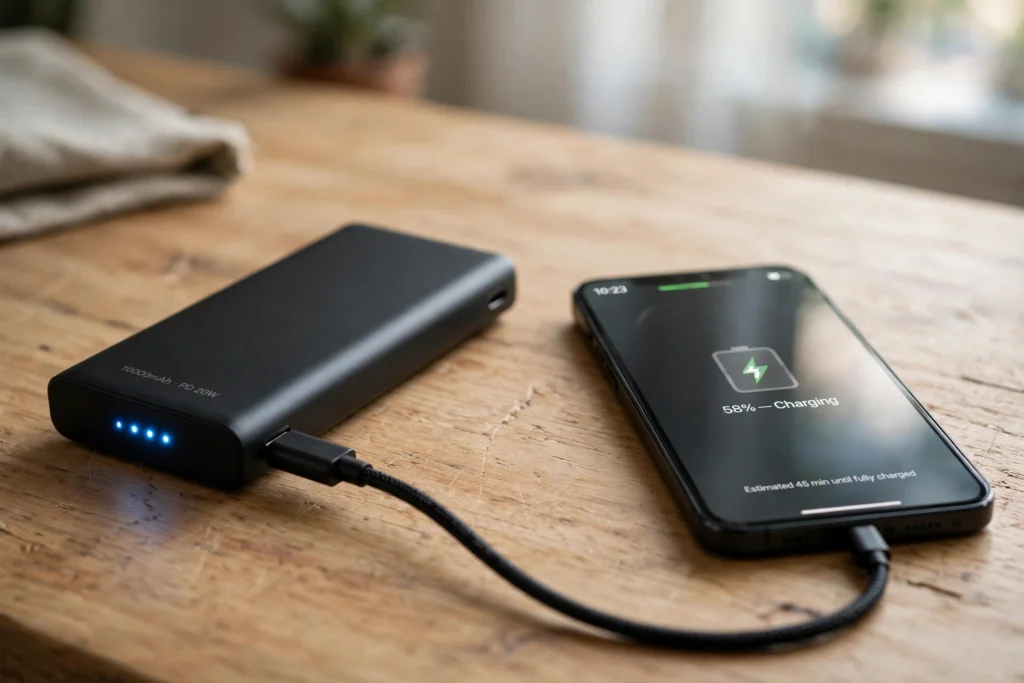
A power bank is a portable battery that stores electricity and hands it back to your phone, earbuds, or tablet through a cable or a wireless pad. Inside sits a rechargeable lithium battery and a circuit board that manages charging. Plug in, and the bank converts its stored energy to the voltage your device expects — no wall socket needed.
Key Takeaways
- A power bank stores energy in lithium cells and releases it through USB ports or a wireless charging pad.
- The mAh number describes the internal cells, not what your phone actually receives — conversion losses take a share.
- Fast charging only works when the bank, the cable, and your phone all support the same standard.
- Heat, swelling, or a strange smell mean stop using the bank and replace it.
- Keep a power bank in your carry-on when you fly; spare lithium batteries do not belong in checked luggage.
What Is Inside a Power Bank?
There are two main parts. The first is the battery itself, usually a lithium-ion or lithium-polymer cell. Lithium-polymer cells are flat pouches, which is why most slim power banks are so thin. Lithium-ion cells look like chunky AA batteries and show up more often in rugged, high-capacity models.
The second part is a small circuit board. It controls how fast the cells charge, stops them from overcharging, cuts power if the bank gets too hot, and converts the cell voltage (around 3.7 volts) up to the 5 volts, or more, that a USB port delivers. Cheap boards skip some of this protection, which is one reason the cheapest banks can behave badly.
How Does a Power Bank Charge Your Phone?
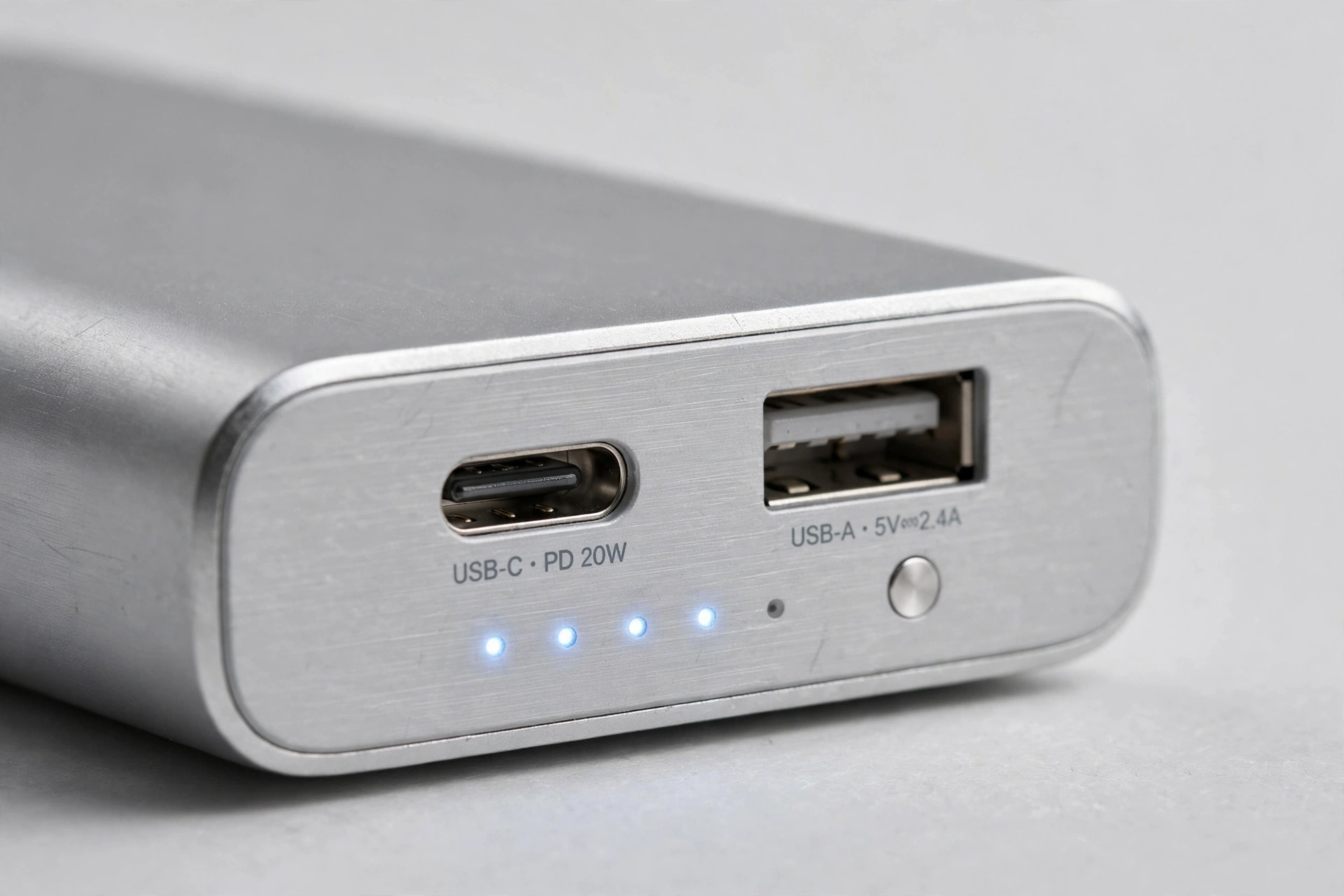
When you connect your phone, the bank’s circuit board wakes up, checks the phone’s request, and starts sending power. Your phone’s own charging circuit then takes over, deciding how much current to accept. That is why a bank rated for fast charging still charges an old phone slowly: the phone sets the pace, not the bank.
Some energy disappears in voltage conversion. The cells hold power at about 3.7 volts, but USB charging runs at 5 volts or higher, so the board boosts the voltage — and boosting costs energy. A little more is lost as heat in the cable and the phone. In practice, a bank delivers roughly 80 to 90 percent of its rated capacity to your device. Cheap banks and long, thin cables lose more.
What Does mAh Capacity Really Mean?
The mAh number — milliamp-hours — tells you how much charge the internal cells can hold. Bigger numbers mean more stored energy, but the number alone does not tell you how many times your phone will charge. For that, you need your phone’s battery size too.
Here is a worked example. A 10,000 mAh bank holds its charge at 3.7 volts, about 37 watt-hours. A typical phone battery holds around 15 watt-hours. In theory that is about two and a half charges — but after conversion losses, expect roughly one and a half to two full charges in real use. The gap is normal, not a fault.
| Power bank capacity | Rough energy stored | What it usually covers |
|---|---|---|
| 5,000 mAh | ~18 Wh | One partial phone charge — a pocket top-up |
| 10,000 mAh | ~37 Wh | One to two full phone charges |
| 20,000 mAh | ~74 Wh | Several phone charges, or a tablet top-up |
A 5,000 mAh bank is light enough to forget in a jacket pocket. A 20,000 mAh bank will keep a phone going for a weekend away, but it weighs more and takes longer to recharge. Pick the size that matches how long you are away from a socket, not the biggest number on the shelf.
What Is Fast Charging, and Does Your Power Bank Support It?
Fast charging is not one technology. It is a family of standards — USB Power Delivery (USB PD) and Qualcomm Quick Charge are the two best known — that let a charger and a phone agree on a higher voltage and current. When all three parts of the chain support the same standard, charging speeds jump. When any part does not, everything falls back to ordinary 5-volt charging.
That is why a bank labelled “22.5W fast charging” can still charge slowly. If your phone only accepts USB PD and the bank only speaks Quick Charge, they settle on the slow common ground. Before buying, check which standard your phone uses, then look for the same words on the bank’s box. The cable matters too: a thin old cable can throttle the whole setup, and this is where a good USB-C cable earns its keep.
Some banks also offer wireless charging — set your phone on the bank’s pad and it charges without a cable, using the same idea as a wireless charging stand. It is slower than a cable and wastes more energy as heat, so it suits top-ups rather than a full recharge from empty.
How Can You Use a Power Bank Safely?
Power banks are safe when treated like the batteries they are:
- Watch for swelling or heat. If a bank feels hot while idle, puffs up, or smells odd, stop using it and recycle it at a battery drop-off point. Do not throw it in household rubbish.
- Keep it dry and cool. Water and high temperatures damage lithium cells. A bank left on a car dashboard in summer is asking for trouble.
- Use the right cable. Frayed or damaged cables can short out. Replace them rather than taping them up.
- Fly with it in your cabin bag. Spare lithium batteries belong in carry-on, not checked luggage. The FAA’s guidance on lithium batteries in luggage explains what is allowed and where it must go.
- Store it partly charged. If you will not use a bank for months, leave it around half full. Lithium cells age fastest when stored fully charged or completely flat, a point Battery University covers in its guide to prolonging lithium-based batteries.
Charging the bank itself is simple: plug it into a wall charger and wait. A 20,000 mAh bank on a slow 5-watt charger can need most of a day, while a 20-watt charger cuts that to a few hours. Most banks stop accepting charge automatically when full, so charge on a hard surface, not under a pillow.
What Should You Look for When Buying One?
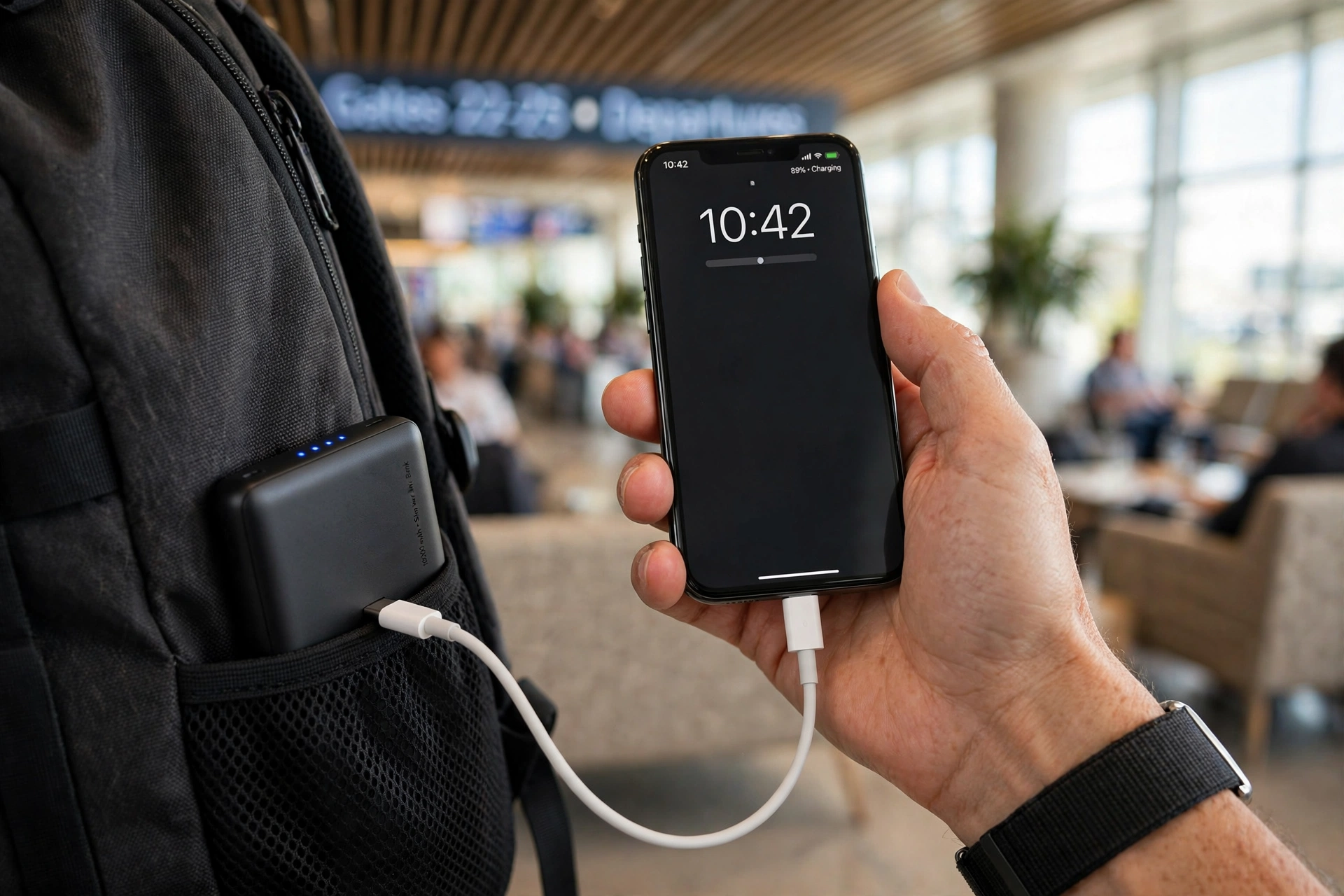
Start with capacity, then check the ports. A bank with one USB-C port that both charges the bank and charges your phone is simpler to live with than one with three ports you never use. Check the output wattage against your phone’s fast-charging standard, and whether it can charge a tablet or a laptop if that matters — many phones sip 15 watts while a small laptop wants 30 or more.
Weight is the trade-off nobody reads on the box until the bank is in their bag. A 10,000 mAh bank is the sweet spot for most people: enough for a full day out, light enough to carry. If you travel with Bluetooth earbuds and a smartwatch as well, one bank with two outputs covers the whole kit, and your phone stays on Wi-Fi while it charges. Finally, buy from a brand you recognise, and be wary of capacity claims that look too good for the price.
Frequently Asked Questions
Can a power bank damage my phone battery?
Not when both are working properly. Your phone controls how much power it accepts, and a decent bank stops sending power when the phone is full. Damage usually comes from faulty or counterfeit banks, not from normal use.
Why does my power bank charge my phone only once when it says 10,000 mAh?
Because the mAh rating describes the internal cells, not what reaches your phone. Voltage conversion and heat take a share, so a 10,000 mAh bank typically delivers one and a half to two full charges to a modern phone.
Is it safe to leave a power bank charging overnight?
Yes, for a bank from a reputable brand — its circuit board stops charging when the cells are full. Charge it on a hard, ventilated surface and keep it away from bedding or direct sun.
Can I take a power bank on a plane?
Yes, in your carry-on bag. Spare lithium batteries are not allowed in checked luggage, and very large banks may need airline approval, so check the rules before you fly.
How long does a power bank last?
Most banks keep working well for a few hundred full charge cycles, which for occasional use means several years. Capacity fades gradually, so a bank that once gave two charges may eventually give one — that is normal ageing, not a sudden failure.
The Bottom Line
A power bank is a simple idea done well: a battery, a careful circuit board, and a port. The capacity number tells you how much energy it holds, the ports and standards decide how fast it delivers that energy, and a few basic safety habits keep it reliable for years. Next time you buy one, match the capacity to your day, check that it speaks your phone’s fast-charging language, and pick a brand you trust.