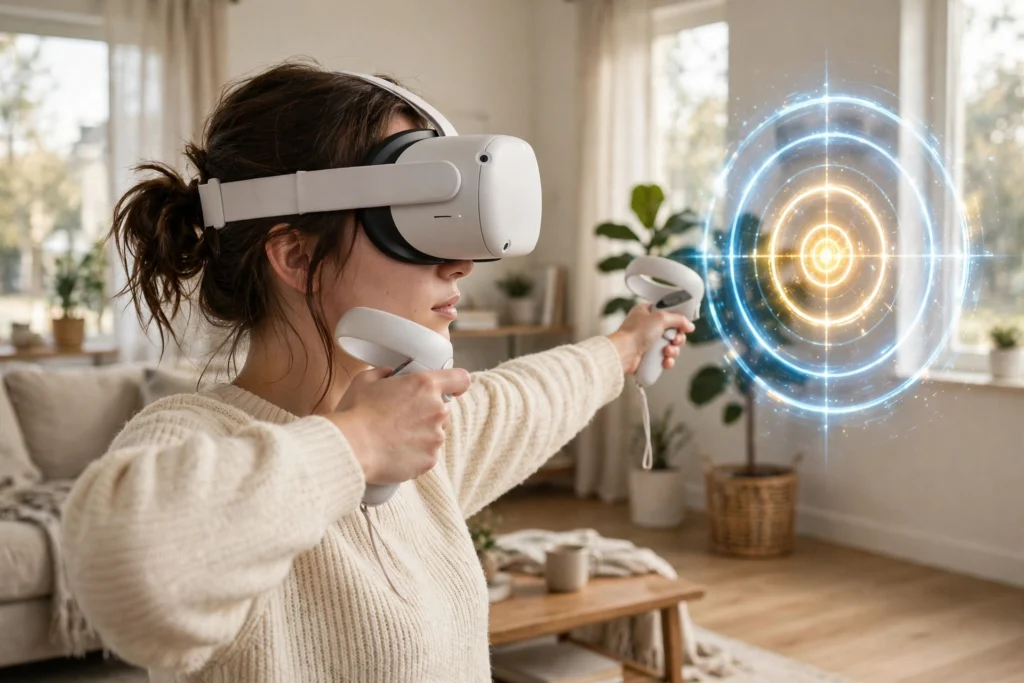
VR archery turns a headset and two controllers into a bow and arrow. You hold one controller out like a bow, pull the other back like a string, aim at a virtual target, and let go. The headset tracks both hands, so the shot feels close to the real thing — with no arrows flying across your living room.
Key Takeaways
- VR archery copies the motions of real archery: nock, draw, aim, release.
- Most games need only a standalone headset, two controllers, and about two square metres of clear floor.
- Holopoint, In Death, and QuiVr are the best-known archery games, each with a different style.
- It builds real aiming habits, but it cannot copy the pull weight of a real bowstring.
- Clear the space first: the biggest risk is your elbow meeting a bookshelf.
How does VR archery actually work?
It starts with tracking. Your VR headset watches your hands through its cameras, and each VR controller reports its position many times a second. Reach to your shoulder and the game reads it as grabbing an arrow; pull one hand back toward your cheek and it reads the draw. The distance between your hands sets the power of the shot.
Aiming is where it gets clever. The arrow flies where your bow hand points, with a little help from the game. Some titles add a faint guide line or sight dot; others leave you to judge by eye. Wind, distance, and moving targets are all simulated, so a long shot needs the same holdover you would use outdoors. Release is the easiest part to get wrong: let go of the trigger and the arrow flies along the line your hands were holding, so a jerk at the last second sends it wide — exactly as on a real range.
What do you need to play?
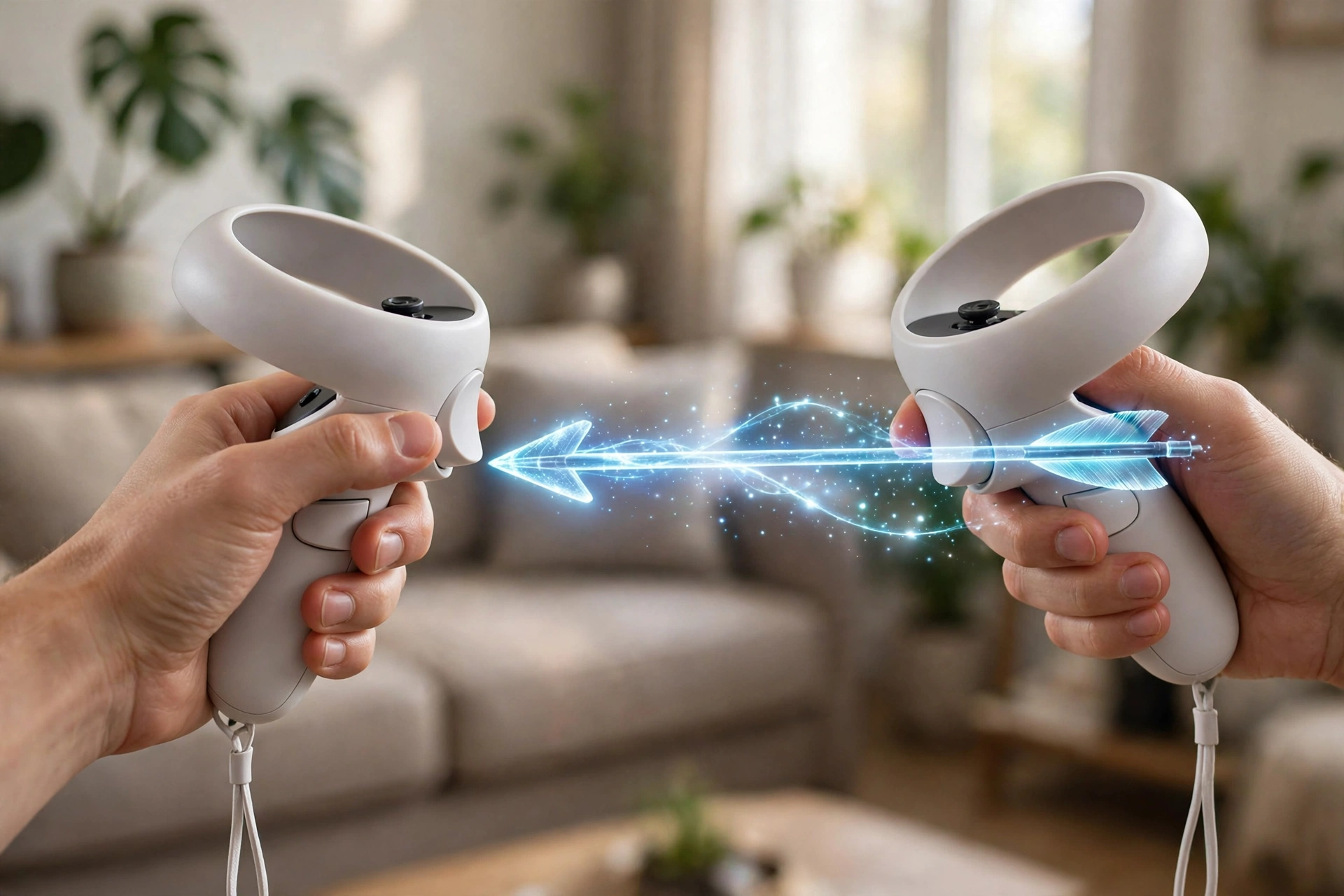
Less than you might think. A standalone headset such as a Meta Quest works on its own, with no PC and no cables to trip over. Either way, you need two charged controllers and a play space of roughly two by two metres, free of furniture, pets, and low-hanging lights.
Some newer games also support hand tracking, so you can mime the draw with empty hands. It feels natural when it works, but controllers are still more reliable: a physical grip tells the game exactly when you have released, and a small vibration confirms the shot.
Which VR archery games are worth trying?
Holopoint is the classic starting point. You stand in a dojo while glowing cubes drift toward you, and you shoot them before they shoot back. It is fast and brutally honest about your aim — within half an hour most players go from missing stationary targets to hitting moving ones.
In Death takes the opposite approach: a dark, gothic roguelike where you move through a ruined abbey with a bow as your main weapon. The archery is slower and more deliberate, rewarding patience over speed.
QuiVr sits in the middle: a bright, wave-based game where you defend a gate from waves of creatures, with friends joining you online. It is the most social of the three and the easiest to pick up first.
| Game | Style | Best for | Session length |
|---|---|---|---|
| Holopoint | Fast arcade shooting | Reflexes and fitness | 10–20 minutes |
| In Death | Dark roguelike adventure | Patient, careful aiming | 30–60 minutes |
| QuiVr | Cooperative wave defence | Playing with friends | 15–30 minutes |
Start on the practice range before scored rounds: ten quiet minutes learning how your game reads the draw will save you a lot of frustration later.
VR archery vs real archery: what is different?
The motions are close, but the experience is not identical. Real archery punishes a weak draw arm: a typical recurve bow pulls 20 to 40 pounds, and holding it at full draw is hard work. In VR there is no string tension, so your arms tire far more slowly. That makes VR brilliant for practising form and poor for building draw strength.
Cost and convenience run the other way. A decent beginner bow, arrows, and range fees add up quickly, and you need somewhere safe to shoot. VR archery needs the headset you may already own, a game that costs less than dinner, and a corner of your living room. You can shoot at midnight, in the rain, or in a flat with no garden.
Safety is the clearest win: no real arrows, no range rules to memorise. The trade-off is feel — no VR game today reproduces the weight of a bow or the snap of a string. Treat VR archery as a cousin of the real sport, not a replacement for it.
Can VR archery teach you real archery skills?
Yes, some of them — the ones beginners usually struggle with. Stance, anchor point, aiming, and follow-through all transfer, because they are about body position and consistency rather than strength. Players who practise regularly in VR often find their first real range session feels familiar. The same kind of skill transfer shows up in other VR sports training, where the value is repetition without the cost of the real thing.
What does not transfer is strength and the physical release. Without string tension, your back and shoulder muscles are not doing the same work. Use VR for volume — lots of relaxed, focused repetitions — and a real range for the feel of a true draw.
A simple 15-minute practice routine
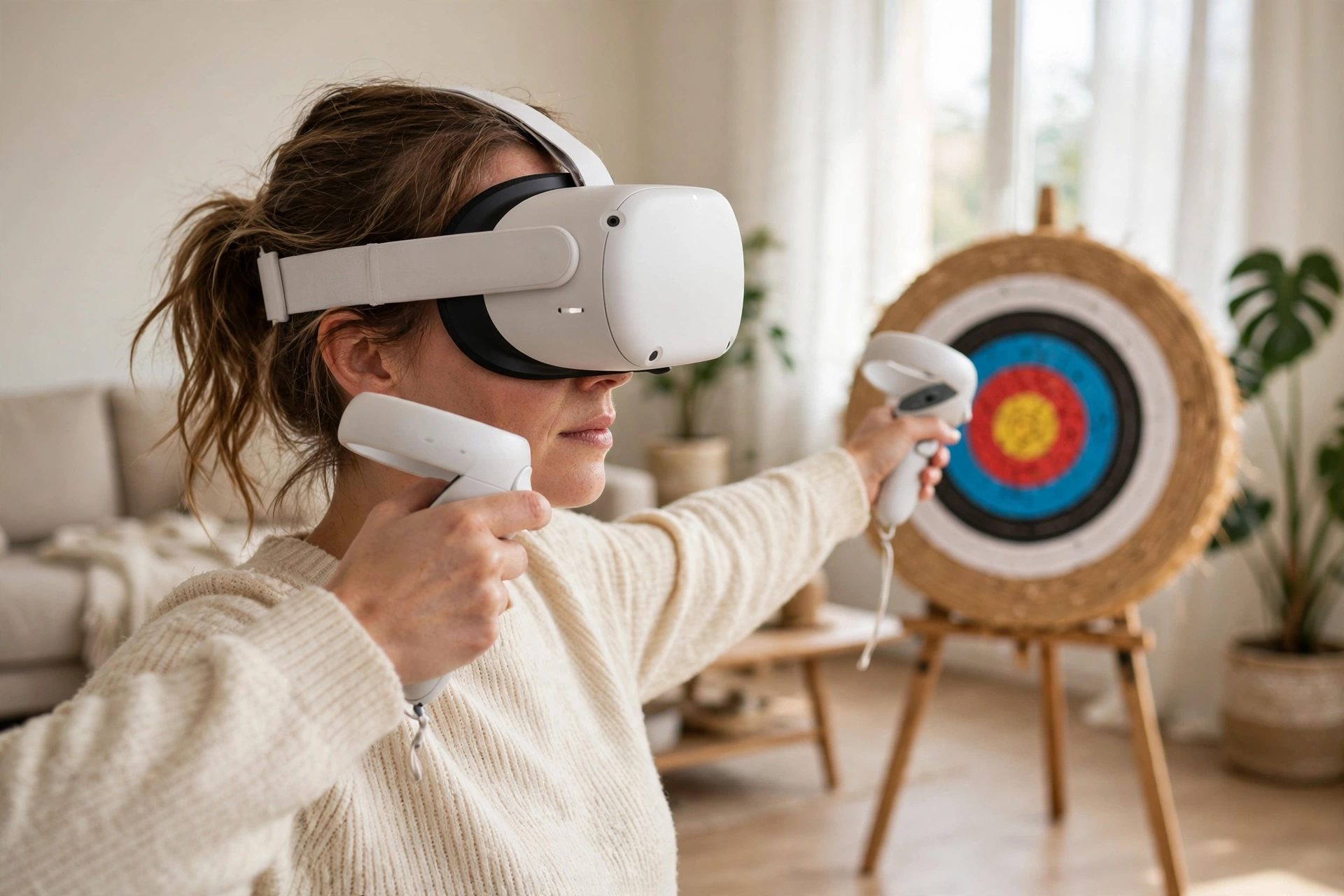
Before your first session, clear the room: push furniture back, roll up any rug that slides, and set the headset’s guardian boundary a little smaller than the room, so you get a warning before your hands reach a wall. Then try this routine instead of random shooting. Spend three minutes on the practice range firing slow, deliberate arrows at a still target, thinking only about your stance and anchor point. Then five minutes on moving targets, focusing on smooth tracking rather than speed, and five minutes of scored rounds. Use the last two minutes to review: which misses went left, which went high, and what changed on the shots that hit? Do that three times a week and your groups will tighten within a fortnight.
Frequently Asked Questions
Do I need a PC to play VR archery?
No. Standalone headsets run archery games on their own, with no computer or cables. A PC headset gives better graphics, but it is not required.
Is VR archery good exercise?
Yes, especially the fast arcade games. Repeated drawing, turning, and dodging raise your heart rate, and a half-hour session can leave your shoulders pleasantly tired. It is not a substitute for strength training.
Can children play VR archery?
Most headsets are designed for ages 10 and up, and younger players should use short sessions with an adult nearby. Check the age guidance for your headset and game first.
Does VR archery help with real archery?
It helps with stance, aim, and consistency. It does not build draw strength or teach the physical release, so combine it with real range time if you want to shoot a real bow.
How much space do I need?
About two by two metres of clear floor is enough for most games, with extra room behind you for the draw. More space is better when targets appear all around you.
Conclusion
VR archery works because it copies the parts of archery that matter most for learning — the stance, the draw, the aim, and the instant feedback — and drops the parts that get in the way, like cost, weather, and range fees. It will not make your arms stronger, but it will teach you to shoot straight, in your living room.
Your next step is simple: pick one game, clear two square metres of floor, and spend fifteen minutes on the practice range tonight. Watch your anchor point — the spot your drawing hand touches your face — and keep it the same on every shot. That one habit, repeated, is worth more than any new accessory. For a broader sense of how the technology around it works, virtual reality itself is a good place to keep reading.