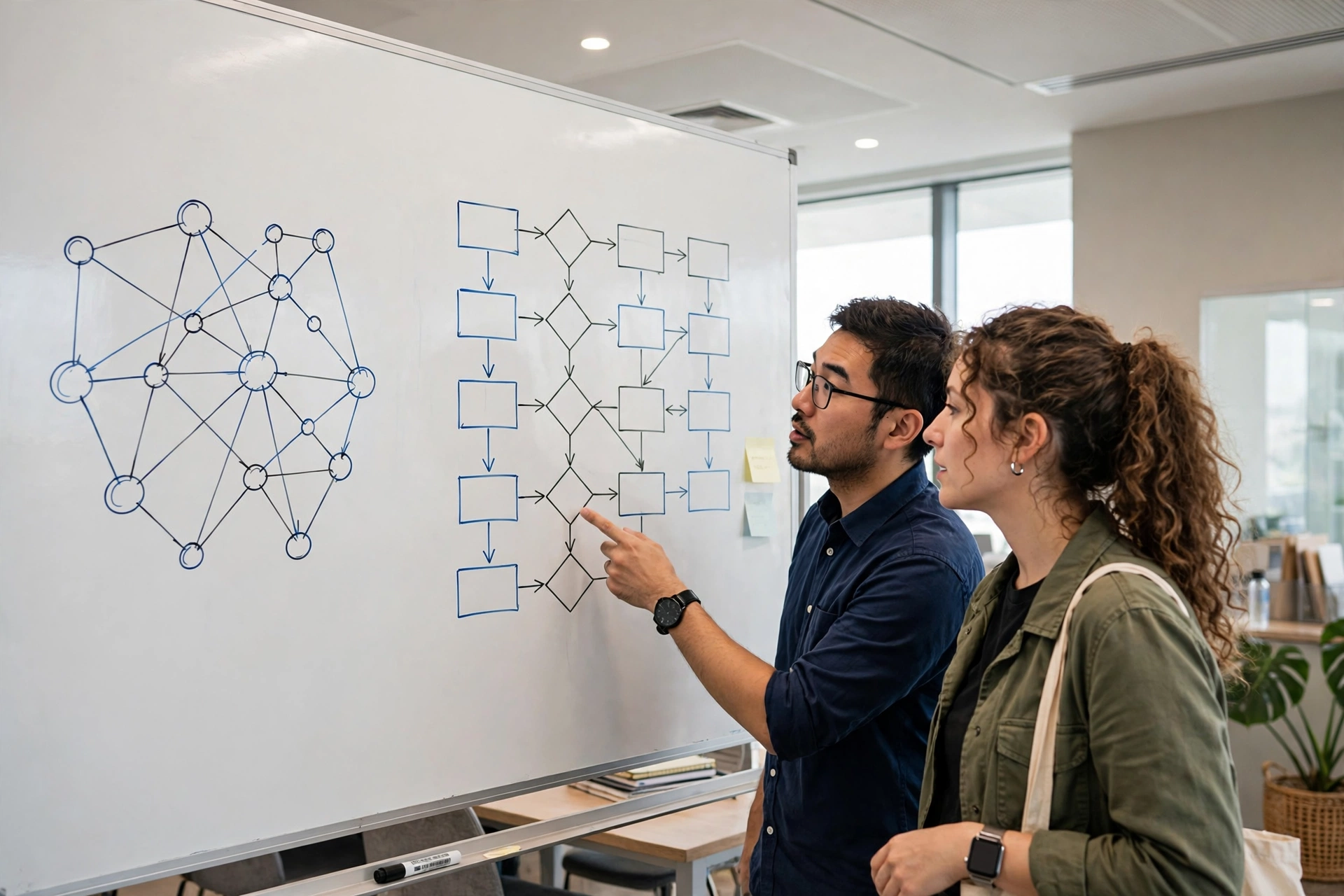
Neurosymbolic AI combines two older ideas: neural networks that learn patterns from data, and symbolic systems that work with clear rules, facts, and logic. Instead of choosing one approach, a neurosymbolic system lets each side do what it does best, so the result can be both flexible and easier to check.
Key Takeaways
- Neurosymbolic AI pairs pattern learning with explicit rules and structured knowledge.
- Neural networks are good at perception, such as recognising objects, words, or sounds in messy data.
- Symbolic reasoning is good at following rules, checking consistency, and explaining a step.
- The hybrid approach can help when data is limited, or when a decision must be audited.
- It is not a single product or model, and it does not remove the need for human checks.
What do the two halves actually do?
Think of the neural side as the eyes and ears. A neural network learns from examples: shown enough pictures, it can recognise a cat or a road sign even when lighting changes. That flexibility has a cost, though — its knowledge is spread across many tuned values, so it can be hard to say exactly why it gave one answer rather than another.
The symbolic side is more like a rulebook. It works with named ideas — objects, colours, relationships, and rules such as “if this, then that”. It can follow a chain of logic, spot a contradiction, and show its working. Its weakness is the opposite one: writing down every rule for a messy real world is slow, and a rule that was not written down simply does not exist for it.
For a broader picture, see our complete guide to artificial intelligence. Neurosymbolic AI is one design approach inside that wider field.

How does a neurosymbolic system work in practice?
In a typical hybrid, the neural part first turns raw input into structured facts. Imagine coloured shapes on a table: a network might identify each shape, its colour, and its position relative to the others. Those findings become named facts for the symbolic part — a red cube, a blue sphere, and the cube to the left of the sphere.
Once the facts are in symbolic form, the system can answer questions by running a small program, rather than by guessing from patterns alone. Ask “How many objects are to the right of the red cube?” and the symbolic part can count the objects that match that rule. If the answer changes, you can trace why: the facts changed, or a different rule was applied.
This pattern connects with deep learning, which supplies the pattern-recognition half, and with AI reasoning, the step-by-step side. The difference is the deliberate split: perception and reasoning stay distinct, cooperating parts.
Researchers have tested this idea in visual question answering, where a system looks at a scene and answers a question about it, and in geometry-style problems, where recognising shapes is only half the job. In both cases, the hybrid can sometimes learn from fewer examples, because the rules already carry some knowledge about the world.
Where does this hybrid help most?
Neurosymbolic AI is most useful where an answer must be both learned and justified. In a regulated setting, a decision affecting a person’s application or safety record should come with a reason a human can inspect. A system that can point to the facts and rules it used gives a reviewer something concrete to check, instead of only a confidence score.
It can also help where training data is scarce. If you already know some domain rules — safety limits or physical constraints — you do not need to teach them all from examples. The symbolic side can enforce them from the start, while the neural side handles what is hard to write down, such as recognising an object in a photograph.
A third benefit is consistency. A purely neural model can give a sensible answer in one case and a contradictory answer in a similar case. A symbolic layer can catch some of those contradictions by checking an answer against rules that must always hold.
What are the limits and trade-offs?
Building a hybrid is harder than building either half alone. Someone must decide where the neural part ends and the symbolic part begins, and what to do when they disagree. If the neural part misidentifies an object, the symbolic part will reason correctly from a wrong fact — and the final answer will still be wrong, just more neatly explained.
There is also a cost in effort. Writing good rules takes domain knowledge and time, and rules can become brittle when the world changes. A rulebook that worked for one clinic or factory may not transfer cleanly to another, even if the neural part does.
Performance is another trade-off. A hybrid may be slower or more complex than a single neural model, especially if the symbolic part must search through many rules. For a simple task, such as sorting photos, that extra machinery may not be worth it.
Finally, an explanation is not proof. A symbolic trace shows what the system claims to have done, but if its facts were wrong, or a rule was poorly chosen, the trace will simply document a mistake in an orderly way.
Our guide to machine learning explains the data-driven side in more depth.
FAQs
Is neurosymbolic AI the same as explainable AI?
No, but they overlap. Explainable AI is the goal of making a decision understandable. Neurosymbolic AI is one way of pursuing it, by building a system whose steps can be inspected. A hybrid can still mislead, so its output should be tested.
Does neurosymbolic AI need less data?
Often, yes: rules can supply knowledge that would otherwise have to be learned from examples. It does not mean no data at all — the neural part still needs examples, and the rules need checking by people who understand the domain.
Why did symbolic AI fall out of favour on its own?
Early symbolic systems struggled with messy, real-world input. Hand-writing rules for every image or accent proved impractical, and those systems could be brittle when they met something unexpected. Neural networks handled that messiness better.
Is neurosymbolic AI already in everyday products?
Elements of the idea appear in systems that combine learned models with rules or knowledge bases, but a full neurosymbolic system is still largely a research approach. When a product claims the term, ask which parts are learned, which are rules, and how they are checked together.
How can I tell if a hybrid claim is meaningful?
Ask three questions: what does the neural part recognise, what rules does the symbolic part enforce, and can the system show the facts and steps behind a specific answer? Vague answers suggest marketing, not a real description.
Conclusion
Neurosymbolic AI is best understood as a practical compromise. Neural networks bring flexible perception, and symbolic reasoning brings structure and a trail people can follow. Put together carefully, they can learn from less data, respect hard constraints, and explain themselves better than either approach alone.
A useful next step is to try that lens on the next AI tool you use. Ask which part of its answer came from recognising a pattern, and which part, if any, came from a rule you could check. If you cannot find the rule part, you are probably looking at a purely neural system — helpful, but not neurosymbolic.
For further reading, IBM describes neuro-symbolic AI and its key properties, while MIT reports on combining deep learning and symbolic reasoning.