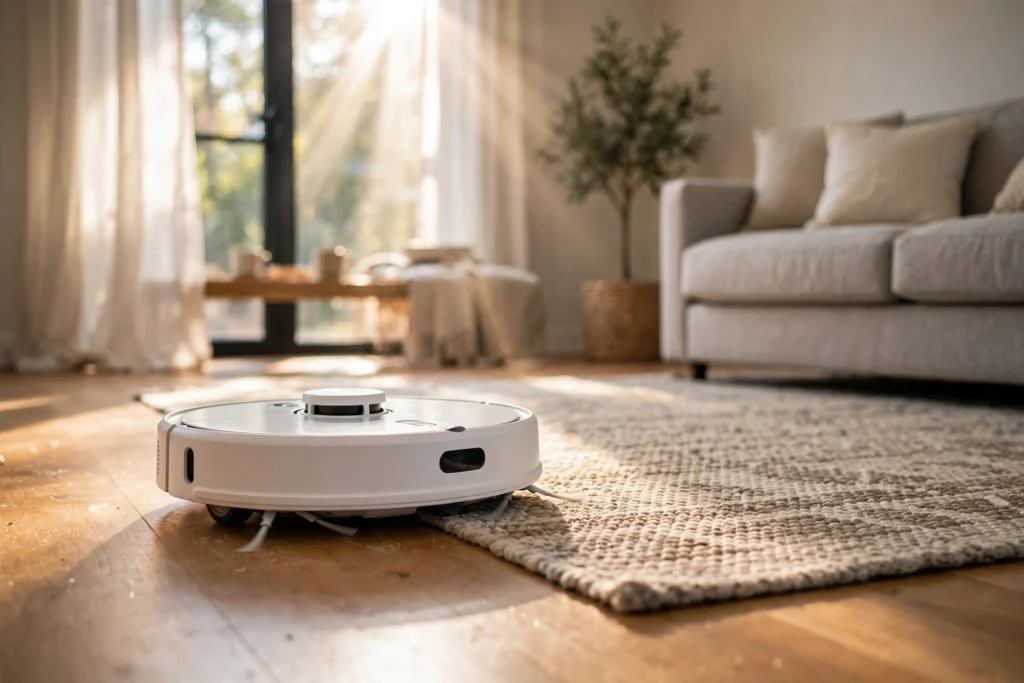
A robot vacuum cleans your floors on its own by combining sensors, a small motor, and a simple plan of your rooms. It senses walls and furniture, avoids drops like stairs, and sweeps dust into a small bin — then returns to its dock to recharge when its battery runs low.
Key Takeaways
- A robot vacuum navigates with bump, cliff, and distance sensors, and smarter models build a map of your rooms.
- A spinning side brush sweeps dirt from edges into the path of a main brush and suction inlet.
- It is best for everyday dust and crumbs, not for deep cleaning thick carpets or large messes.
- Clearing cables, small rugs, and clutter before a run makes a big difference to the result.
- Regular emptying and brush cleaning matter more than buying the most expensive model.
How does a robot vacuum know where it is?
Cheaper models often work by a mix of luck and patience: they drive in a rough pattern, bump gently into a wall or chair leg, turn, and carry on. Given enough time, they cover most of an open room, though they may visit some spots twice and miss others.
Smarter models are more deliberate. They use a laser turret, a camera, or both to measure distances and build a floor map as they go. Later runs follow neat rows across that map instead of wandering.
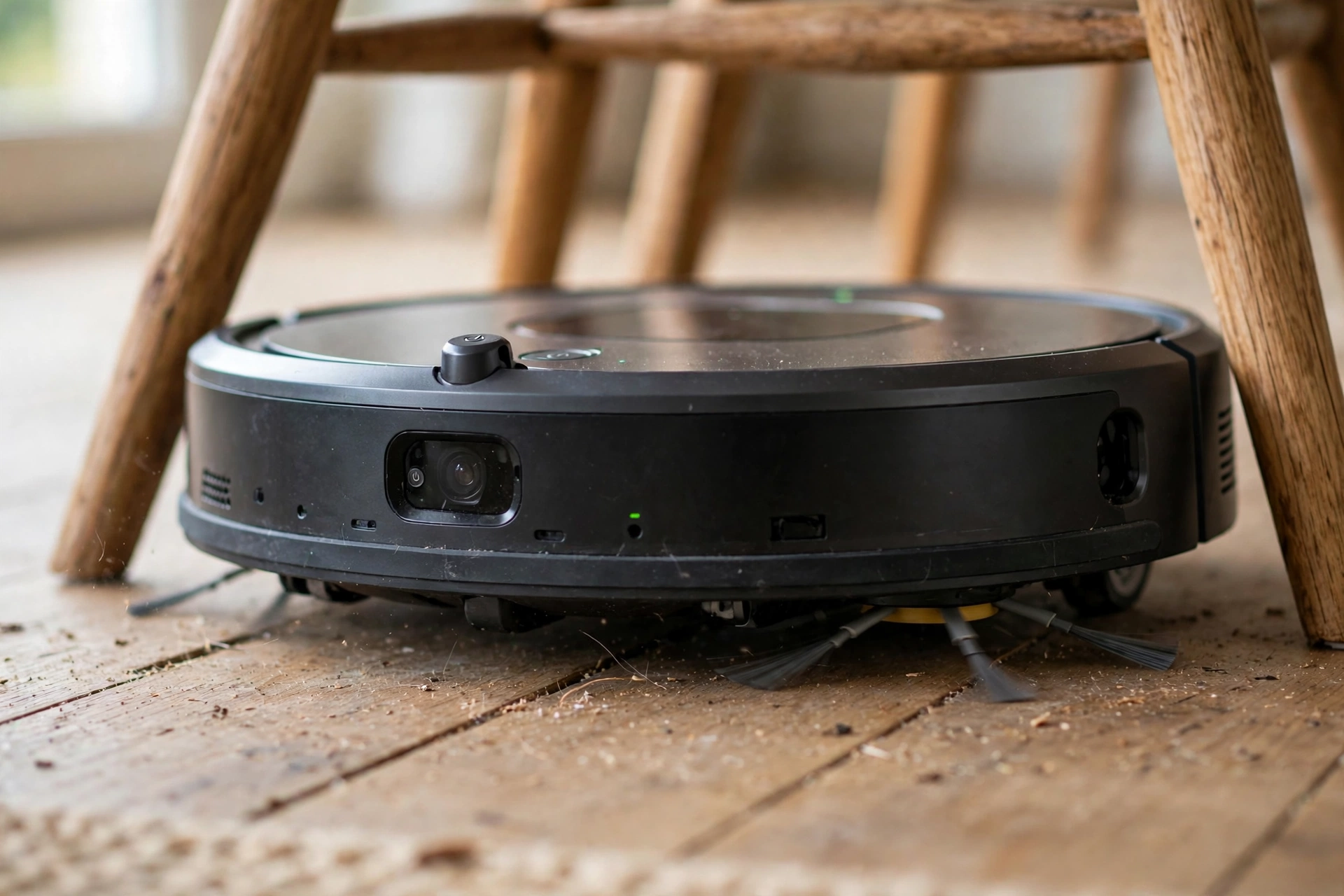
That map also lets some apps clean one room only, or avoid a room — but not every model offers this, so check before you buy.
How does it avoid falling down stairs?
Underneath the front edge of most robot vacuums sit cliff sensors. These point downward and watch for the floor. When the floor suddenly disappears — at the top of a staircase, for example — the sensor reading changes, and the vacuum stops and backs away.
This works well on ordinary stairs, but it is not foolproof: very dark carpets can confuse some sensors, and shiny floors can cause trouble too. Watch the first few runs if you have either, and use a barrier or no-go zone if your model supports one.
Bump sensors handle the other direction. When the vacuum touches a chair leg or wall, a spring-loaded bumper tells it to turn slightly and try another angle — which is why robot vacuums rarely damage furniture.
How does it actually pick up dirt?
Cleaning happens in three small steps, one after another. First, a spinning side brush flicks dust and crumbs out of corners and along skirting boards, into the vacuum’s path. Then a main brush — sometimes a bristle roller, sometimes a rubber roller — agitates the floor surface and lifts dirt toward the suction inlet. Finally, the motor’s suction pulls that dirt into a dustbin inside the robot.
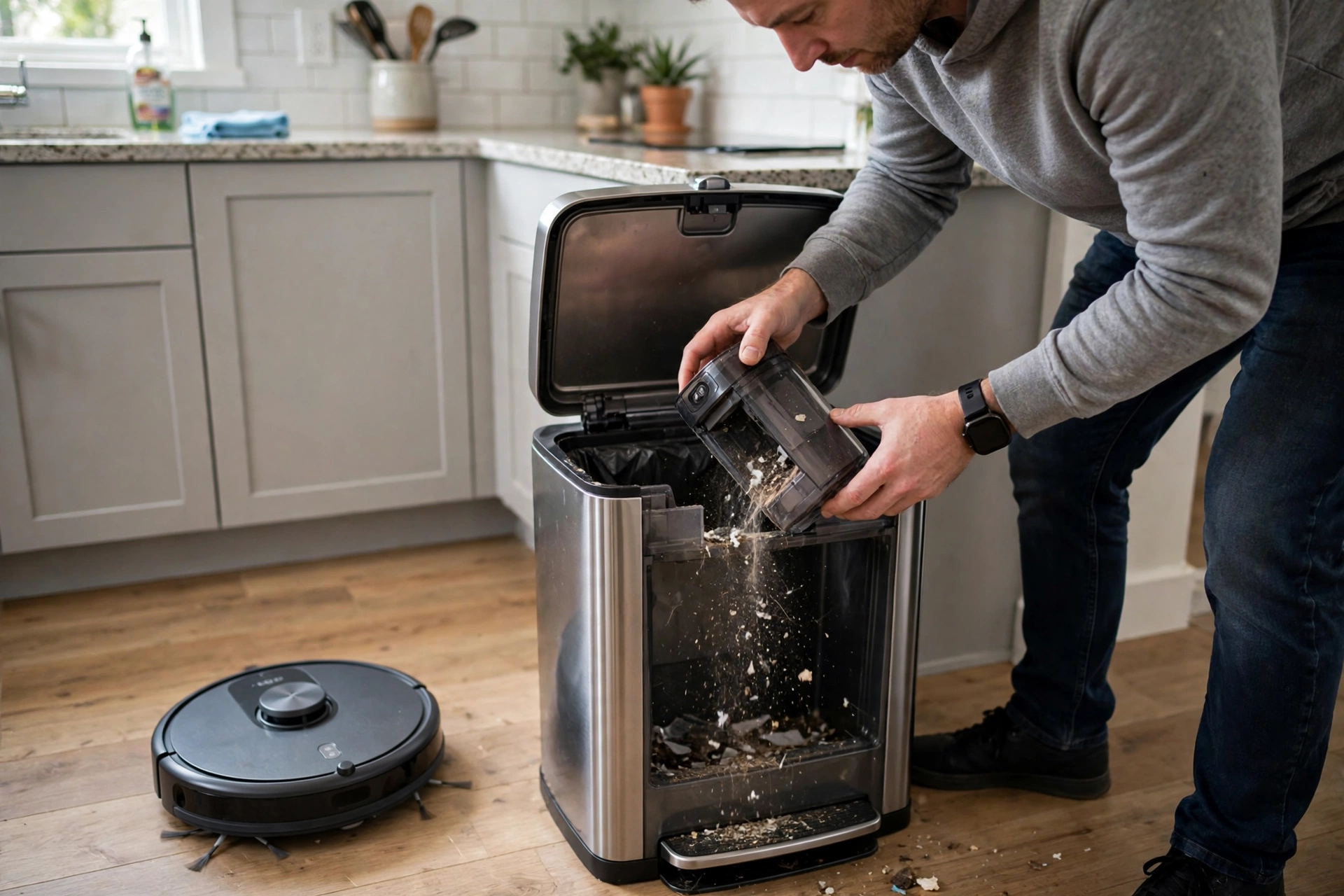
That bin is small, often much smaller than a full-size vacuum’s. Pet hair fills it fast, and a full bin means weaker pickup. Emptying it after every run or two keeps results consistent.
The same applies to brushes: hair wraps around rollers over time, so a weekly check — pulling off wrapped hair and wiping the sensors — prevents most “it stopped cleaning properly” complaints.
Why does it sometimes miss spots or get stuck?
Usually, the answer is the room, not the robot. Charging cables, shoelaces, curtain hems, and dog toys are classic traps: the vacuum either eats them, drags them around, or stops and asks for help. High-pile rugs can also slow it down, and thresholds between rooms can be too tall for some models to climb.
Mapping does not fix a cluttered floor. The most reliable trick is a quick tidy before the run — lift cables, pick up small items, and fold rug tassels under. Battery life matters too: a small flat may be done in one charge, while a larger home may need a recharge-and-resume model.
Do robot vacuums replace a regular vacuum?
For most homes, the honest answer is: not quite. A robot vacuum is excellent at keeping everyday dust, crumbs, and pet hair under control between deeper cleans — a real benefit, especially with pets or children.
But it will not deep-clean a thick carpet as thoroughly as a full-size vacuum, clean stairs, or handle a spilled bag of flour with grace. Think of it as a helper for the frequent, boring part, while a traditional vacuum still handles the occasional thorough clean.
What should you check before buying one?
Start with your home, not the spec sheet. Hard floors, low-pile rugs, and open rooms suit almost any robot vacuum. Thick carpets, lots of thresholds, pets that shed heavily, and multi-storey homes narrow the choice — you may want stronger suction, a larger bin, or a model that can store more than one floor map.
Also check practical details: noise, how easy the bin is to empty, whether replacement brushes and filters are easy to find, and whether it needs an app and Wi-Fi or runs with a simple button. A model that fits your routine will get used far more than a clever one that is fiddly to live with.
Frequently Asked Questions
Are robot vacuums good for pet hair?
They help a lot with daily pet hair on hard floors and low-pile rugs, but they are not magic. Hair wraps around brushes, so expect to clean the rollers regularly, and empty the bin often during shedding season.
Can a robot vacuum fall down the stairs?
Cliff sensors are designed to stop it at a drop, and they work well in most homes. Still, watch the first runs if you have dark carpets or unusual stairs, and use a barrier or no-go zone if your model supports one.
Do robot vacuums work on carpets?
Yes, on low and medium-pile carpets they do a decent job of surface cleaning. Thick, plush carpets are harder: suction and brush contact are limited, so a full-size vacuum still does the deeper work.
Can one robot vacuum clean two floors?
It can clean both floors if you carry it between them, but it needs a map for each floor to navigate well. Some models store multiple maps; simpler ones may need to re-learn a floor each time.
How often should I empty and clean a robot vacuum?
Empty the bin after every one or two runs, check the brushes weekly for wrapped hair, and wipe the sensors now and then. That routine keeps suction strong and prevents most breakdowns.
Conclusion
A robot vacuum is not a mystery box: it senses its way around, maps what it can, and sweeps dirt into a small bin, a little at a time. It shines as a regular helper for everyday floors, and it works best in a home that is tidied before the run.
If you are thinking of buying one, start with a simple next step: measure your thresholds, note your floor types, and run a short list of two or three models against those facts before you compare prices. That small check will tell you more than any feature list about whether a robot vacuum will actually suit your home.