
Model pruning is a way of making an AI model smaller by removing the parts that contribute the least. Instead of starting over with a smaller design, you take a working model, identify its least useful weights or connections, cut them away, and then check — and often retrain — what is left so it still does its job well.
Key Takeaways
- Model pruning removes low-value weights, neurons, or whole structures from a trained neural network.
- The goal is a smaller, faster model that keeps most of its original accuracy, not a perfect copy.
- Pruning can be gradual, with retraining in between, or done in a single pass followed by fine-tuning.
- Unstructured pruning removes scattered weights, while structured pruning removes larger blocks that hardware can use more easily.
- Pruning works best when it is tested on fresh examples, and it pairs well with other compression methods.
What does pruning actually remove?
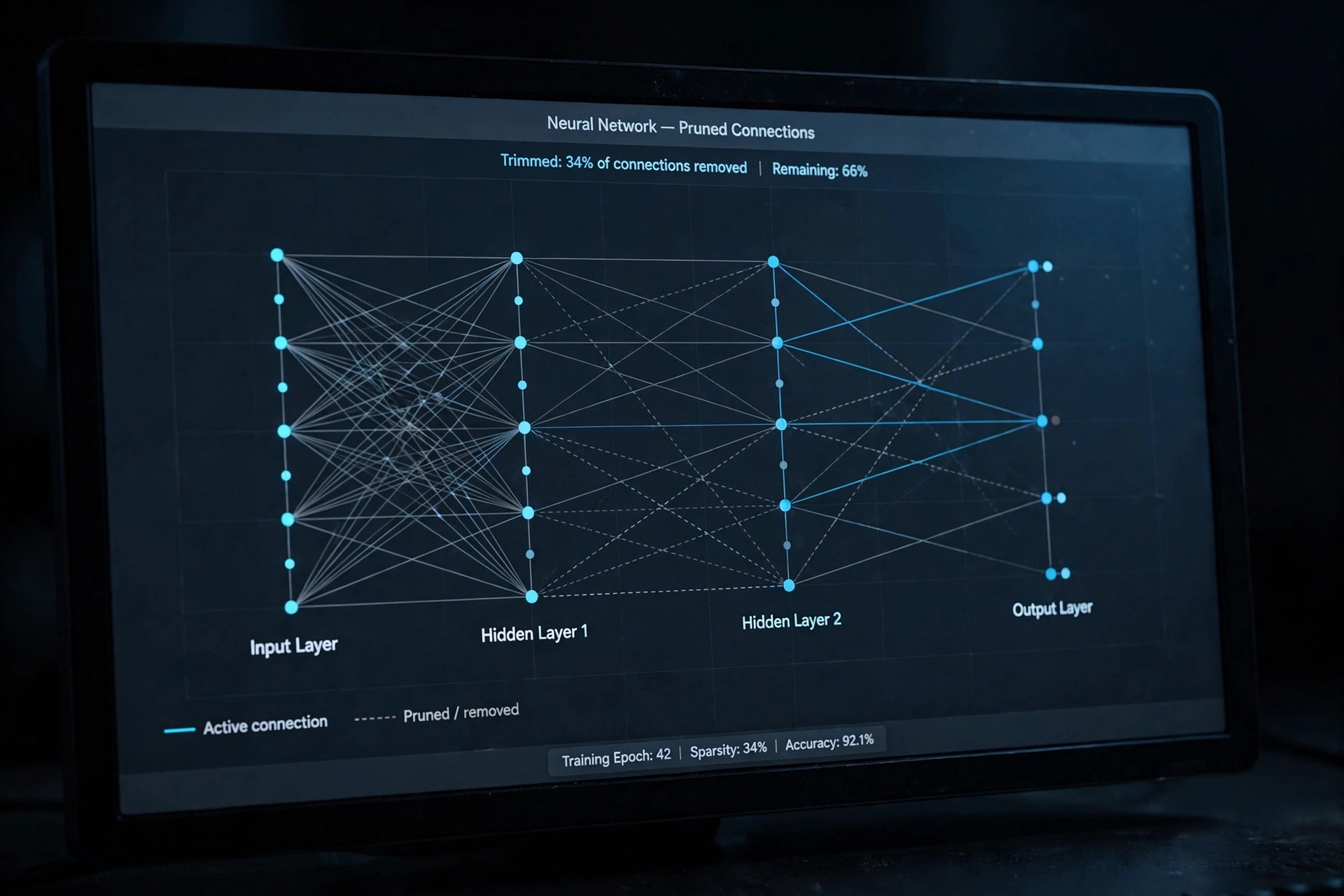
A neural network is, in simple terms, a web of connections. Each connection has a weight, a number that says how much influence one part of the network should have on the next. During training, those weights are adjusted again and again until the model gives useful answers.
Not every weight ends up pulling its weight, so to speak. Some settle close to zero, which means they barely change the result. Others duplicate work already done elsewhere. Pruning targets those parts first.
Depending on the method, pruning might remove:
- Individual weights, leaving a sparser web of connections behind.
- Whole neurons, which are the small processing units inside a layer.
- Filters in an image model, which are the pieces that look for particular patterns.
- Larger blocks, such as an attention head or even a whole layer, when a structured approach is used.
Think of it like editing a long first draft. You are not rewriting the whole piece. You are cutting sentences that repeat a point, or paragraphs that do not move the argument forward, and then reading the result again to make sure it still makes sense.
That editing analogy only goes so far, though. A model does not understand its own text. It only has numbers and patterns, so deciding what is safe to cut takes measurement, not judgement about meaning.
How does a model decide what to cut?
The simplest rule is magnitude: small weights are treated as less important than large ones. If a weight is close to zero, removing it changes the model’s output very little, at least in theory. This is why magnitude-based pruning is such a common starting point. It is easy to explain, easy to implement, and often works surprisingly well for a first pass.
But size alone is not the whole story. A small weight can still matter in combination with others, and a large weight can be redundant if another path carries the same information. That is why more careful methods look at more than magnitude.
Some methods check how much the model’s error would rise if a particular weight or unit were removed. Others look at activations — how strongly a unit actually fires on real examples — rather than just the weight values stored in the model. If a unit rarely fires, or fires in almost the same way for every input, it may be a candidate for removal.
For large language models, this distinction matters even more. Recent approaches try to score weights using both the weights themselves and the activations they produce on sample inputs, because a weight that looks unimportant on paper can still affect the output when the model is actually running. The practical lesson for a beginner is the same either way: pruning is a measurement problem. You need a sensible score, a way to apply it, and a test that tells you whether the cut helped or hurt.
What is the difference between unstructured and structured pruning?
This is one of the most useful distinctions in the whole topic, because it explains why a heavily pruned model is not always a faster model in practice.
Unstructured pruning removes individual weights wherever they score lowest, with no regard for pattern. The result is a sparse model: many connections are gone, but the ones that remain are scattered. In theory, that should save a great deal of work. In practice, ordinary hardware is built to handle dense, regular calculations, and it may still do much of the same work unless it has special support for sparse operations. The model file may shrink, especially after compression, but the speed gain can be smaller than expected.
Structured pruning takes a coarser approach. Instead of picking off single weights, it removes whole neurons, filters, channels, or layers. The remaining model is still dense and regular, just smaller. That makes it much easier for standard hardware and software to actually run faster, because there is simply less of the model left to compute.
There is also a middle ground, sometimes called semi-structured pruning, which removes weights in a regular pattern — for example, keeping a fixed number of weights in each small group. The idea is to keep some of the flexibility of unstructured pruning while giving hardware a pattern it can exploit.
If you only remember one point from this section, make it this: counting how much you removed is not the same as measuring how much faster the model became. Both numbers matter, and the second one is the one users actually feel.
Does pruning happen once, or gradually?
Both approaches are used, and the choice usually depends on how much you are trying to remove.
One-shot pruning cuts a large share of the model in a single step, then fine-tunes what remains. It is quicker to try, and for modest cuts it can work well. The risk is that a single large cut can damage the model in ways that are hard to repair, especially if the scoring method missed an important interaction between weights.
Gradual pruning spreads the same total cut over many training steps. A small share is removed, the model is allowed to adjust, then a little more is removed, and so on. This gives the remaining weights time to compensate for what was lost. TensorFlow’s model optimization guide describes magnitude-based pruning in exactly this gradual way: weights are zeroed out step by step during training, rather than all at once.
In practice, most serious pruning jobs follow a loop:
- Train, or start from, a working model.
- Score its weights, neurons, or structures.
- Remove the lowest-scoring share.
- Retrain or fine-tune the pruned model briefly.
- Test it on examples it has not seen before.
- Repeat, if more trimming is still needed and accuracy is holding up.
That loop is also a good habit for learning the topic. It forces you to treat pruning as an experiment with a clear before-and-after comparison, not as a one-click optimisation.
What happens after pruning?
After the cuts, the model usually needs a short period of retraining, often called fine-tuning. The remaining weights adjust to fill the gaps left by the removed ones. Without this step, accuracy often drops more than it needs to, because the model was trained with those connections present.
Testing matters just as much as retraining. A pruned model should be checked on fresh examples, including the awkward cases that a simple test set might miss. If it only performs well on the examples used during pruning, you have not really learned whether the smaller model is reliable.
It is also worth checking more than accuracy. A pruned model might answer slightly less accurately but much faster, use less memory, or run on a device that could not hold the original at all. Whether that trade is worth it depends on the job. For a photo-sorting feature on a phone, a small drop in accuracy might be acceptable if the feature now works offline. For a safety-critical check, it probably is not.
This is where pruning connects naturally to the wider picture of what artificial intelligence is and how machine learning models are trained in the first place. Pruning does not change what the model learned in some magical way. It changes how much of that learning is kept, and how efficiently it is stored and run.
Where does pruning help most?
Pruning helps most where size, speed, or energy use is the bottleneck. A few everyday examples make the point clearer than any abstract claim.
On phones and other small devices, a pruned model may fit in memory where the original would not, or run without sending every request to a server. That can mean quicker responses, lower battery use, and features that still work with a weak connection.
In embedded systems — the small computers inside cameras, appliances, vehicles, and industrial equipment — there is often no room, and no budget, for a large model. A smaller model that does one job well is far more useful than a large model that cannot run there at all.
For services that answer millions of requests, even a modest reduction in size can add up. Less computation per answer can mean lower running costs and less waiting for users, provided the accuracy trade-off has been measured honestly.
Pruning is less useful when the model is already small, when accuracy is the only thing that matters, or when the hardware cannot take advantage of the sparser or smaller model. In those cases, a different approach — or no compression at all — may be the better choice.

How is pruning different from distillation and quantization?
These three terms often appear together, because they are all ways of making models smaller or cheaper to run. They are not the same thing, though, and it helps to keep them apart.
Model distillation creates a new, smaller model by teaching it to copy a larger teacher model. The student learns from the teacher’s answers, not just from the original labels. Pruning, by contrast, starts with the original model itself and cuts parts of it away. You could think of distillation as training a replacement, and pruning as editing the original.
Quantization changes how the model’s numbers are stored, using fewer bits for each weight. A weight that once took a larger, more precise number now takes a smaller, rougher one. The structure of the model stays the same; only the precision changes. Pruning changes the structure itself, by removing weights or units altogether.
In real projects, these methods are often combined. A team might prune a model, then quantize what remains, then fine-tune the result — or distil a large model first and prune the student afterwards. Each step trades a little accuracy for a smaller or faster model, and each step needs its own test. Stacking them without testing in between is a quick way to lose track of which change caused a problem.
For a fuller technical overview, the TensorFlow guide to trimming insignificant weights and the Wikipedia overview of pruning in neural networks are both clear starting points, and they are linked below.
FAQs
Does pruning always make a model faster?
No. Removing weights reduces the size of the model, but whether it runs faster depends on the type of pruning and the hardware. Structured pruning usually gives a clearer speed gain, because the model that remains is smaller and still regular. Unstructured pruning may need special sparse-operation support before the speed gain shows up in practice.
Can a pruned model be more accurate than the original?
It can, occasionally, and usually only slightly. Removing noisy or redundant parts can act a bit like regularisation, which sometimes helps a model generalise to new examples. But that is not the normal expectation, and it should not be promised. The usual goal is to keep most of the accuracy while gaining size or speed.
How much can you prune before accuracy falls apart?
There is no single safe number, and that is worth saying plainly. It depends on the model, the task, the pruning method, and how much retraining follows. A model with a lot of redundancy may tolerate a large cut. A tightly trained model for a hard task may not. The honest answer is to prune gradually, test after each step, and stop when the trade-off stops being worth it.
Is pruning only for large language models?
No. Pruning has been used for image models, speech models, and smaller networks for many years, long before large language models became the headline example. Language models have simply made the problem more visible, because they are so large and so expensive to run. The same basic idea — remove what contributes least, then retrain and test — applies across model types.
Do I need special tools to try pruning?
Not to learn the idea. A small, well-documented example with a tiny model is enough to see the loop in action: score, cut, retrain, and compare. For production use, frameworks and libraries provide pruning tools and guides, but the underlying steps are the same. Start small, keep a copy of the original model, and compare the pruned version on fresh examples before drawing any conclusions.
Conclusion: a practical next step
Model pruning is best understood as careful editing, not as a shortcut. You start with a model that works, measure which parts matter least, remove them in stages, retrain what remains, and test the result on examples it has not seen. Done that way, it can turn a model that is too big or too slow for its intended device into one that is practical to use.
A good next step is to pick a tiny, well-documented pruning example and run the loop yourself: prune a small model a little, retrain it, and compare the before-and-after results on fresh test examples, including accuracy, size, and speed where you can measure them. You will learn more from that comparison — including where pruning starts to hurt — than from any general claim about how much can be removed.
For background reading, see the TensorFlow guide to trimming insignificant weights and the Wikipedia overview of pruning in artificial neural networks.