This article is general information only, not medical advice. It explains how VR training technology works; it is not a guide to treating patients or choosing a medical course.
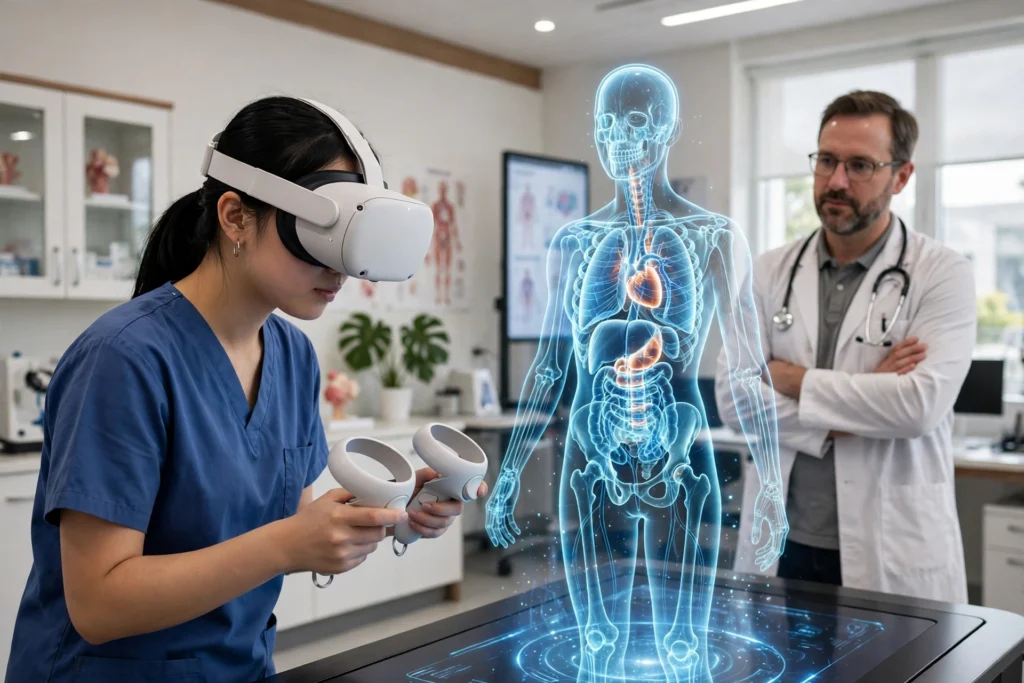
VR medical training uses a headset, hand controllers, and a simulated patient or anatomy model to let students practise clinical skills without a real patient in the room. A trainee can repeat a procedure, make a mistake, see what went wrong, and try again — all in a scene an instructor can pause, rewind, or change.
That repeatability is the main point. In a real ward, a student may only see a rare emergency once, and only as an observer. In VR, the same scenario can run ten times, with different complications each time. It does not replace supervised work with real patients, but it gives learners a safer place to build confidence before they reach the bedside.
Key Takeaways
- VR medical training places students inside simulated wards, operating rooms, and anatomy models they can explore and practise on.
- It is mainly used for anatomy learning, surgical steps, emergency drills, and communication practice.
- Instructors can repeat, pause, and score a scenario, which is hard to do with a one-off real case.
- It cannot teach the feel of real tissue, the pressure of a live ward, or the judgement that comes from supervised experience.
- Motion sickness, cost, and the need for good content are real limits, so a short trial is a sensible first step.
What Happens Inside a VR Medical Training Session?
A session usually starts outside the headset. The instructor explains the case: a patient with a particular problem, a procedure to practise, or an anatomy topic to explore. The student checks the headset fit, picks up the controllers, and steps into a virtual room that may look like a ward, a clinic, or an operating theatre.
Inside, the student is not just watching a video. They move their head to look around, reach out with controllers to pick up virtual instruments, and make choices — which test to order, which step comes next, or how to respond to a patient who is getting worse. The software reacts: a monitor may change, a virtual patient may speak, or a warning may appear if a step is missed.
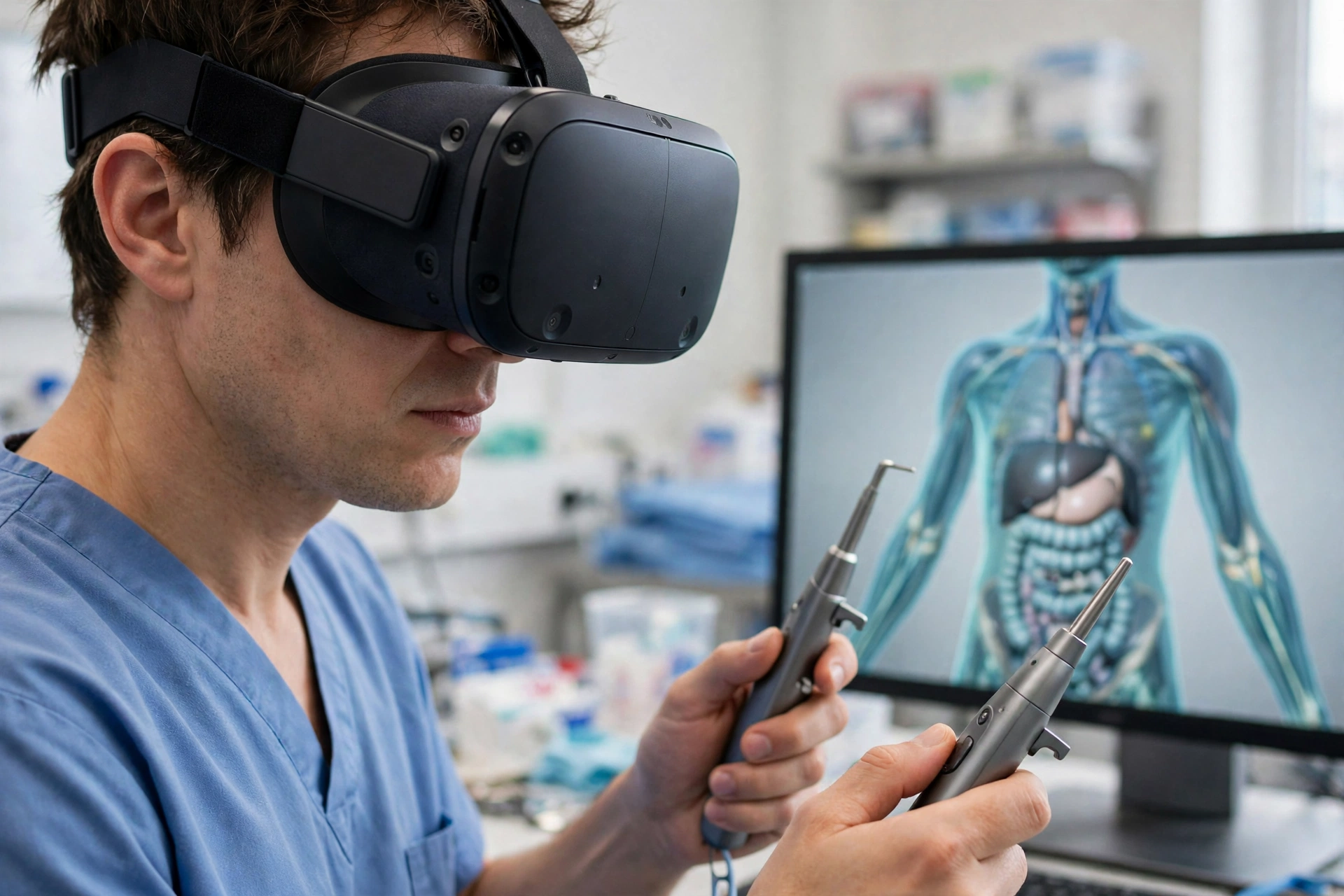
Afterwards comes the part many students say matters most: the debrief. The instructor replays key moments, asks why a decision was made, and points out what to change next time. Because the scenario is recorded, that conversation can be precise in a way a memory of a busy ward round rarely is.
How Does VR Teach Anatomy Differently?
Textbooks and flat diagrams show anatomy from one angle at a time. VR lets a student walk around a three-dimensional model, peel back layers, and look at a heart or a joint from inside as well as outside. That sounds like a gimmick until you try it: turning a model over with your own hands makes spatial relationships much easier to remember than staring at a labelled picture.
Students can also explore variations that a single plastic model cannot show. A heart with a particular defect, for example, can be examined next to a typical heart, so the difference is visible rather than described. Teachers often pair this with ordinary study — VR for the shape and position, notes and lectures for the names, functions, and clinical meaning.
It is not a complete anatomy course on its own, though. VR models are simplified, and they do not show the natural variation, texture, or messiness of a real body. Used well, they are a study aid that makes the rest of the learning stick better, not a replacement for it.
Can Students Really Practise Surgery in VR?
They can practise the steps, the order, and the decision-making of a procedure — and that is genuinely useful. A trainee learning a routine operation can rehearse where to stand, which instrument comes next, and what to do when something unexpected happens, without any risk to a patient.
What VR cannot yet do well is reproduce touch. Real surgery depends on feeling resistance, tension, and the subtle difference between tissues. Controllers can vibrate and give some feedback, but they are not the same as holding a real instrument. That is why VR surgical training is best seen as preparation for supervised practice, not a substitute for it. A student who has rehearsed the steps in VR still needs an experienced surgeon beside them for their first real cases, and that will not change soon.
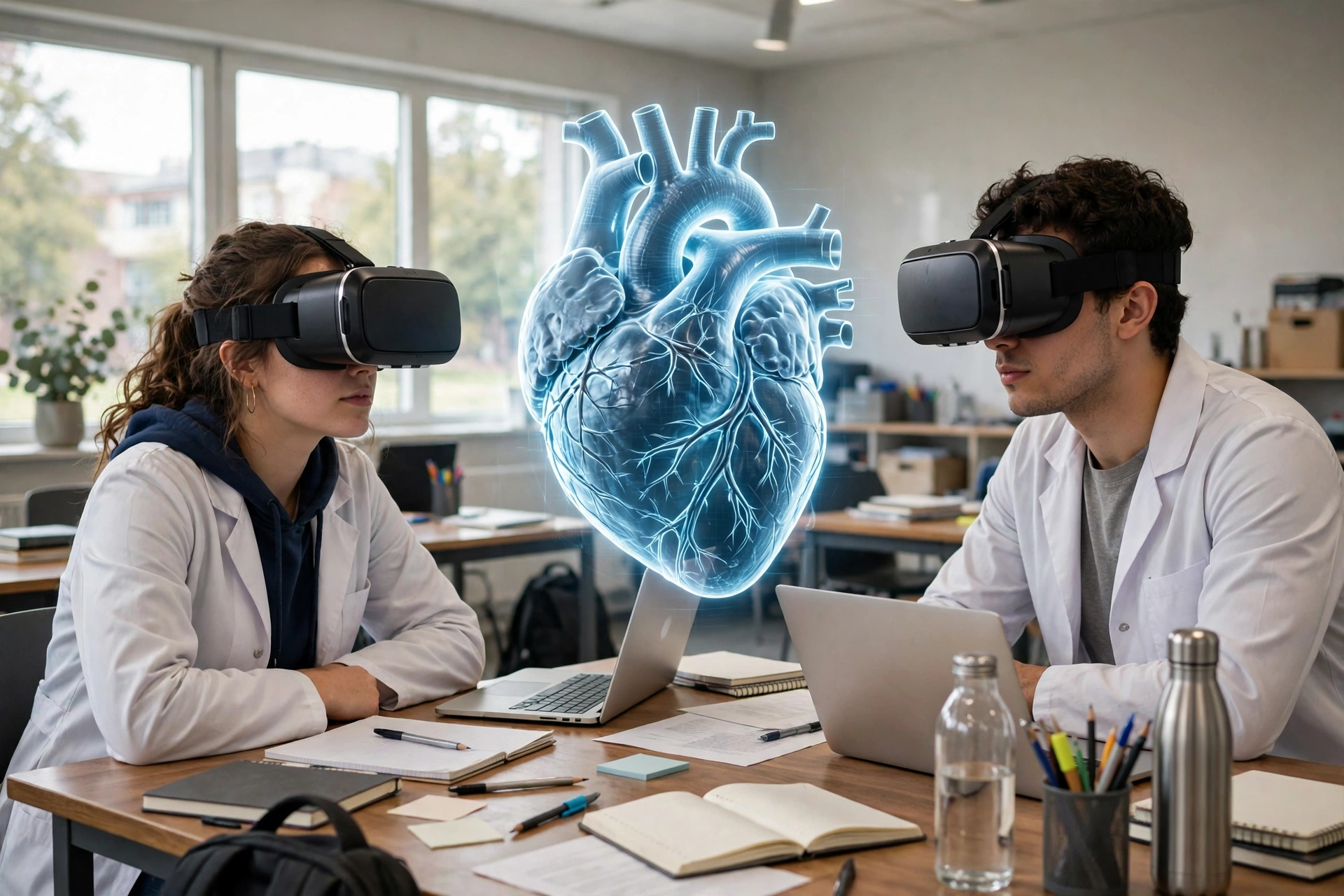
The same logic applies to emergencies. A VR cardiac arrest drill can teach a team to communicate clearly, assign roles, and follow a protocol under time pressure. It cannot reproduce the noise, crowding, and emotional weight of a real emergency — but it can make the first real drill feel less unfamiliar, which is a real advantage.
What Else Is VR Used for in Medical Training?
Beyond anatomy and surgery, VR is used for communication and teamwork. A student might practise breaking difficult news to a virtual patient, calming an anxious relative, or handing over a case to a colleague. These scenes can be repeated with different patient reactions, so a learner can try a gentler phrasing or a clearer explanation and see how the conversation changes.
It is also used for safety training: infection control routines, moving patients safely, and responding to fires or other ward emergencies. In each case the benefit is the same — a mistake in VR costs nothing but a retry, while the same mistake in a real hospital could harm someone.
Some programmes use VR for empathy training too, such as experiencing a ward from a patient’s point of view, with blurred vision or muffled hearing. Done thoughtfully, that can change how a student talks to patients. Done carelessly, it can feel like a game, so good programmes always follow it with a guided discussion.
What Are the Limits and Risks?
Motion sickness is the most common problem. If the virtual movement does not match what the body feels, a student can feel dizzy or queasy, especially in longer sessions. Short, seated scenarios and regular breaks help, but some people simply tolerate VR poorly, and no training programme should force it.
Cost and content quality are the other big limits. Headsets have become cheaper, but well-designed medical scenarios are expensive to build and need regular updating as guidance changes. A flashy headset running a weak scenario teaches little, so the software and the teaching plan matter more than the hardware. Our guides to how VR headsets work, how VR controllers work, and how VR room mapping works explain the kit in plain language.
There is also a risk of overconfidence. Passing a VR scenario is not the same as being ready for a real patient. Good programmes are explicit about this: VR is a rehearsal room, and the real test is still supervised practice, assessed by experienced clinicians.
How Do You Choose a VR Medical Training Programme?
Start with the teaching, not the headset. Ask what skill the programme targets, how it is assessed, and how it fits with the rest of the course. A clear link to real clinical practice — for example, VR anatomy before a dissection session, or a VR emergency drill before a ward placement — is a good sign.
Ask who designed the content and how often it is updated. Medical guidance changes, and a scenario built years ago may teach an outdated protocol. Also ask how instructors are trained: a good VR session needs a teacher who can run the debrief, not just someone who can switch the headset on.
Finally, try a short session first. Comfort, clarity, and whether the scenario feels relevant are things you can judge in twenty minutes. If it feels confusing, uncomfortable, or disconnected from real practice, that tells you something useful before any larger commitment.
Frequently Asked Questions
Does VR medical training replace real clinical experience?
No. It prepares students for real experience by letting them rehearse steps, decisions, and teamwork safely. Supervised work with real patients remains essential, and VR is best used alongside it, not instead of it.
Do students need an expensive headset for VR medical training?
Not necessarily. Many training programmes provide the headset and software, and the quality of the scenario matters more than having the most expensive device. Comfort, clear lenses, and reliable tracking matter most for learning.
Can VR help with anatomy exams?
It can help with spatial understanding — where structures sit and how they relate to each other. It still needs to be combined with ordinary study of names, functions, and clinical details, since exams test more than shape alone.
Is VR medical training safe for students?
Supervised sessions are generally low risk, with motion sickness and eye strain the most common side effects. Sessions are usually short, with breaks, and students with epilepsy, severe balance problems, or certain eye conditions should raise this with their tutor first.
What should a first VR medical session look like?
A short, guided scenario with a clear goal, an instructor present, and time afterwards to talk through what happened. If the session has no debrief and no link to the rest of the course, it is probably more demonstration than training.
Conclusion: A Practical Next Step
VR medical training works best as a rehearsal room: a place to explore anatomy in three dimensions, practise procedure steps, drill emergencies, and rehearse difficult conversations, all with the safety net of being able to pause and retry. It does not replace real patients, real tissue, or experienced supervision, and programmes that claim otherwise should be treated with caution.
If you are curious, a practical next step is to ask your course or training provider whether a short, supervised VR trial is available, and to go in with one question: what specific skill will this session help me practise, and how will I know if I have improved? The answer will tell you quickly whether VR is a useful tool for your learning — or just an impressive headset.
For background on the technology itself, see Britannica’s overview of virtual reality and the NCBI Bookshelf chapter on virtual reality in medical education.