Direct answer
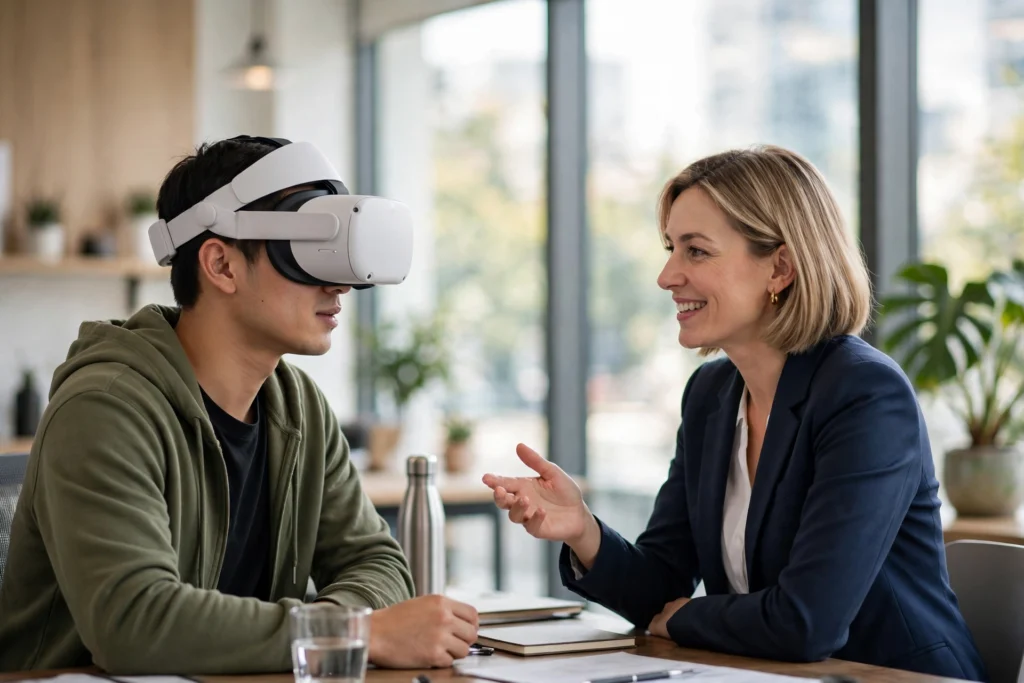
VR job interviews are practice sessions in a virtual room, where a lifelike interviewer asks questions and you answer out loud, as in a real interview. The headset tracks your head, hands, and voice, and the software gives you feedback afterwards on what you said and how you came across. It is rehearsal with pressure, but without the stakes.
Key Takeaways
- A VR interview puts you in a virtual office with an interviewer avatar who asks questions and reacts to your answers.
- Sessions end with feedback on wording, pace, eye contact, and body language.
- You can repeat the same interview as many times as you like, changing the questions or the difficulty each time.
- VR practice suits behavioural, panel, and customer-facing interviews best; it works less well for technical ones.
- It is rehearsal, not a replacement for talking to a real person before the big day.
What happens inside a VR interview?
Picture a normal interview room: a desk, two chairs, a window, maybe a whiteboard. In VR, that room is drawn around you by the headset. Across the desk sits an interviewer — sometimes a realistic-looking person, sometimes a simpler avatar. They ask a question, and you answer out loud.
The questions follow a script written for a job type: a teaching interview might open with classroom scenarios, a sales role with a difficult customer. Some programs let you set the role and difficulty first. Your avatar matters too: as our guide to how VR avatars work explains, your headset moves your virtual body, so a nod from you is a nod from your avatar. If your headset supports it, VR hand tracking lets you gesture naturally without controllers.

How does the feedback work?
The feedback is where VR interview practice earns its keep. After a session, most programs show a short report: what you said, how long you paused, whether you used filler words, and how your voice sounded. Some score you on clarity and structure, and flag where you drifted.
A few programs let you replay the session, so you can watch yourself answer. That is uncomfortable and useful: you might notice you look down at every hard question, or that your answers run twice as long as you thought. The best feedback is specific rather than flattering — “you paused before the weakness question” is something you can act on; “great job” is not. Treat any single score lightly: these systems judge speech patterns, and they can misread a thoughtful pause as hesitation.
What kinds of interviews can you practise?
Behavioural interviews are the most natural fit. Questions like “tell me about a time you solved a problem” follow a pattern, and repeating them in VR helps you shape a tight answer with a clear beginning, middle, and end. Panel interviews work well too: several avatars sit across from you, and you practise sharing your attention between them.
Customer-facing roles are another strong match. A support or hospitality interview often includes a role-play — an unhappy customer, a tricky request — and VR lets you run that scene several times with different twists. Social VR helps here: if you have talked to avatars in a shared virtual room, an interview avatar feels less strange. Technical interviews are a weaker fit: a coding walkthrough is hard without a real keyboard, so the technical half is better rehearsed on a real screen with a real person.
What does VR practice do better than rehearsing alone?
Talking to a mirror or a notes page has one big flaw: there is no pressure. A virtual interviewer staring at you, waiting for an answer, creates a small dose of the nerves you will feel on the day. You want your first wobble in practice, not in front of a hiring manager.
Repetition is the other advantage. You can run the same tricky question five times in an evening, trying a shorter answer, then a more detailed one, then one that starts with the result. Each run costs a few minutes and no embarrassment. Timing helps too: seeing “two minutes forty seconds” next to a question you thought you answered in thirty seconds is a useful shock.
Where does VR practice fall short?
It is worth being honest about the limits. A virtual interviewer follows a script, so it cannot surprise you the way a real person can. A hiring manager might follow your answer with an unexpected question, change direction mid-sentence, or simply sit in silence to see what you do next. A scripted avatar will not improvise the way a person does.
Cost and access are real barriers as well. You need a headset, or access to one through a college, library, or training centre, and some of the better programs sit behind a subscription. If you already own a headset, the extra cost is small; if you do not, buying one just for interview practice is hard to justify, and a free mock interview with a friend may serve you better. And VR cannot teach you what to say about your own experience — it can only polish how you say it.
How do you get the most from a practice session?
Start with a real job in mind, not a generic interview: pick the role you are applying for and choose questions that match it. Do short sessions rather than one long marathon — twenty minutes of focused practice, then a break to read the feedback, beats an hour on autopilot.
Watch the replay: it shows the habits — looking down, long pauses, wandering answers. Take one note per session, one habit to fix, and work on that alone in the next run. Finally, mix VR practice with a real conversation: ask a friend or a careers adviser to run a mock interview after a few VR sessions. The virtual room builds timing and confidence; the real person tests whether your answers hold up when someone pushes back.
Frequently Asked Questions
Do I need a VR headset for interview practice?
For full VR sessions, yes. Some training platforms, such as VirtualSpeech, also run practice in a web browser without a headset, so you can rehearse the same conversations on a laptop. You keep the questions and feedback, but you lose the sense of sitting in a room with someone.
Can VR practice replace a real mock interview?
Not entirely. VR is good for repetition, timing, and spotting habits, but a real mock interviewer can improvise, challenge a weak answer, and tell you honestly how you came across. Use VR to sharpen your answers first, then test them on a person.
Will VR interview practice help with nerves?
It can help, because nerves often come from unfamiliarity: the more times you have sat through the opening questions, the less strange they feel on the day. It will not remove nerves completely, though, and a little nervous energy is normal. If anxiety about interviews is seriously affecting you, talking to a careers adviser or a counsellor is a better step than more practice alone.
Is my practice data private?
It depends on the platform. Sessions may record your voice and track your movements, and some platforms share reports with a teacher or employer who set up the training. Before your first session, check the platform’s privacy notice and find out who can see your recordings and scores. Platforms built for education, such as Bodyswaps, publish guidance on how practice data is handled.
Can employers interview me in VR for a real job?
A small number of employers do use VR as part of hiring, usually for training-style assessments rather than a full interview. For most jobs, the interview itself still happens in person or on a video call. VR is mainly a practice tool for candidates, not a hiring channel — though that may change as headsets become more common.
Conclusion
VR job interviews will not get you the job on their own, but they give you something hard to get any other way: a room, an interviewer, and a second chance. Stumble over the weakness question on Monday, fix it on Tuesday, and walk in on Friday knowing how your answer sounds. That is a real advantage, as long as you treat the feedback as a guide and still test yourself against a real person before the day arrives.
The practical next step is simple. Pick one interview question you dread, find a VR practice app or a browser-based alternative, and run it three times this week. Watch the replay, fix one habit, then test the improved answer on someone you trust. That short loop — practise, review, fix, test — is the whole method, and it works whether the room is real or virtual.