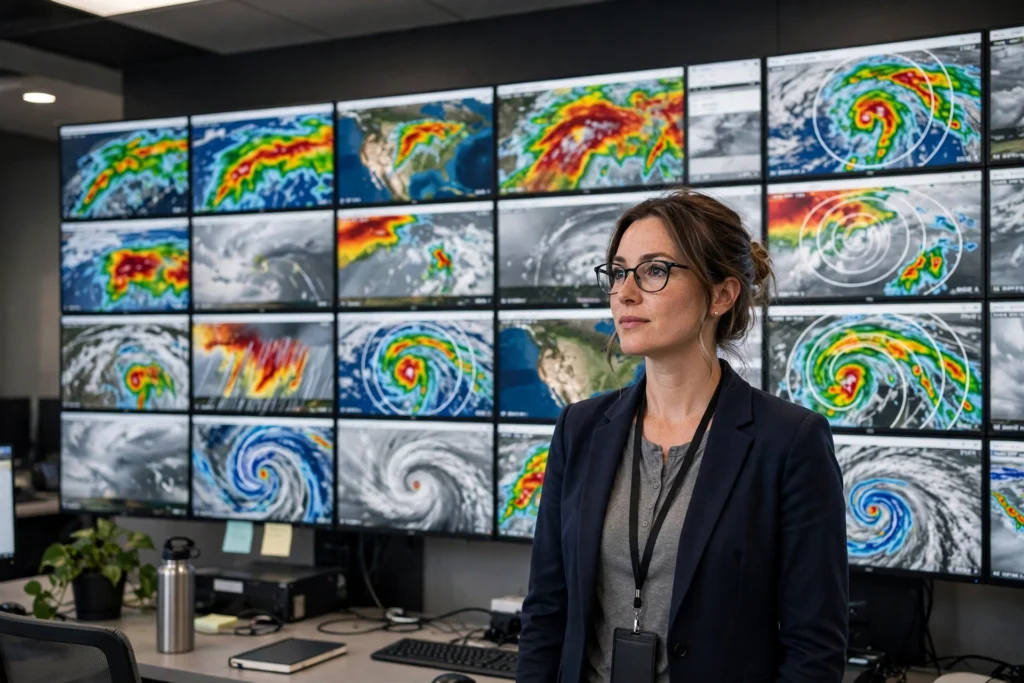
AI weather forecasting uses machine learning models trained on decades of past weather data, live satellite images and sensor readings to predict what the sky will do next. Instead of only solving physics equations, these models learn patterns — how storms form, move and fade — and then apply them to today’s conditions, often producing a forecast in minutes rather than hours.
Key Takeaways
- AI weather models learn from decades of past weather, not just physics equations.
- They combine satellite images, radar, weather stations and ocean buoys into one picture.
- Short-term rain forecasts and storm tracking are where AI shines most.
- Long-range forecasts still lean heavily on traditional physics models.
- A forecast is a probability, not a promise — check for updates before big plans.
What data does AI weather forecasting use?
A weather model is only as good as the data fed into it, and modern forecasting drinks from a very wide tap. Satellites photograph cloud cover and measure temperature and moisture from space. Radar stations track rainfall minute by minute. Weather stations, aircraft, ships and ocean buoys report wind, pressure and temperature from the ground, the air and the sea.
Machine learning models are more flexible than older systems about messy data. Traditional forecasting needed each measurement cleaned up and slotted into a rigid grid before the maths could start. AI models can take uneven observations and still find the signal in them — which matters, because the atmosphere is never measured evenly, with far more sensors over cities than over oceans.
The training data goes back decades. Archives held by services such as Europe’s Copernicus programme and America’s NOAA contain huge records of past weather, and models study them the way a student studies past exam papers, learning what a developing storm looked like twelve hours before it arrived.
How do the models actually make a forecast?
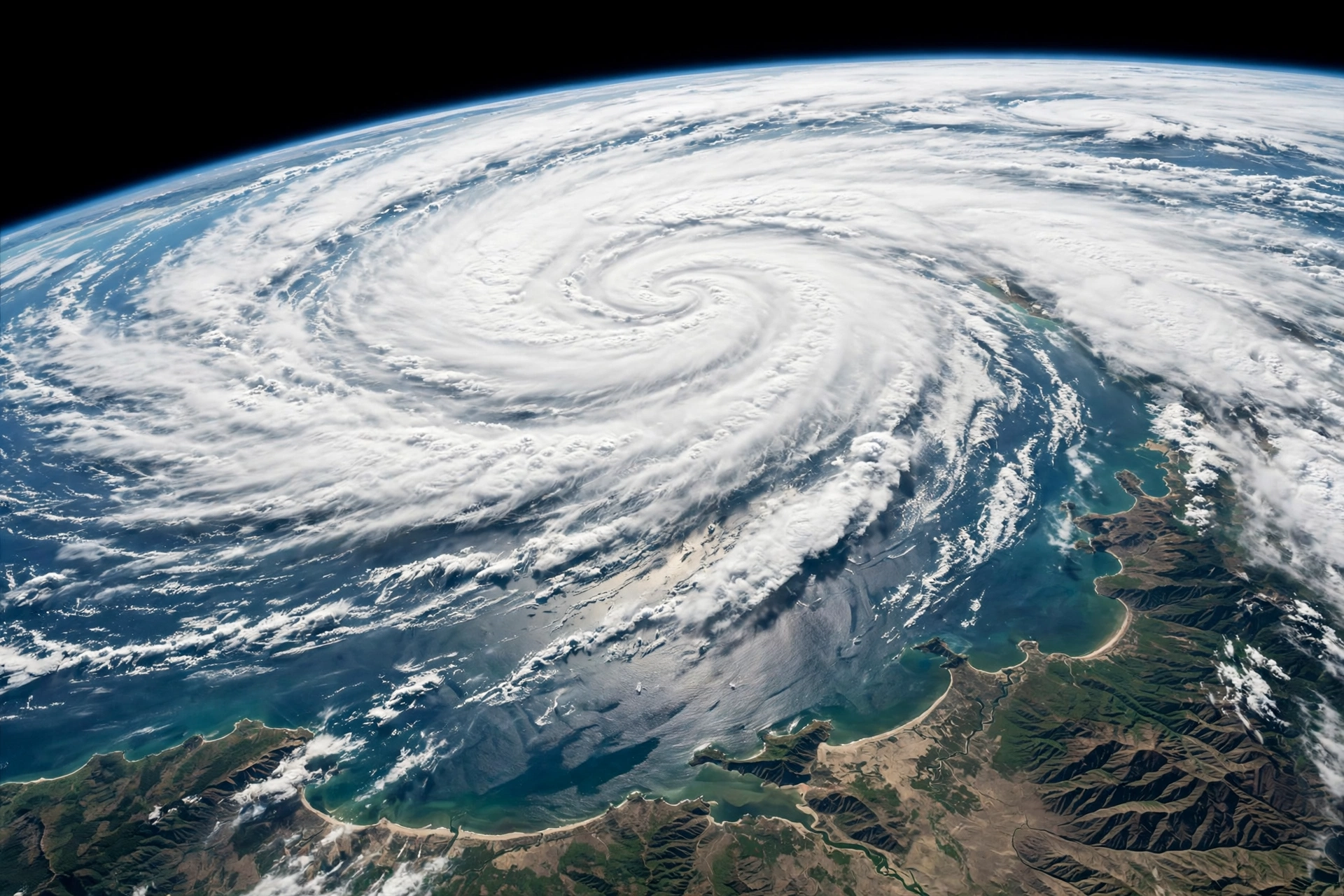
Traditional forecasting works like a giant physics simulation. It divides the atmosphere into a three-dimensional grid, fills each box with current measurements, and steps forward in time using the laws of physics. It is accurate, but it takes serious computing power and hours of number crunching.
AI forecasting takes a different route. A model such as Google DeepMind’s GraphCast is trained on forty years of historical weather data, learning how the atmosphere tends to evolve from one state to the next. Once trained, it can roll a forecast forward ten days in under a minute on a single machine. It is pattern matching on an enormous scale.
Most systems in use today mix the two approaches. The physics model still handles the broad picture, while AI sharpens the details — especially the tricky, local stuff. A common example is “nowcasting”: predicting rain in the next hour or two for your exact neighbourhood. Radar images go in, a model spots how rain cells are moving and growing, and out comes a short-term forecast that updates every few minutes.
AI also helps with downscaling: global models work on coarse grids, sometimes tens of kilometres across, which is fine for a continent but useless for a valley. AI models learn how the broad forecast usually plays out in a specific place and fill in the local detail.
Where does AI beat traditional forecasting?
Speed is the headline win. A physics-based model can take hours on a supercomputer to produce a ten-day forecast. An AI model, once trained, can do the same job in minutes. That speed matters when a storm is developing fast and every updated run counts.
AI also does well with the messy, fast-changing weather that physics models find hardest: sudden downpours, thunderstorms and localised flooding. These events happen on small scales and short timescales, exactly where pattern recognition earns its keep. Several national weather services now run AI models alongside their traditional ones, and the AI versions often score better on short-range rain prediction.
There is a cost angle too. Training a big weather model is expensive, but running it is cheap, so smaller countries and research groups that could never afford a supercomputer can now run high-quality forecasts of their own.
Where does AI still struggle?
For all the progress, AI forecasting has real limits, and forecasters are open about them. The first is the long range. Beyond about a week ahead, the atmosphere becomes so chaotic that small errors grow fast, and AI models lose their edge over physics models. A ten-day AI forecast is useful as a guide, not as a guarantee.
The second limit is rare events. Machine learning learns from the past, so it is naturally better at ordinary weather than at once-in-a-decade extremes. A model trained mostly on typical winters may underplay a record-breaking storm, because it has seen few examples like it. Researchers tackle this with extra training on extreme cases, but it remains a weak spot.
Then there is the “black box” problem. A physics model can explain why it expects rain: the pressure is falling, the air is rising, moisture is streaming in. An AI model often cannot say why in the same way, which makes forecasters cautious about trusting it blindly, especially when lives depend on a warning.
How do forecasters use AI day to day?
In a forecasting office, AI is a colleague, not a replacement. A meteorologist starts the shift by comparing several model runs — traditional and AI-based — and looking for where they agree and where they part ways. Agreement builds confidence; disagreement is a flag to dig deeper. AI also handles the grunt work: sifting through satellite and radar feeds, flagging developing storms, and drafting first versions of local forecasts, which frees the human forecaster for the judgement calls.
What does this mean for the forecast on your phone?
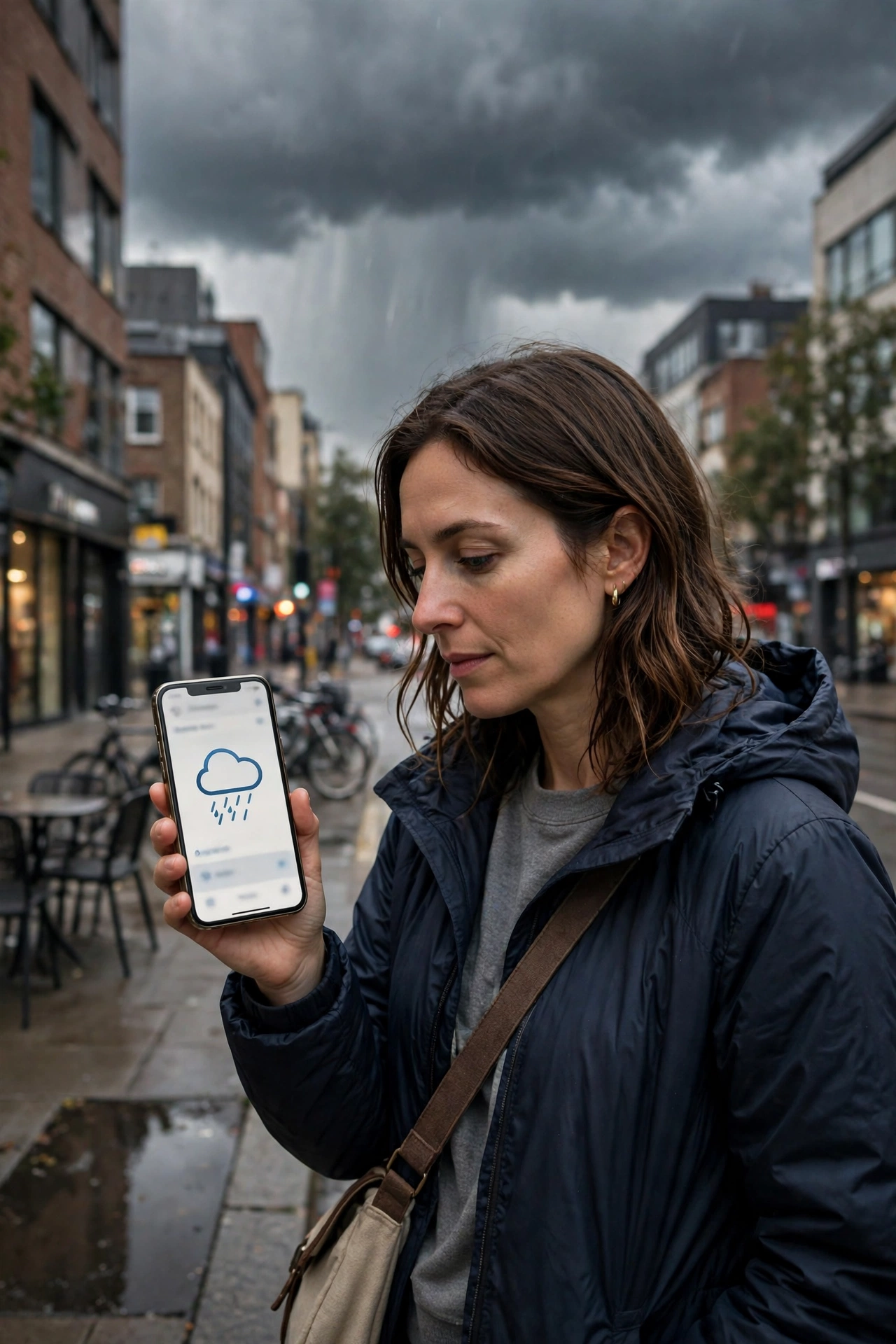
For most of us, AI weather forecasting shows up as a better phone app. Rain alerts arrive sooner and for a smaller area — “rain starting in 15 minutes” rather than “rain likely this afternoon.” Travel plans get sharper too, with hour-by-hour forecasts that actually reflect the weather outside your window.
But the same limits apply. If two apps disagree, it is usually because they use different models, different data, or different ways of smoothing the numbers. Neither is “wrong” in a simple sense; they are different best guesses. For anything that really matters, check more than one source, look at the forecast’s confidence or probability, and check again closer to the time.
The trend is clear, though. Forecasts are getting faster, more local and more accurate, and AI is a large part of why. The physics has not gone away — it is still the foundation — but machine learning has given forecasters a powerful new tool for reading the sky.
Frequently Asked Questions
Is AI weather forecasting more accurate than traditional forecasts?
For short-range forecasts, especially rain in the next few hours, AI models often match or beat traditional physics models. For forecasts a week or more ahead, traditional models still hold their own. Most services use both and compare them.
Can AI predict extreme weather like hurricanes?
AI can track hurricanes and predict their path well, often as accurately as traditional models. Predicting exactly how strong a storm will become is harder, because extreme storms are rare in the training data.
How far ahead can AI forecast the weather?
AI models can produce forecasts out to ten days, and some research models reach further. But accuracy drops sharply after the first week, whatever the method. A forecast for tomorrow is far more reliable than one for next weekend.
Does AI replace human meteorologists?
No. AI produces model runs, but people interpret them, weigh disagreements between models, and decide when to issue warnings. The judgement, local knowledge and accountability still sit with human forecasters.
Why do different apps give different forecasts?
Apps use different models, different data sources and different ways of presenting uncertainty. One may show the most likely outcome, another the average of many runs. Checking two or three sources usually gives a better picture than trusting one alone.
Conclusion
AI weather forecasting works by learning from decades of past weather and applying those patterns to live data from satellites, radar and sensors. It is fast, it is sharp at short-range rain and storm prediction, and it is already improving the forecasts on our phones. It is not magic, though: long-range and extreme events still challenge it, and human forecasters remain in charge of the final call.
Next time your app says rain in fifteen minutes, you will know a little about what went into that guess. And if the day matters, do what forecasters do: check more than one model, look at the probability, and check again before you head out.