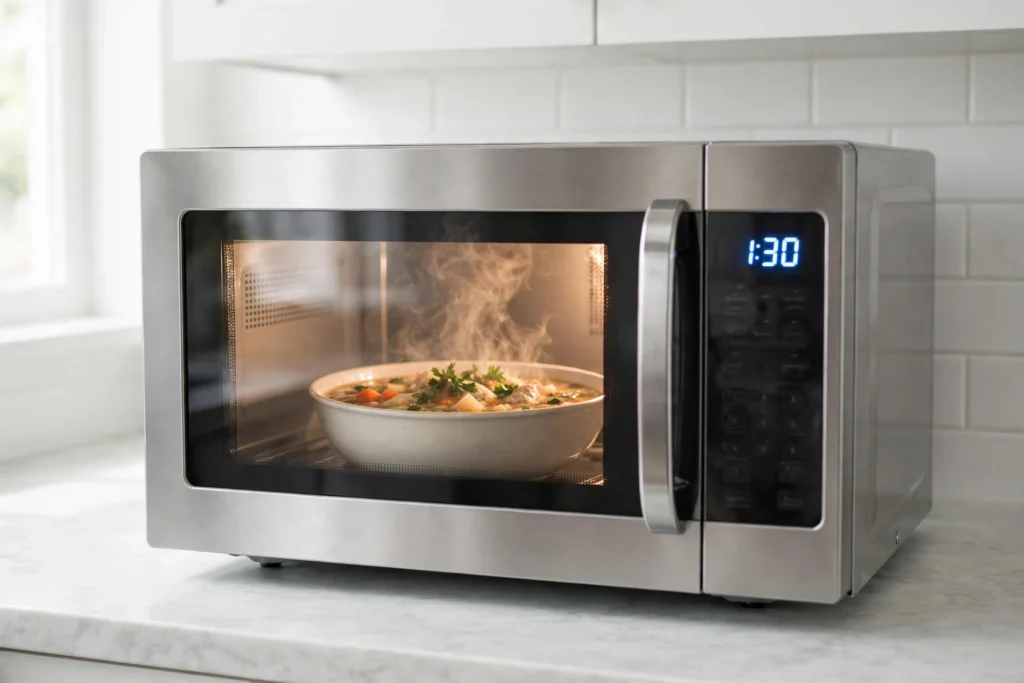
A microwave oven works by turning electricity into microwaves — a form of radio-wave energy — and aiming them at your food. A part called the magnetron makes those waves, and they make the water, fat, and sugar molecules in the food vibrate. That vibration creates friction, and the friction becomes heat, so food cooks in minutes without the oven itself getting hot.
Key Takeaways
- A magnetron generates microwaves at about 2.45 GHz, and the waves heat food by shaking water molecules.
- The metal cavity reflects the waves inward, while the turntable and a spinning stirrer spread them around for more even heating.
- Microwaves only reach a short distance into food, so the middle of thick food warms by conduction from the hot outside.
- Metal reflects microwaves, which is why metal containers can spark and damage the oven.
- Door seals and interlock switches stop the magnetron the moment the door opens.
What is inside a microwave oven?
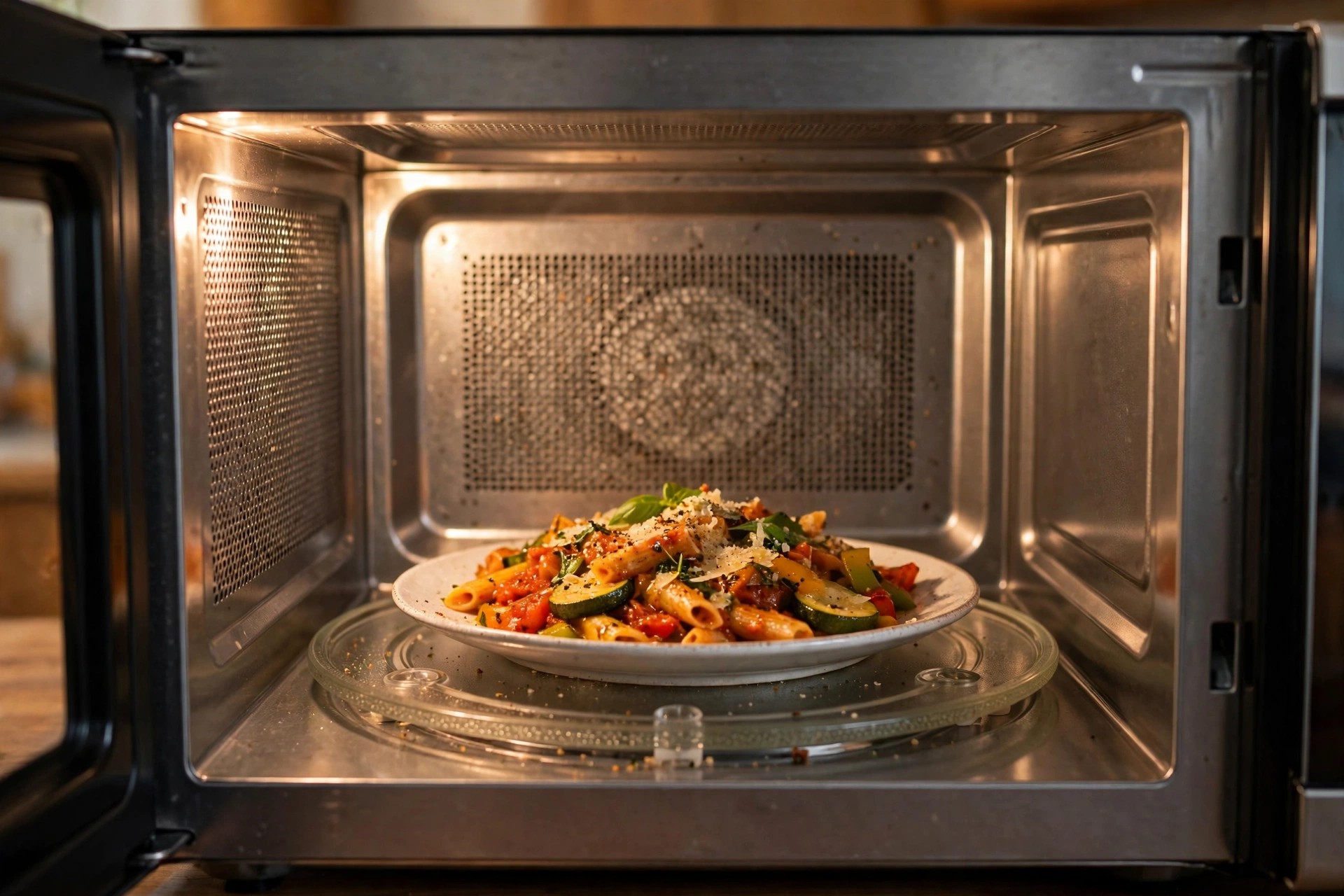
Only a few parts do the real work. The magnetron sits behind a panel on one side. It is a vacuum tube that converts mains electricity into microwaves, using a strong magnet and a small antenna-like probe. A short metal channel called a waveguide carries the waves into the cooking cavity — a metal box that reflects them around inside instead of letting them escape. A fan cools the magnetron, and a small motor turns the glass plate.
There is also a stirrer fan, a small metal blade near the waveguide opening. It spins while the oven runs, scattering the waves in different directions so heating is less patchy. All of this is switched by the door interlocks: two separate switches that cut power to the magnetron the instant the latch releases. That is the main reason a microwave is safe to stand beside — it simply cannot keep making microwaves with the door open.
How do microwaves actually heat food?
Forget the idea of the oven being hot. In a normal oven, hot air slowly warms food from the outside in. A microwave does something different. Its waves are tuned to a frequency that water molecules respond to strongly. Each water molecule is slightly polar — one end carries a tiny positive charge, the other a tiny negative charge. As the microwave’s electric field flips back and forth billions of times a second, the molecules twist to line up with it. That frantic twisting rubs molecules against each other, and the rubbing produces heat.
Fats and sugars absorb microwaves too, though less eagerly than water. That is why a bowl of soup heats faster than a dry bread roll, and why the sauce on a pizza can be scalding while the crust is merely warm. Glass, ceramic, and most plastics barely absorb microwaves at all, which is why the plate often stays cooler than the food on it. Nothing in the food becomes radioactive: the waves carry too little energy to change atoms. Once the magnetron switches off, the heating stops.
Why does food heat unevenly in a microwave?
Anyone who has bitten into a microwaved pasty knows the problem: one corner is lava-hot, another is fridge-cold. The cause is the waves themselves. Inside the metal cavity, microwaves form a standing pattern of peaks and troughs — spots where the energy is strong and spots where it is weak. Food in a weak spot barely warms, while food in a strong spot overheats. Microwaves also only penetrate about an inch into food. The outer layers absorb most of the energy, and the centre has to wait for heat to travel inward by conduction.
The turntable is the main fix. By slowly rotating the plate, it moves every part of the dish through strong and weak spots in turn, evening things out over a couple of minutes. But it cannot fix everything. Thick, dense food — a whole chicken, a block of frozen mince — will still heat unevenly, because the waves simply cannot reach the middle. That is also why frozen food needs standing time after the beep: heat keeps spreading inward while the food rests.
Why can’t you put metal in a microwave?
Metal reflects microwaves instead of absorbing them. A smooth metal tray bounces them back toward the magnetron, which can overheat it. Thin or crinkled metal, like foil with sharp edges, is worse: the waves concentrate at points and edges until the air itself breaks down, and you get sparks that can scorch the cavity. Some metal is designed to be microwave-safe, like the racks in combination ovens, but those are shaped and positioned by the manufacturer.
The everyday rule is simple: use glass, ceramic, or containers labelled microwave-safe, and keep foil, metal trays, and anything with metallic trim out. Check so-called safe plastics too — some soften or warp with very hot, fatty food.
How can you heat food more evenly?
A few small habits make a real difference. First, spread food out in a shallow layer rather than piling it in the middle of the plate; a ring shape with an empty centre heats more evenly than a mound. Second, stir halfway through, and again at the end, so hot and cold patches mix. Third, use a lower power setting for dense or frozen food. Lower power doesn’t make the magnetron weaker — it switches it on and off in cycles, giving heat time to spread inward between bursts.
Covering the dish with a microwave-safe lid or a loose sheet of kitchen paper helps too. It traps steam, which carries heat across the surface and keeps food from drying out. And let food stand for a minute or two after cooking. That standing time isn’t wasted — it is when conduction finishes the job the microwaves started.
Is microwave radiation dangerous?
Microwaves are non-ionising radiation, in the same broad family as radio waves and visible light — far below X-rays on the energy scale. Only ionising radiation carries enough energy to knock electrons off atoms and damage cells. Microwaves can only heat tissue, the same way they heat food, and only at levels far above what leaks from a working oven.
Regulators set strict limits on leakage, and manufacturers must certify that their ovens meet them. The US Food and Drug Administration, for example, limits leakage to a tiny fraction of the level known to cause harm, and requires two independent door interlocks. A microwave in good condition — door closing firmly, seals intact, no damage — leaks almost nothing. The genuine risks are ordinary kitchen ones: burns from hot containers and steam, and super-heated water. Water heated alone in a smooth mug can pass boiling point without bubbling, then erupt when disturbed. Adding a spoonful of coffee or sugar before heating removes most of that risk.
FAQs
Does a microwave cook food from the inside out?
No — that’s a common myth. Microwaves heat the outer layers first, to a depth of roughly an inch, and the centre warms by conduction. That is why thick food needs stirring and standing time.
Why does the plate stay cool while the food gets hot?
Glass and ceramic barely absorb microwaves, so the plate doesn’t heat directly. It only warms up from contact with the hot food sitting on it. The same applies to most microwave-safe plastic.
Can microwaves make food radioactive?
No. Microwaves are non-ionising and carry too little energy to change atoms. They only make water molecules vibrate, which produces heat. Once the oven stops, the waves are gone — nothing lingers in the food.
Why do some foods explode in a microwave?
Foods with a sealed skin — whole eggs in their shell, sealed jars, unpierced potatoes — trap steam inside as they heat. Pressure builds until the skin bursts. Piercing skins and removing lids before heating prevents it.
Should you stand away from a running microwave?
You don’t need to, as long as the oven is in good condition. Leakage limits are set far below harmful levels, and the interlocks stop the magnetron when the door opens. If the door is bent or the seals are damaged, stop using it.
Conclusion
A microwave oven is a small radio transmitter aimed at your dinner. Its magnetron makes waves, the metal cavity keeps them bouncing around, and the turntable and stirrer spread them so your food heats as evenly as the physics allows. Knowing that explains nearly every quirk — the cold spots, the metal rule, the standing time. If your microwave heats unevenly, try spreading food in a ring, stirring halfway, and letting it stand for a minute before eating. And if you’re curious how the rest of your kitchen tech works, our guide to how wireless charging works shows a very different way of moving energy without wires.